
New-hampshire LSPD Requirements: Hours, Exams & Step-by-Step Guide
Stop guessing if your categories match New-hampshire requirements. License Trail checks your direct, indirect, and supervision hours against LSPD requirements continuously and flags mismatches before you submit.
No credit card required · Free plan available
Quick Requirements Overview
- Issuing authority: NH Board of Psychologists (RSA 329‑B:15‑a); distinct from Psychologist license (RSA 329‑B:15)
- Degree: Doctoral degree in psychology required
- NHDOE prerequisite: Must hold NHDOE School Psychologist certification
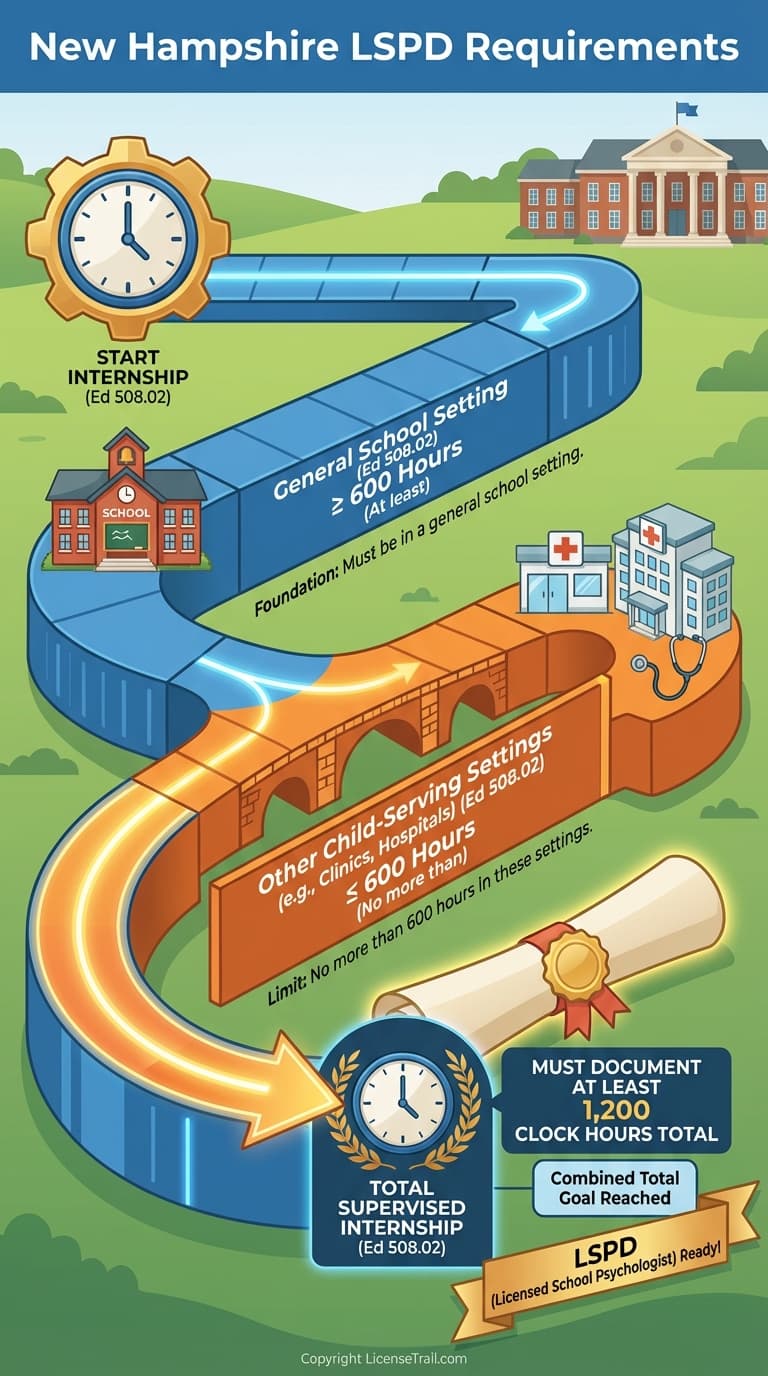
- Internship hours (NHDOE Ed 508.02): 1,200 clock hours supervised internship; full‑time 1 year or half‑time over 2 consecutive years
- Internship setting split: ≥600 hours in a general school setting; up to 600 hours may be in other child‑serving settings (cannot replace more than half)
- Exam: Must pass Board‑accepted exam(s), including a national school psychologists’ exam (e.g., Praxis)
- Admin/fitness: Good professional character; fingerprints/background check; pay OPLC fees
- Scope: Practice generally limited to educational settings unless additionally licensed (e.g., as a Psychologist)
License Details
Procedures
In New Hampshire, the “Licensed School Psychologist‑Doctoral” (LSPD) credential is issued by the New Hampshire Board of Psychologists under RSA 329‑B:15‑a. It is legally distinct from a general “psychologist” license under RSA 329‑B:15, and it is tightly linked to certification as a school psychologist through the New Hampshire Department of Education (NHDOE).
Below is a step‑by‑step breakdown of what the state actually requires, with a focus on hours and the Board’s own wording where it exists.
1. Understand what the LSPD license is (and is not)
State law defines:
- “Licensed school psychologist‑doctoral” as a person licensed under RSA 329‑B:15‑a. (law.justia.com)
- The Board must issue this license to someone who:
- Has a doctoral degree in psychology,
- Is certified as a school psychologist by the NH Department of Education, and
- Meets several additional Board‑set conditions (exam, character, background check, fees). (law.justia.com)
The statute also limits the scope of this license:
Unless otherwise licensed under another provision, an LSPD or LSPS license covers services provided in educational settings. (law.justia.com)
If you want to practice broadly as a psychologist outside school‑related contexts (e.g., general private practice), you normally also need the full psychologist license and must meet its separate supervised‑experience hour requirements (described in Section 4 below).
2. Core legal requirements for the LSPD license (Board of Psychologists)
RSA 329‑B:15‑a is the controlling statute for LSPD. Summarized, the Board shall issue an LSPD license to any person who:
- Holds a doctoral degree in psychology; and
- Is certified as a school psychologist by the NHDOE, Bureau of Credentialing; and
- Has completed all of the following: (law.justia.com)
- Passed “a satisfactory examination in psychology as determined by the board including a national school psychologists’ examination.”
- In practice, the “national school psychologists’ examination” is the Praxis School Psychologist exam; the Board decides what else, if anything, counts as the “satisfactory examination in psychology.”
- Met “education and other requirements determined by the board.”
- Is “of good professional character.”
- Submitted fingerprints and a criminal history records release (per RSA 329‑B:14‑a).
- Paid all fees set by the Office of Professional Licensure and Certification (OPLC).
- Passed “a satisfactory examination in psychology as determined by the board including a national school psychologists’ examination.”
Notice that the statute itself does not give a specific hour count for LSPD. Instead, it requires that you already be certified as a school psychologist by the Department of Education, and that Board‑determined requirements are met.
That means the key explicit hour requirement for LSPD eligibility is found in the NHDOE school psychologist certification rule, not in the Psyc rules.
3. Hours required to become a certified school psychologist (NHDOE) — prerequisite for LSPD
To even be eligible for the LSPD license, you must hold NH school psychologist certification. The NHDOE sets that standard in Ed 508.02, “School Psychologist,” which provides the entry‑level requirements.
3.1 Pathways to certification
Ed 508.02 allows either:
- Completion of a state board of education–approved school psychology program (doctoral, specialist/CAGS, or master’s level); or (regulations.justia.com)
- Completion of at least 60 graduate semester hours (with a master’s degree) plus a qualifying internship, if not coming from a fully approved program.
In both cases, the crucial piece for your question is the internship hour requirement.
3.2 Internship hour requirement for NH school psychologist certification
Ed 508.02(b) describes the internship in specific hour terms. Paraphrased:
- You must complete “experience in a supervised internship in a general school setting for 1,200 clock hours”,
- Done full‑time over one year or half‑time over two consecutive years in a general school setting.
- If additional supervised experiences take place in mental health clinics, psychiatric hospitals, or other institutions for children, these can count toward the internship but cannot replace more than 600 of the 1,200 hours in a general school setting. (regulations.justia.com)
So, in concrete terms, the NHDOE requirement you must meet to qualify for LSPD is:
- Total internship: 1,200 clock hours of supervised internship.
- Setting requirement:
- At least 600 hours must be in a general school setting;
- Up to 600 hours may be in other child‑serving settings (mental health clinics, psychiatric hospitals, etc.), but only as a supplement, not a replacement, for the core school‑based internship.
- Time frame:
- Either 1 year full‑time or 2 consecutive years half‑time.
Those internship hours are what the state has explicitly tied to school psychologist certification, which in turn is an explicit prerequisite for the LSPD license.
4. Supervised experience hours for a psychologist license (if you also pursue full psychologist licensure)
Separate from the LSPD credential, NH has specific, very detailed hour requirements for full psychologist licensure. These are spelled out in the Board’s administrative rules in Chapter Psyc 300.
Because the question asked for the type of hours and wording the Board uses (for example, “1,500 hours of direct experience”), it is important to distinguish these psychologist‑license hours from the school‑psychologist certification hours in Section 3.
4.1 Overall supervised clinical experience requirement
Under Psyc 302.03 (Prelicensure Supervised Practice), the Board requires that, before seeking licensure as a psychologist, an applicant must:
- Complete at least two years of supervised clinical experience in the area of psychology in which they plan to practice;
- One of those years must occur before receipt of the doctoral degree, as an internship;
- The other year must occur after the academic institution has certified that all doctoral degree requirements have been met. (regulations.justia.com)
The rule then defines the hours:
- Each year of supervised clinical experience must include “not less than 1500 clock hours of psychology practice,”
- Completed within not less than 12 and not more than 24 consecutive calendar months. (regulations.justia.com)
In other words, for a full psychologist license, the Board explicitly expects:
- Total supervised clinical hours: 3,000 hours
- 1,500 hours of pre‑doctoral internship experience; and
- 1,500 hours of post‑doctoral supervised clinical experience.
This structure is confirmed again in the Board’s application process rule, which requires documentation of: (law.cornell.edu)
- “Predoctoral internship experience of a minimum of 1500 hours”; and
- “Postdoctoral experience of a minimum of 1500 hours.”
4.2 Nature of the post‑doctoral hours (what must be supervised)
The post‑doctoral year is further defined in Psyc 302.05, which, in summary, requires that: (regulations.justia.com)
- Supervision must consist of:
- At least one hour per week of face‑to‑face individual clinical supervision,
- Not less than 50 hours total,
- Focused specifically on the applicant’s direct health service in psychology to individuals or groups of patients.
- The post‑doctoral clinical supervisor must be a licensed or certified psychologist who assumes professional and legal responsibility for the applicant’s work.
- The post‑doctoral hours begin once the program certifies that all degree requirements have been met, regardless of when the diploma is formally conferred.
For the internship (pre‑doctoral) year, the Board applies standards very similar to those summarized by national licensure resources: the internship year must be a formal, organized training program of at least 1,500 hours completed within 24 months, under licensed psychologists, with a variety of assessment and treatment activities, and with substantial direct client contact and supervision. (ecpcta.org)
4.3 How this relates to LSPD
The critical distinction:
- The 3,000 hours (1,500 + 1,500) are required for licensure as a psychologist under RSA 329‑B:15 and the Psyc 300 rules. (gc.nh.gov)
- RSA 329‑B:15‑a (LSPD) does not incorporate that 3,000‑hour psychologist standard by reference, nor do the current Psyc rules create a separate supervised‑hours section specific to LSPD.
Practically, that means:
- To be an LSPD practicing only in educational settings, the only published state‑level hour minimum explicitly tied to LSPD eligibility is the NHDOE internship requirement of 1,200 clock hours (with at least 600 in a general school setting). (regulations.justia.com)
- If you additionally seek full psychologist licensure, you must satisfy the Board’s 3,000‑hour supervised clinical experience requirement described above, in addition to meeting LSPD prerequisites if you want to hold both licenses.
Many doctoral‑level school psychology internships in New Hampshire are built to meet (or exceed) the 1,500‑hour psychologist‑internship expectation (for example, a 1,500‑hour APPIC‑member year with 15–20 hours of direct face‑to‑face clinical work per week), so that graduates can qualify for both school psychology and psychologist pathways. (whitebirchedu.com)
5. Putting it together: hour requirements in concrete numbers
For someone targeting an LSPD credential in New Hampshire, the hour‑related requirements break down as follows:
5.1 Minimum hours tied directly to LSPD eligibility
These come via the NHDOE school psychologist certification, which LSPD applicants must already hold:
- 1,200 clock hours of supervised internship in school psychology
- At least 600 hours in a general school setting;
- Up to 600 hours may be in other child‑serving settings (e.g., mental health clinics, psychiatric hospitals) but cannot replace more than half of the school‑based hours;
- Completed full‑time in 1 year or half‑time over 2 consecutive years. (regulations.justia.com)
There is no separate, published LSPD‑only hour requirement beyond this; the Board’s statute focuses on degree, NHDOE certification, exam, character, background check, and fees. (law.justia.com)
5.2 Additional hours only if you also want full psychologist licensure
If you intend to hold both:
-
Predoctoral internship / supervised clinical experience
- Minimum 1,500 hours of internship‑level supervised clinical experience in psychology as recognized by the Board. (regulations.justia.com)
-
Post‑doctoral supervised clinical experience
- Minimum 1,500 hours of supervised clinical work, completed over 12–24 consecutive months;
- With at least 50 hours of weekly, one‑on‑one, face‑to‑face supervision focused on your direct health services in psychology. (regulations.justia.com)
Taken together, for the psychologist license you must document:
- Total supervised clinical experience:
- 3,000 hours (1,500 predoctoral + 1,500 postdoctoral) meeting all Board conditions on setting, supervision, and structure.
These 3,000 hours are separate from, and more extensive than, the 1,200‑hour school psychology internship required for NHDOE certification, although in some doctoral school psychology programs, a single year of internship can be structured to satisfy both the DOE requirement and the Board’s 1,500‑hour internship expectation.
6. Practical sequence for an aspiring LSPD in New Hampshire
In practice, the process typically looks like this:
-
Complete a doctoral degree in psychology
- Preferably in school psychology or a closely aligned area, from a regionally accredited institution. (law.justia.com)
-
Complete a school psychology training program that satisfies NHDOE’s Ed 508.02 requirements, including:
- 60+ graduate semester hours (unless you are in an approved program that directly satisfies Ed 508.02);
- A 1,200‑hour supervised internship, with at least 600 hours in a general school setting, within the specified timeframe. (regulations.justia.com)
-
Obtain NHDOE school psychologist certification
- This typically includes passing the Praxis School Psychologist exam and meeting the educational/internship standards.
-
Apply to the Board of Psychologists for LSPD licensure under RSA 329‑B:15‑a, demonstrating that you:
- Hold a doctoral degree in psychology;
- Are certified as a school psychologist by NHDOE;
- Have passed a satisfactory examination in psychology, including a national school psychology exam, as determined by the Board;
- Are of good professional character;
- Have completed the fingerprint‑based background check;
- Have paid the applicable OPLC fees. (law.justia.com)
-
(Optional) Complete post‑doctoral supervised clinical experience and meet the 3,000‑hour Board standard to be licensed as a psychologist as well, if you plan to work in broader clinical settings or use the “psychologist” title independently. (regulations.justia.com)
Key takeaway on hours
- For the LSPD license itself, the state’s explicit, quantified hour requirement is the NHDOE‑mandated 1,200 hours of supervised school psychology internship, at least 600 of which must be in a general school setting.
- For full psychologist licensure, the Board of Psychologists requires 3,000 hours of supervised clinical experience in psychology, split into:
- 1,500 hours of pre‑doctoral internship experience, and
- 1,500 hours of post‑doctoral supervised clinical experience, with specific supervision requirements.
State law and rules as of mid‑2025 do not create an additional, LSPD‑specific supervised‑hours standard beyond those two systems; instead, LSPD sits at the intersection of NHDOE school psychologist certification (1,200‑hour internship) and the Board’s licensure framework for psychologists and school psychologists.
Track your LSPD hours with confidence
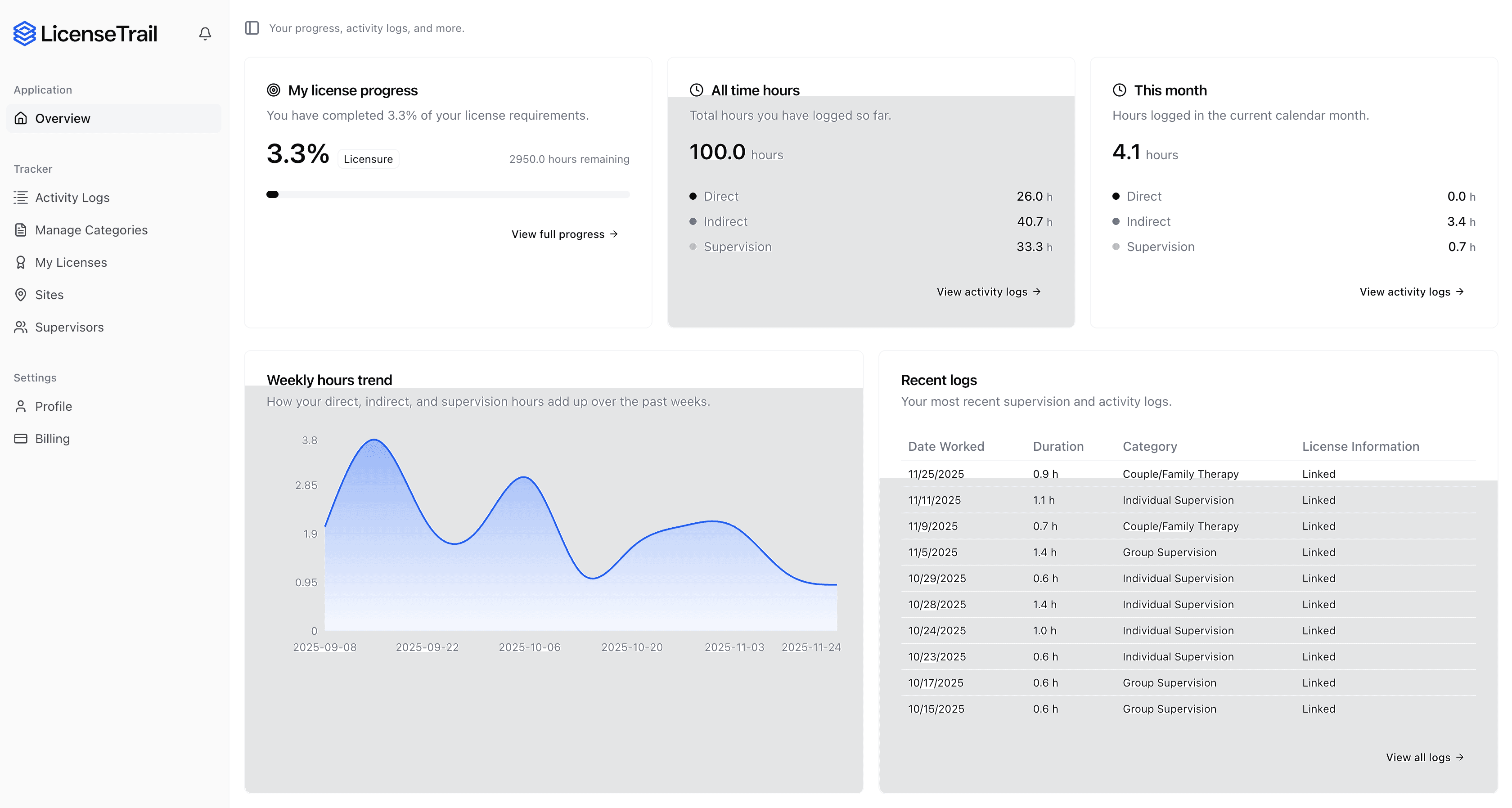
License Trail checks your direct, indirect, and supervision hours against New-hampshire LSPD requirements continuously and flags mismatches before you submit.
 Start Tracking for Free
No credit card required · Free plan available
Related Licenses
Is your spreadsheet hiding New-hampshire LSPD risks?
Stop guessing if your categories match New Hampshire Board of Psychologists requirements. License Trail checks your direct, indirect, and supervision hours continuously and flags mismatches before you submit.
Import or log
Bring your spreadsheet or start fresh
Upload your existing tracking spreadsheet and we'll map every hour into the right New Hampshire Board of Psychologists categories automatically.
Verify against New-hampshire
Catch mismatches before the board does
License Trail checks your direct, indirect, and supervision hours against New-hampshire LSPD requirements continuously.
Export board-ready
One-click clean reports
Generate professional, board-ready reports for supervision meetings and New Hampshire Board of Psychologists submissions in seconds.
No credit card required · Free plan available