
New-hampshire PSY Requirements: Hours, Exams & Step-by-Step Guide
Stop guessing if your categories match New-hampshire requirements. License Trail checks your direct, indirect, and supervision hours against PSY requirements continuously and flags mismatches before you submit.
No credit card required · Free plan available
Quick Requirements Overview
- Doctoral degree in psychology from a regionally accredited institution; APA/CPA-accredited programs accepted without extra documentation (non-accredited must meet Psyc 302.01/.02 content/credit requirements).
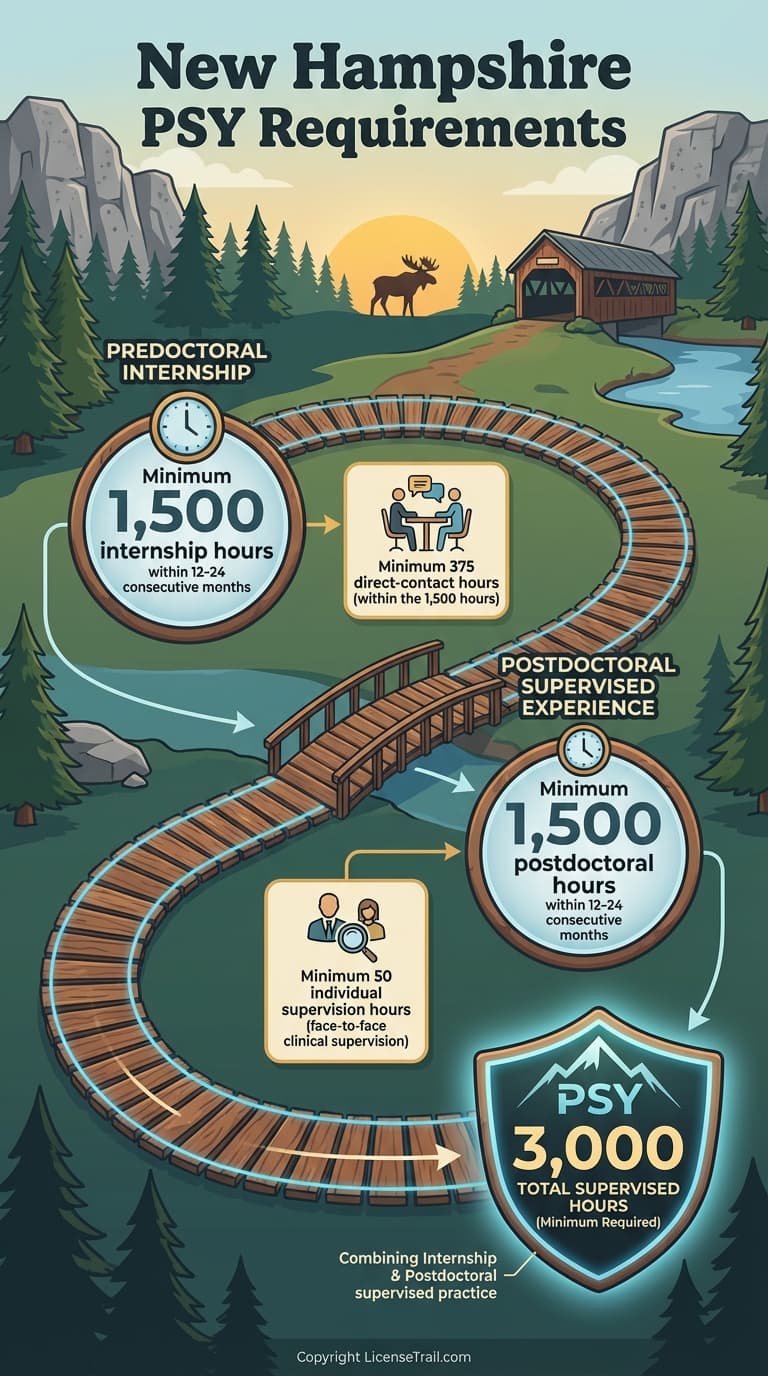
- Total supervised clinical experience: 3,000 hours = 2 years x 1,500 hours each (completed in 12–24 consecutive months per year).
- Year 1 (predoctoral): formal internship in an organized health care setting; 1,500 hours (APA/CPA internships accepted; non-accredited must meet program/supervision criteria incl. 375+ direct patient hours).
- Year 2 (postdoctoral): 1,500 hours after program certifies degree requirements complete; minimum 50 hours face-to-face individual supervision (≥1 hr/week).
- Supervision: supervisor must be a licensed psychologist where supervision occurs; no dual relationship; coursework/practicum hours don’t count; independent private practice not acceptable.
- Exam: EPPP required, passing scaled score ≥ 500; may be approved to sit after 200 postdoc hours (application otherwise acceptable).
- Application/documentation: universal application + Board forms (supervised experience summary, graduate course sheet, internship & postdoc verification) and fees.
- Background/character: fingerprints + criminal history release and good professional character required (RSA 329‑B).
License Details
Procedures
Licensure as a Psychologist (PSY) in New Hampshire centers on three pillars: a qualifying doctoral degree, 3,000 hours of supervised clinical experience (split 1,500/1,500), and passing the EPPP exam, all under the rules of the New Hampshire Board of Psychologists and RSA 329‑B.
Below is a structured walk‑through grounded in the Board’s current administrative rules and statute.
1. Statutory baseline: what the law requires
Under RSA 329‑B:15, the Board issues a psychologist license to a person who:
- Has passed a satisfactory examination in psychology.
- Has received a doctoral degree in a program whose content was “primarily psychological.”
- Has had at least 2 years of satisfactory, supervised experience in the field of psychology.
- Is of good professional character.
- Has paid all required fees.
- Has submitted fingerprints and a criminal history records release form under RSA 329‑B:14‑a. (gc.nh.gov)
In practice, the “2 years of supervised experience” is defined by Board rule as two years of 1,500 hours each (3,000 hours total), with one predoctoral internship year and one postdoctoral year.
2. Educational requirements (doctoral degree)
Board rule Psyc 302.01 requires that:
- All applicants must have a doctoral degree from an accredited institution of higher learning that is regionally accredited. (law.cornell.edu)
- If the doctoral program is APA‑accredited, the educational requirement “shall be deemed acceptable without further documentation.” (law.cornell.edu)
- If the program is not APA‑accredited, it must, among other things:
- Consist of at least 3 academic years of full‑time graduate study.
- Be clearly identified as a psychology program and a coherent, integrated sequence of study.
- Include supervised practicum, internship, field, or laboratory training “appropriate to psychology practice.” (law.cornell.edu)
For non‑APA/CPA programs, Psyc 302.02 further requires at least 24 semester hours across specified substantive areas (ethics, research design, statistics, psychometrics, psychotherapy techniques, biological bases, cognitive‑affective bases, social bases, and individual differences in behavior). (law.cornell.edu)
3. Overall supervised experience requirement: 3,000 hours
The Board’s prelicensure supervised practice rule (Psyc 302.03) defines the core structure: (regulations.justia.com)
- Before seeking licensure, an applicant must complete at least 2 years of supervised clinical experience in the area of psychology in which they plan to practice.
- One year must occur prior to receipt of the doctoral degree as an internship.
- One year must be after the academic institution has certified that all requirements for the doctoral degree have been completed.
- Each year of supervised clinical experience must include “not less than 1500 clock hours of psychology practice,” completed in not less than 12 and not more than 24 consecutive calendar months.
Key constraints on what counts:
- The supervisor must be a licensed psychologist in the state where supervision occurs and must not have a dual relationship with the supervisee (e.g., spouse, close relative, or therapist). (regulations.justia.com)
- Acceptable experience must include direct, formal contact with a licensed person responsible for the educational development and guidance of the supervisee. (regulations.justia.com)
- Hours spent in coursework, practicum, or other course‑related experiences cannot be counted toward the required supervised experience. (regulations.justia.com)
- Independent private practice, even under supervision, is not acceptable as supervised professional experience. (regulations.justia.com)
In other words, New Hampshire requires 3,000 clock hours of supervised clinical experience, structured as:
- 1,500 hours: formal internship (predoctoral).
- 1,500 hours: postdoctoral supervised clinical experience.
4. Year 1 – Predoctoral internship (1,500 hours)
Psyc 302.04 governs the internship year and states that: (law.cornell.edu)
- “The first year of clinical supervised experience shall occur as a formal internship in an organized health care setting,” referred to as a program, agency, or consortium.
- Internships accredited by APA or CPA are accepted without further documentation.
For non‑accredited internships, the program must meet specific criteria, including:
-
Program structure and hours
- The internship must provide a planned, programmed sequence of training experiences, documented in a written statement or brochure describing goals, content, and expectations.
- It must offer training in a range of assessment and intervention activities conducted directly with patients seeking health services.
- It must provide “a minimum of 1500 hours of training to be completed within a maximum of 24 consecutive months.” (law.cornell.edu)
-
Staffing and supervision
- The program must designate a staff psychologist (licensed/certified where the program operates) responsible for the integrity and quality of the training program.
- At least two psychologists must be on staff as supervisors, with at least one actively licensed psychologist.
- Supervision must be provided by a staff member who carries clinical responsibility for the cases being supervised, and at least one staff psychologist must provide half of the internship supervision. (law.cornell.edu)
-
Direct patient contact and supervision time
- At least 375 hours of the intern’s program time must be direct patient contact.
- The program must include at least 2 hours per week of regularly scheduled, formal, face‑to‑face individual supervision focusing on health services the intern provides directly to patients.
- The program must include at least 2 hours per week of learning activities, such as:
- Case conferences involving the intern’s cases.
- Seminars on clinical issues.
- Co‑therapy with a staff person plus discussion.
- Group supervision or additional individual supervision. (law.cornell.edu)
-
Trainee status and records
- Training must be post‑clerkship, post‑practicum, and post‑externship.
- The trainee must use a title such as “intern,” “resident,” or “fellow” to indicate trainee status. (law.cornell.edu)
- The program must keep permanent records of:
- Dates of attendance and supervised clinical experience.
- Hours of face‑to‑face individual supervision (in person or via electronic medium).
- Total hours of supervised clinical work experience.
- Supervisors’ names, license numbers, and highest degrees. (law.cornell.edu)
How this maps to hours:
- The Board’s application form requires you to document “predoctoral internship experience of a minimum of 1500 hours” as part of your Summary of Supervised Clinical Experience. (law.cornell.edu)
5. Year 2 – Postdoctoral supervised experience (1,500 hours)
Psyc 302.05 defines the second year of supervised experience: (regulations.justia.com)
- The second year of supervised experience is the postdoctoral year.
- Supervision requirements:
- Supervision must consist of at least 1 hour per week, and not less than 50 total hours, of face‑to‑face individual clinical supervision.
- That supervision must address the applicant’s direct health service in psychology provided to individuals or groups of patients.
- The postdoctoral clinical supervisor must be a licensed or certified psychologist and must assume professional and legal responsibility for the applicant’s professional activities, cases, training, and supervision.
- Postdoctoral hours begin when the doctoral program certifies that all degree requirements have been met, whether or not the degree has been formally conferred.
Record‑keeping responsibilities (by the program and employing agency) include permanent records of: (regulations.justia.com)
- Dates of attendance and dates of supervised clinical experience (noting in‑person vs. electronic medium).
- Hours of face‑to‑face individual supervision.
- Total hours of supervised clinical work experience.
- Each supervisor’s license type, state, license number, issue date, and highest degree.
An applicant may continue to practice under supervision after submitting a licensure application but before licensure is granted, as long as the arrangement complies with the supervision rules. (regulations.justia.com)
Again, on the Board’s own application forms, you must report “postdoctoral experience of a minimum of 1500 hours.” (law.cornell.edu)
6. How the Board expects you to document your 3,000 hours
Under Psyc 303.02, the application to the Office of Professional Licensure and Certification (OPLC) requires several supporting documents, including: (law.cornell.edu)
-
Summary of Supervised Clinical Experience for Internship and Post Doc
You must report, among other items:- “Predoctoral internship experience of a minimum of 1500 hours.”
- “Postdoctoral experience of a minimum of 1500 hours.”
- Total hours of supervised clinical experience.
- Total hours of face‑to‑face, on‑site individual and group supervision.
-
Graduate Program Course Sheet
- Indicate whether any of your graduate study was online/remote.
- Confirm whether the program was APA or CPA accredited (or document content areas if non‑accredited as required by Psyc 302.02). (law.cornell.edu)
-
Internship Confirmation Form
Sent to your internship director, who must confirm and provide details such as:- Whether the internship was APA‑approved.
- Start/end dates, hours per week, face‑to‑face supervision hours per week, total supervised hours, and total hours worked.
- Whether the internship was successfully completed and whether the director recommends you for licensure. (law.cornell.edu)
-
Postdoctoral Experience Form
Completed by your postdoctoral supervisor to document:- Dates of postdoctoral supervision.
- Hours worked per week, weeks worked, and total hours completed.
- Hours per week and total hours of individual face‑to‑face supervision, and total supervised face‑to‑face hours (individual + group). (law.cornell.edu)
These forms operationalize the Board’s requirement that you have at least 1,500 internship hours + 1,500 postdoc hours and that a substantial subset of those hours is clearly supervised face‑to‑face clinical work.
7. Examination requirement: EPPP
Psyc 303.05 governs the Examination for Professional Practice in Psychology (EPPP): (law.cornell.edu)
- All applicants must take the EPPP.
- The Board considers a scaled score of 500 or greater as a passing score.
- You can be approved to sit for the EPPP once you have completed at least 200 hours of your postdoctoral supervised experience under Psyc 302.05 and the rest of your application (except the remaining hours) is acceptable.
- If you fail the EPPP, you may retake it; failing twice triggers additional coursework requirements before another re‑examination.
8. Additional application elements and character requirements
Beyond education, supervised hours, and the EPPP, you must:
- Submit the Universal Application for Initial Licensure and the required Board addendum through OPLC, with all fees. (law.cornell.edu)
- Provide a fingerprint‑based criminal history record and criminal history records release form, as required by RSA 329‑B:14‑a and referenced in 329‑B:15. (gc.nh.gov)
- Demonstrate good professional character, as required by statute. (gc.nh.gov)
9. Step‑by‑step roadmap (condensed)
-
Complete a qualifying psychology doctorate
- Preferably APA/CPA‑accredited; otherwise, ensure it meets Psyc 302.01 and 302.02.
-
Complete a formal internship (Year 1 supervised experience)
- At least 1,500 hours in an organized health care setting.
- Meet internship criteria (375+ direct patient hours, weekly supervision and learning activities, trainee title).
-
Complete postdoctoral supervised clinical experience (Year 2)
- At least 1,500 hours of supervised clinical work.
- At least 50 hours of face‑to‑face individual clinical supervision (≥1 hour/week).
-
Track and document all hours and supervision
- Ensure supervisors and programs maintain the records that Psyc 302.04 and 302.05 require.
-
Apply for licensure and EPPP approval
- Submit the universal application, supervised experience summary, Graduate Program Course Sheet, Internship Confirmation Form, Postdoctoral Experience Form, and fees.
- Once you have 200+ postdoc hours, the Board can approve you to sit for the EPPP.
-
Pass the EPPP (scaled score ≥ 500) and complete any remaining supervised hours.
-
Complete background check and character review
- Submit fingerprints and criminal history release; satisfy the Board that you are of good professional character.
Once all these elements are satisfied and approved, the New Hampshire Board of Psychologists may issue your psychologist (PSY) license under RSA 329‑B.
Track your PSY hours with confidence
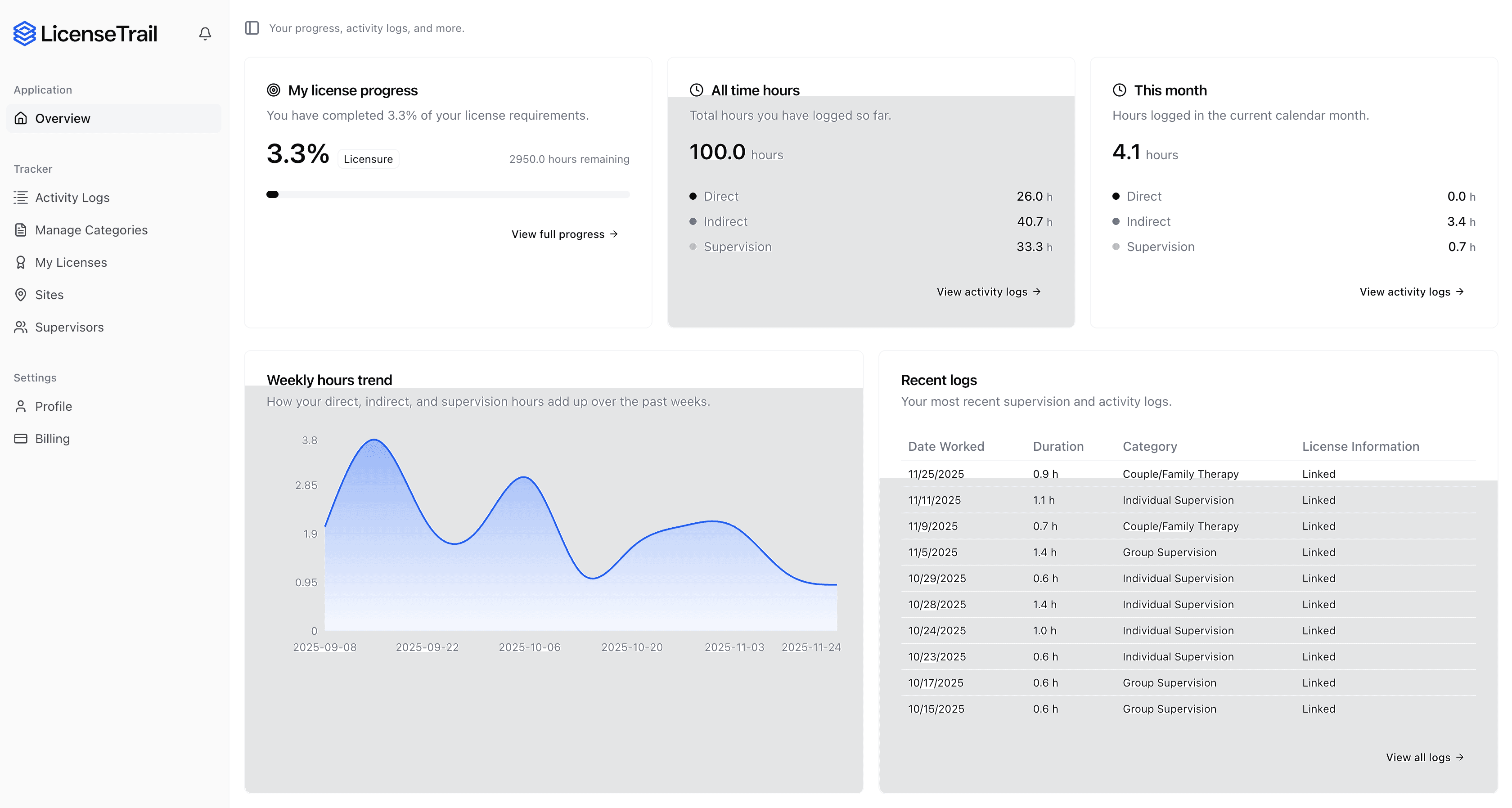
License Trail checks your direct, indirect, and supervision hours against New-hampshire PSY requirements continuously and flags mismatches before you submit.
 Start Tracking for Free
No credit card required · Free plan available
Is your spreadsheet hiding New-hampshire PSY risks?
Stop guessing if your categories match New Hampshire Board of Psychologists requirements. License Trail checks your direct, indirect, and supervision hours continuously and flags mismatches before you submit.
Import or log
Bring your spreadsheet or start fresh
Upload your existing tracking spreadsheet and we'll map every hour into the right New Hampshire Board of Psychologists categories automatically.
Verify against New-hampshire
Catch mismatches before the board does
License Trail checks your direct, indirect, and supervision hours against New-hampshire PSY requirements continuously.
Export board-ready
One-click clean reports
Generate professional, board-ready reports for supervision meetings and New Hampshire Board of Psychologists submissions in seconds.
No credit card required · Free plan available