
New-hampshire LSPS Requirements: Hours, Exams & Step-by-Step Guide
Stop guessing if your categories match New-hampshire requirements. License Trail checks your direct, indirect, and supervision hours against LSPS requirements continuously and flags mismatches before you submit.
No credit card required · Free plan available
Quick Requirements Overview
- Must not hold a doctoral degree in psychology (LSPS is the non‑doctoral school psychology license).
- Must first be NHDOE certified as a School Psychologist (required prerequisite for LSPS).
- NHDOE education requirement: 60 graduate semester hours (or equivalent) culminating in at least a master’s; 54 semester hours must be non‑internship coursework.
- NHDOE internship: 1,200 supervised clock hours; completed full‑time in 1 school year or half‑time over 2 consecutive school years.
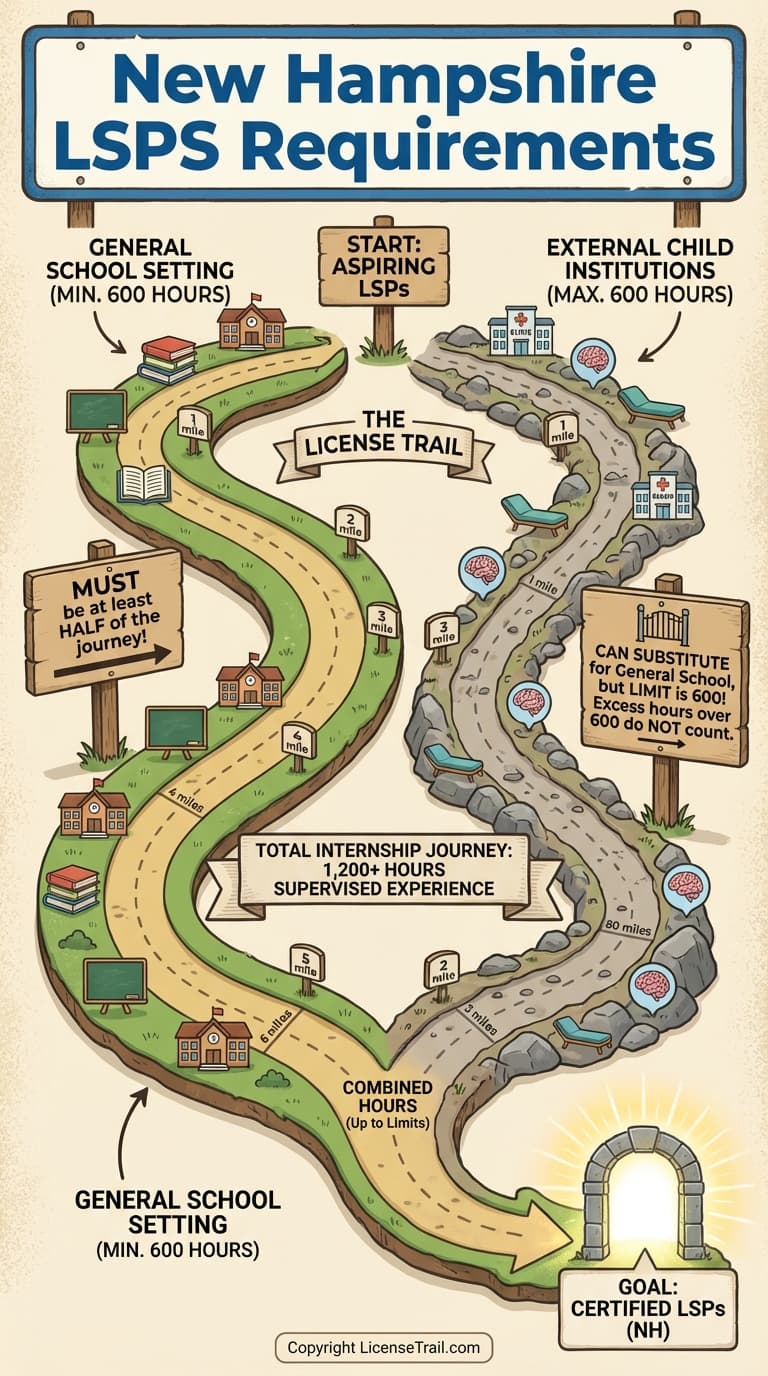
- Internship setting limits: ≥600 hours in a general school setting; ≤600 hours may be in approved non‑school child‑serving settings (e.g., clinics/hospitals/institutions for children).
- Board requirement: pass an exam including a national school psychologists’ exam (as determined by the Board).
- Application requirements include good professional character, fingerprints/criminal history check, and fees.
- Renewal/maintenance: keep current NHDOE certification and complete 40 CE hours/2 years (≥30 Category A; 6 live interactive ethics), plus 40 collaboration hours per licensing period.
License Details
Procedures
Licensure as a Licensed School Psychologist–Specialist (LSPS) in New Hampshire sits at the intersection of the New Hampshire Board of Psychologists and the New Hampshire Department of Education (NHDOE). To get the LSPS license, you must first meet the Department of Education’s requirements to be credentialed as a school psychologist and then satisfy the Board of Psychologists’ licensing requirements under RSA 329‑B:15‑a and its rules.
Below is a structured guide, with emphasis on the specific hour requirements and the exact types of experience New Hampshire defines.
1. Regulatory framework and where the LSPS fits
Governing statute. Licensed school psychologist–specialist is one of the licenses created in RSA 329‑B:15‑a, “Licensed School Psychologist‑Doctoral and Licensed School Psychologist‑Specialist.” The statute distinguishes:
- Licensed school psychologist‑doctoral – for applicants with a doctoral degree in psychology.
- Licensed school psychologist‑specialist – for applicants who do not hold a doctoral degree. (law.justia.com)
Both licenses are regulated by the New Hampshire Board of Psychologists, under Chapter 329‑B, Psychologists. (law.justia.com)
Required link to the Department of Education. For both the doctoral and specialist titles, RSA 329‑B:15‑a requires that the applicant be “certified as a school psychologist by the New Hampshire department of education, bureau of credentialing” and meet additional Board requirements. (law.justia.com)
That means the only place New Hampshire sets specific, numeric practicum/internship hour requirements for LSPS candidates is in the NHDOE credentialing rules for school psychologists, not in the Board of Psychologists statute itself.
Those NHDOE rules are in Ed 508.02 – School Psychologist, under the credential standards for educational personnel. (regulations.justia.com)
2. Core statutory requirements for LSPS under RSA 329‑B:15‑a
Under RSA 329‑B:15‑a, II, the Board “shall issue a license for the title of licensed school psychologist‑specialist” to a person who: (law.justia.com)
-
Does not have a doctoral degree in psychology; and
-
Is certified as a school psychologist by the NH Department of Education, bureau of credentialing; and
-
Has completed all of the following Board‑level requirements:
-
Examination:
Has passed a satisfactory examination in psychology, including a national school psychologists’ examination, as determined by the Board. (law.justia.com) -
Education and other requirements:
Has met “education and other requirements” as determined by the Board (in practice, this is anchored in holding NHDOE school psychologist certification, which itself has explicit hour requirements—see section 3). (law.justia.com) -
Character:
Is of good professional character. (law.justia.com) -
Criminal background check:
Has submitted fingerprints and a criminal history records release form in accordance with RSA 329‑B:14‑a. (law.justia.com) -
Fees:
Has paid all fees established by the Office of Professional Licensure and Certification under RSA 310‑A:1‑a. (law.justia.com)
-
Notably, RSA 329‑B:15‑a does not prescribe a specific number of supervised post‑degree practice hours for LSPS licensure (unlike the general psychologist license in RSA 329‑B:15, which requires at least two years of supervised experience). (gc.nh.gov)
All quantitative “hours” requirements for LSPS entry are therefore imported from the NHDOE school psychologist credential.
3. Hour requirements embedded in the NHDOE school psychologist credential (Ed 508.02)
To be certified as a school psychologist by NHDOE—the mandatory gateway to LSPS licensure—you must meet Ed 508.02 – School Psychologist. The rule specifies both graduate semester‑hour requirements and supervised internship hour requirements.
3.1 Graduate coursework hours
Ed 508.02 offers two basic pathways: (regulations.justia.com)
-
Completion of a state board of education–approved school psychology program at the doctoral, certificate of advanced graduate study (CAGS), specialist, or master’s level; or
-
Meeting both of these requirements:
- At least 60 graduate semester hours (or equivalent), culminating in at least a master’s degree; and
- Of those 60 hours, at least 54 semester hours must be exclusive of credit for the supervised internship experience described below.
So, in plain numerical terms, the education rule requires:
- Total graduate study: at least 60 semester hours
- Coursework only (non‑internship): at least 54 of those 60 must be classroom or equivalent (not counting internship credits)
These semester‑hour requirements are conditions of the NHDOE school psychologist credential, and therefore indirectly required for LSPS licensure because RSA 329‑B:15‑a requires Department of Education certification. (law.justia.com)
3.2 Supervised internship hours
Ed 508.02 then defines the supervised internship requirement in explicit “clock‑hour” terms: (regulations.justia.com)
- You must complete a supervised internship in a general school setting for 1,200 clock hours.
- This internship must be completed either:
- Full‑time over one school year, or
- Half‑time over two consecutive school years.
The rule also allows part of those 1,200 hours to be in non‑school child‑serving settings, with an important limit:
- Experiences in mental health clinics, psychiatric hospitals, or other institutions for children may count for no more than 600 of the 1,200 hours.
- At least 600 of the 1,200 hours must remain in a general school setting. (regulations.justia.com)
In other words, for LSPS candidacy via NHDOE certification, the minimum experiential hour structure is:
- 1,200 total supervised internship hours in school psychology
- At least 600 hours must be in a general school setting
- Up to 600 hours can be in other approved child‑serving settings (mental health clinics, psychiatric hospitals, other institutions for children)
- This internship is formally supervised and specifically tied to the graduate program.
There is no additional, state‑mandated breakdown between “direct service” hours and “indirect service” hours in Ed 508.02. The rule speaks in terms of “clock hours” of supervised internship, with location limits, not sub‑categories like assessment vs. counseling vs. consultation hours. (regulations.justia.com)
4. What New Hampshire does not require for LSPS hours
Because the question asks for specifics, including an example such as “1,500 hours of direct experience and 1,500 hours of supervised experience”:
- There is no provision in RSA 329‑B:15‑a or Ed 508.02 that requires 1,500 hours of direct experience plus 1,500 hours of supervised experience for LSPS applicants.
- The only quantified pre‑licensure practice requirement specifically tied to LSPS licensure is the 1,200‑hour supervised internship required for the NHDOE school psychologist credential (with the 600/600 school vs. non‑school cap). (law.justia.com)
By contrast:
- The general psychologist license (PhD/PsyD psychologist, not LSPS) requires at least two years of supervised experience in the field of psychology. (gc.nh.gov)
- For licensure by endorsement (for psychologists moving from other jurisdictions), the OPLC endorsement rule (Plc 313.51) treats “substantially similar” psychologist standards as including a minimum of 2,500 hours or 2 full‑time years of supervised experience—again, this is written for psychologist licensure, not LSPS. (gc.nh.gov)
None of these generalized supervised‑experience hour requirements are repeated or cross‑referenced in the LSPS section of the statute.
5. Scope of practice limits tied to the LSPS license
RSA 329‑B:15‑a also defines how and where LSPS licensees may practice: (law.justia.com)
- Unless they hold another license, a licensed school psychologist‑specialist’s license is “for services provided in those settings that are provided in an educational institution.”
- Services outside such educational settings are allowed only if they are directly related to the client’s improvement of school functioning (e.g., learning, development, social and emotional functioning, behavior) and must be tied to the practitioner’s own students and employment in a school.
- LSPS licensees may not hold themselves out as “psychologists” or “psychological examiners,” or use business names built around those titles, except as “school psychologists” or “nationally certified school psychologists” unless they are otherwise licensed under a different provision.
Separate definitional sections of RSA 329‑B describe “school psychology practice” and “school psychology services” as focused on assessment, intervention, consultation, systems‑level work, and services related to school functioning and transition to post‑secondary goals. (gc.nh.gov)
These scope‑of‑practice provisions don’t add new time‑based requirements, but they are part of the verbiage that defines what LSPS license holders are actually authorized to do in New Hampshire.
6. Ongoing hour‑based requirements after you are licensed
Once you hold an LSPS license, the Board of Psychologists’ continued status rules impose hour‑based maintenance requirements, separate from the internship:
6.1 Continuing education (CE) hours – Psyc 402
Under Psyc 402.02 – Continuing Education Requirements, each licensee (including school psychologists) must complete during each 2‑year license term: (regulations.justia.com)
- 40 hours of approved continuing education
- At least 30 of the 40 hours must be from “Category A” activities (offered or approved by specified professional bodies such as APA, NASP, NH Psychological Association, etc.).
- At least 6 of the 40 hours must be in ethics, from Category A, and taken in a live and interactive format.
- No more than 10 hours may be from Category B activities (broader professional activities such as non‑approved workshops, certain teaching or publishing).
These are educational hours, not supervised practice hours, but they are explicitly quantified and required for renewal.
6.2 Collaboration hours – Psyc 403
Under Psyc 403.01 – Collaboration Requirements, each active licensee must also complete 40 hours of collaboration during the licensing period and document those hours for renewal. (regulations.justia.com)
The rule does not treat these as supervised clinical hours; rather, they are intended to ensure ongoing professional collaboration (consultations, peer discussions, etc.) as part of competent practice.
6.3 Renewal documentation for school psychologists – Psyc 401
For renewal specifically, Psyc 401.02(c) requires that a school psychologist (which includes LSPS licensees) submit: (regulations.justia.com)
- The universal renewal application required by the OPLC; and
- A copy of their current New Hampshire Department of Education school psychologist certification.
This effectively ties continued LSPS licensure to maintaining your NHDOE school psychologist credential, which itself is anchored in the 60 graduate hours and 1,200 internship hours you originally completed. (regulations.justia.com)
7. Step‑by‑step pathway to LSPS licensure in New Hampshire (with hours highlighted)
Putting the legal and regulatory pieces together, the pathway looks like this:
-
Complete a graduate school psychology program that satisfies Ed 508.02.
- Either a state‑approved doctoral/CAGS/specialist/master’s program in school psychology, or
- At least 60 semester hours of graduate study culminating in at least a master’s degree, with at least 54 hours of coursework (not counting internship credits). (regulations.justia.com)
-
Complete the supervised internship required by Ed 508.02.
- 1,200 clock hours of supervised internship in school psychology.
- At least 600 hours must be in a general school setting.
- Up to 600 hours may be in mental health clinics, psychiatric hospitals, or other institutions for children.
- Internship completed full‑time in one year or half‑time over two consecutive years. (regulations.justia.com)
-
Obtain NHDOE certification as a school psychologist.
- Apply to the NH Department of Education under Ed 508.02 and related credentialing procedures.
- This is the SEA credential that RSA 329‑B:15‑a requires as a prerequisite for LSPS licensure. (regulations.justia.com)
-
Pass the required examination(s).
- RSA 329‑B:15‑a requires LSPS applicants to pass a satisfactory examination in psychology that includes a national school psychologists’ exam, as determined by the Board (typically the Praxis School Psychologist exam). (law.justia.com)
-
Apply to the New Hampshire Board of Psychologists / OPLC for LSPS licensure.
- Submit the LSPS application (through OPLC’s universal forms), evidence of NHDOE school psychologist certification, and exam scores.
- Undergo a fingerprint‑based criminal history check in accordance with RSA 329‑B:14‑a. (law.justia.com)
- Demonstrate good professional character (the Board may review disciplinary history, criminal records, etc.). (law.justia.com)
- Pay the required licensing fee.
-
Practice within the LSPS scope.
- Practice is primarily in educational institutions, with services outside school settings allowed only when directly related to students’ school functioning and tied to the licensee’s school employment.
- Do not represent yourself simply as a “psychologist” or “psychological examiner” unless you hold another qualifying psychology license; you may use titles such as “school psychologist” or “nationally certified school psychologist” consistent with statute. (law.justia.com)
-
Maintain and renew your license.
- Every 2‑year license term, complete:
- 40 hours of continuing education, including 30 Category A hours and 6 live, interactive ethics hours from Category A. (regulations.justia.com)
- 40 hours of collaboration during the licensing period. (regulations.justia.com)
- Renew through OPLC using the universal renewal application and provide a current copy of your NHDOE school psychologist certification. (regulations.justia.com)
- Every 2‑year license term, complete:
8. Summary of key hour requirements for LSPS in New Hampshire
For an LSPS applicant and licensee, the main quantified hours currently defined in New Hampshire law and rules are:
Pre‑licensure (via NHDOE credential, Ed 508.02): (regulations.justia.com)
-
Graduate education:
- Minimum 60 graduate semester hours in school psychology or equivalent
- At least 54 of those hours must be non‑internship coursework.
-
Supervised internship:
- 1,200 clock hours total, supervised
- At least 600 hours in a general school setting
- No more than 600 hours in other child‑serving settings (clinics, hospitals, etc.)
- Completed full‑time over 1 year or half‑time over 2 consecutive years.
Post‑licensure (Board of Psychologists rules): (regulations.justia.com)
-
Continuing education:
- 40 CE hours every 2 years, including
- At least 30 Category A hours
- At least 6 ethics hours, Category A, live and interactive.
-
Collaboration:
- 40 hours of collaboration per licensing period.
-
Credential maintenance:
- Ongoing NHDOE school psychologist certification (no new hour totals specified beyond initial 60/1,200, but you must keep the credential active).
There are no separate statutory requirements for LSPS licensure such as “1,500 hours of direct experience plus 1,500 hours of supervised experience.” Those kinds of large post‑degree supervised‑experience totals apply in New Hampshire only to psychologist licensure under RSA 329‑B and related rules, not to the LSPS category. (gc.nh.gov)
Track your LSPS hours with confidence
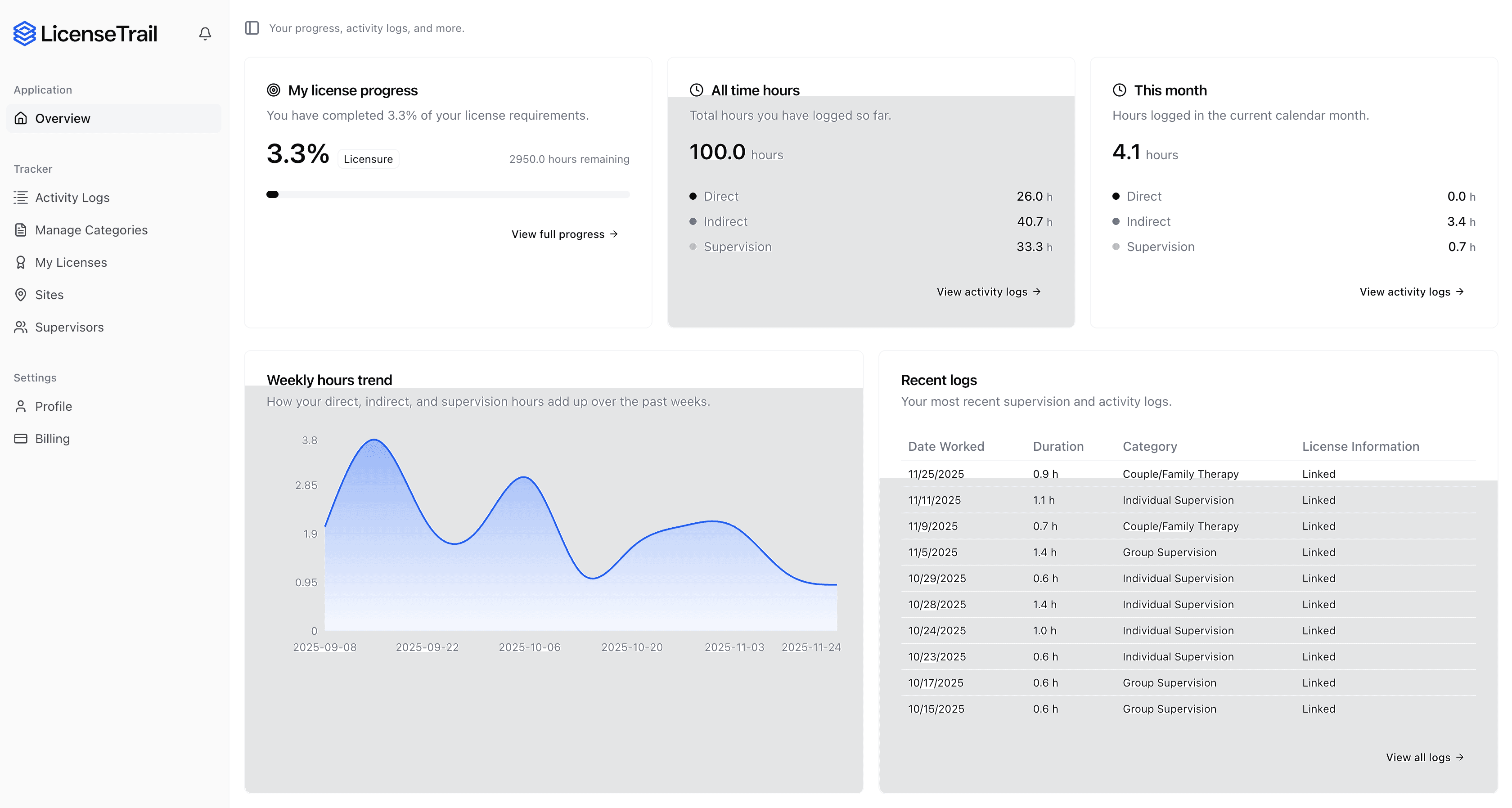
License Trail checks your direct, indirect, and supervision hours against New-hampshire LSPS requirements continuously and flags mismatches before you submit.
 Start Tracking for Free
No credit card required · Free plan available
Related Licenses
Is your spreadsheet hiding New-hampshire LSPS risks?
Stop guessing if your categories match New Hampshire Board of Psychologists requirements. License Trail checks your direct, indirect, and supervision hours continuously and flags mismatches before you submit.
Import or log
Bring your spreadsheet or start fresh
Upload your existing tracking spreadsheet and we'll map every hour into the right New Hampshire Board of Psychologists categories automatically.
Verify against New-hampshire
Catch mismatches before the board does
License Trail checks your direct, indirect, and supervision hours against New-hampshire LSPS requirements continuously.
Export board-ready
One-click clean reports
Generate professional, board-ready reports for supervision meetings and New Hampshire Board of Psychologists submissions in seconds.
No credit card required · Free plan available