
New-jersey LPC Requirements: Hours, Exams & Step-by-Step Guide
Stop guessing if your categories match New-jersey requirements. License Trail checks your direct, indirect, and supervision hours against LPC requirements continuously and flags mismatches before you submit.
No credit card required · Free plan available
Quick Requirements Overview
- Age/character: 18+ and “good moral character”
- Education: Master’s/Doctorate in Counseling; 60 graduate semester hours from a regionally accredited, counseling-prep program
- Coursework: 45/60 credits across ≥8 core counseling content areas (e.g., theory, helping relationship, assessment/appraisal, group, career, multicultural, research, profession)
- Exam: Pass NBCC NCE (or successor)
- Experience (standard): 3 “calendar years” supervised professional counseling experience (max 1,500 hrs/year; caps 30 hrs/week and 125 hrs/month); only 1 year pre-degree; 2 years post-LAC
- Experience (reduced): 2 calendar years post-LAC if +30 graduate semester hours beyond the master’s (counseling-related); must still have ≥1 year post-master’s experience
- Supervision: ≥50 hrs/year documented face-to-face (≈1 hr/week); ≤10 hrs/year may be group; supervisor must be a qualified clinical licensee
- Time limit: Up to 6 years to complete supervised experience (6 years from LAC date for LAC holders)
License Details
Procedures
New Jersey licenses professional counselors through the State Board of Marriage and Family Therapy Examiners, Professional Counselor Examiners Committee. The Licensed Professional Counselor (LPC) credential is the independent practice license; most applicants first hold a Licensed Associate Counselor (LAC).
Below is a step‑by‑step explanation of the LPC requirements with the Board’s own terminology and how the hours break down in practice.
1. Baseline statutory requirements
Under New Jersey statute, to become an LPC you must show the Committee that you: (law.justia.com)
- Are at least 18 years of age.
- Are “of good moral character.”
- Have the required education (see below).
- Have completed the required supervised counseling experience.
- Have passed the National Counselor Examination (NCE) of the National Board for Certified Counselors (NBCC).
These statutory requirements are implemented and detailed in the New Jersey Administrative Code, Chapter 13:34, Subchapter 11.
2. Educational requirements
The Professional Counselor Examiners Committee’s rule on education (N.J.A.C. 13:34‑11.2) requires: (law.cornell.edu)
-
Degree level and program type
- A minimum of 60 graduate semester hours and
- A master’s degree or doctorate in counseling
- In a “planned educational program designed to prepare students for the professional practice of counseling” from a regionally accredited institution.
The degree and transcript must clearly show that the degree awarded is a master’s or doctorate in counseling, and that the program’s stated purpose is to prepare students for the professional practice of counseling. (law.cornell.edu)
-
Core counseling coursework (45 of the 60 credits)
Of the 60 graduate credits, at least 45 semester hours must be distributed in at least eight of the following content areas (summarizing the Board’s descriptions): (law.cornell.edu)
- Counseling theory and practice
- The helping relationship
- Human growth and development and maladaptive behavior
- Lifestyle and career development
- Group dynamics, processes, counseling, and consulting
- Appraisal of individuals
- Social and cultural foundations
- Research and evaluation
- The counseling profession
(The full rule elaborates on what each category must cover.)
3. Examination requirement
The Board’s examination rule (N.J.A.C. 13:34‑11.4) states that: (law.cornell.edu)
-
An applicant for LPC “shall submit to the Committee … proof that the applicant has successfully passed the National Counselor Examination (NCE) or its successor, administered by the National Board for Certified Counselors (NBCC) or its successor.”
-
Typically, you are admitted to the NCE only after the Committee has reviewed your coursework and given written permission, unless you took the NCE as part of your graduate program or under another state’s exam process.
In practice, you usually pass the NCE as part of the LAC process and then reuse that exam for LPC.
4. Key Board definitions about hours and supervision
Before looking at the LPC hour totals, it helps to understand how the Board defines “calendar year,” “professional counseling experience,” and “supervision” (N.J.A.C. 13:34‑10.2): (law.cornell.edu)
-
“One calendar year”
-
The Board defines one calendar year as:
“a maximum of 1,500 hours of supervised counseling experience over a period of 52 weeks, which is considered full‑time”
or
“no less than 750 hours of supervised counseling experience in each of two 52‑week periods for a total of 1,500 hours … which is considered part‑time.”
-
No more than 30 hours of supervised counseling experience per week.
-
No more than 125 hours of supervised counseling experience per month.
So, administratively, 1 calendar year = up to 1,500 hours of supervised counseling experience.
-
-
“Professional counseling experience” / “professional counseling services”
- “Professional counseling experience” means rendering professional counseling services while under the direct supervision of a qualified supervisor.
- “Professional counseling services” is defined broadly as applying mental health and human development principles to:
- facilitate human development and adjustment across the lifespan;
- clinically assess and evaluate mental, emotional, and associated distresses;
- conduct assessments and evaluations to set goals and objectives;
- plan, implement, and evaluate counseling interventions. (law.cornell.edu)
The Board does not split hours into “direct client contact” vs “indirect” in the text of this rule; instead, hours must qualify as professional counseling services within that definition and occur under supervision.
-
“Supervision”
- “Supervision” or “supervised” means weekly interaction with a qualified supervisor who:
- monitors the performance of the licensed associate counselor; and
- provides “weekly, documented, face‑to‑face consultation, guidance and instruction” regarding the counselor’s skills and competencies.
- This “includes at least 50 hours of face‑to‑face supervision per one calendar year, at the rate of one hour per week, of which not more than 10 hours may be group supervision.” (law.cornell.edu)
Over three calendar years of experience, that implies a minimum of 150 hours of documented face‑to‑face clinical supervision, with at most 30 of those hours in group format.
- “Supervision” or “supervised” means weekly interaction with a qualified supervisor who:
-
“Qualified supervisor”
- A qualified supervisor is someone who holds a clinical license (professional counseling, MFT, psychology, psychiatry, or social work) for at least three years in the state where services are provided, and who also has an approved clinical supervision credential or graduate coursework in supervision, as detailed in N.J.A.C. 13:34‑10.2 and 13:34‑13.1. (law.cornell.edu)
5. Supervised experience requirements for LPC (the hours)
The detailed LPC experience requirements are set out in N.J.A.C. 13:34‑11.3 and are consistent with the statute at N.J.S.A. 45:8B‑40(d). (law.cornell.edu)
5.1 Standard route (no extra post‑master’s credits)
Under N.J.A.C. 13:34‑11.3(a)(1), the primary pathway requires:
- “Three calendar years of supervised professional counseling experience in a professional counseling setting”,
- Only one calendar year may be obtained prior to the granting of the master’s degree, and
- Two calendar years of supervised professional counseling experience shall have been obtained following licensure as an associate counselor (LAC).” (law.cornell.edu)
Using the Board’s own definition of “one calendar year”:
- Each calendar year = up to 1,500 hours of supervised counseling experience. (law.cornell.edu)
Therefore, the standard route equates to:
- Up to 4,500 hours of supervised counseling experience total, broken down as:
- Up to 1,500 hours (one calendar year) possibly obtained before the master’s degree (e.g., qualifying practicum/internship or other supervised counseling work that meets the Board’s standards and is not double‑counted toward core coursework). (law.cornell.edu)
- At least 3,000 hours (two calendar years) obtained after you are licensed as a Licensed Associate Counselor (LAC) in acceptable professional counseling settings under a qualified supervisor.
In addition, embedded within those calendar years, the Board requires supervision hours as defined earlier:
- At least 50 hours of face‑to‑face supervision per calendar year,
- At a rate of one hour per week, and
- No more than 10 hours of that per year may be group supervision. (law.cornell.edu)
So under the standard route, you are looking at:
- Supervised counseling work (“professional counseling experience”): up to 4,500 hours across three calendar years; and
- Clinical supervision meetings: at least 150 hours of documented, face‑to‑face supervision across those three years.
5.2 Reduced‑experience route with additional post‑master’s credits
New Jersey law allows you to reduce the experience requirement by completing an additional block of graduate coursework clearly related to counseling. The statute provides that an applicant may “eliminate one year of the required supervised counseling experience by substituting 30 graduate semester hours beyond the master’s degree” that are related to counseling and acceptable to the Committee, but “in no case … may the applicant have less than one year of supervised professional counseling experience after the granting of the master’s degree.” (law.justia.com)
The Board’s rule (N.J.A.C. 13:34‑11.3(a)(2)) implements this as:
- Two calendar years of supervised professional counseling experience as a licensed associate counselor in a professional counseling setting, provided that:
- You have completed, after your 60‑credit counseling master’s degree, an additional 30 graduate semester hours clearly related to counseling, from the same content areas listed in N.J.A.C. 13:34‑11.2(a)3ii(1)–(9). (law.cornell.edu)
Using the Board’s calendar‑year definition:
- Two calendar years = up to 3,000 hours of supervised counseling experience (1,500 per year). (law.cornell.edu)
Supervision under this route:
- Minimum 50 hours of face‑to‑face supervision per calendar year, so at least 100 hours of supervision across the two years. (law.cornell.edu)
Hours from graduate practicums and internships may still count under this route, subject to the same limitation that they cannot also be used to fulfill the 45 core course hours in the educational requirement. (law.cornell.edu)
5.3 Time limit for completing supervised experience
The Board also sets a timeframe for finishing your supervised experience:
- “An applicant for licensure may take up to a maximum of six years to satisfy the supervised professional counseling experience requirement” under the definitions in N.J.A.C. 13:34‑10.2. (law.cornell.edu)
- A person already licensed as an LAC has six years from the date of LAC licensure to complete the supervised experience. (law.cornell.edu)
6. Role of the Licensed Associate Counselor (LAC)
While your question is focused on LPC, it’s important to note that New Jersey expects the post‑master’s supervised hours to be accrued while licensed as an LAC, with very limited allowance for pre‑master’s hours:
- Under N.J.A.C. 13:34‑11.3(a)(1), two calendar years of supervised experience must be obtained after licensure as an associate counselor (LAC). (law.cornell.edu)
- No more than one calendar year (up to 1,500 hours) of experience can be obtained prior to:
- granting of the master’s degree (standard route), or
- completion of the 60 graduate semester hours (reduced‑experience route). (law.cornell.edu)
In practice, the typical progression is:
- Finish a 60‑credit counseling master’s that meets N.J.A.C. 13:34‑11.2.
- Obtain LAC licensure and NCE approval. (law.cornell.edu)
- Complete 2–3 calendar years of supervised professional counseling experience under a qualified supervisor, within the 6‑year window, meeting the hour limits and supervision requirements.
- Apply to the Committee for LPC once all supervised experience and other requirements are documented.
7. How the New Jersey Board itself “talks about” the hours
Putting the Board’s own terminology together:
- The required experience for LPC is framed as “three calendar years of supervised professional counseling experience” (or two calendar years with 30 extra post‑master’s credits), not as separate “direct” vs “indirect” hour minimums. (law.cornell.edu)
- A “calendar year” is specifically defined as up to 1,500 hours of supervised counseling experience, with caps of 30 hours per week and 125 per month. (law.cornell.edu)
- Within each calendar year, “supervision” must include at least 50 hours of face‑to‑face supervision, not more than 10 of which may be group supervision. (law.cornell.edu)
- All counted hours must be “professional counseling experience” (i.e., provision of professional counseling services under direct supervision) in a professional counseling setting acceptable to the Committee. (law.cornell.edu)
Translated into the type of numeric summary you asked for:
-
Standard route:
- 4,500 hours of supervised counseling experience (3 calendar years × 1,500 hours), at least 3,000 of which must be post‑master’s and post‑LAC,
- plus at least 150 hours of documented, face‑to‑face clinical supervision across those years.
-
Reduced‑experience route with 30 additional post‑master’s credits:
- 3,000 hours of supervised counseling experience (2 calendar years × 1,500 hours) as an LAC,
- plus at least 100 hours of documented, face‑to‑face clinical supervision across those two years.
New Jersey’s regulations are written around calendar years of “supervised professional counseling experience” with specified hour caps and supervision minimums, rather than splitting the requirement into distinct numerical targets for “direct client contact” versus “other” experience.
Track your LPC hours with confidence
License Trail checks your direct, indirect, and supervision hours against New-jersey LPC requirements continuously and flags mismatches before you submit.
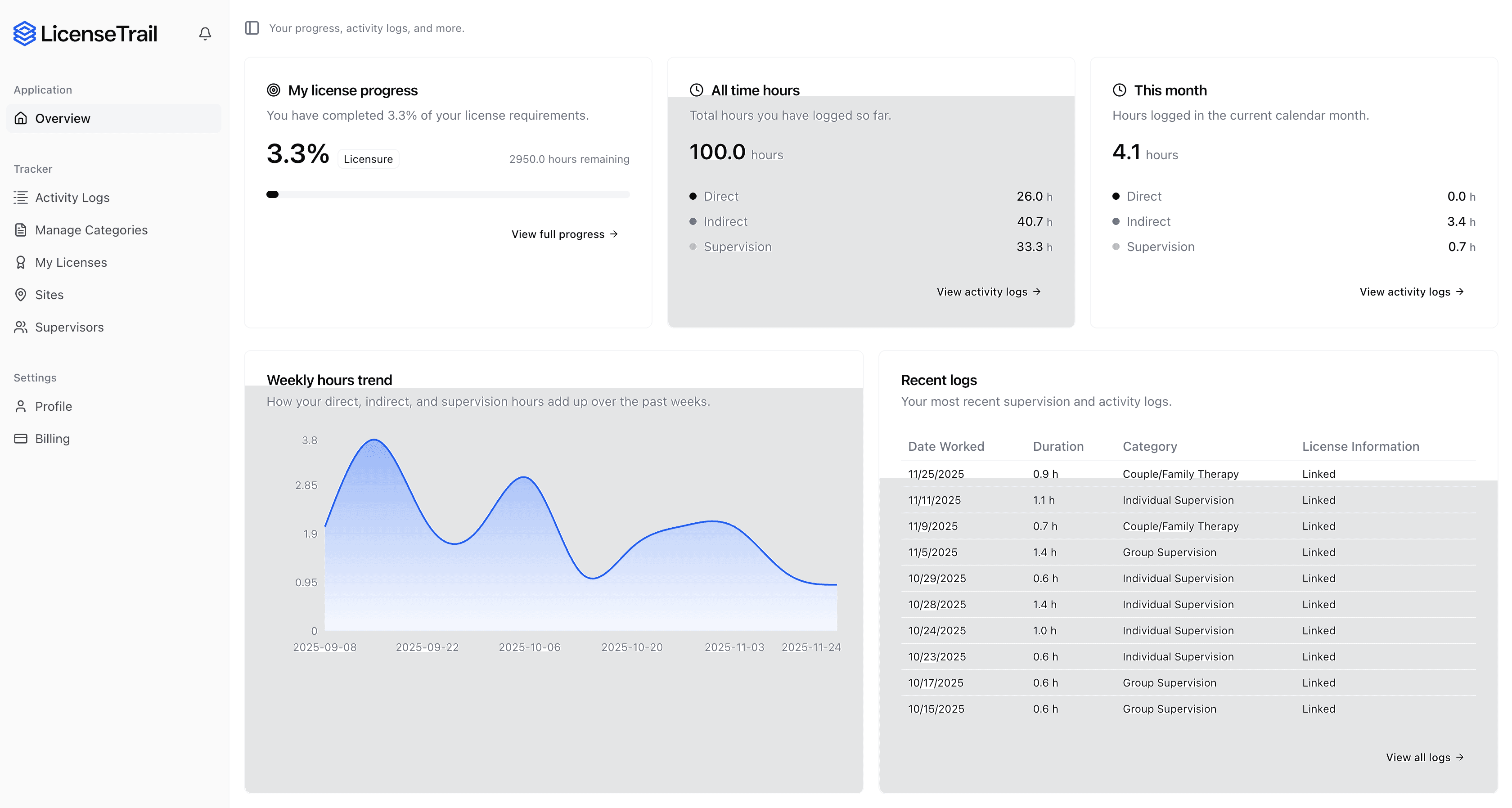 Start Tracking for Free
No credit card required · Free plan available
Is your spreadsheet hiding New-jersey LPC risks?
Stop guessing if your categories match New Jersey Board of Marriage and Family Therapy Examiners requirements. License Trail checks your direct, indirect, and supervision hours continuously and flags mismatches before you submit.
Import or log
Bring your spreadsheet or start fresh
Upload your existing tracking spreadsheet and we'll map every hour into the right New Jersey Board of Marriage and Family Therapy Examiners categories automatically.
Verify against New-jersey
Catch mismatches before the board does
License Trail checks your direct, indirect, and supervision hours against New-jersey LPC requirements continuously.
Export board-ready
One-click clean reports
Generate professional, board-ready reports for supervision meetings and New Jersey Board of Marriage and Family Therapy Examiners submissions in seconds.
No credit card required · Free plan available