
New-jersey LRC Requirements: Hours, Exams & Step-by-Step Guide
Stop guessing if your categories match New-jersey requirements. License Trail checks your direct, indirect, and supervision hours against LRC requirements continuously and flags mismatches before you submit.
No credit card required · Free plan available
Quick Requirements Overview
- Minimum eligibility: age 18+ and good moral character; apply via NJ Professional Counselor Examiners Committee
- Education: Master’s in a planned rehab counseling program from a regionally accredited school; program accredited by CORE (or successor) at graduation
- Pre-degree fieldwork: 100-hour supervised practicum + 600-hour supervised internship (weekly individual/group supervision)
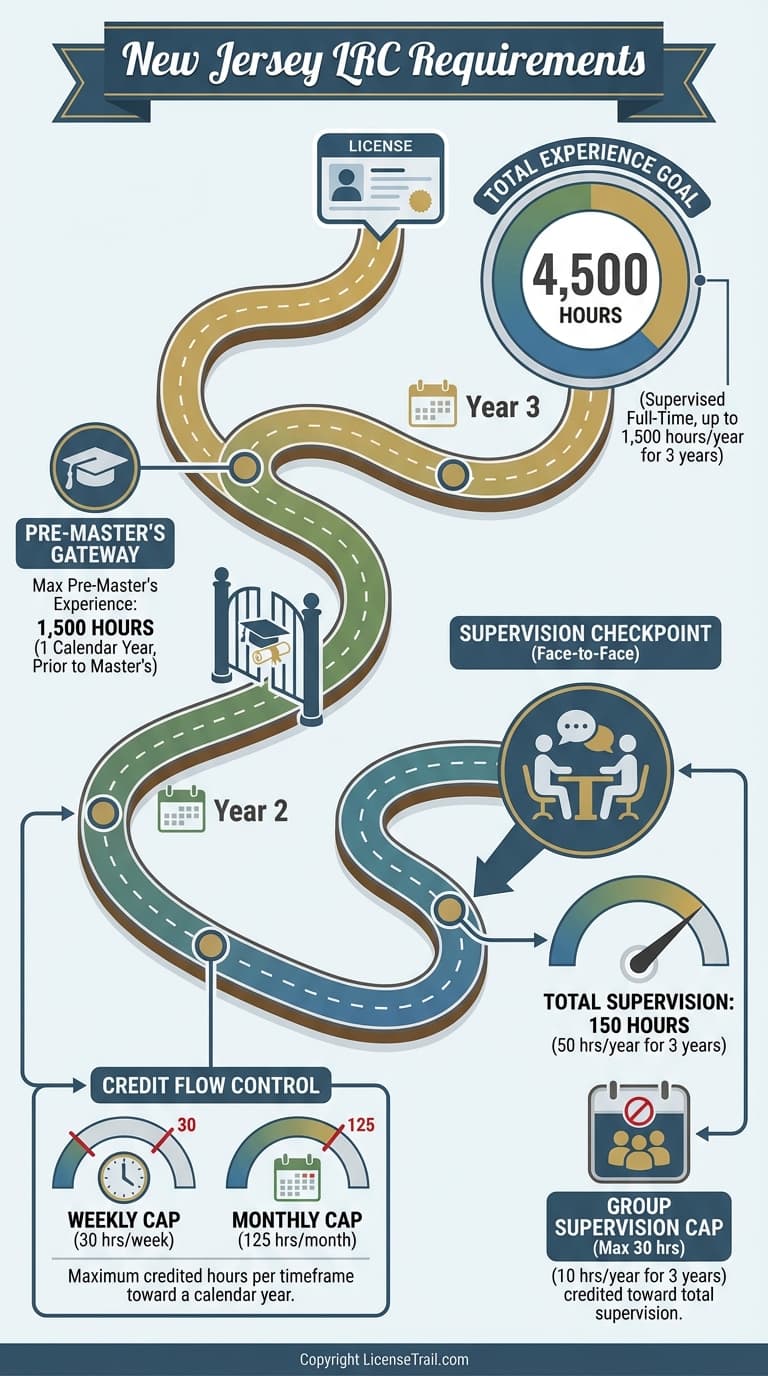
- Post-degree supervised experience: either 2 calendar years (up to 3,000 hrs) or 3 calendar years (up to 4,500 hrs); max 30 hrs/week and 125 hrs/month; ≤1 calendar year may be earned pre-master’s
- Supervision during experience: at least 50 hrs/year documented face-to-face (≈1 hr/week); ≤10 hrs/year may be group supervision
- Experience completion window: up to 6 years to finish required supervised experience
- Exam: pass the CRCC Certified Rehabilitation Counselor (CRC) examination (often requires committee permission)
- Application items: application + fee, official transcripts, supervisor certification for practicum/internship, and criminal history background check authorization
License Details
Procedures
Becoming a Licensed Rehabilitation Counselor (LRC) in New Jersey
In New Jersey, the title Licensed Rehabilitation Counselor is a protected license issued by the Professional Counselor Examiners Committee of the Board of Marriage and Family Therapy Examiners. The license is often abbreviated in practice as LRC, but in statute and regulation it is referred to as a “licensed rehabilitation counselor.” (pub.njleg.gov)
Licensure requirements are spelled out in the New Jersey Administrative Code, primarily N.J.A.C. 13:34‑20, 21, 23 and 24. What follows is a step‑by‑step breakdown, with the exact types of hours and the committee’s own terminology highlighted.
1. Basic Eligibility and Governing Body
You apply to the Professional Counselor Examiners Committee, which reviews your file and recommends you for licensure to the Board. (law.justia.com)
At minimum, an applicant for licensure as a rehabilitation counselor must: (law.cornell.edu)
- Be at least 18 years of age
- Be of good moral character
- Meet the education, supervised experience, and examination requirements described below
2. Educational Requirements: Master’s in Rehabilitation Counseling
The core educational rule is in N.J.A.C. 13:34‑21.2:
- You must hold “a master’s degree in a planned educational program designed to prepare students for the professional practice of rehabilitation counseling from a regionally accredited institution of higher education.” (law.cornell.edu)
- Your degree program must be accredited by the Council on Rehabilitation Education (CORE) or its successor at the time of graduation. (law.cornell.edu)
The regulations also require specific coursework (introduction to rehabilitation counseling, career development, etc.), but the key hour‑based educational requirements are the practicum and internship, discussed next.
3. Required Practicum and Internship Hours (Pre‑degree)
As part of the master’s program, N.J.A.C. 13:34‑21.2(a)3xii requires: (law.cornell.edu)
- Practicum
- “A minimum of 100 hours of supervised field‑based experience in an approved agency”
- Internship
- “600 hours [of supervised field‑based experience] for the internship.”
- During both practicum and internship, students must attend weekly group and/or individual supervision.
So at the educational stage you must complete at least 700 hours of supervised, field‑based experience (100 + 600), under supervision and in approved settings.
Important: These practicum/internship hours are primarily educational hours. Under certain conditions, some of these hours may later be counted toward your supervised experience requirement (see Section 4), but they cannot be double‑counted both as “educational requirements” and as “experience” for licensure. (law.cornell.edu)
4. Post‑degree Supervised Rehabilitation Counseling Experience
After (and partly during) your degree, you must complete supervised rehabilitation counseling experience under N.J.A.C. 13:34‑21.3. The code gives you two pathways: (law.cornell.edu)
4.1 The Committee’s Official Language
A “rehabilitation counseling experience” is defined as:
- “the rendering of rehabilitation counseling services while under the supervision of a qualified supervisor.” (law.cornell.edu)
The Committee uses “calendar years of supervised rehabilitation counseling experience”, not a simple flat hour count, but “one calendar year” is precisely defined, which effectively converts years into hours.
4.2 What “One Calendar Year” Means (Hours)
For rehabilitation counselors, N.J.A.C. 13:34‑20.2 defines “one calendar year” as: (law.cornell.edu)
“a maximum of 1,500 hours of supervised counseling experience over a period of 52 weeks, which is considered full‑time, or no less than 750 hours of supervised counseling experience in each of two 52‑week periods for a total of 1,500 hours of supervised counseling experience, which is considered part‑time. No more than 30 hours of supervised counseling experience shall be obtained in any one week. No more than 125 hours of supervised counseling experience shall be earned in any one month.”
Applied to rehabilitation counseling:
- 1 calendar year = up to 1,500 hours of supervised rehabilitation counseling experience
- Experience must respect caps of 30 hours/week and 125 hours/month
4.3 Pathway A – Three Calendar Years of Supervised Experience
Under 13:34‑21.3(a)1, one option is: (law.cornell.edu)
- “Three calendar years of supervised rehabilitation counseling experience in a rehabilitation counseling setting, only one calendar year of which may be obtained prior to the granting of the master’s degree.”
- Practicum/internship hours may be counted toward a portion of this supervised counseling experience only if those courses are not also used to satisfy the educational requirements of 13:34‑21.2.
Translating this using the definition of one calendar year:
- Up to 3 × 1,500 = 4,500 hours of supervised rehabilitation counseling experience
- Minimum pattern, if part‑time, is 3 × 1,500 = 4,500 hours spread over three 52‑week years (at least 750 hours in each 52‑week block)
- No more than one calendar year (i.e., up to 1,500 hours) may be earned before the master’s degree is granted.
4.4 Pathway B – Two Calendar Years of Supervised Experience
Under 13:34‑21.3(a)2, the alternative is: (law.cornell.edu)
- “Two calendar years of supervised rehabilitation counseling experience in a rehabilitation counseling setting.”
- Again, some graduate‑level practicum or internship hours can be counted toward this requirement, provided those same courses are not used for the educational requirement.
- No more than one calendar year of supervised professional counseling experience may be obtained prior to the granting of the master’s degree.
Using the “one calendar year” definition:
- Up to 2 × 1,500 = 3,000 hours of supervised rehabilitation counseling experience
- For a part‑time pattern, each calendar year still corresponds to 1,500 hours (minimum 750 hours in each of two 52‑week periods)
4.5 Direct vs. Supervised Hours
New Jersey does not split these hours into separate numeric categories such as “direct client contact hours” vs. “indirect hours.” Instead, the board’s language is:
- “rehabilitation counseling experience” = the rendering of rehabilitation counseling services while under supervision (law.cornell.edu)
- “supervised rehabilitation counseling experience” = rehabilitation counseling experience performed under a “qualified supervisor” within the definitions above (law.cornell.edu)
There is a separate minimum for supervision meetings (see Section 5), but the regulations do not require a specific number of “direct client” hours within the 1,500‑hour year. The entire 1,500‑hour year is treated as supervised rehabilitation counseling experience, subject to supervision and setting requirements.
4.6 Time Limit to Complete Experience
Under 13:34‑21.3(b), you have: (law.cornell.edu)
- Up to six years to complete the required supervised rehabilitation counseling experience.
5. Supervision Requirements and Qualified Supervisor Standards
The regulations for rehabilitation counselors include detailed definitions of supervision and supervisor qualifications. (law.cornell.edu)
5.1 Definition of “Supervision” and Required Supervision Hours
For rehabilitation counseling, “supervision” or “supervised” is defined in N.J.A.C. 13:34‑20.2 as: (law.cornell.edu)
Weekly interaction with a qualified supervisor who monitors the supervisee’s performance and provides weekly, documented face‑to‑face consultation, guidance and instruction, including “at least 50 hours of face‑to‑face supervision per one calendar year, at the rate of one hour per week, of which not more than 10 hours may be group supervision.”
This means:
- Per calendar year of supervised experience:
- Minimum 50 hours of documented, face‑to‑face supervision
- About 1 hour/week, with at most 10 of those hours in group supervision
Therefore, depending on your pathway:
- Three‑year pathway: at least 150 hours of face‑to‑face supervision (3 × 50)
- Two‑year pathway: at least 100 hours of face‑to‑face supervision (2 × 50)
These supervision hours are in addition to the supervised experience hours; they are not a separate “experience category” but a required part of how that experience is overseen.
5.2 “Qualified Supervisor” – Who Can Supervise You
For rehabilitation counselors, a “qualified supervisor” is defined in 13:34‑20.2 and must also meet additional standards in 13:34‑23.1: (law.cornell.edu)
Key points:
- Holds a clinical license to provide mental health counseling services in the state where services are provided.
- Has held that clinical license long enough to accumulate 3,000 hours of work experience subsequent to holding the clinical license, obtained over at least two years but not more than six years. (law.cornell.edu)
- Holds an approved clinical supervisor credential from the Center for Credentialing and Education of the NBCC (or an equivalent supervisor credential recognized by the supervisor’s own professional licensing board). (law.cornell.edu)
- Must create a written supervision plan, have it approved by the Committee, provide ongoing supervisory activities (co‑counseling, observation, case review, feedback, etc.), and document hours and dates of supervision, types of cases, and proficiency ratings. (law.cornell.edu)
- May supervise no more than six mental health counselors at any one time. (law.cornell.edu)
6. Examination Requirement: Certified Rehabilitation Counselor (CRC) Exam
In addition to education and supervised experience, you must satisfy the examination requirement in N.J.A.C. 13:34‑21.4: (law.cornell.edu)
- You must “successfully complete the Certified Rehabilitation Counselor Examination administered by the Commission on Rehabilitation Counselor Certification (CRCC), or its successor.”
- Typically, you may sit for the CRC only after the Committee has reviewed and approved your coursework and has provided written permission—unless you:
- Took the exam as part of your graduate program, or
- Took it in another state as part of that state’s licensing requirements.
Passing the CRC exam is therefore a mandatory condition for LRC licensure in New Jersey.
7. Application Package and Background Check
Under 13:34‑21.2(a), an applicant for licensure as a rehabilitation counselor must submit to the Committee: (law.cornell.edu)
- Completed application form with educational and experiential information
- Application fee (as specified in the fee schedule at N.J.A.C. 13:34‑26.1)
- Official transcripts documenting the required master’s program in rehabilitation counseling
- Supervisor’s certification verifying you met supervision requirements for practicum and internship
- Certification and Authorization Form for a Criminal History Background Check
The Committee then reviews your file and, if satisfied that you meet education, experience and examination requirements, recommends licensure to the Board. (pub.njleg.gov)
8. Scope of Practice Once Licensed
The scope of practice for a New Jersey rehabilitation counselor is defined at N.J.A.C. 13:34‑20.3, which states that the practice includes, but is not limited to: (law.cornell.edu)
- Rehabilitation counseling interventions
- Clinical assessment and evaluation of persons with disabilities
- Program evaluation
- Rehabilitation counseling services as defined in 13:34‑20.2
And, under statute, a “licensed rehabilitation counselor” is a person who holds a current, valid license issued under this framework; no one may hold themselves out as a licensed rehabilitation counselor or engage in the practice of rehabilitation counseling under that title without such licensure. (pub.njleg.gov)
9. Continuing Education (After You Are Licensed)
For completeness: once licensed, you must meet continuing education requirements for license renewal (40 contact hours per biennial period, with specified ethics and social/cultural competence content). However, a rehabilitation counselor is “not required to obtain continuing education contact hours” during the period of initial licensure before the first biennial renewal; CE applies to subsequent renewals. (law.cornell.edu)
Summary of Hour‑Based Requirements, Using the Board’s Own Framework
- Educational field experience:
- 100 hours supervised practicum
- 600 hours supervised internship
- Post‑degree supervised rehabilitation counseling experience (choose one path):
- Three calendar years, defined as up to 4,500 hours of supervised experience (3 × 1,500) with at least 50 hours/year of face‑to‑face supervision (total at least 150 hours of supervision); only one calendar year may be pre‑master’s.
- OR Two calendar years, defined as up to 3,000 hours of supervised experience (2 × 1,500) with at least 50 hours/year of face‑to‑face supervision (total at least 100 hours of supervision); no more than one calendar year may be pre‑master’s.
- Examination:
- Pass the Certified Rehabilitation Counselor (CRC) Exam administered by CRCC.
All of these requirements must be met under the definitions of “one calendar year,” “rehabilitation counseling experience,” “supervision,” and “qualified supervisor” adopted by the New Jersey Professional Counselor Examiners Committee in N.J.A.C. 13:34‑20, 21 and 23.
Track your LRC hours with confidence
License Trail checks your direct, indirect, and supervision hours against New-jersey LRC requirements continuously and flags mismatches before you submit.
 Start Tracking for Free
No credit card required · Free plan available
Related Licenses
Is your spreadsheet hiding New-jersey LRC risks?
Stop guessing if your categories match New Jersey Professional Counselor Examiners Committee requirements. License Trail checks your direct, indirect, and supervision hours continuously and flags mismatches before you submit.
Import or log
Bring your spreadsheet or start fresh
Upload your existing tracking spreadsheet and we'll map every hour into the right New Jersey Professional Counselor Examiners Committee categories automatically.
Verify against New-jersey
Catch mismatches before the board does
License Trail checks your direct, indirect, and supervision hours against New-jersey LRC requirements continuously.
Export board-ready
One-click clean reports
Generate professional, board-ready reports for supervision meetings and New Jersey Professional Counselor Examiners Committee submissions in seconds.
No credit card required · Free plan available