
New-jersey TP-UNSUP Requirements: Hours, Exams & Step-by-Step Guide
Stop guessing if your categories match New-jersey requirements. License Trail checks your direct, indirect, and supervision hours against TP-UNSUP requirements continuously and flags mismatches before you submit.
No credit card required · Free plan available
Quick Requirements Overview
- Permit scope/duration: Temporary permit for unsupervised (independent) practice in NJ for up to 1 year while licensure is finalized.
- Core eligibility: Must hold an out-of-state psychologist license in good standing with substantially similar requirements and meet all NJ licensure requirements except the NJ jurisprudence online exam (incl. acceptable doctorate + EPPP).
- Experience for NJ licensure: 2 years / 3,500 hours supervised experience total (1,750 hrs/year).
- Per-year hour breakdown: 1,000 client-contact hrs + 200 supervision hrs (≥ 100 individual face-to-face; remainder individual/group) + 550 other professional activities hrs.
- Additional TP‑UNSUP requirement: 2 years of active postdoctoral applied practice within the last 4 years before applying.
- Application/documentation: Must file full NJ licensure application, submit written request for TP‑UNSUP, and provide a written NJ practice plan (caseload, affiliations, billing).
- Practice limits while permitted: Max 20 client/group-contact hrs per week; may set/collect fees directly; no custody/parenting-time or TPR evaluations.
- Jurisprudence deadline/renewal: Must complete NJ jurisprudence exam within 90 days of permit issuance; extension possible for good cause with request/fee ≥30 days before expiration.
License Details
Procedures
New Jersey offers a one‑year unsupervised temporary permit (commonly referred to as “TP‑UNSUP”) for psychologists who are essentially fully qualified for licensure in the state and are only finishing the jurisprudence requirement. This permit allows independent practice for up to one year while the licensing process is completed.
Below is a structured explanation of:
- What the TP‑UNSUP is
- Exactly who qualifies
- The specific supervised‑experience hour requirements tied to New Jersey licensure
- What you can and cannot do while holding this permit
1. What the one‑year unsupervised temporary permit (TP‑UNSUP) is
Under N.J.A.C. 13:42‑3.1, the Board of Psychological Examiners may issue a “temporary permit for the unsupervised practice of psychology for a period not to exceed one year” to qualifying psychologists. (regulations.justia.com)
Key points:
- It is a temporary New Jersey authorization to practice independently.
- It is available only to psychologists who already hold a license in another state with substantially similar requirements and who otherwise meet all New Jersey licensure requirements except the jurisprudence online examination. (regulations.justia.com)
- It is intended as a bridge while you complete the New Jersey jurisprudence exam and the Board finishes the licensing process.
2. Core eligibility criteria for TP‑UNSUP
Under N.J.A.C. 13:42‑3.1(a), the Board issues the one‑year unsupervised permit only to a psychologist who meets all of the following: (regulations.justia.com)
-
Current out‑of‑state license
- You must hold a license in good standing as a psychologist in another state whose licensure requirements are “substantially similar” to New Jersey’s.
-
Meets New Jersey’s substantive licensure requirements
- You must otherwise qualify for New Jersey licensure under the Practicing Psychology Licensing Act (N.J.S.A. 45:14B‑1 et seq.).
- In practice, this means you must have:
- An acceptable doctoral degree, and
- The required two years of supervised professional experience (explained in detail in Section 3), and
- A passing score on the EPPP (written national examination).
-
Good professional standing
- You must not have engaged in conduct that would justify denying a permit under New Jersey’s Uniform Enforcement Act, and
- You must have no disciplinary actions against any psychology license you hold in another state.
-
Only the jurisprudence exam outstanding
- You must meet all requirements of New Jersey law other than completing the jurisprudence online examination in New Jersey. (regulations.justia.com)
-
Recent postdoctoral practice
- You must have at least two years of active post‑doctoral experience in the practice of applied psychology within the four years immediately preceding application. (regulations.justia.com)
- The regulation does not express this in hours; it is framed as two years of active post‑doctoral experience.
-
Practice plan in New Jersey
- You must submit a specific written plan describing your intended practice during the permit year, including:
- Number and types of cases you will assume
- Any affiliation or association with other mental health providers in New Jersey
- Whether you will bill clients directly or through another entity (e.g., employer). (regulations.justia.com)
- You must submit a specific written plan describing your intended practice during the permit year, including:
-
Licensure application filed
- You must have filed a full application for licensure with the Board.
In addition, N.J.A.C. 13:42‑3.6 requires that an application for licensure and all supporting documents (except the two‑year supervised‑experience documentation, if still in process) be on file before a temporary permit (unsupervised or supervised) is issued. (regulations.justia.com)
3. Required supervised‑experience hours for New Jersey licensure
Even though the TP‑UNSUP itself is not an “hours‑gathering” permit, you must already satisfy New Jersey’s supervised‑experience requirement (or its equivalent as accepted by the Board) to qualify for TP‑UNSUP.
3.1 Total amount of supervised experience
Under N.J.A.C. 13:42‑2.1 and 13:42‑4.1, an applicant must document two years of full‑time or full‑time‑equivalent supervised experience in the practice of psychology. (law.cornell.edu)
- Two years of supervised experience = a minimum of 3,500 hours.
- This is calculated as 1,750 hours per year of full‑time supervised experience.
3.2 Yearly breakdown of the 1,750 hours
N.J.A.C. 13:42‑4.1(b) defines the composition of one year (1,750 hours) of supervised experience as follows: (regulations.justia.com)
For each qualifying year you must have at least:
-
1,000 client contact hours
- Direct provision of psychological services to clients (individuals, families, groups).
- Client contact is capped by another rule (see below) at no more than 20 client or group contact hours per week during permit status. (regulations.justia.com)
-
200 hours of supervision
- At least 100 hours must be individual face‑to‑face supervision with your supervisor.
- Up to 100 hours may be in group or individual supervision.
- The required ratio is one hour of supervision for every five hours of client contact per week. (regulations.justia.com)
-
550 hours of “other work‑related activities”
- Activities such as:
- Recordkeeping and documentation
- Consultations with other providers
- Report writing and related administrative/clinical tasks. (regulations.justia.com)
- Activities such as:
Over the minimum two years, this works out to at least:
- 2,000 client‑contact hours
- 400 hours of supervision (≥200 individual, up to 200 group or additional individual)
- 1,100 hours of other work‑related activities
for a total of at least 3,500 hours of supervised professional experience.
3.3 When those hours can be earned
Recent statutory changes (P.L. 2020, c.134) allow the two years of supervised experience to be earned before or after the doctoral degree, provided they otherwise meet the Board’s criteria. (law.cornell.edu)
Many applicants now combine qualifying pre‑doctoral practica/internship hours with post‑doctoral supervised work, as long as the total structure matches the requirements above.
4. Additional experience requirement specific to TP‑UNSUP
The supervised‑experience hours above are the baseline for licensure.
For the one‑year unsupervised permit, the Board imposes an extra requirement:
- You must have had at least two years of active post‑doctoral experience in the practice of applied psychology within the four years immediately preceding your application. (regulations.justia.com)
This is on top of meeting the supervised‑experience standard and is framed as “active post‑doctoral experience,” not as a new set of defined hours. The Board is looking for recent, real‑world practice at the post‑doctoral level before allowing independent practice under a temporary New Jersey permit.
5. Application process and documentation
In practice, becoming licensed in New Jersey via TP‑UNSUP typically follows this sequence:
-
File a full application for New Jersey psychologist licensure
- Application form and fee
- Official transcripts and dissertation abstract
- References/good‑moral‑character certificates
- Documentation of two years (3,500 hours) of supervised experience as defined in N.J.A.C. 13:42‑4.1. (law.cornell.edu)
-
Demonstrate out‑of‑state licensure
- Verification of your current psychologist license in another state in good standing, with substantially similar requirements. (regulations.justia.com)
-
Document EPPP passage
- The Board typically requires proof that you have passed the Examination for Professional Practice in Psychology (EPPP) as part of satisfying “all requirements other than the jurisprudence online examination.” (law.cornell.edu)
-
Demonstrate recent post‑doctoral experience
- Evidence that you have at least two years of active post‑doctoral practice in applied psychology within the last four years. (regulations.justia.com)
-
Submit a written request for TP‑UNSUP
- Under N.J.A.C. 13:42‑3.6(b), you must formally request in writing the issuance of a one‑year unsupervised temporary permit to practice while you complete the jurisprudence exam. (regulations.justia.com)
-
Provide a specific written practice plan
- As required by N.J.A.C. 13:42‑3.1(a)7, you must detail:
- Types and number of cases
- Affiliations with any New Jersey mental‑health entities
- Billing arrangements (direct billing vs. employer entity). (regulations.justia.com)
- As required by N.J.A.C. 13:42‑3.1(a)7, you must detail:
Once the Board approves your application and practice plan, it issues the one‑year unsupervised temporary permit (TP‑UNSUP).
6. Practice rules and limits while on a TP‑UNSUP
The New Jersey Administrative Code sets out specific rules for all temporary permit holders, including those with a one‑year unsupervised permit.
6.1 Weekly client‑contact cap
- Under N.J.A.C. 13:42‑3.6(f), both one‑year unsupervised and three‑year supervised permit holders must limit client contact to no more than 20 client or group‑contact hours per week. (regulations.justia.com)
This cap is also why the supervised‑experience standard is written around 1,000 client contact hours per year; at 20 hours per week, that equates to approximately 50 weeks of work.
6.2 Fees and compensation
- Unsupervised permit holders may set and receive professional fees directly.
- Supervised permit holders may not bill directly and can only be compensated through the supervisor or employing entity. (regulations.justia.com)
This is a key distinction: TP‑UNSUP allows independent billing; the three‑year supervised permit (TP‑SUP) does not.
6.3 Advertising and title use
Under N.J.A.C. 13:42‑3.6(j): (regulations.justia.com)
- Permit holders may not advertise generally.
- A one‑year unsupervised permit holder may identify the location of their practice solely by name and address.
- You may indicate your academic degree (e.g., Ph.D., Psy.D.).
- You may not use the words “psychology,” “psychologist,” or derivatives in a way reserved for fully licensed psychologists until you are actually licensed.
You must also include your permit number on any printed representations of practice. (regulations.justia.com)
6.4 Mandatory written disclosure to clients
Before treatment begins, a one‑year unsupervised permit holder must obtain a written disclosure form signed by the client, confirming that: (regulations.justia.com)
- Services are being rendered by a permit holder who is not yet a licensed psychologist in New Jersey; and
- Third‑party payors may not reimburse for services provided by a person not licensed by the Board.
This signed disclosure must be kept in the client’s record.
6.5 Prohibited evaluations
Both one‑year unsupervised and three‑year supervised temporary permit holders are prohibited from performing:
- Custody/parenting‑time evaluations
- Termination‑of‑parental‑rights evaluations (regulations.justia.com)
These evaluations are reserved for fully licensed psychologists in New Jersey.
7. Jurisprudence exam deadlines, permit duration, and extensions
7.1 Jurisprudence exam deadline
Under N.J.A.C. 13:42‑3.1(b): (regulations.justia.com)
- A TP‑UNSUP holder must complete the online jurisprudence examination within 90 days of the permit’s issuance.
- Failure to meet this deadline can result in revocation of the permit, after notice.
The permit holder must also complete the entire examination process (i.e., any remaining required exams) before the one‑year permit expires. (regulations.justia.com)
7.2 Permit duration and possible extension
- The baseline duration is up to one year from issuance. (regulations.justia.com)
- Under N.J.A.C. 13:42‑3.4, the Board may extend a temporary permit for good cause, upon written request:
- The request and fee must be submitted no later than 30 days before the permit’s expiration.
- The Board may require:
- An in‑person appearance to review your caseload,
- Changes in caseload, supervisory arrangements, or other conditions,
- Proof that continuing the permit with conditions protects the public welfare. (regulations.justia.com)
8. Putting the hour requirements in context for TP‑UNSUP
To summarize the “hours” aspect in the way you requested:
-
For New Jersey psychologist licensure (which you must essentially satisfy to qualify for TP‑UNSUP):
- Total supervised experience:
- 3,500 hours over two years of full‑time or equivalent supervised practice.
- Per year (1,750 hours):
- 1,000 hours of client contact;
- 200 hours of supervision (≥100 individual face‑to‑face, remainder individual or group);
- 550 hours of other work‑related activities (documentation, consultation, report writing, etc.). (regulations.justia.com)
- Total supervised experience:
-
For the TP‑UNSUP one‑year unsupervised permit itself:
- No new separate numeric hour minimum is specified for the permit.
- Instead, you must:
- Already meet the two‑year supervised‑experience standard described above (or be deemed substantially equivalent); and
- Have two years of active post‑doctoral applied practice within the last four years; and
- Abide by the 20‑hours‑per‑week cap on client contact during the permit term. (regulations.justia.com)
In other words, the Board’s defined hour breakdown (client contact, supervision, other activities) is tied to licensure eligibility, and the TP‑UNSUP is a temporary independent‑practice authorization granted to applicants who have already met those structured hour requirements and all other criteria except the jurisprudence exam.
Track your TP-UNSUP hours with confidence
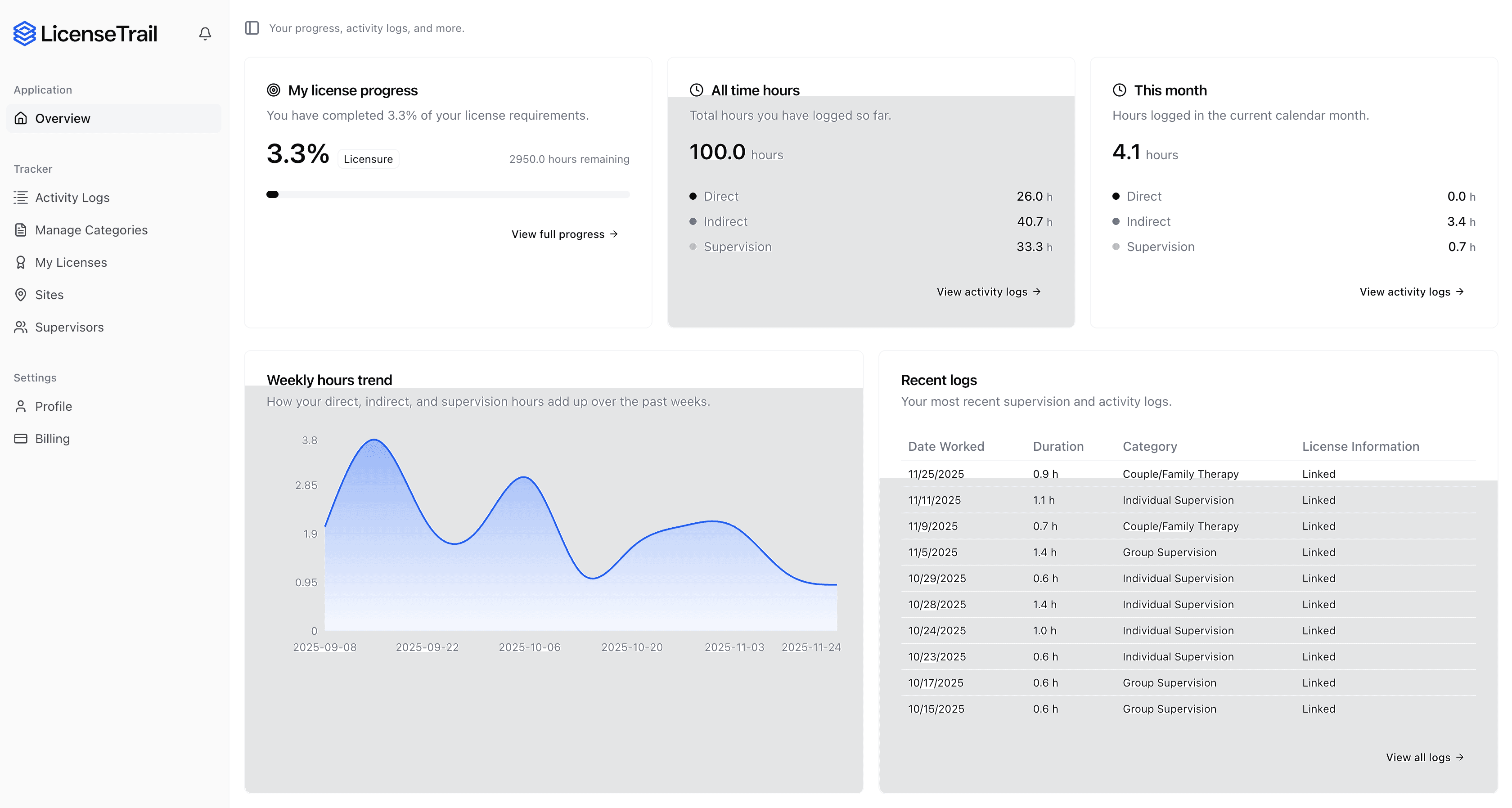
License Trail checks your direct, indirect, and supervision hours against New-jersey TP-UNSUP requirements continuously and flags mismatches before you submit.
 Start Tracking for Free
No credit card required · Free plan available
Related Licenses
Is your spreadsheet hiding New-jersey TP-UNSUP risks?
Stop guessing if your categories match New Jersey Board of Psychological Examiners requirements. License Trail checks your direct, indirect, and supervision hours continuously and flags mismatches before you submit.
Import or log
Bring your spreadsheet or start fresh
Upload your existing tracking spreadsheet and we'll map every hour into the right New Jersey Board of Psychological Examiners categories automatically.
Verify against New-jersey
Catch mismatches before the board does
License Trail checks your direct, indirect, and supervision hours against New-jersey TP-UNSUP requirements continuously.
Export board-ready
One-click clean reports
Generate professional, board-ready reports for supervision meetings and New Jersey Board of Psychological Examiners submissions in seconds.
No credit card required · Free plan available