
New-jersey TP-SUP Requirements: Hours, Exams & Step-by-Step Guide
Stop guessing if your categories match New-jersey requirements. License Trail checks your direct, indirect, and supervision hours against TP-SUP requirements continuously and flags mismatches before you submit.
No credit card required · Free plan available
Quick Requirements Overview
- Temporary permit (TP‑SUP) authorizes supervised practice only for up to 3 years; no independent practice; must have NJ licensure application on file (minus supervised-experience requirement) and submit written request + proposed supervisor(s) + permit fee.
- Must complete licensure supervised experience: 3,500 hours total (2 years at 1,750 hrs/year full-time or equivalent).
- Each 1,750-hr year must include: 1,000 client contact hrs, 200 supervision hrs (≥ 100 individual face-to-face; remainder individual/group), 550 other work-related hrs.
- Client contact cap: ≤ 20 client/group contact hrs per week.
- Supervision structure: 1 hr supervision per 5 hrs weekly client contact.
- Supervisor eligibility: psychologist licensed ≥ 2 years (NJ; or out-of-state if eligible for NJ licensure); Board approval required; supervisor may oversee ≤ 3 permit holders at once (unless Board allows more).
- Practice/billing limits: see only clients assigned by supervisor; cannot set/receive fees directly (paid via supervisor/employer); include permit number on printed representations; restricted advertising/title use; prohibited from custody/parenting-time and termination-of-parental-rights evaluations.
- Must pass EPPP + NJ jurisprudence online exam and complete required hours before permit expires; extension possible for good cause.
License Details
Procedures
New Jersey’s “TP‑SUP” status refers to the Board of Psychological Examiners’ three‑year supervised temporary permit. This permit allows you to practice psychology under supervision while you complete the supervised‑experience and examination requirements for full licensure.
Below is a step‑by‑step explanation of what the Board requires, with emphasis on the supervised hours and the Board’s own terminology.
1. What the three‑year supervised temporary permit is
Under N.J.A.C. 13:42‑3.2, the Board “shall issue a numbered temporary permit for the supervised practice of psychology for a period not to exceed three years” to a qualified individual.
In practice:
- This is the supervised temporary permit commonly coded as TP‑SUP.
- It is for applicants who meet all New Jersey licensure requirements except:
- The required number of supervised experience hours, and/or
- Passing the written examination (EPPP) and the New Jersey jurisprudence online examination.
- The permit is specifically for the “supervised practice of psychology” and does not authorize independent practice.
By rule, if you are applying for licensure and have not yet completed the Board’s required supervised experience, you are required to obtain this three‑year supervised permit.
2. Baseline licensure application that must be on file
Before the Board can issue a three‑year supervised permit, you must have a full licensure application on file.
2.1. Core application materials
N.J.A.C. 13:42‑2.1 requires that an “applicant for licensure shall file with the Board an application together with all supporting material.” Those supporting materials include:
- Official transcripts (meeting detailed doctoral‑program requirements in psychology or an allied field).
- Abstract of your doctoral dissertation as published in Dissertation Abstracts International.
- Two certificates of good moral character.
- Documentation of required additional graduate psychology credits as specified in N.J.A.C. 13:42‑2.1(e), (h).
The doctoral degree must be from a program that is: APA/CPA accredited, listed by ASPPB/National Register Joint Designation, or meets equivalent Board criteria in N.J.A.C. 13:42‑2.1(f).
2.2. Specific requirement for TP‑SUP applicants
N.J.A.C. 13:42‑3.6(a) adds that an applicant for a three‑year supervised temporary permit must have on file:
- An application for licensure with all supporting material required by N.J.A.C. 13:42‑2.1(a),
- Except the “two year supervised experience requirement” (because that is what you are going to earn under the permit).
You must then submit a written request asking the Board to issue a three‑year supervised temporary permit “for the purpose of meeting the supervised experience requirement” and/or to practice while you still need to pass the written and jurisprudence exams.
In practice, the Board also requires:
- The Application for Proposed Supervisors form, identifying each psychologist who will supervise you.
- Payment of the temporary permit fee (commonly listed as $110 plus $50 for each additional supervisor in Board‑based guidance).
3. Supervised‑experience hours required under TP‑SUP
The three‑year supervised permit itself does not have a separate “hours” requirement; instead it is the vehicle under which you complete the licensure supervised‑experience requirement set out in Subchapter 4.
3.1. Total supervised‑experience requirement
N.J.A.C. 13:42‑4.1(a) requires that an applicant “document the competent performance of at least two years of full‑time or full‑time‑equivalent supervised experience in the practice of psychology.”
The regulation then defines one year of full‑time supervised experience as a minimum of 1,750 hours.
This means the Board’s total minimum supervised‑experience requirement for licensure is:
- 2 years × 1,750 hours = 3,500 hours of supervised professional experience.
3.2. Per‑year breakdown: types of hours
N.J.A.C. 13:42‑4.1(b) specifies exactly how each 1,750‑hour year must be composed. For each “year” of supervised experience (1,750 hours), you must have at least:
-
1,000 client contact hours
- Defined in the rule as “client contact hours,” and they must comply with the weekly limit in N.J.A.C. 13:42‑3.6(f).
- These are direct clinical services: assessment, psychotherapy, counseling, consultation with or on behalf of identified clients.
-
200 hours of supervision
The regulation breaks this down as:
- 200 total hours of supervision per 1,750‑hour year.
- At least 100 hours must be individual face‑to‑face supervision.
- The remaining 100 hours may be individual or group supervision.
- Supervision ratio: one hour of supervision for each five hours of client contact per week.
-
550 hours in “other work‑related activities”
- The Board’s phrase is “other work‑related activities such as recordkeeping, consultations, report writing, etc.”
- This can include charting, treatment planning, case conferences, professional reading tied to specific cases, and related tasks.
Putting this together for the full 3,500‑hour requirement:
- 2,000 client contact hours (1,000 per year × 2 years)
- 400 hours of supervision (200 per year, including at least 200 hours of individual face‑to‑face supervision across the two years)
- 1,100 hours of other work‑related activities (550 per year × 2 years)
These hours can be spread across pre‑doctoral and post‑doctoral settings if they meet the regulatory conditions and supervision standards discussed below.
3.3. Pre‑doctoral vs. post‑doctoral hours (important recent change)
New Jersey law was amended by P.L. 2020, c.134. N.J.A.C. 13:42‑4.1(c)–(d) now state that for applicants applying after October 1, 2020:
- The two years (3,500 hours) of supervised experience may be completed prior to the individual’s receiving a doctoral degree, and
- Applicants with pending applications as of December 14, 2020 may update their applications to count qualifying pre‑doctoral experience toward the required two years.
In other words:
- The Board no longer insists that a fixed portion of the 3,500 hours must be post‑doctoral.
- However, if you still do not have the full 3,500 hours at the time you apply for licensure, you must complete them under a three‑year supervised temporary permit (TP‑SUP).
4. Limits on your practice while holding the three‑year supervised permit
Once the Board grants the three‑year supervised permit, several key practice limitations apply under N.J.A.C. 13:42‑3.6:
-
No practice before the permit is issued
- “An applicant … shall not provide psychological services until a permit has been issued by the Board.”
-
Client‑assignment limitation
- A supervised permit holder “shall see only those clients assigned … by the supervisor.”
-
No independent or unsupervised practice
- A supervised permit holder “shall not engage in unsupervised or independent practice.”
-
Weekly cap on direct client contact
- Both one‑year and three‑year permit holders must “limit client contact to no more than 20 client or group contact hours in any one week.”
- This cap applies directly to the “client contact hours” described in 13:42‑4.1(b)(1), and effectively prevents you from compressing 1,000 contact hours into a very short time.
-
Fee‑setting and payment
- A supervised permit holder may not set or receive professional fees directly from clients; you may “be compensated only through the supervisor or employing entity,” per N.J.A.C. 13:42‑3.6(e) and 13:42‑4.6.
-
Title and advertising restrictions
- You may not use the words “psychology,” “psychologist,” or derivatives in advertising before licensure.
- Permit holders may not advertise services at all, except that holders of a one‑year unsupervised permit may list name and address; that exception does not apply to the three‑year supervised permit.
-
Prohibited types of evaluations
- One‑year unsupervised and three‑year supervised permit holders are prohibited from performing custody/parenting‑time evaluations and termination of parental rights evaluations.
-
Identification of permit status
- You must include your permit number on any printed representations of practice.
5. Supervisor requirements and supervision structure
Because TP‑SUP status is entirely supervision‑dependent, the Board is very specific about who can supervise and how supervision must be conducted.
5.1. Who may supervise (Authorized supervisors)
Under N.J.A.C. 13:42‑4.2, supervision for licensure purposes must be rendered by:
- A psychologist licensed in New Jersey for at least two years, or
- For out‑of‑state experience, a psychologist licensed in that other state for at least two years who is eligible for licensure in New Jersey.
5.2. Supervisor responsibilities
N.J.A.C. 13:42‑4.4 sets out detailed “Responsibilities of supervisor”. Key points include:
- The supervisor must obtain prior Board approval and submit a letter stating that they agree to supervise the permit holder.
- A supervisor may supervise no more than three permit holders at one time, unless the Board allows more for good cause.
- Every six months (and at the end of supervision) the supervisor must document the supervised experience on a Board form, including:
- Dates of supervision,
- Nature of cases assigned,
- A proficiency rating for the permit holder.
- The supervisor must ensure the permit holder always has a current, valid permit and does not practice independently.
- Before client treatment begins, the supervisor must secure a written disclosure form, signed by the client, acknowledging that:
- Services are being provided by a permit holder who is not a licensed psychologist, and
- Third‑party payors may not reimburse services rendered by someone who is not licensed.
- The supervisor retains full professional responsibility for fees and billing and must provide appropriate working conditions, consultation, and training opportunities.
As a TP‑SUP holder, you are explicitly responsible for ensuring that your supervisor complies with these supervision requirements.
6. Exams and timing while on the three‑year supervised permit
N.J.A.C. 13:42‑3.2(c) requires that a three‑year supervised permit holder must:
- Obtain the required supervised experience, and
- Successfully complete:
- The national written examination (EPPP), and
- The jurisprudence online examination covering New Jersey laws and regulations,
before the permit expires.
If you are unable to complete these within three years, N.J.A.C. 13:42‑3.4 allows you to request a permit extension for good cause, with conditions the Board considers necessary to protect the public (e.g., reduced caseload, changes in supervision).
7. Practical summary of the supervised‑hour structure
From the perspective of someone holding or planning to hold a TP‑SUP three‑year supervised temporary permit in New Jersey, the state‑board‑defined hour requirements are:
-
Total requirement for full licensure:
- 3,500 hours of supervised professional experience in psychology, which must constitute two years of full‑time or full‑time‑equivalent supervised practice.
-
Composition of each “year” (1,750 hours) as defined in N.J.A.C. 13:42‑4.1(b):
- 1,000 client contact hours (direct service to clients, subject to the 20‑hours‑per‑week cap).
- 200 hours of supervision, of which:
- At least 100 hours must be individual face‑to‑face supervision,
- Up to 100 hours may be individual or group supervision,
- With an ongoing ratio of one hour of supervision for every five hours of weekly client contact.
- 550 hours in “other work‑related activities”, explicitly including recordkeeping, consultations, and report writing.
-
Across the full 3,500 hours, that translates to at least:
- 2,000 client contact hours,
- 400 hours of supervision,
- 1,100 hours of other work‑related activities,
all of which must be under Board‑authorized supervision and within the practice limits imposed on TP‑SUP permit holders.
These are the operative numbers and Board terms you would rely on when planning, documenting, and ultimately presenting your supervised experience for conversion of a TP‑SUP permit into full New Jersey psychologist licensure.
Track your TP-SUP hours with confidence
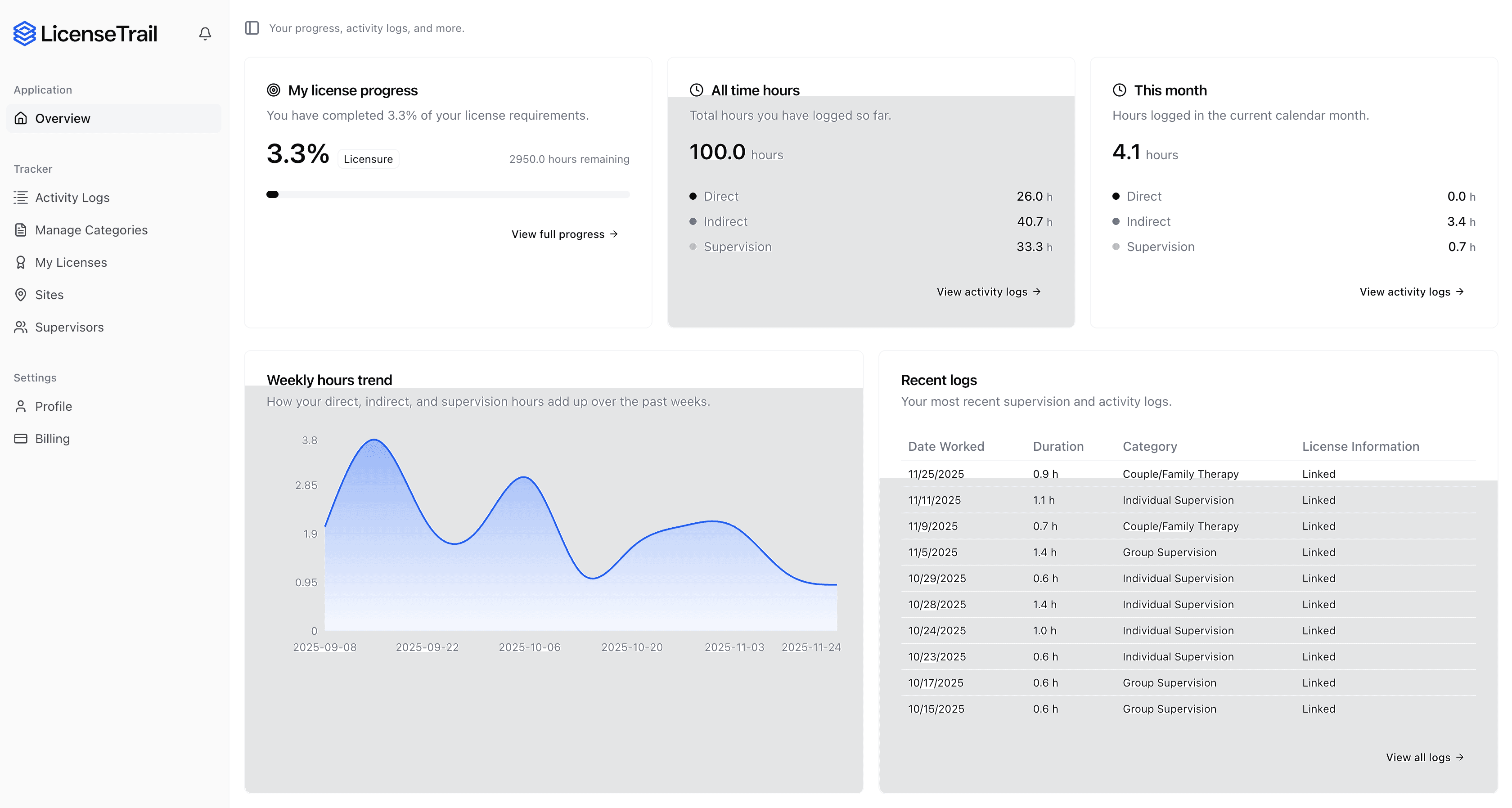
License Trail checks your direct, indirect, and supervision hours against New-jersey TP-SUP requirements continuously and flags mismatches before you submit.
 Start Tracking for Free
No credit card required · Free plan available
Related Licenses
Is your spreadsheet hiding New-jersey TP-SUP risks?
Stop guessing if your categories match New Jersey Board of Psychological Examiners requirements. License Trail checks your direct, indirect, and supervision hours continuously and flags mismatches before you submit.
Import or log
Bring your spreadsheet or start fresh
Upload your existing tracking spreadsheet and we'll map every hour into the right New Jersey Board of Psychological Examiners categories automatically.
Verify against New-jersey
Catch mismatches before the board does
License Trail checks your direct, indirect, and supervision hours against New-jersey TP-SUP requirements continuously.
Export board-ready
One-click clean reports
Generate professional, board-ready reports for supervision meetings and New Jersey Board of Psychological Examiners submissions in seconds.
No credit card required · Free plan available