
New-mexico LADAC Requirements: Hours, Exams & Step-by-Step Guide
Stop guessing if your categories match New-mexico requirements. License Trail checks your direct, indirect, and supervision hours against LADAC requirements continuously and flags mismatches before you submit.
No credit card required · Free plan available
Quick Requirements Overview
- Age/Ethics: Must be 21+ and sign Board Code of Ethics attestation.
- Exam: Pass NAADAC NCAC Level I (NCAC I).
- Education (degree): Associate, bachelor’s, master’s, or doctoral in counseling/counseling-related/substance-abuse-related field (other fields discretionary).
- Education (training hours): 276 clock hours total: 90 alcohol + 90 drug + 90 counseling + 6 ethics (for bachelor’s+, ethics must be within 2 years of application).
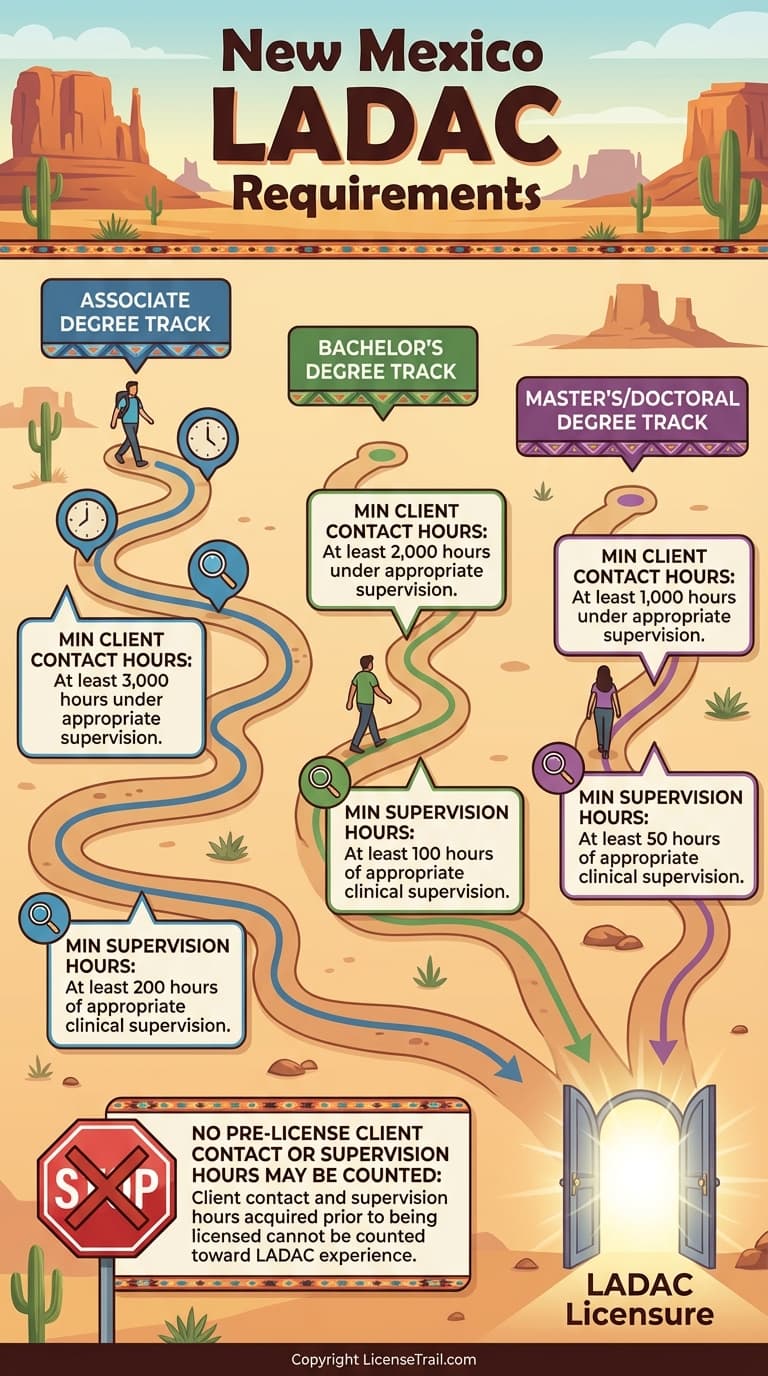
- Supervised experience (by degree): Assoc 3,000 client + 200 supervision (min 3 yrs); Bach 2,000 + 100 (min 2 yrs); Grad 1,000 + 50 (min 1 yr).
- Timing rule: No client-contact/supervision hours earned before being licensed (typically LSAA) count toward LADAC.
- Supervision/LSAA: While accruing hours, must practice under supervision at all times by an approved supervisor (e.g., LPCC/LMFT/LPAT/psychologist/psychiatrist/LADAC w/ 3 yrs post-licensure experience/psychiatric CNS/LISW/LCSW).
- Application docs: Application + sealed transcripts, verification of 276 hours, and supervisor verification of client-contact & supervision hours (Board forms/attachments).
License Details
Procedures
Becoming a Licensed Alcohol and Drug Abuse Counselor (LADAC) in New Mexico is governed by the New Mexico Counseling and Therapy Practice Board under Title 16, Chapter 27 of the New Mexico Administrative Code (NMAC). The LADAC is an independent license focused specifically on alcohol and drug abuse counseling.
Below is a structured, article‑style guide based directly on the current NMAC rules and Board materials as of mid‑2025.
1. Regulatory framework and role of LADAC
The LADAC credential is created and regulated in:
- 16.27.11 NMAC – Requirements for licensure with examination as an alcohol and drug abuse counselor (LADAC). (law.cornell.edu)
- 16.27.1 NMAC – Definitions, which defines the practice of alcohol and drug abuse counseling and clarifies what LADACs may do. (law.cornell.edu)
The rules describe the LADAC as an independent license (no supervision required once fully licensed) and define “practice of alcohol abuse or drug abuse counseling” as counseling under appropriate supervision that can include screening, assessment, treatment planning, counseling, crisis intervention, education, case management, referral, and related services specific to alcohol and drug abuse. (law.cornell.edu)
These same services are what your “client contact hours” must consist of during your supervised experience.
2. Basic eligibility for LADAC
Under 16.27.11.9 NMAC (Applicants for Licensure), an applicant for LADAC must: (law.cornell.edu)
-
Age
- Be at least 21 years of age.
-
Ethics attestation
- Sign a Board‑supplied statement that you have read the Code of Ethics and agree to be bound by it.
-
Examination
- Demonstrate professional competency by passing the National Certification Examination for Addiction Counselors, NCAC Level I (the NAADAC NCAC I exam).
-
Education and supervised experience, described in detail below.
3. Education and training hour requirements
The Board sets minimum degree level and specific clock‑hour training requirements for all LADAC applicants. This is spelled out in 16.27.11.9(D) NMAC. (law.cornell.edu)
3.1 Degree requirement
You must hold one of the following from an accredited institution:
- Associate degree in counseling, a counseling‑related field, or a substance‑abuse‑related field,
- Baccalaureate degree in counseling, a counseling‑related field, or a substance‑abuse‑related field, or
- Master’s or doctoral degree in counseling, a counseling‑related field, or a substance‑abuse‑related field.
The Board may approve degrees in other fields case‑by‑case, but this is expressly discretionary. (law.cornell.edu)
3.2 Required 276 “clock hours” of content‑specific education
Regardless of degree level, the same content totals are required. NMAC defines “qualifying education” as 276 clock hours, broken down as: (law.cornell.edu)
- 90 hours in alcohol abuse
- 90 hours in drug abuse
- 90 hours in counseling
- 6 hours specifically in alcohol and drug counseling ethics
The Board equates 1 semester credit hour = 15 clock hours of education, and these hours can be met through academic coursework, workshops, and trainings, so long as the content fits the required areas. (law.cornell.edu)
For bachelor’s and graduate‑level applicants, the rule further specifies that the 6 ethics hours must be completed within two years prior to submitting the LADAC application. (law.cornell.edu)
4. Supervised experience: types of hours and exact totals
The centerpiece of LADAC licensure is the combination of client‑contact experience and supervision hours. The Board’s exact phrasing is in 16.27.11.9(E) NMAC, which distinguishes between:
- “client contact hours under appropriate supervision of experience in the practice of alcohol and drug abuse counseling”, and
- additional “hours of appropriate supervision.” (law.cornell.edu)
These are two different categories of hours:
- Client contact hours = time spent directly providing alcohol and drug abuse counseling services (screening, assessment, counseling, crisis intervention, etc.) to clients.
- Supervision hours = time spent with your supervisor (or in approved supervisory activities) reviewing cases, receiving feedback, observation, etc. These are not counted as client contact.
4.1 Required hours by degree level
The total supervised experience required for LADAC is:
If you hold an associate degree
- Minimum time: 3 years
- Client contact hours: 3,000 client contact hours in the practice of alcohol and drug abuse counseling, under appropriate supervision
- Supervision hours: 200 hours of appropriate supervision (in addition to the 3,000 client‑contact hours) (law.cornell.edu)
In other words, the Board’s requirements for an associate‑level applicant are:
3,000 hours of client contact
plus 200 hours of supervision.
If you hold a baccalaureate degree
- Minimum time: 2 years
- Client contact hours: 2,000 client contact hours in alcohol and drug abuse counseling under appropriate supervision
- Supervision hours: 100 hours of appropriate supervision (law.cornell.edu)
So for a bachelor’s‑level applicant, the Board requires:
2,000 hours of client contact
plus 100 hours of supervision.
If you hold a master’s or doctoral degree
- Minimum time: 1 year
- Client contact hours: 1,000 client contact hours in alcohol and drug abuse counseling under appropriate supervision
- Supervision hours: 50 hours of appropriate supervision (law.cornell.edu)
For a master’s/doctoral applicant, the requirement is:
1,000 hours of client contact
plus 50 hours of supervision.
The Board explicitly uses the phrases “client contact hours” and “hours of appropriate supervision,” and joins them with “and”, which means the supervision hours are in addition to, not included within, the client‑contact totals.
4.2 When hours count (critical requirement)
Under 16.27.11.8(C) NMAC (Supervision), the Board states that “client contact and supervision hours acquired prior to being licensed will not be acceptable for licensure.” (law.cornell.edu)
In practice, this means:
- You must be under an appropriate Board‑recognized license while you accrue LADAC hours.
- For substance‑abuse counseling, that license is typically the Licensed Substance Abuse Associate (LSAA), discussed below.
- Hours earned before you hold LSAA (or another qualifying license under Board rules) cannot be counted toward the LADAC experience requirement.
5. The LSAA stage and supervision structure
Although your goal is LADAC, nearly all candidates proceed first through Licensed Substance Abuse Associate (LSAA) status in order to legally provide services and accrue the supervised experience hours.
5.1 LSAA supervision rules
Supervision for LSAA is governed by 16.27.13.8 NMAC. It states that supervision for a substance abuse associate must be provided by one of the following, who also has experience in alcohol and drug abuse counseling: (law.cornell.edu)
- LPCC (Licensed Professional Clinical Mental Health Counselor)
- LMFT
- LPAT
- Psychologist
- Psychiatrist
- LADAC with three years of alcohol and drug abuse experience acquired after licensure
- Clinical nurse specialist in psychiatry
- LISW or LCSW
Key LSAA supervision rules from 16.27.13.8: (law.cornell.edu)
- A “licensed substance abuse associate must practice under supervision at all times.”
- Even after you have completed all LADAC requirements, you must continue practicing under supervision until the Board actually issues your LADAC license.
This is the period during which you accumulate the client contact hours and supervision hours that later get documented for your LADAC application under 16.27.11.9(E). (law.cornell.edu)
6. What actually counts as “client contact” for LADAC hours
The NMAC’s definition of “practice of alcohol abuse or drug abuse counseling” at 16.27.1.7(S) NMAC describes the kinds of activities you perform during client‑contact hours. These include, specifically for alcohol and drug abuse: (law.cornell.edu)
- Screening and assessment
- Consultation
- Development of treatment plans
- Case management
- Counseling (individual, group, family, couples)
- Referral and appraisal
- Crisis intervention
- Education
- Reporting and record‑keeping
To be safely countable as client contact hours for LADAC purposes, the hours should:
- Involve direct service to individuals, couples, families, or groups;
- Be focused on alcohol or drug abuse issues;
- Occur under the supervision structure described for LSAA/LADAC.
Indirect activities (documentation, staff meetings, etc.) may be part of your job but are not typically credited as “client contact” unless they are integral to direct clinical work and your supervisor explicitly tracks them as such under Board‑accepted standards.
7. Application documentation and Board “verbiage”
When you are ready to apply for LADAC, 16.27.11.9(F) NMAC lists the required documentation: (law.cornell.edu)
- Completed application (as specified in 16.27.3.8 NMAC).
- Proof of education and experience, including:
- Official transcripts in sealed envelopes from each degree‑granting institution.
- Detailed documentation of your 276 clock hours of alcohol, drug, counseling, and ethics training (often submitted on the Board’s “Verification of Education and Training Hours (Attachment D)” form). (law.cornell.edu)
- A statement from each supervisor (on Board Attachment B) verifying:
- Your total client contact hours,
- Your supervision hours, and
- That your performance met “adequate counseling standards of alcohol and drug practice.” (law.cornell.edu)
- Ethics statement (again): the applicant signs that they have read and will follow the Code of Ethics.
- License verification, if you hold licenses in other jurisdictions.
The Board also uses specific phrases like “client contact hours under appropriate supervision” and “hours of appropriate supervision” in this documentation; supervisors must report hours using the same categories.
8. Fees and Board‑level logistics
The New Mexico Counseling and Therapy Practice Board’s fee schedule currently lists: (rld.nm.gov)
- Application fee (all licenses, including LADAC): $75 (non‑refundable)
- Initial LADAC licensure fee: $150
- Annual LADAC renewal fee: $150
The application is now submitted through the state’s online licensing portal, with supporting documents mailed or uploaded as the Board directs.
9. After licensure: supervision status and continuing practice
Once the Board issues your LADAC license:
- No supervision is required to practice; LADAC is explicitly an independent license under 16.27.11.8(A) NMAC. (law.cornell.edu)
- The Board “strongly recommends” that independently licensed counselors maintain ongoing consultation or peer‑review, especially when working with complex or co‑occurring disorders in integrated behavioral health settings.
Continuing education requirements (40 hours per year with specified ethics content) are set out in other parts of 16.27 NMAC and in Board guidance, and apply once you are licensed.
10. Condensed checklist of LADAC hour‑related requirements
To summarize the hours and their types, using the Board’s terminology:
-
Content‑specific education (all degrees)
- 276 clock hours total, consisting of:
- 90 hours – alcohol abuse
- 90 hours – drug abuse
- 90 hours – counseling
- 6 hours – alcohol and drug counseling ethics (for bachelor’s+ degree, obtained within 2 years before application). (law.cornell.edu)
- 276 clock hours total, consisting of:
-
Supervised experience, by degree:
-
Associate degree
- 3 years minimum,
- 3,000 client contact hours under appropriate supervision in alcohol and drug abuse counseling, and
- 200 hours of appropriate supervision (non‑client‑contact supervisory time). (law.cornell.edu)
-
Baccalaureate degree
- 2 years minimum,
- 2,000 client contact hours in alcohol and drug abuse counseling under appropriate supervision, and
- 100 hours of appropriate supervision. (law.cornell.edu)
-
Master’s or doctoral degree
- 1 year minimum,
- 1,000 client contact hours in alcohol and drug abuse counseling under appropriate supervision, and
- 50 hours of appropriate supervision. (law.cornell.edu)
-
-
Timing of hours
- No client contact or supervision hours accrued before you are licensed (typically as LSAA) may be counted: “client contact and supervision hours acquired prior to being licensed will not be acceptable for licensure.” (law.cornell.edu)
-
Supervision structure while accruing hours
- As an LSAA, you must practice under supervision at all times and your supervisor must be one of the license types listed in 16.27.13.8 NMAC (LPCC, LMFT, LPAT, psychologist, psychiatrist, experienced LADAC, psychiatric CNS, LISW/LCSW), all of whom must have experience in alcohol and drug abuse counseling. (law.cornell.edu)
These are the controlling, Board‑level requirements for LADAC in New Mexico and reflect the Board’s own categories and terminology for the hours (client contact vs. supervision) that must be documented.
Track your LADAC hours with confidence
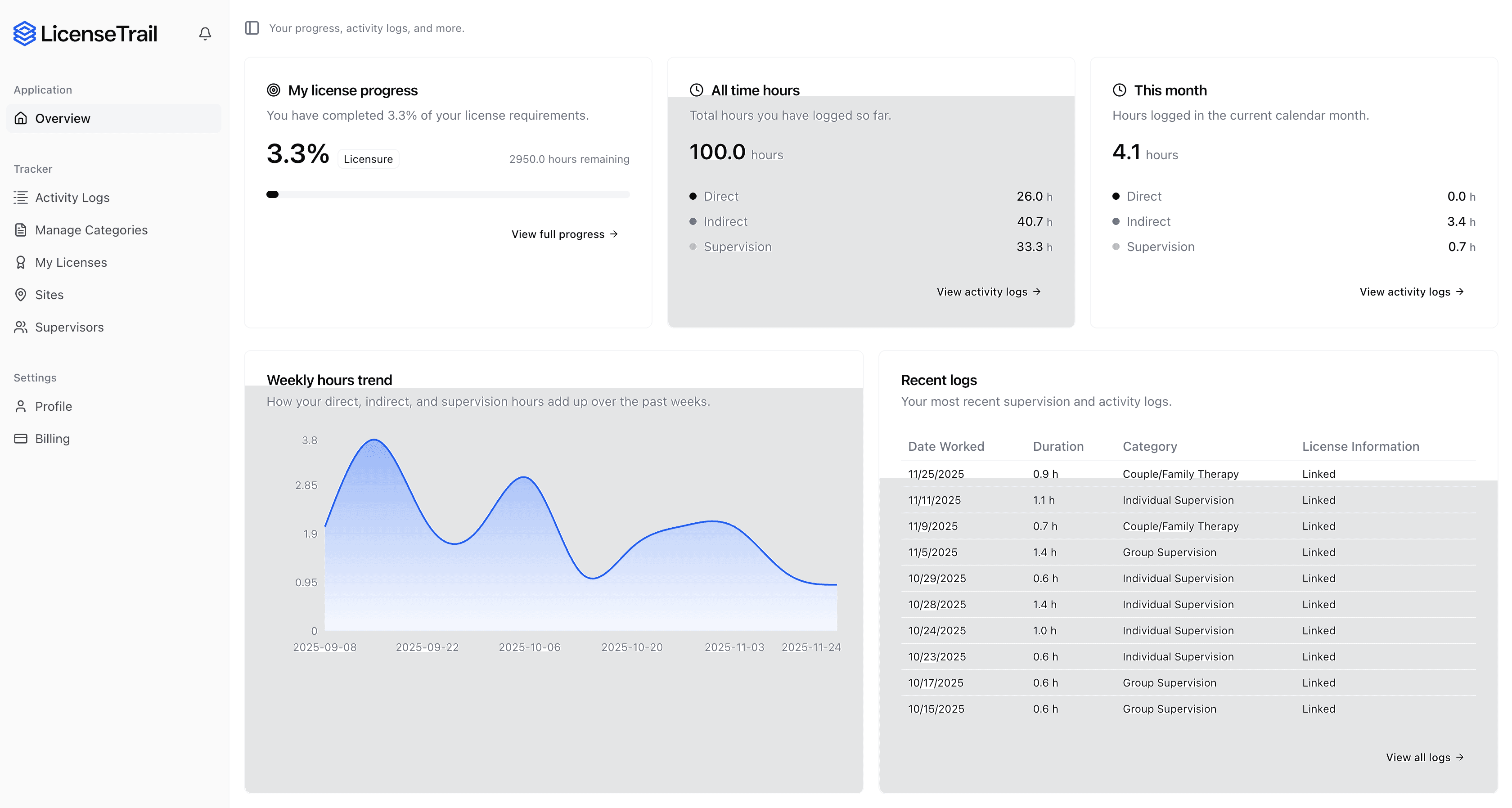
License Trail checks your direct, indirect, and supervision hours against New-mexico LADAC requirements continuously and flags mismatches before you submit.
 Start Tracking for Free
No credit card required · Free plan available
Is your spreadsheet hiding New-mexico LADAC risks?
Stop guessing if your categories match New Mexico Counseling and Therapy Practice Board requirements. License Trail checks your direct, indirect, and supervision hours continuously and flags mismatches before you submit.
Import or log
Bring your spreadsheet or start fresh
Upload your existing tracking spreadsheet and we'll map every hour into the right New Mexico Counseling and Therapy Practice Board categories automatically.
Verify against New-mexico
Catch mismatches before the board does
License Trail checks your direct, indirect, and supervision hours against New-mexico LADAC requirements continuously.
Export board-ready
One-click clean reports
Generate professional, board-ready reports for supervision meetings and New Mexico Counseling and Therapy Practice Board submissions in seconds.
No credit card required · Free plan available