
New-mexico LPCC Requirements: Hours, Exams & Step-by-Step Guide
Stop guessing if your categories match New-mexico requirements. License Trail checks your direct, indirect, and supervision hours against LPCC requirements continuously and flags mismatches before you submit.
No credit card required · Free plan available
Quick Requirements Overview
- Regulator: NM Regulation & Licensing Dept., Counseling and Therapy Practice Board (NMAC 16.27.4)
- Pathway: LMHC (supervised practice) → LPCC (independent)
- Education: Master’s/Doctorate in counseling/related field + 48 graduate semester hours (72 quarter) in clinical core curriculum; age 21+; ethics statement required
- Exams: NCE (typically for LMHC) + NCMHCE (required for LPCC)
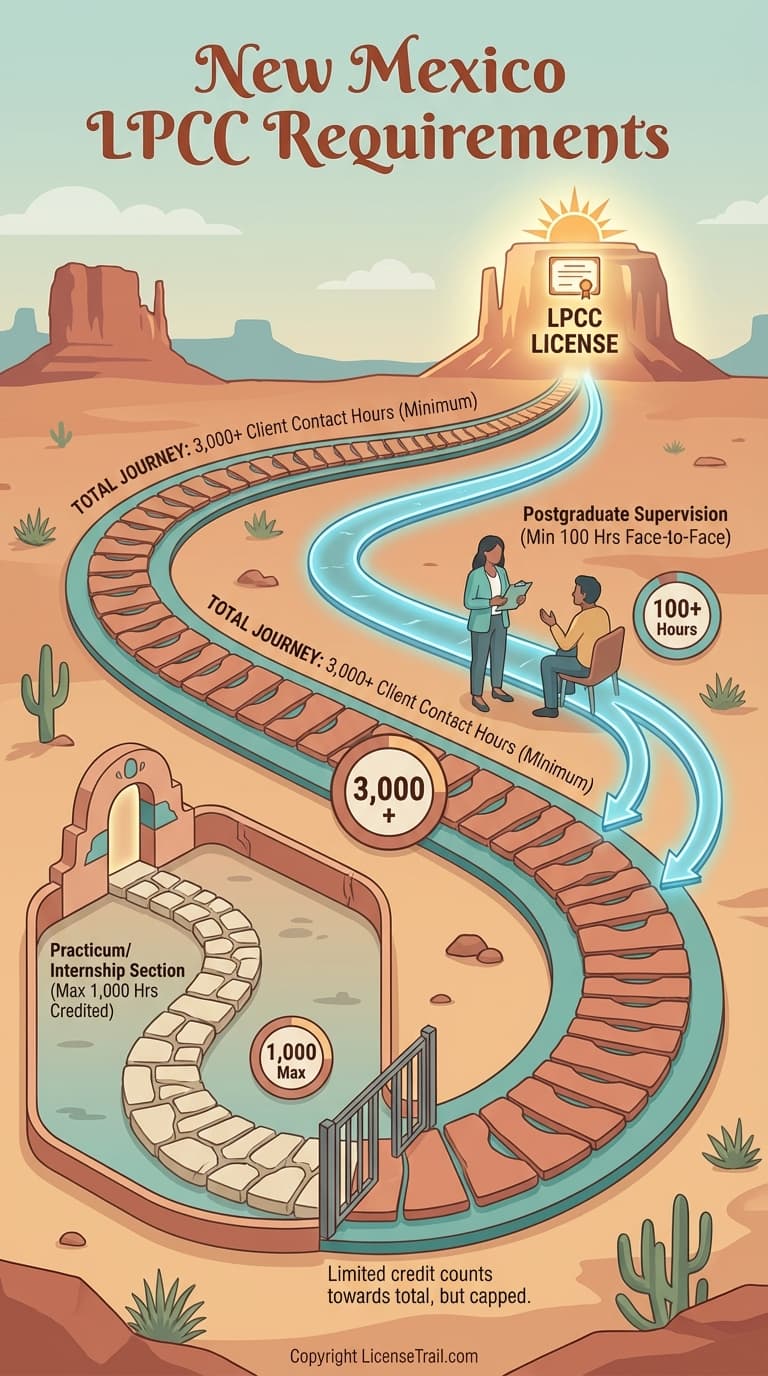
- Experience: 3,000 hours postgraduate clinical client contact + 100 hours face-to-face postgraduate supervision over minimum 2 years (no 1,500/1,500 split)
- Practicum/Internship credit: Up to 1,000 of the 3,000 client-contact hours may come from practicum/internship (credit from transcripts; not counted toward 100 supervision hours)
- Hour validity rules: No pre-license hours accepted; hours can become invalid if >5 years old at application unless continuously licensed in good standing
- Supervisor qualifications: Board-approved supervisor with supervision designation (e.g., LPCC/LMFT/LPAT/psychologist/psychiatrist/LCSW/LISW)
License Details
Procedures
Becoming a Licensed Professional Clinical Mental Health Counselor (LPCC) in New Mexico is a two‑stage process regulated by the Regulation and Licensing Department, Counseling and Therapy Practice Board. You first practice under supervision as a Licensed Mental Health Counselor (LMHC), then upgrade to LPCC once you meet the education, exam, and supervised‑experience requirements.
The key point about hours: New Mexico does not split experience into something like “1,500 hours direct + 1,500 hours supervised.” Instead, the Board’s rule requires:
- 3,000 hours of postgraduate clinical client contact, and
- 100 hours of appropriate face‑to‑face postgraduate supervision,
over a minimum of two years of postgraduate professional clinical counseling experience. (srca.nm.gov)
Below is a step‑by‑step guide with the relevant Board language and hour types.
1. Governing authority and license types
Licensure is set out in the New Mexico Administrative Code (NMAC), Title 16, Chapter 27. Part 4 covers:
“REQUIREMENTS FOR LICENSURE AS A PROFESSIONAL CLINICAL MENTAL HEALTH COUNSELOR (LPCC)” (srca.nm.gov)
The Board recognizes two counseling levels on this track:
- LMHC – Licensed Mental Health Counselor (pre‑independent, supervised)
- LPCC – Licensed Professional Clinical Mental Health Counselor (independent)
By rule, LMHCs (and LPCs where applicable) “must practice under supervision” and client contact or supervision hours before you are licensed are not accepted toward LPCC. (law.cornell.edu)
2. Educational requirements (before you can accumulate LPCC hours)
Under 16.27.4 NMAC, an LPCC applicant must: (srca.nm.gov)
- Be at least 21 years of age.
- Sign a statement that they have read the Board’s code of ethics and agree to be bound by it.
- Hold a master’s or doctoral degree in counseling or a counseling‑related field from an accredited institution.
- Have no fewer than 48 graduate semester hours (or 72 quarter hours) in the mental health clinical core curriculum defined in 16.27.2 NMAC. These hours may be part of the degree or taken as additional graduate coursework.
Most candidates meet these requirements as part of a CACREP‑type or similar counseling program that includes practicum and internship. Summaries of these curriculum expectations are consistent across professional resources. (mentalhealthcounselorlicense.com)
3. Step one: Obtain LMHC and begin supervised practice
Although 16.27.4 focuses on LPCC, in practice you must first be licensed as an LMHC before accumulating LPCC experience hours; pre‑license hours are not accepted. (law.cornell.edu)
Typical LMHC path:
- Complete your qualifying graduate degree (48+ semester hours with practicum/internship). (mentalhealthcounselorlicense.com)
- Apply for LMHC with the Board and be authorized to take the National Counselor Examination (NCE).
- Pass the NCE; the Board issues LMHC, often contingent on completing the exam within a set timeframe. (mentalhealthcounselorlicense.com)
- Begin working as an LMHC under Board‑approved supervision to accumulate the post‑graduate hours required for LPCC.
Board supervision rules emphasize:
- Supervision must be provided by an LPCC, LMFT, LPAT, psychologist, psychiatrist, LCSW, or LISW who holds a supervision designation from the Board.
- “Client contact and supervision hours prior to being licensed will not be acceptable for licensure.”
- Supervised contact hours become invalid if obtained more than five years before submission for independent LPCC licensure (with an exception for those continuously licensed in good standing). (law.cornell.edu)
4. Core LPCC experience requirement: types and amounts of hours
The controlling rule is 16.27.4.9 NMAC, which sets the minimum experience for LPCC licensure by examination. (srca.nm.gov)
4.1 Minimum duration
The rule requires:
- “A minimum of two years’ postgraduate professional clinical counseling experience.”
This two‑year minimum is widely reflected in Board‑based summaries of the licensure pathway. (mentalhealthcounselorlicense.com)
4.2 Clinical client‑contact hours
The Board’s language requires evidence of having participated in:
- “a total of 3,000 hours of postgraduate clinical client contact”
Key points about these hours:
- They must be post‑graduate (after your qualifying degree).
- They must be clinical client contact, meaning direct clinical services to clients (individuals, couples, families, or groups) such as assessment, diagnosis, counseling, and treatment planning. The Board does not break this 3,000 into sub‑categories (e.g., crisis vs. general counseling); professional summaries interpret this as direct clinical work with clients. (srca.nm.gov)
- These hours are typically accumulated while licensed as an LMHC under supervision.
4.3 Supervision hours
In addition to the 3,000 clinical client hours, the rule requires:
- “100 hours of appropriate face to face postgraduate supervision.” (srca.nm.gov)
Important features of these 100 hours:
- They must be face‑to‑face supervision (in person or synchronous video, depending on Board rules at the time).
- Supervision must be provided by a Board‑approved supervisor (LPCC, LMFT, LPAT, psychologist, psychiatrist, LCSW, or LISW with the Board’s supervision designation). (law.cornell.edu)
- Professional resources describe this as post‑graduate supervision, distinct from supervision received during your graduate practicum or internship. (mentalhealthcounselorlicense.com)
4.4 Credit for internship/practicum hours
The Board allows some of your graduate training hours to count toward the 3,000 clinical client‑contact hours, but not toward the 100 hours of post‑graduate supervision:
- “Up to 1,000 clinical client contact hours may be from the applicant's internship or practicum.”
- This credit is automatically awarded by Board staff based on the number of semester or quarter hours of practicum and internship shown on your official transcripts.
- These internship/practicum hours “should not be included” on the Board’s Attachment B form used to verify post‑graduate experience, because they are calculated separately from your academic record. (srca.nm.gov)
Professional summaries of the rule mirror this: 3,000 total hours of post‑graduate clinical client contact, with up to 1,000 coming from practicum/internship, and at least 100 hours of face‑to‑face supervision. (mentalhealthcounselorlicense.com)
4.5 Time limits and validity of hours
As noted in the Board’s supervision rules:
- Client contact and supervision hours obtained before you are licensed will not be accepted.
- Supervised contact hours older than five years at the time of LPCC application become invalid, unless you have continuously maintained a license in good standing. (law.cornell.edu)
This makes it important to:
- Start accruing hours promptly once you have LMHC.
- Apply for LPCC within a reasonable window once you’ve met the requirements.
5. How the hours break down in practice
Putting the official language into a simple structure:
| Requirement type | Amount required (Board rule) |
|---|---|
| Minimum duration of post‑grad clinical work | At least 2 years postgraduate professional clinical counseling experience |
| Clinical client contact (post‑grad, total) | 3,000 hours of postgraduate clinical client contact |
| Supervision (post‑grad) | 100 hours of appropriate face‑to‑face postgraduate supervision |
| Practicum/internship credit | Up to 1,000 of the 3,000 client‑contact hours may come from practicum/internship |
| Pre‑license hours | 0 hours accepted – pre‑licensure hours are not credited |
| Age | Must be 21 or older |
All of this comes directly from 16.27.4.9 NMAC and related supervision sections. (srca.nm.gov)
So, responding to your specific example:
New Mexico does not require 1,500 hours of direct experience and 1,500 hours of supervised experience. Instead, the Board’s rule is:
- 3,000 hours of postgraduate clinical client contact,
- plus 100 hours of appropriate face‑to‑face postgraduate supervision,
completed over at least two years of postgraduate professional clinical counseling experience, with up to 1,000 of the clinical hours allowed from your graduate practicum/internship. (srca.nm.gov)
6. Exams and final LPCC application
In addition to the hours, the Board requires LPCC applicants to demonstrate professional competency by passing both of the following exams: (srca.nm.gov)
- National Counselor Examination (NCE) – typically passed at the LMHC stage.
- National Clinical Mental Health Counseling Examination (NCMHCE) – required for LPCC.
The application for LPCC includes:
- Application form and $75 application fee (per Part 17 fee schedule).
- Documentation of:
- The two years of postgraduate professional clinical counseling experience.
- The 3,000 hours of postgraduate clinical client contact.
- The 100 hours of appropriate face‑to‑face postgraduate supervision, typically verified on the Board’s Attachment B form.
- Any practicum/internship credit (determined automatically from official transcripts).
- Proof of passing the NCE and NCMHCE.
Professional guides that track Board rules add that an initial license‑issuance fee (often cited as $220) is due when the LPCC is granted. (publichealthonline.org)
7. Practical interpretation of “clinical client contact” and “appropriate supervision”
While the NMAC does not micro‑categorize the 3,000 hours, Board rules and professional summaries interpret the key phrases as follows:
- “Postgraduate clinical client contact” – Direct, face‑to‑face (or equivalent) clinical service with clients in a counseling/therapy context: intake, assessment, diagnosis, counseling sessions, treatment planning, and related therapeutic interventions.
- “Appropriate face to face postgraduate supervision” – Scheduled supervision meetings in which a qualified supervisor reviews your clinical work, provides feedback, and ensures that your practice meets “adequate counseling and therapy standards of practice,” as described in Board commentary on documentation requirements. (srca.nm.gov)
Because the Board can request additional documentation or affidavits if a supervisor’s statement is unavailable, maintaining detailed logs of all client contact and supervision sessions is strongly recommended. (srca.nm.gov)
In summary, licensure as an LPCC in New Mexico hinges on meeting the education requirements, passing both the NCE and NCMHCE, and—most crucially—documenting 3,000 hours of postgraduate clinical client contact plus 100 hours of face‑to‑face postgraduate supervision over at least two years, in the exact terms laid out by the Counseling and Therapy Practice Board.
Track your LPCC hours with confidence
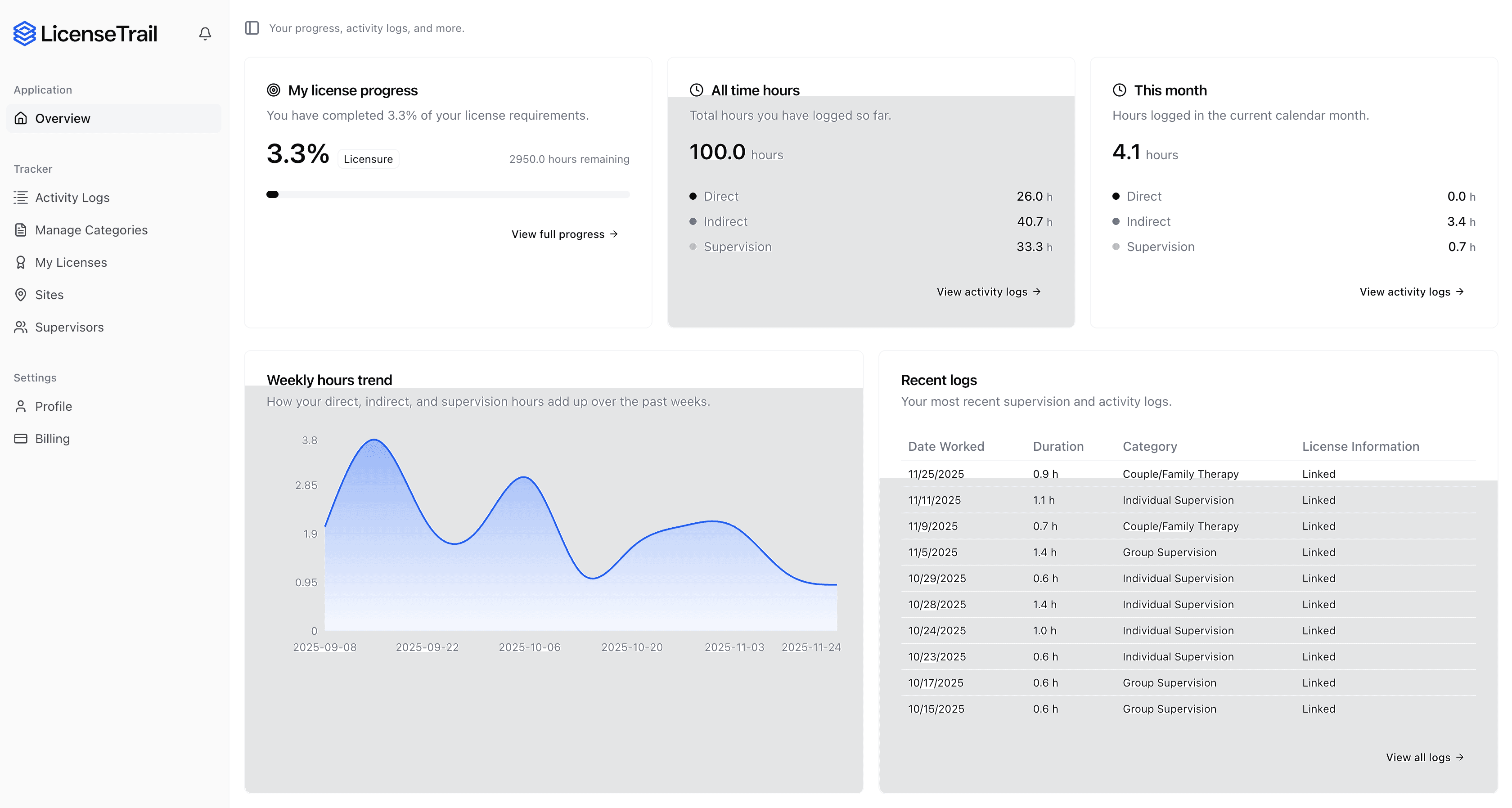
License Trail checks your direct, indirect, and supervision hours against New-mexico LPCC requirements continuously and flags mismatches before you submit.
 Start Tracking for Free
No credit card required · Free plan available
Is your spreadsheet hiding New-mexico LPCC risks?
Stop guessing if your categories match New Mexico Counseling and Therapy Practice Board requirements. License Trail checks your direct, indirect, and supervision hours continuously and flags mismatches before you submit.
Import or log
Bring your spreadsheet or start fresh
Upload your existing tracking spreadsheet and we'll map every hour into the right New Mexico Counseling and Therapy Practice Board categories automatically.
Verify against New-mexico
Catch mismatches before the board does
License Trail checks your direct, indirect, and supervision hours against New-mexico LPCC requirements continuously.
Export board-ready
One-click clean reports
Generate professional, board-ready reports for supervision meetings and New Mexico Counseling and Therapy Practice Board submissions in seconds.
No credit card required · Free plan available