
New-mexico LPAT Requirements: Hours, Exams & Step-by-Step Guide
Stop guessing if your categories match New-mexico requirements. License Trail checks your direct, indirect, and supervision hours against LPAT requirements continuously and flags mismatches before you submit.
No credit card required · Free plan available
Quick Requirements Overview
- Governing body: NM Counseling & Therapy Practice Board (RLD); authority: Counseling and Therapy Practice Act + 16.27 NMAC
- Age/ethics: 21+; attest to Board code of ethics and good moral character
- Education: Master’s/doctoral in art therapy/counseling/related; if related field, complete 48 grad semester hrs (72 quarter hrs) in art therapy core curriculum
- Experience duration: Minimum 2 years of postgraduate professional art therapy experience
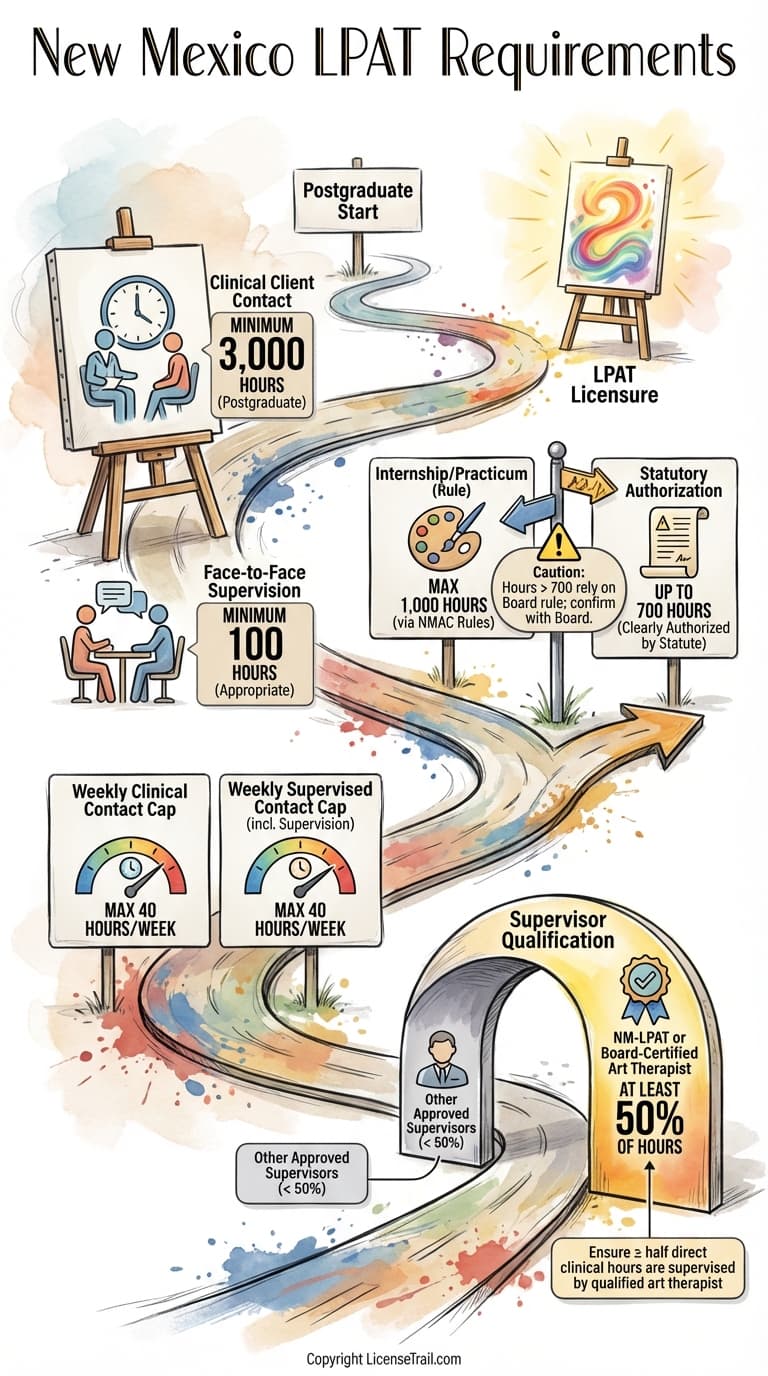
- Direct clinical hours: 3,000 postgraduate clinical client contact (face-to-face clinical services)
- Internship/practicum credit: Up to 1,000 of the 3,000 client contact hours may come from qualifying internship/practicum
- Supervision: 100 hours of postgraduate clinical supervision; ≥50% of supervised work hours must be under a NM LPAT or certified board art therapist; supervisor must be Board-approved/registered
- Exam/fees: Pass Board-approved exam; fees noted: $75 application + $220 initial license (per cited sources)
License Details
Procedures
Licensed Professional Art Therapist (LPAT) licensure in New Mexico is created by the Counseling and Therapy Practice Act (Chapter 61, Article 9A NMSA 1978) and implemented by the New Mexico Administrative Code (NMAC), Title 16, Chapter 27. The license is issued by the New Mexico Counseling and Therapy Practice Board under the Regulation and Licensing Department.
Below is a synthesis of those primary sources, focused on the precise hour requirements and how the Board defines them.
1. Legal framework and governing body
Key authorities:
- Statute: NMSA 1978, § 61‑9A‑13, “Professional art therapist; requirements for licensure” (repeal delayed until July 1, 2028). (law.justia.com)
- Regulation: 16.27.7.10 NMAC, “Applicants for licensure by examination: as a professional art therapist (LPAT) must possess the following qualifications…”. (law.cornell.edu)
- Definitions: 61‑9A‑3 NMSA 1978; 16.27.19.7 NMAC; 16.27.18.23 NMAC. (codes.findlaw.com)
The Counseling and Therapy Practice Board (“the board”) is the licensing authority for LPATs. (codes.findlaw.com)
2. Baseline eligibility for LPAT
From § 61‑9A‑13 and 16.27.7.10 NMAC, an LPAT applicant must show:
-
Age
- At least 21 years old. (law.cornell.edu)
-
Ethics and character
- Sign a statement (on the application) that you have read the Board’s code of ethics and agree to be governed by it. (law.cornell.edu)
- The rule further requires that the applicant “is of good moral character with conduct consistent with the code of ethics.” (srca.nm.gov)
-
Education
- A master’s or doctoral degree in:
- art therapy,
- counseling, or
- a counseling‑related field.
- If the degree is in a related field, you must complete 48 graduate semester hours (or 72 quarter hours) in the art therapy core curriculum as defined in 16.27.7.11 NMAC. (srca.nm.gov)
- A master’s or doctoral degree in:
-
Professional competency
- Demonstrate competency by passing an examination prescribed by the Board (see Section 6 below). (law.justia.com)
3. Experience and hour requirements (post‑graduate)
The New Mexico LPAT license does not use a “1,500 direct + 1,500 supervised” structure. Instead, statute and rule set out:
3.1. Overall experience requirement
Both statute and rule require:
- Minimum of two years of postgraduate professional art therapy experience. (srca.nm.gov)
“Postgraduate” means after completion of the qualifying master’s or doctoral degree.
3.2. Client contact hours (direct clinical experience)
The governing statute states that an LPAT must complete “three thousand client contact hours” as part of their post‑graduate professional experience. (law.justia.com)
The corresponding rule requires evidence of “a total of 3000 hours of postgraduate clinical client contact.” (srca.nm.gov)
In other words:
- 3,000 hours of direct, clinical client work after graduation are required.
How “client contact hours” are defined
The statute defines “client contact hours” as:
the face‑to‑face time spent with a client to appraise, assess, evaluate, diagnose, treat psychopathology and provide counseling services. (codes.findlaw.com)
Applied to LPATs, this means:
- Time that counts must be direct, face‑to‑face clinical service (in person or approved electronic format), involving:
- assessment and evaluation,
- diagnosis (if within your role),
- treatment/psychotherapy through art therapy and counseling interventions,
- and other counseling services directed to the client’s mental health.
The term “postgraduate clinical client contact” is not separately defined, but it is interpreted as client contact hours (as defined above) that occur after you earn the qualifying degree.
How many hours may come from internship/practicum?
There is some historic confusion between 700 vs. 1,000 hours. The current compiled NMAC (as of 2025) reads:
- Of the 3,000 hours, up to 1,000 clinical client contact hours may be from the applicant’s internship or practicum. (srca.nm.gov)
Earlier versions and older secondary sources often mentioned 700 hours. (law.justia.com)
However, the 2023 amendment to 16.27.7.10 NMAC changed this to 1,000 and that is what appears in the official consolidated rule and on current legal compilations. (srca.nm.gov)
Current reading (for practical purposes):
- Total required postgraduate clinical client contact: 3,000 hours
- Of these, up to 1,000 hours may be drawn from internship/practicum beyond the basic degree requirements.
3.3. Supervision hours
The regulation requires:
- 100 hours of appropriate face‑to‑face postgraduate supervision. (srca.nm.gov)
Statute similarly requires “one hundred hours of post‑graduate experience under appropriate supervision,” and specifies that supervision must be provided by a New Mexico‑licensed professional art therapist or certified board therapist for at least fifty percent of the working hours. (law.justia.com)
Putting this together:
- Total supervision hours:
- 100 hours of post‑graduate clinical supervision specifically tied to your art therapy practice.
- Who supervises:
- At least 50% of your supervised working hours must be under a New Mexico LPAT or a “certified board therapist” (i.e., someone credentialed in art therapy per the Board’s rules). (law.justia.com)
The Board-wide supervisor definitions add that:
- “Clinical supervision” consists of supportive and educative activities aimed at improving application of counseling theory and technique directly with clients, and
- “clinical supervision is the only supervision acceptable for licensure.” (law.cornell.edu)
So administrative or managerial oversight does not count; the 100 hours must be clinical supervision.
3.4. Who can be an approved supervisor
Board rules on approved supervisors (16.27.19.7 and related provisions) state that:
- “Supervisors” must be independently licensed as one of the following, and have:
- completed 9 continuing education units in supervision, and
- registered as supervisors with the Counseling and Therapy Practice Board. (regulations.justia.com)
Eligible license types include:
- Licensed Professional Art Therapist (LPAT)
- Licensed Professional Clinical Mental Health Counselor (LPCC)
- Licensed Marriage and Family Therapist (LMFT)
- Licensed Clinical Social Worker (LCSW)
- Independently licensed alcohol and drug abuse counselor (LADAC)
- Licensed psychologist
However, because the art therapy statute specifically requires that at least half of the working hours be supervised by a New Mexico‑licensed professional art therapist or certified board therapist, you should structure supervision so that:
- ≥ 50% of your hours are under an LPAT (or art‑therapy‑certified supervisor), and
- the remaining hours, if any, are under another Board‑approved supervisor type listed above. (law.justia.com)
3.5. Electronic and telephonic work and supervision
The Board’s electronic therapy rule clarifies that:
- Electronic and telephonic supervision, counseling, and psychotherapy are considered contact hours and are still subject to the face‑to‑face supervision requirements. (law.cornell.edu)
This means that properly structured telehealth sessions and remote supervision can count toward:
- your 3,000 clinical client contact hours, and
- your 100 supervision hours,
as long as they otherwise meet Board requirements.
4. Summary of the hour requirements in Board/statutory language
Pulling the key phrases together (paraphrased and narrowly quoted where necessary):
- Experience:
- Minimum of two years of postgraduate professional art therapy experience. (srca.nm.gov)
- Direct clinical hours:
- Evidence of 3,000 hours of postgraduate clinical client contact (face‑to‑face clinical work with clients, including appraisal, assessment, diagnosis, treatment, and counseling). (srca.nm.gov)
- Supervision hours:
- 100 hours of appropriate face‑to‑face postgraduate supervision, which must be clinical supervision and, for at least half the working hours, under a New Mexico LPAT or certified board art therapist. (srca.nm.gov)
- Internship/practicum credit:
- Up to 1,000 of the 3,000 clinical client contact hours may come from qualifying internship/practicum beyond the minimum degree requirements. (srca.nm.gov)
5. Examination requirement
The statute requires that an LPAT applicant:
- “demonstrates professional competency by passing an examination as prescribed by the board.” (law.justia.com)
The Board’s emergency licensure and examination rule further states that:
- Applicants who have completed the educational and supervision requirements for LPAT (and other independent licenses) must pass the Board‑approved examination(s). (srca.nm.gov)
In practice, the New Mexico Art Therapy Association and other professional sources describe the Art Therapy Credentials Board Examination (ATCBE) as the exam used for LPAT applicants, and the Board’s materials historically align with that. (nmarttherapy.wordpress.com)
Because the rule uses the broader phrase “board approved examination(s),” you should:
- Confirm on the Board’s current site or with staff which exam is being used at the time you apply, as exam requirements can change.
6. Application and documentation with the Board
The Counseling and Therapy Practice Board now uses an online licensing portal for all applications. (rld.nm.gov)
For LPAT by examination, you should expect to provide at least:
-
Completed online application and application fee
- 16.27.7.10 NMAC sets the application fee at $75 for LPAT; the Board’s fee schedule lists an additional $220 initial LPAT license fee. (srca.nm.gov)
-
Proof of education
- Official transcripts showing the qualifying master’s or doctoral degree.
- If your degree is in a related field, the Board uses an art therapy core curriculum worksheet (Attachment F) to document the required 48 semester / 72 quarter hours in art therapy coursework. (rld.nm.gov)
-
Experience and supervision verification
- The Board makes available:
- “Experience Verification – Attachment B” (supervision hours)
- “LPAT Verification of Education and Training Hours – Attachment F” (for LPAT‑specific training/experience). (rld.nm.gov)
- Supervisors generally must complete and sign these forms (often in sealed or board‑direct‑submission format) documenting:
- Your 3,000 clinical client contact hours
- Your 100 supervision hours
- Settings and dates of practice
- Their own licensure and Board‑approved supervisor designation.
- The Board makes available:
-
Ethics and character
- A signed statement that you have read and agree to abide by the Board’s code of ethics. (law.cornell.edu)
-
Exam results
- Official verification that you passed the required Board‑approved exam (commonly the ATCBE). (srca.nm.gov)
7. Practical “roadmap” to LPAT licensure in New Mexico
Putting the statutory and regulatory requirements into a practical sequence:
-
Complete your master’s or doctoral degree
- In art therapy, counseling, or a counseling‑related field, from an accredited institution.
- Ensure your program either:
- already includes the art therapy core curriculum as defined in 16.27.7.11 NMAC, or
- you supplement with the necessary coursework (48 semester / 72 quarter hours in art therapy‑specific content). (srca.nm.gov)
-
Secure appropriate supervised positions in applied counseling settings
- Work in hospitals, community mental health centers, schools, or private practices where you can provide clinical art therapy services directly to clients. (regulations.justia.com)
-
Engage an approved supervisor (or supervisors)
- At least one supervisor must be an LPAT or art‑therapy‑certified clinician in New Mexico who is registered with the Board as an approved supervisor.
- Confirm that your supervisors:
- hold an independent license (LPAT, LPCC, LMFT, LCSW, psychologist, etc.), and
- have the Board’s supervision designation. (regulations.justia.com)
- Structure your plan so that ≥ 50% of your supervised work hours are under an LPAT or certified board art therapist, in line with § 61‑9A‑13. (law.justia.com)
-
Accumulate and document the required hours
- Postgraduate professional experience:
- At least two years of art therapy practice after the degree.
- Direct clinical hours:
- 3,000 hours of postgraduate clinical client contact.
- Up to 1,000 hours may be counted from internship/practicum beyond the minimum degree requirements (if properly documented). (srca.nm.gov)
- Supervision hours:
- 100 hours of clinical supervision, face‑to‑face (including approved electronic supervision), with at least half under a New Mexico LPAT or art‑therapy‑certified supervisor. (srca.nm.gov)
- Keep detailed logs that match what Attachment B and Attachment F will ask for (dates, settings, populations, supervisor names and license numbers, individual vs. group supervision, and totals).
- Postgraduate professional experience:
-
Pass the Board‑approved examination
- Register for and pass the exam designated by the Board (historically, the ATCBE for LPAT applicants). (nmarttherapy.wordpress.com)
-
Apply through the Board’s online portal
- Submit your application, fees, transcripts, hour verification forms, exam results, and ethics attestation via the Counseling and Therapy Practice Board’s online system. (rld.nm.gov)
8. Notes about future changes
- The LPAT statute, § 61‑9A‑13 NMSA 1978, is currently scheduled for repeal on July 1, 2028, as part of a broader sunset provision. (law.justia.com)
- Until the Legislature and Board enact replacement provisions, the requirements summarized above remain in effect, but anyone planning licensure close to that date should monitor:
- updates to Chapter 61, Article 9A NMSA 1978, and
- amendments to 16.27.7 NMAC on the official New Mexico Administrative Code site.
Concise hours summary (current law/rule)
For New Mexico LPAT (Licensed Professional Art Therapist) licensure by examination, the Counseling and Therapy Practice Board currently requires:
- 2+ years of postgraduate professional art therapy experience
- 3,000 hours of postgraduate clinical client contact, of which up to 1,000 may be from qualifying internship/practicum
- 100 hours of postgraduate clinical supervision, face‑to‑face (including approved telehealth), with at least half the supervised work under a New Mexico LPAT or certified board art therapist
All of this must be accompanied by the specified education, ethical attestation, and passage of a Board‑approved examination. (srca.nm.gov)
Track your LPAT hours with confidence
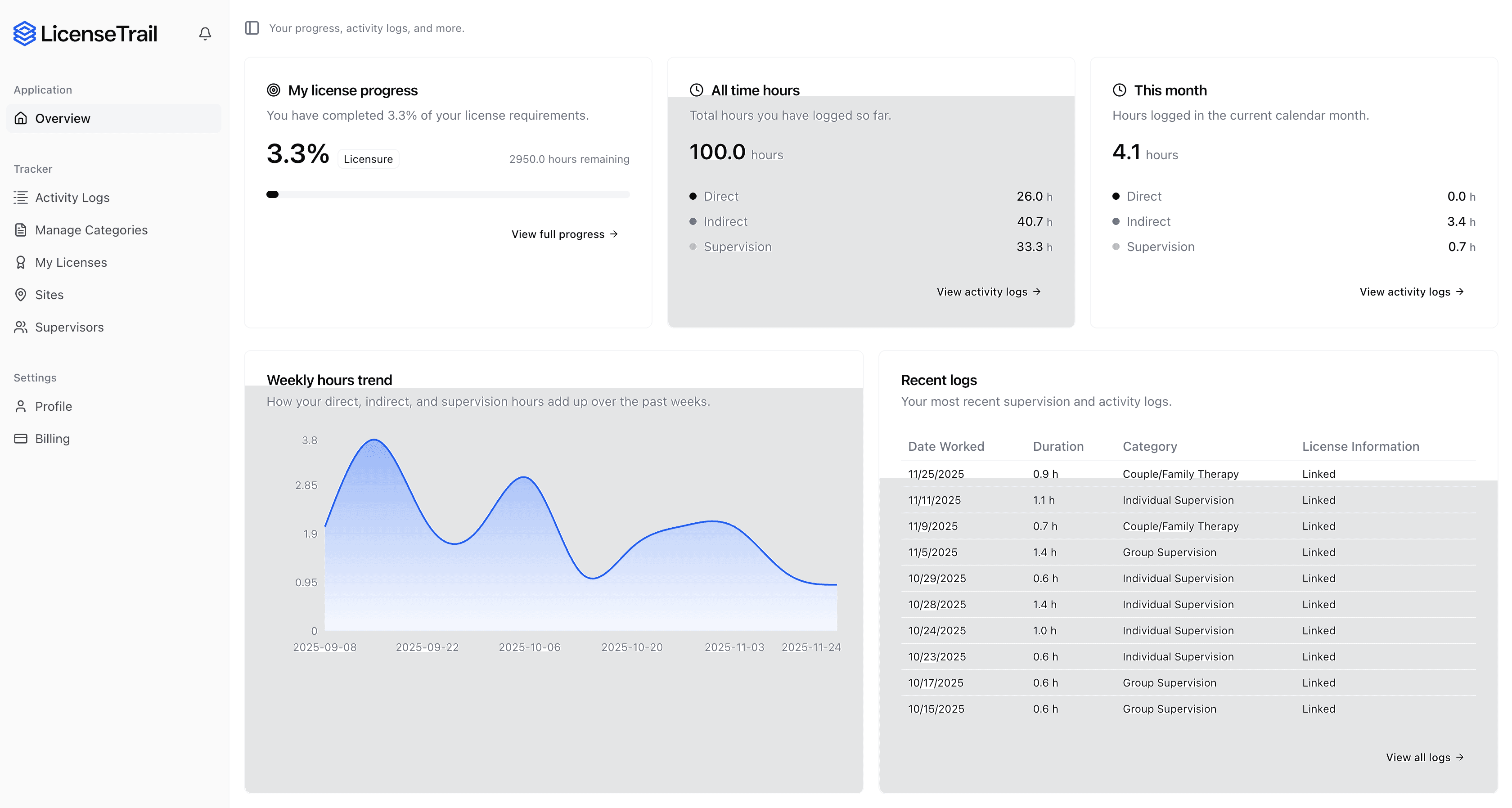
License Trail checks your direct, indirect, and supervision hours against New-mexico LPAT requirements continuously and flags mismatches before you submit.
 Start Tracking for Free
No credit card required · Free plan available
Is your spreadsheet hiding New-mexico LPAT risks?
Stop guessing if your categories match New Mexico Counseling and Therapy Practice Board requirements. License Trail checks your direct, indirect, and supervision hours continuously and flags mismatches before you submit.
Import or log
Bring your spreadsheet or start fresh
Upload your existing tracking spreadsheet and we'll map every hour into the right New Mexico Counseling and Therapy Practice Board categories automatically.
Verify against New-mexico
Catch mismatches before the board does
License Trail checks your direct, indirect, and supervision hours against New-mexico LPAT requirements continuously.
Export board-ready
One-click clean reports
Generate professional, board-ready reports for supervision meetings and New Mexico Counseling and Therapy Practice Board submissions in seconds.
No credit card required · Free plan available