
North-dakota LAPC Requirements: Hours, Exams & Step-by-Step Guide
Stop guessing if your categories match North-dakota requirements. License Trail checks your direct, indirect, and supervision hours against LAPC requirements continuously and flags mismatches before you submit.
No credit card required · Free plan available
Quick Requirements Overview
- Degree/Credits: Master’s in counseling (or Board-approved equivalent) from an accredited institution; 60 semester credits / 90 quarter credits with specified counseling content areas.
- Graduate Clinical Training: 100-hour practicum + 600-hour internship (supervised; counseling-relevant settings) completed within the graduate program.
- Exam: Pass the NCE (NBCC).
- Application Docs: Official transcripts, Board application/forms, Plan of Supervision, statement/professional intent, and fee (per Board).
- Recommendations: 3 required—(1) practicum agency contact, (2) master’s program advisor, (3) additional counselor educator.
- Supervision Plan/Rules (while LAPC): Practice only under approved supervision; 100 supervision hours total over 2 years, with ≥60 individual face-to-face (in-person or secure video); group supervision allowed; no ownership interest in the practice setting.
- Time Limit: LAPC issued for up to 2 years; extension beyond 2 years requires specified professional recommendations.
- Background Check: Statewide + nationwide criminal history record check required.
License Details
Procedures
In North Dakota, the Licensed Associate Professional Counselor (LAPC) credential is the entry‑level counseling license issued by the North Dakota Board of Counselor Examiners (NDBCE). It allows you to practice counseling only under approved supervision while you complete the experience required for the full Licensed Professional Counselor (LPC) license.
Below is a step‑by‑step outline of what the Board requires, with emphasis on the specific hours and the language used in statute and rule.
1. How the law defines the LAPC role
North Dakota’s counselor licensing law (Century Code chapter 43‑47) defines:
- “Counseling” as applying human development and mental health principles in a professional relationship to prevent, assess, and treat emotional or behavioral disorders, and to plan, implement, and evaluate treatment plans using professional counseling strategies. (codes.findlaw.com)
- “Licensed associate professional counselor” as a person granted an associate professional license “to offer and conduct counseling under the supervision of a licensed professional counselor or such other person” who meets the Board’s supervisor requirements. (codes.findlaw.com)
By law, you generally may not engage in counseling in North Dakota unless you are either an LPC or an LAPC. (codes.findlaw.com)
2. Educational requirements and graduate clinical hours
2.1. Degree and credit requirements
To qualify for an LAPC license, you must have:
- A master’s degree in counseling (or another program that meets the Board’s academic standards) from an accredited school or college. (codes.findlaw.com)
- At least 60 graduate semester credits (or 90 quarter credits) “relating to counseling”, shown on your graduate transcript(s), including coursework in all of the following areas: (law.cornell.edu)
- Counseling theories
- Counseling methods
- Group counseling
- Individual appraisal, assessment, or testing
- Counseling‑related research methods (must include statistical analysis of counseling‑related data)
- Human growth and development
- Multicultural counseling
- Career and lifestyle development
- Professional orientation and ethics (at least 3 semester credits or 5 quarter credits, including the counseling profession and the ACA Code of Ethics)
- Counseling practicum and internship
These requirements come directly from North Dakota Administrative Code (N.D. Admin. Code) § 97‑02‑01‑02 on academic programs. (law.cornell.edu)
2.2. Required graduate practicum and internship hours (pre‑licensure)
The same rule specifies minimum clinical training hours that must be embedded in your master’s program:
-
Practicum:
- Must be 100 hours of training in supervised practica in settings “relevant to the practice of counseling.” (law.cornell.edu)
-
Internship:
- Must be 600 hours of training in supervised internship settings relevant to counseling practice. (law.cornell.edu)
The Board allows these 700 total hours (100 + 600) to be counted within the 60 required graduate credits. (law.cornell.edu)
In practical terms: to be eligible for LAPC, your degree must include at least 700 hours of supervised graduate‑level counseling practicum/internship meeting these standards.
3. Legal framework for the LAPC license
Under North Dakota Century Code § 43‑47‑06(3), the Board will issue an LAPC license to an applicant who: (codes.findlaw.com)
- Holds a qualifying counseling master’s degree from an accredited institution that meets the Board’s academic standards (described above);
- Provides personal and professional recommendations as required by the Board; and
- Submits a written plan for supervised experience that meets Board requirements.
An LAPC license is limited in duration:
- An associate professional counselor “may be licensed for no more than two years.”
- It cannot be extended beyond two years, except with a recommendation from the LAPC’s supervisor and three other counselors, at least one of whom must be a professor from the LAPC’s training program. (codes.findlaw.com)
4. Specific Board requirements to apply for the LAPC
N.D. Admin. Code § 97‑02‑01‑03 sets out the minimum elements you must submit to the Board to become an LAPC. (law.cornell.edu)
4.1. Evidence of qualifying education
You must submit:
- A copy of your master’s degree (documentation from the accredited school or college)
- The degree must meet the academic standards of § 97‑02‑01‑02 (60 credits, required coursework, and 700 hours of practicum/internship as above). (law.cornell.edu)
4.2. Three required professional recommendations
Your application must include three recommendations, and the rule is specific about who they must come from: (law.cornell.edu)
- One from your practicum agency contact person
- One from your master’s degree program advisor
- One from an additional counselor educator
These must be sent to the Board as part of your LAPC application.
4.3. Written plan for supervised experience (Plan of Supervision)
You must submit a written supervision plan. The Board requires that this plan, at minimum: (law.cornell.edu)
- Includes an estimated number of client contact hours per week; and
- Specifies the supervision you will receive.
The Board’s rule then defines the required supervision structure and hours over the two‑year LAPC period:
- Supervision must include individual, face‑to‑face meetings at regular intervals over the two‑year period of supervised experience.
- Group supervision (e.g., case conferences with a professional staff) may also be used.
- Over the two years you must document:
- A total of 100 hours of supervision (individual + group), and
- At least 60 of those hours must be individual face‑to‑face supervision. (law.cornell.edu)
- The supervised experience may not occur in a practice in which you hold an ownership interest. (law.cornell.edu)
The supervisor must be:
- A Licensed Professional Counselor (LPC) or Licensed Professional Clinical Counselor (LPCC) certified as a supervisor under the Board’s rules (N.D. Admin. Code § 97‑02‑01‑08), or
- Another supervising professional allowed under § 43‑47‑06(2)(c) (for example, certain licensed psychologists), if the Board authorizes that supervision. (law.cornell.edu)
“Face‑to‑face” supervision may be provided via secure, HIPAA‑compliant video communication on a secure server, not just in person. (law.cornell.edu)
4.4. Pass the National Counselor Examination (NCE)
The LAPC rule also requires:
- Evidence of successful completion of the National Counselor Examination (NCE) administered by the National Board for Certified Counselors. (law.cornell.edu)
You must pass the NCE before the Board will grant the LAPC license.
4.5. Criminal history record check and other forms
By statute, the Board must require: (law.justia.com)
- A statewide and nationwide criminal history record check for counselor licensure applicants; and
- Standard application materials such as:
- Official graduate transcripts sent directly to the Board
- A Plan of Supervision form
- Three professional recommendations (as specified above)
- An education/experience form and a statement of professional intent describing how you intend to use the license and who you intend to serve.
The Board also charges a licensing fee, set by rule; because fees can change, you should confirm the current amount on the Board’s website or directly with the office. (phoenix.edu)
5. Hours you must complete while holding the LAPC
Once the LAPC is granted, you use that two‑year window to complete supervised experience that will qualify you for full LPC licensure.
5.1. Duration of supervised experience
The LPC section of the law requires: (codes.findlaw.com)
- Two years of supervised experience, at least 50% of which must be under an LPC or licensed psychologist (or an equivalent supervisor as approved by the Board).
Your LAPC period is typically that two‑year supervised experience period. You cannot hold an initial LAPC for more than two years without a special recommendation, as noted earlier. (codes.findlaw.com)
5.2. Supervision hours during that two‑year period
As summarized above, N.D. Admin. Code § 97‑02‑01‑03 requires that your two‑year plan and experience include at least: (law.cornell.edu)
- 100 total hours of supervision,
- Of which at least 60 hours must be individual, face‑to‑face supervision (in person or secure video),
- With the remaining up to 40 hours permitted in group supervision formats.
These are Board‑defined supervision hours, not just employer expectations.
5.3. Direct client contact hours during LAPC (Board practice standards)
The administrative rule quoted above does not specify a single number for required direct client hours, but multiple licensure summaries that track the Board’s Plan of Supervision requirements agree on the following current practice standard:
- At least 400 hours of direct client counseling contact per year of the LAPC supervised period, for a minimum of 800 hours of direct therapy experience over two years. (humanservicesedu.org)
- You should typically see at least about 10 different clients each year during this period. (careersinpsychology.org)
An earlier national survey of state laws (prepared for TRICARE) described North Dakota’s requirement somewhat more conservatively as 400 hours of client counseling contact over the two‑year LAPC supervisory period plus the 100 hours of supervision. (ncbi.nlm.nih.gov) More recent sources representing North Dakota’s requirements (including career and licensure‑focused organizations) describe the standard as 400 client hours per year (800 total). (humanservicesedu.org)
Because direct‑contact hour expectations can be updated in Board policy and forms without changing the statute, it is wise to:
- Use at least 800 direct client hours (≈400 per year) as your planning baseline, and
- Confirm the exact target with the Board’s current Plan of Supervision instructions before finalizing your plan.
6. Putting it all together: what you must have for LAPC
To summarize the key hour‑related requirements and Board‑defined language relevant to becoming an LAPC in North Dakota:
-
Graduate clinical training (completed before application):
- 100 hours of supervised counseling practicum; and
- 600 hours of supervised counseling internship;
together described in rule as practica and internship “in settings relevant to the practice of counseling.” (law.cornell.edu)
-
Supervised experience plan for the LAPC period (two years):
- Plan must estimate client contact hours per week and specify supervision received. (law.cornell.edu)
- You must complete two years of supervised experience to qualify later as an LPC, with at least 50% of that supervision under an LPC or psychologist (or equivalent) as described in statute. (codes.findlaw.com)
-
Supervision hours during the LAPC period (as defined in rule):
- 100 hours of documented supervision (individual + group) over the two years;
- At least 60 hours must be individual face‑to‑face supervision (in person or secure video);
- Supervision must occur at regular intervals; group supervision may supplement individual supervision;
- Supervised experience may not be in a practice where you have an ownership interest. (law.cornell.edu)
-
Direct client contact hours during the LAPC period (Board practice standard):
- Current licensure summaries that track NDBCE standards indicate you should expect to complete at least 800 hours of direct therapy experience with clients (about 400 hours per year), along with the 100 hours of supervision above. (humanservicesedu.org)
-
Other application elements defined by law or rule:
- Qualifying master’s degree (60 credits) meeting content requirements. (law.cornell.edu)
- Three professional recommendations: practicum agency contact, program advisor, additional counselor educator. (law.cornell.edu)
- Passing score on the NCE. (law.cornell.edu)
- Written Plan of Supervision meeting the Board’s specifications. (law.cornell.edu)
- Criminal history record check, plus forms and fees required by the Board. (law.justia.com)
Because North Dakota periodically amends its administrative code and may update Board forms (for example, changing the exact number of required client‑contact hours or supervision details), you should always check the most recent Title 97 rules and the current NDBCE application packet before you apply or finalize a supervision plan.
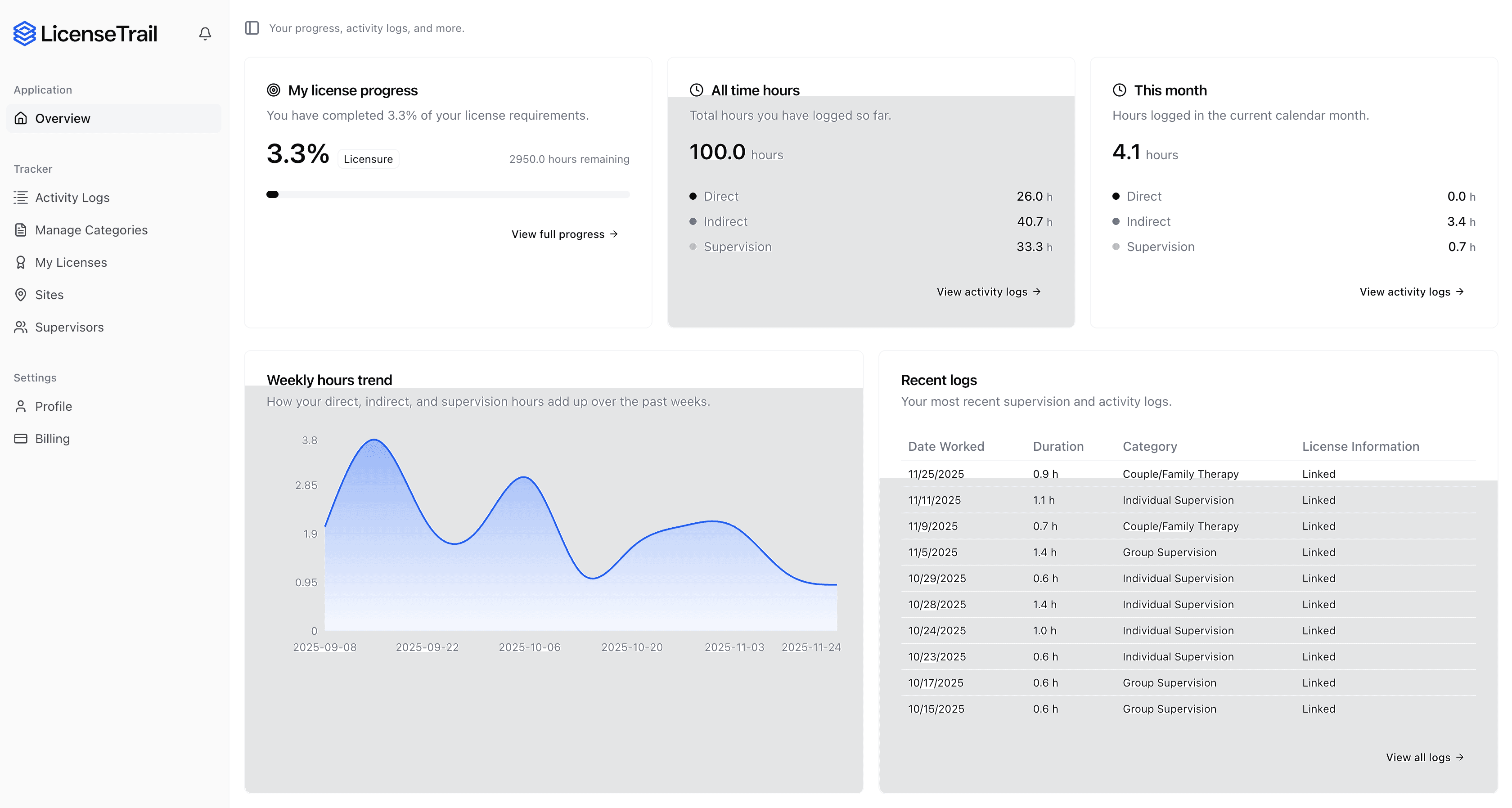
Track your LAPC hours with confidence
License Trail checks your direct, indirect, and supervision hours against North-dakota LAPC requirements continuously and flags mismatches before you submit.
 Start Tracking for Free
No credit card required · Free plan available
Is your spreadsheet hiding North-dakota LAPC risks?
Stop guessing if your categories match North Dakota Board of Counselor Examiners requirements. License Trail checks your direct, indirect, and supervision hours continuously and flags mismatches before you submit.
Import or log
Bring your spreadsheet or start fresh
Upload your existing tracking spreadsheet and we'll map every hour into the right North Dakota Board of Counselor Examiners categories automatically.
Verify against North-dakota
Catch mismatches before the board does
License Trail checks your direct, indirect, and supervision hours against North-dakota LAPC requirements continuously.
Export board-ready
One-click clean reports
Generate professional, board-ready reports for supervision meetings and North Dakota Board of Counselor Examiners submissions in seconds.
No credit card required · Free plan available