
Ohio COBA Requirements: Hours, Exams & Step-by-Step Guide
Stop guessing if your categories match Ohio requirements. License Trail checks your direct, indirect, and supervision hours against COBA requirements continuously and flags mismatches before you submit.
No credit card required · Free plan available
Quick Requirements Overview
- Protected credential: Practicing ABA or using the title COBA generally requires an Ohio State Board of Psychology certificate (limited exceptions).
- Application basics: Board form filed under oath + fee + meet ethical/professional standards.
- Background check: BCII + FBI criminal records check required.
- Primary eligibility path: Hold current BCBA (or successor) with written verification sent to the Board.
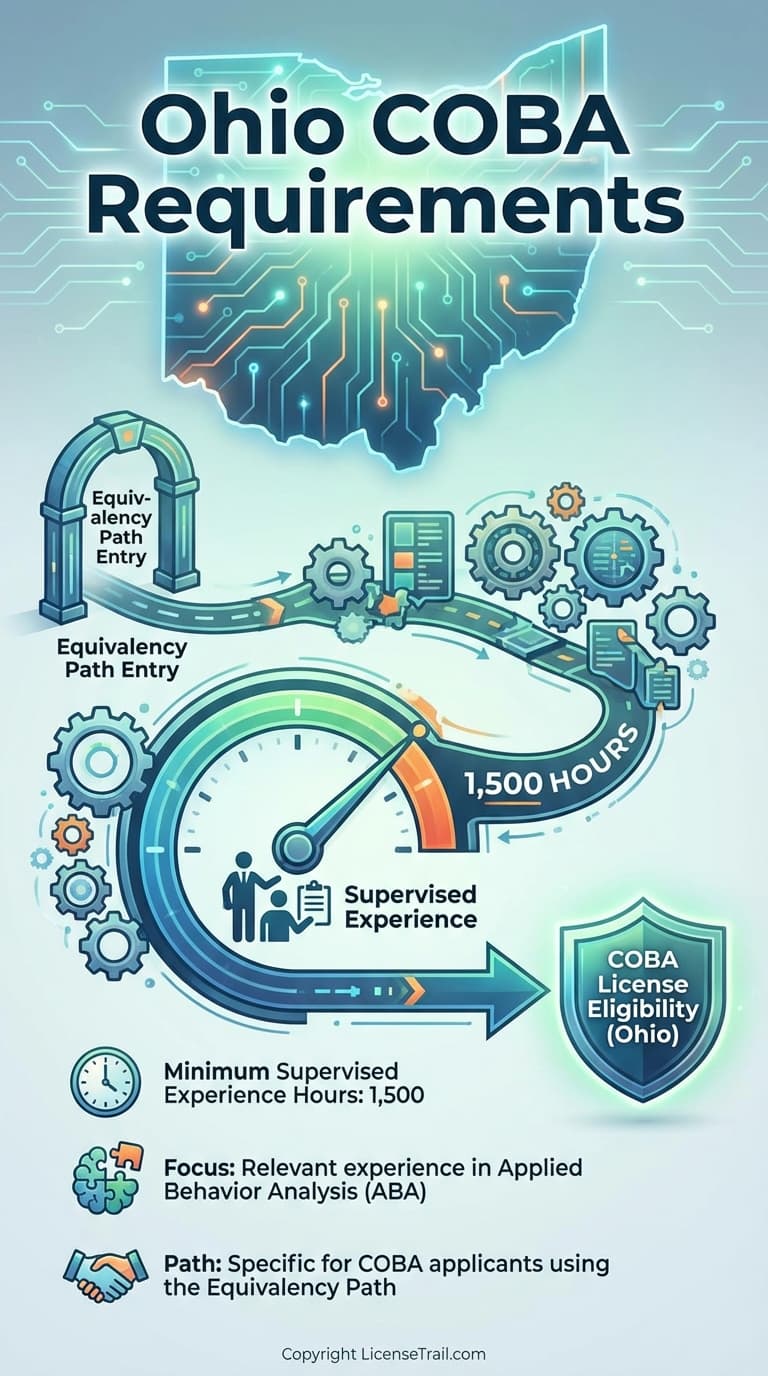
- Equivalency path (non-BCBA): Qualifying master’s/doctoral degree + 270 classroom hours of specified ABA coursework + pass a psychometrically valid ABA exam + 1,500 hours relevant supervised ABA experience (single total).
- Jurisprudence: Attest you studied applicable laws/rules + attend Board jurisprudence workshop + pass post-workshop exam.
- References: 3 letters of reference sent directly to the Board from approved professional categories.
- Renewal: Every 2 years—23 CE hours (incl. 4 hours ethics/professional conduct/cultural competency).
License Details
Procedures
In Ohio, the title “Certified Ohio Behavior Analyst” (COBA) is a protected credential. With limited exceptions, you may not practice applied behavior analysis or hold yourself out as a “certified Ohio behavior analyst” without a certificate issued by the State Board of Psychology. (codes.ohio.gov)
Below is a step‑by‑step guide based directly on the Ohio Revised Code and Ohio Administrative Code provisions that govern COBA certification.
1. Understand the basic legal framework
The core statute for COBA certification is Ohio Revised Code (ORC) 4783.04, “Application for certificate; eligibility.” It requires that an applicant: (codes.ohio.gov)
To be eligible, you must:
- Submit a written application on a Board‑prescribed form.
- Show you conduct professional activities in accordance with accepted professional and ethical standards.
- Comply with Ohio’s criminal records check laws (ORC 4776.01–4776.04).
- Demonstrate either
- Current certification as a Board Certified Behavior Analyst (BCBA) by the Behavior Analyst Certification Board (BACB) or its successor, or
- Completion of equivalent requirements and passage of a psychometrically valid examination by a nationally accredited credentialing organization.
- Pay the Board’s fee. (codes.ohio.gov)
On the rule side, Ohio Administrative Code (OAC) 4783‑1‑01 (“Application for certification”) confirms that all COBA applicants file under oath, in a Board‑prescribed format, with the appropriate fee. (codes.ohio.gov)
2. Choose your pathway: BCBA, equivalency, or reciprocity
A. Standard BCBA pathway (most common)
OAC 4783‑4‑01 states that COBA requirements “include that the applicant shall demonstrate current certification as a board certified behavior analyst by the ‘Behavior Analyst Certification Board’ or its successor organization,” or meet reciprocity or equivalent‑requirements routes. (codes.ohio.gov)
For the standard route, you:
- Hold a current, valid BCBA (or successor) certification.
- Arrange for written verification from BACB to be sent to the Ohio Board as part of your application. (codes.ohio.gov)
Important on hours:
Under this BCBA pathway, Ohio itself does not restate or add a separate numeric hour breakdown. The Board relies on BACB certification to verify that you have met the supervised fieldwork/experience hour requirements set by BACB. Any specific numbers of “fieldwork,” “supervised,” or “direct” hours you must complete are determined by BACB policy, not by the Ohio rules.
B. “Equivalent requirements” pathway (for non‑BCBA applicants)
If you are not a BCBA but want to qualify via equivalent education, coursework, supervised experience, and exam, OAC 4783‑4‑01 spells out detailed criteria. This is the path where Ohio explicitly defines both classroom hours and supervised experience hours. (codes.ohio.gov)
At a high level, you must show:
- A qualifying master’s or doctoral degree in behavior analysis or a related field (natural science, education, psychology, counseling, social work, human services, or another field related to behavior analysis as judged by the Board), from an appropriately accredited institution (U.S., Canada, or certain evaluated foreign degrees). (codes.ohio.gov)
- Minimum of 270 classroom hours of specified ABA coursework (details in Section 3 below). (codes.ohio.gov)
- Passing score on a psychometrically valid ABA exam administered by a nationally accredited credentialing organization. (codes.ohio.gov)
- Completion of a minimum of 1,500 hours of relevant supervised experience in applied behavior analysis satisfactory to the Board. (codes.ohio.gov)
This equivalency path is where Ohio itself uses a specific hour requirement.
C. Reciprocity / Out‑of‑state licensure route
If you already hold an applied behavior analyst license or certification in another U.S. jurisdiction, you may qualify through reciprocity or under Ohio’s general licensure‑recognition law (Chapter 4796).
OAC 4783‑4‑02 directs that, upon application by an ABA licensee from another state/territory/DC, the Board shall issue a certificate without requiring BACB verification if you: (codes.ohio.gov)
- Show compliance with:
- OAC 4783‑1‑01(B)(2) (reference letters) and
- OAC 4783‑4‑01(C) (jurisprudence requirements; see Section 5),
- Pay the fee; and
- Provide primary‑source verification that:
- You have held an ABA license/certification in that jurisdiction for at least one year before applying, and
- You have been actively engaged in ABA practice for at least one of the five years immediately preceding your application.
3. Classroom (didactic) hour requirements under the equivalency route
OAC 4783‑4‑01(B)(1)(d) requires that your coursework “shall include a minimum of two hundred seventy classroom hours” in specified content areas, either on your qualifying degree transcript or on transcripts for post‑degree coursework. (codes.ohio.gov)
The rule then breaks those 270 classroom hours down as follows (paraphrased, but tracking the Board’s wording and structure): (codes.ohio.gov)
-
45 hours – Ethical and professional conduct
- In one or more freestanding courses devoted to ethical and professional conduct, based on BACB’s professional disciplinary and ethical standards and guidelines.
-
45 hours – Concepts and principles of behavior analysis
- Based on BACB’s foundational knowledge list.
-
Research methods in behavior analysis – 45 hours total
- 25 hours in measurement (including data analysis).
- 20 hours in experimental design.
-
Applied behavior analysis – 120 hours total
Within this block, the rule specifies:- 45 hours in fundamental elements of behavior change and specific behavior change procedures.
- 30 hours in identification of the problem and assessment.
- 10 hours in intervention and behavior change considerations.
- 10 hours in behavior change systems.
- 10 hours in implementation management and supervision.
- 30 discretionary hours related to applied behavior analysis.
These are classroom (didactic) hours, not fieldwork or clinical practice hours.
4. Supervised experience hours required by the Ohio Board
The Ohio‑specific supervised experience requirement appears in OAC 4783‑4‑01(A)(3) (under the equivalency criteria). The rule states that the applicant must show:
“Completion of a minimum of fifteen hundred hours of relevant supervised experience in applied behavior analysis satisfactory to the board.” (codes.ohio.gov)
Key points about this requirement, based on the rule’s wording:
- It is a single minimum of 1,500 hours.
- The Board’s rule does not divide this into separate “direct experience” versus “supervision” hour categories.
- The experience must be:
- Relevant to applied behavior analysis, and
- Supervised, and
- Satisfactory to the Board (giving the Board discretion to judge whether the nature, setting, and supervision meet its standards).
So, to clarify using your example:
- Ohio does not require “1,500 hours of direct experience” plus “1,500 hours of supervised experience.”
- Instead, Ohio’s rule requires at least 1,500 hours of relevant supervised ABA experience in total.
The specific structure of that supervision (percentage of time supervised, minimum contacts, etc.) is not broken down in this rule; the Board relies in part on BACB/other national standards and on its general supervision rules in Chapter 4783‑6, which describe how supervision must protect client welfare and define supervision planning, observation, training, and documentation expectations. (codes.ohio.gov)
5. Jurisprudence and legal‑knowledge requirements
Beyond education and hours, Ohio requires you to demonstrate an understanding of relevant law and rules.
ORC 4783.04(A)(3) requires applicants to “demonstrate an understanding of the law regarding behavioral health practice.” (codes.ohio.gov)
OAC 4783‑4‑01(C) implements this through Board‑run jurisprudence requirements, which include: (codes.ohio.gov)
-
Attestation of study
- You must sign a statement that you have received and studied:
- Chapter 4783 of the Revised Code,
- Agency 4783 of the Administrative Code, and
- Any applicable state and federal laws governing COBA practice and legal responsibilities.
- You must sign a statement that you have received and studied:
-
Attendance at a jurisprudence workshop
- A workshop (no longer than four hours) prepared and presented by the Board.
-
Passing a post‑workshop written exam
- You must earn a passing score on an exam covering the workshop material.
- The Board publishes information about the workshop and passing scores on its website.
You must complete these steps as a condition of certification.
6. Reference letters and character/competence documentation
OAC 4783‑1‑01(B)(2) requires at least three letters of reference from individuals substantially familiar with your professional conduct, competencies, and personal character. These letters: (codes.ohio.gov)
- Must be sent directly to the Board; and
- Must come from allowed categories, such as:
- An Ohio‑licensed psychologist or school psychologist,
- A psychologist/school psychologist licensed in another jurisdiction and legally practicing where the supervision occurred,
- A BCBA in good standing,
- An independently licensed counselor, social worker, or marriage and family therapist under ORC 4757, or
- A certified Ohio behavior analyst.
This requirement applies across pathways (BCBA, equivalency, reciprocity).
7. Criminal records check
You must complete a state and federal criminal records check:
- ORC 4783.04(A)(2) cross‑references Ohio’s criminal records check statutes (ORC 4776.01–4776.04). (codes.ohio.gov)
- OAC 4783‑4‑03 (referenced in Chapter 4783‑4) specifies that all applicants for initial COBA certification must submit a BCII/FBI check in accordance with ORC 4783.04. (codes.ohio.gov)
The check must be completed and received by the Board before they can issue a certificate.
8. Filing the application itself
Under OAC 4783‑1‑01: (codes.ohio.gov)
- You file under oath using the Board’s prescribed electronic/online format (via Ohio’s eLicense system).
- Your application must include:
- BACB verification (or documentation showing equivalency or reciprocity eligibility).
- At least three qualifying reference letters sent directly to the Board.
- Any documentation needed for degree/coursework and supervised‑experience review (for equivalency applicants).
- Attestations related to study of laws/rules and workshop/exam completion (as applicable).
- The application lapses if you have not completed all requirements within three years of initial filing; you would then need to re‑apply.
9. After you become a COBA: renewal and CE hours
While your question is about initial licensure, it is worth noting the ongoing hour requirement for maintaining the credential.
ORC 4783.05 and OAC 4783‑2‑01 require that, every two years, a COBA renewing their certificate must show at least 23 hours of continuing education, including at least 4 hours in ethics, professional conduct, or cultural competency. (law.justia.com)
These are continuing‑education hours, separate from the 1,500 supervised experience hours used for initial certification.
10. Summary of hour requirements the Ohio Board itself defines
Putting it together, the hour‑related requirements that are expressly defined in Ohio’s own rules for COBA certification are:
-
270 classroom (didactic) hours in specified ABA content areas (ethics, concepts/principles, research methods, applied behavior analysis subdomains), for applicants using the equivalency route rather than an existing BCBA. (codes.ohio.gov)
-
1,500 hours of relevant supervised experience in applied behavior analysis, for equivalency‑route applicants:
- Expressly stated as a minimum of 1,500 hours.
- Defined as relevant supervised ABA experience that is “satisfactory to the board.”
- Not split by the rule into “direct” versus “supervisory” hour categories. (codes.ohio.gov)
-
23 hours of continuing education every two years after certification, with at least 4 hours in ethics/professional conduct/cultural competency, for renewal. (law.justia.com)
Any additional hour breakdowns you may see (e.g., specific numbers of supervised vs. direct fieldwork hours) typically come from BACB’s own BCBA standards, not from the Ohio State Board of Psychology. For the purpose of Ohio COBA licensure, the Board’s binding language is what is quoted and summarized above.
Track your COBA hours with confidence
License Trail checks your direct, indirect, and supervision hours against Ohio COBA requirements continuously and flags mismatches before you submit.
 Start Tracking for Free
No credit card required · Free plan available
Is your spreadsheet hiding Ohio COBA risks?
Stop guessing if your categories match Ohio State Board of Psychology requirements. License Trail checks your direct, indirect, and supervision hours continuously and flags mismatches before you submit.
Import or log
Bring your spreadsheet or start fresh
Upload your existing tracking spreadsheet and we'll map every hour into the right Ohio State Board of Psychology categories automatically.
Verify against Ohio
Catch mismatches before the board does
License Trail checks your direct, indirect, and supervision hours against Ohio COBA requirements continuously.
Export board-ready
One-click clean reports
Generate professional, board-ready reports for supervision meetings and Ohio State Board of Psychology submissions in seconds.
No credit card required · Free plan available