
Ohio ISP Requirements: Hours, Exams & Step-by-Step Guide
Stop guessing if your categories match Ohio requirements. License Trail checks your direct, indirect, and supervision hours against ISP requirements continuously and flags mismatches before you submit.
No credit card required · Free plan available
Quick Requirements Overview
- Governed by OH RC 4732 & OAC 4732-9; authorizes independent practice of school psychology (outside school employment) under the OH State Board of Psychology
- Age: at least 21
- Education: Master’s (or Board-equivalent) in school psychology from an accredited/candidate institution
- Coursework: 60 semester / 90 quarter graduate hours in school-psychology–relevant content (incl. required assessment/intervention/consultation/statistics areas)
- Total experience: 4 years school psychology experience
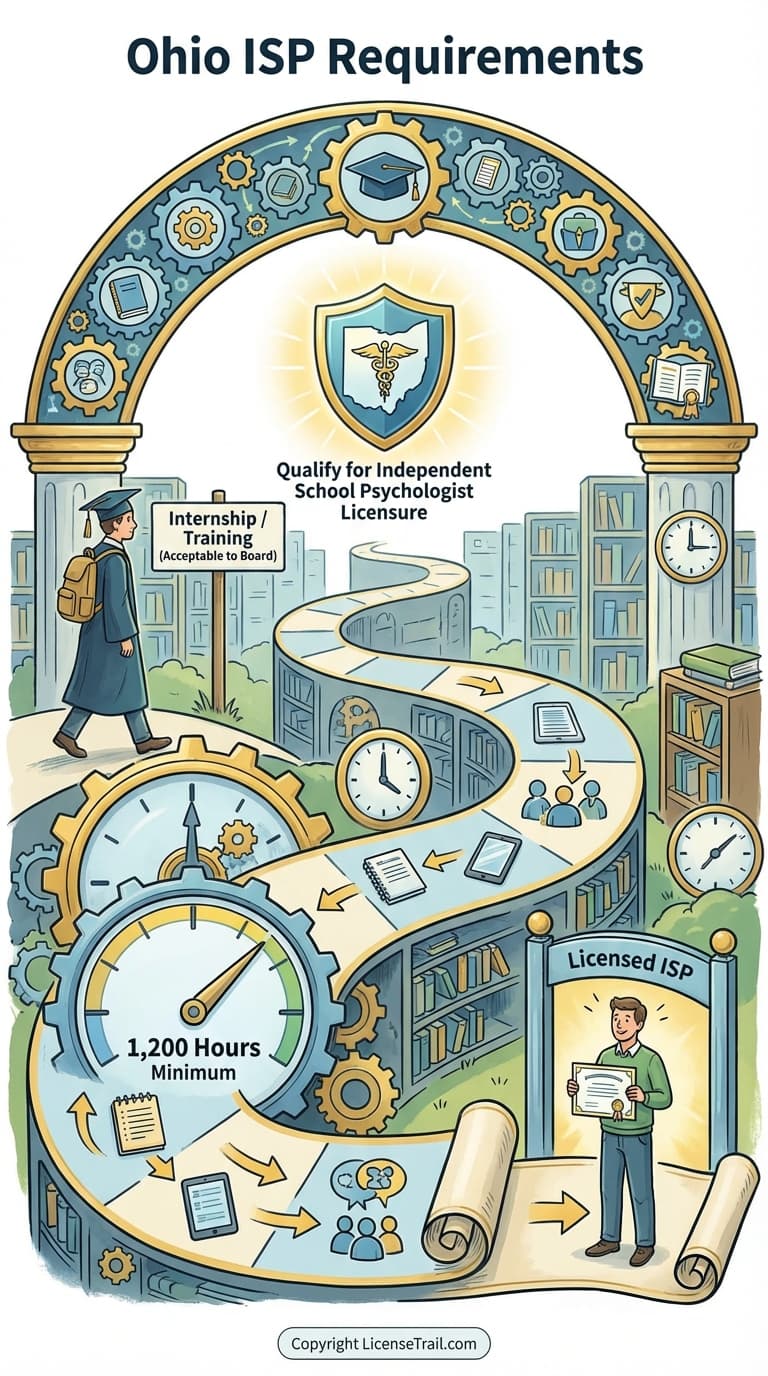
- Internship: 1 year, minimum 1,200 hours, in qualifying school-psychology activities with appropriate supervision
- Post-internship: 27 months full-time as a certificated school psychologist, over 3 school years (each 9 months @ 35 hrs/week or equivalent; max 1 year credit per 12 months)
- Other requirements: criminal records check (fingerprints/BCI); pass Board-required exam(s) (incl. possible jurisprudence/ethics); $300 application fee; renewal biennially with 23 CE hours/2 years (incl. 4 ethics/culture-related)
License Details
Procedures
Licensure as a Licensed Independent School Psychologist (ISP) in Ohio is governed primarily by Chapter 4732 of the Ohio Revised Code and Chapter 4732‑9 of the Ohio Administrative Code. The license allows you to practice school psychology independently, outside of employment by a board of education or approved private school, under the authority of the Ohio State Board of Psychology. (codes.ohio.gov)
Below is a step‑by‑step guide organized around what the statutes and rules actually say, with emphasis on the hours and experience requirements.
1. What “Licensed Independent School Psychologist” Means in Ohio
Ohio law distinguishes:
- School psychologist – practices school psychology within employment by a board of education or qualifying private school or certain disability programs. (codes.ohio.gov)
- Independent school psychologist – practices school psychology outside that employment context and “holds self out to the public” as an independent practitioner. (codes.ohio.gov)
A “licensed independent school psychologist” is simply a person holding a current, valid license to practice independent school psychology under Chapter 4732. (codes.ohio.gov)
2. Minimum Educational Requirements
Ohio Revised Code 4732.10(C) and Ohio Admin. Code 4732‑9‑02 set the baseline education for an independent school psychologist license: (law.justia.com)
-
Graduate degree
- At least a master’s degree in school psychology, or
- A graduate degree “considered equivalent” by the Board.
-
Accredited institution
- The degree must be from an institution that is fully accredited or in “candidate for accreditation” status, subject to time limits. (law.cornell.edu)
-
Graduate coursework hours
- You must have at least 90 graduate quarter hours or 60 graduate semester hours of coursework (practica may be included) relevant to the study of school psychology. (law.cornell.edu)
-
Required content areas
Rule 4732‑9‑02 further specifies that this 90 quarter/60 semester hours must cover, among others: (law.cornell.edu)- Science of human development
- Science of psychology and education
- Social‑emotional development
- Standardized group measurement
- Program design
- Statistics and research design
- Psychoeducational assessment of children (with practicum)
- Functional and curricular assessment of behavior and learning
- Consultation
- Intervention and remedial techniques based on assessment data
Plus coursework in at least three additional areas (e.g., role and function of the school psychologist, curriculum and instruction, organization and operation of schools, educational administration, emerging technologies).
-
Age
- You must be at least 21 years of age. (law.justia.com)
3. Overall Experience Structure: Four Years Total
Ohio uses a four‑year school psychology experience model, not a simple “X direct hours + Y supervised hours” format.
The key structure in rule and statute is: (law.justia.com)
- Four years of school psychology experience total,
- One of those four years must be a school psychology internship (or comparable training),
- At least 27 months of full‑time post‑internship experience as a certificated school psychologist (that is, about three school years), and
- Specific minimum time commitments per year (months and hours per week).
The Board defines both the internship hours and the full‑time work expectations in its rules, which are summarized next.
4. Internship Requirement – “No Less Than Twelve Hundred Hours”
Rule 4732‑9‑02(C) states that the four years of experience must include “one year of school psychology internship of no less than twelve hundred hours” or other training acceptable to the Board. (law.cornell.edu)
Key points about the internship:
- Minimum hours:
- 1,200 hours total (this is the one place where the rules use a specific hour number).
- Role and activities:
- Your internship year must involve school psychology activities such as:
- Evaluation/diagnosis/test interpretation related to learning problems,
- Intervention and counseling for educationally related learning issues (including emotional/behavioral aspects),
- Educational or vocational consultation and direct educational services. (codes.ohio.gov)
- Your internship year must involve school psychology activities such as:
- Setting and supervision:
- The internship or other acceptable training must be in:
- A school psychology internship (often in school settings), or
- “Other training experience acceptable to the board,” under supervision of a licensed psychologist or (independent) school psychologist, meeting supervision rules in Chapter 4732‑13. (codes.ohio.gov)
- The internship or other acceptable training must be in:
This internship year counts as one of the four required years of school psychology experience.
5. Post‑Internship Experience – “Twenty‑Seven Months … of Full‑Time Experience”
In addition to the internship, Ohio law requires substantial post‑internship experience.
5.1 Statutory requirement
Current versions of Revised Code 4732.10 provide that an applicant must: (law.justia.com)
furnish proof of at least twenty‑seven months, exclusive of internship, of full‑time experience as a certificated school psychologist employed by a board of education or qualifying private school, or experience the Board deems equivalent.
This 27‑month requirement is separate from and in addition to the 1,200‑hour internship.
5.2 How the Board converts this into “years” and weekly hours
Rule 4732‑9‑03(B) explains how the 27 months and four years are computed: (codes.ohio.gov)
- Four years of required experience (including the internship year), as described in rule 4732‑9‑02(C).
- Each of those four years must include “at least nine months’ full‑time work at thirty‑five hours per week or the equivalence of same in part‑time work” (quoted phrase from the rule).
- The twenty‑seven months of full‑time experience (exclusive of internship) must be “distributed over a period of at least three school years of nine months each.”
- You cannot receive credit for more than one year of experience in any twelve‑month period.
5.3 What that means in approximate hours
While the Board itself describes this in terms of months and hours per week, you can translate it approximately:
- Internship
- Minimum of 1,200 hours.
- Each non‑internship “year”
- At least 9 months × 35 hours/week.
- If you approximate 4 weeks per month, that’s ~1,260 hours per year minimum.
- Total post‑internship full‑time
- Three such school years (27 months) ≈ 3 × 1,260 ≈ 3,780 hours of full‑time work as a certificated school psychologist.
The Board, however, enforces this as 27 months / three 9‑month school years at 35 hours per week (or equivalent), not as a single numeric “X hours” figure in rule text.
6. What Counts as Acceptable Experience and Supervision
Rule 4732‑9‑02(C) and related supervision rules specify the nature and setting of acceptable experience. (law.cornell.edu)
6.1 Required types of activities
Your four years of school psychology experience (internship + other years) must involve one or more of these activity types:
- Evaluation/diagnosis/test interpretation focused on:
- Intellectual ability
- Learning patterns and achievement
- Motivation
- Social‑emotional or behavioral factors directly related to learning.
- Intervention services, including counseling, aimed at:
- Amelioration or prevention of educationally related learning problems, including emotional/behavioral aspects.
- Educational or vocational consultation or direct educational services (but not industrial consultation or counseling in vocational rehabilitation contexts).
6.2 Where the experience must occur
- At least half of the four years (two years) must be within the scope of employment as a school psychologist:
- Employed by a board of education, or
- Employed by a private school meeting applicable state/provincial standards. (codes.ohio.gov)
- Experience outside that context can still count if:
- It is school‑psychology work, and
- It is under appropriate professional supervision (see below).
6.3 Supervision requirements for non‑school‑employment experience
Any qualifying training/experience outside direct employment by a school must: (codes.ohio.gov)
- Be supervised by:
- A psychologist or school psychologist licensed by the Ohio Board of Psychology, or
- A psychologist or school psychologist licensed in another U.S. state/territory, D.C., or Canadian province, or
- A person eligible for such licensure if the supervisee is a federal employee exempt from state licensing.
- Meet supervision standards in rules 4732‑13‑01 through 4732‑13‑04 (covering definitions of supervision, frequency, documentation, and telepsychology aspects).
7. Criminal Records Check
In addition to education and experience, all applicants for initial licensure (psychologist, independent school psychologist, or licensed school psychologist) must complete a criminal records check under Rule 4732‑9‑04 and Revised Code 4732.091. (codes.ohio.gov)
- You must submit fingerprints and the required form to the Bureau of Criminal Identification and Investigation.
- The Board receives the results directly from the Bureau and will not issue a license if, in its discretion, the background check renders you ineligible.
- You bear all associated costs.
8. Examination Requirements
Once you meet the education and experience prerequisites, you must be admitted to and pass the licensing exam.
8.1 Admission to examination
-
Section 4732.10 and Rule 4732‑9‑02 together specify that, once the entrance examiner finds you meet:
- Age 21+,
- Required degree and coursework,
- Four years of qualifying school psychology experience (including the 1,200‑hour internship and 27 months of full‑time certificated employment),
you are admitted to the examination for an independent school psychologist license. (law.justia.com)
8.2 Nature of the exam
Under Revised Code 4732.11(B): (codes.ohio.gov)
- You must earn a score acceptable to the Board on an examination selected by the Board for independent school psychologist licensure.
- The Board may also require you to pass an exam covering:
- Chapter 4732 of the Revised Code,
- Board rules under that chapter,
- Related statutes,
- Professional ethical principles, and
- Professional standards of care.
- This additional exam may be oral or written.
The Board’s website and application materials specify the current examination format and procedures.
9. Application, Fees, and Issuance of License
9.1 Application and fees
- Under Revised Code 4732.09, an applicant must file a written, sworn application on a Board form to practice independent school psychology. (codes.ohio.gov)
- Revised Code 4732.15 requires a $300 license application fee (non‑refundable). (codes.ohio.gov)
9.2 Issuance of license
After you have:
- Met the education and experience requirements,
- Passed the required exam(s), and
- Paid the license fee,
the Board “shall issue the appropriate license” under 4732.12 (psychologist, independent school psychologist, or school psychologist). (codes.ohio.gov)
10. Reciprocity / Licensure by Endorsement
If you are already licensed as a psychologist, school psychologist, or independent school psychologist in another jurisdiction, you may qualify for licensure in Ohio through endorsement:
- Rule 4732‑7‑01 allows the Board to issue a license to applicants licensed or certified in another state, territory, or D.C., or who hold an ABPP diploma, if they: (codes.ohio.gov)
- Meet the applicable requirements of 4732.10 and relevant Board rules (4732‑9‑01 or 4732‑9‑02), as evidenced by national credentials (e.g., CPQ, ABPP, National Register), and
- Pass the Ohio Board’s jurisprudence/ethics examination under rule 4732‑11‑01(E).
Specific documentation and pathways are spelled out in the Board’s application instructions for out‑of‑state licensees.
11. Renewal and Continuing Education for ISPs
Once licensed as an independent school psychologist:
-
Registration cycle and fee
- Revised Code 4732.14 requires biennial registration (every even‑numbered year) for licensed psychologists and licensed independent school psychologists.
- A biennial registration fee is specified (currently $365 in statute). (codes.findlaw.com)
-
Continuing education
- Under 4732.141(A)(1)(a), every independent school psychologist must complete at least 23 hours of continuing education in psychology every two years, including at least 4 hours in:
- Professional conduct,
- Ethics, and/or
- The role of culture/ethnic identity in psychological assessment, consultation, or interventions. (codes.ohio.gov)
- You certify CE completion when you file your biennial registration.
- Under 4732.141(A)(1)(a), every independent school psychologist must complete at least 23 hours of continuing education in psychology every two years, including at least 4 hours in:
Failure to comply can lead to non‑renewal, suspension, or other Board action.
12. Summary of the Key Hour‑ and Time‑Based Requirements
Putting the time components together, the Ohio State Board of Psychology’s framework for ISP licensure is:
- Graduate education
- Minimum 90 quarter / 60 semester graduate hours in school‑psychology–relevant coursework.
- Experience
- Internship year
- One year of school psychology internship of no less than 1,200 hours, in school psychology roles under appropriate supervision.
- Post‑internship experience
- At least 27 months (three 9‑month school years) of full‑time experience as a certificated school psychologist:
- Each year includes at least 9 months of 35 hours per week (or part‑time equivalent).
- Practically, this is roughly 3,780+ hours of post‑internship full‑time school psychology work, though the rules themselves speak in months and 35‑hour weeks, not in a single hour total.
- At least 27 months (three 9‑month school years) of full‑time experience as a certificated school psychologist:
- Total span
- A four‑year sequence of school psychology experience (internship year + three years of certificated school psychologist employment), with no more than one “year” credited in any 12‑month period.
- Internship year
Ohio does not divide these into separate “direct service hours vs supervised hours” in the way some states require, beyond specifying:
- A 1,200‑hour supervised internship year; and
- Three additional school years (27 months) of full‑time certificated school psychologist work that meet Board definitions of school psychology practice and supervision. (law.cornell.edu)
Track your ISP hours with confidence
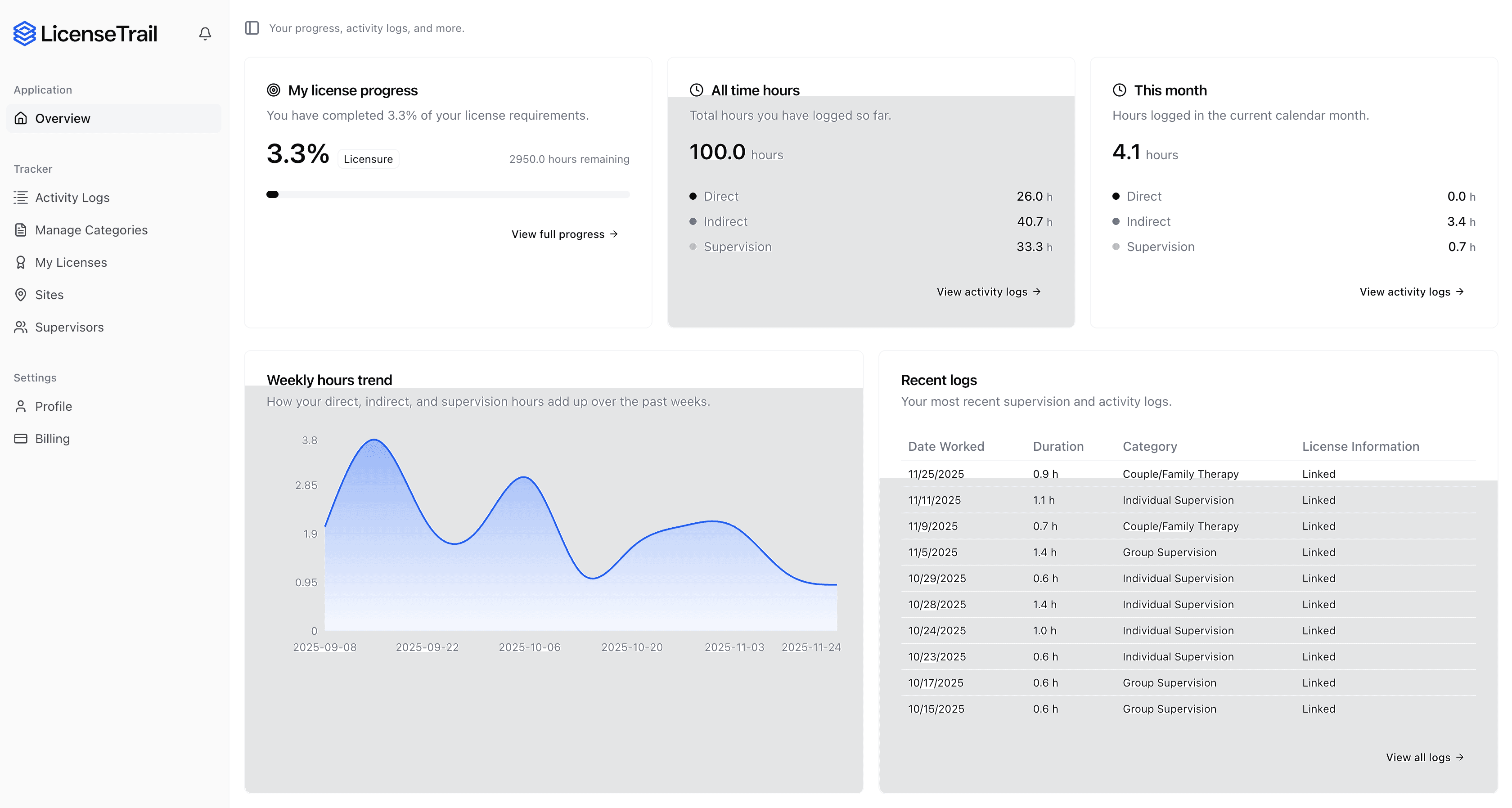
License Trail checks your direct, indirect, and supervision hours against Ohio ISP requirements continuously and flags mismatches before you submit.
 Start Tracking for Free
No credit card required · Free plan available
Is your spreadsheet hiding Ohio ISP risks?
Stop guessing if your categories match Ohio State Board of Psychology requirements. License Trail checks your direct, indirect, and supervision hours continuously and flags mismatches before you submit.
Import or log
Bring your spreadsheet or start fresh
Upload your existing tracking spreadsheet and we'll map every hour into the right Ohio State Board of Psychology categories automatically.
Verify against Ohio
Catch mismatches before the board does
License Trail checks your direct, indirect, and supervision hours against Ohio ISP requirements continuously.
Export board-ready
One-click clean reports
Generate professional, board-ready reports for supervision meetings and Ohio State Board of Psychology submissions in seconds.
No credit card required · Free plan available