
Ohio PSY Requirements: Hours, Exams & Step-by-Step Guide
Stop guessing if your categories match Ohio requirements. License Trail checks your direct, indirect, and supervision hours against PSY requirements continuously and flags mismatches before you submit.
No credit card required · Free plan available
Quick Requirements Overview
- Age ≥21 and doctoral degree in psychology/school psychology from APA/CPA-accredited or ASPPB/NR-designated program (NASP approval for school psych doctorates)
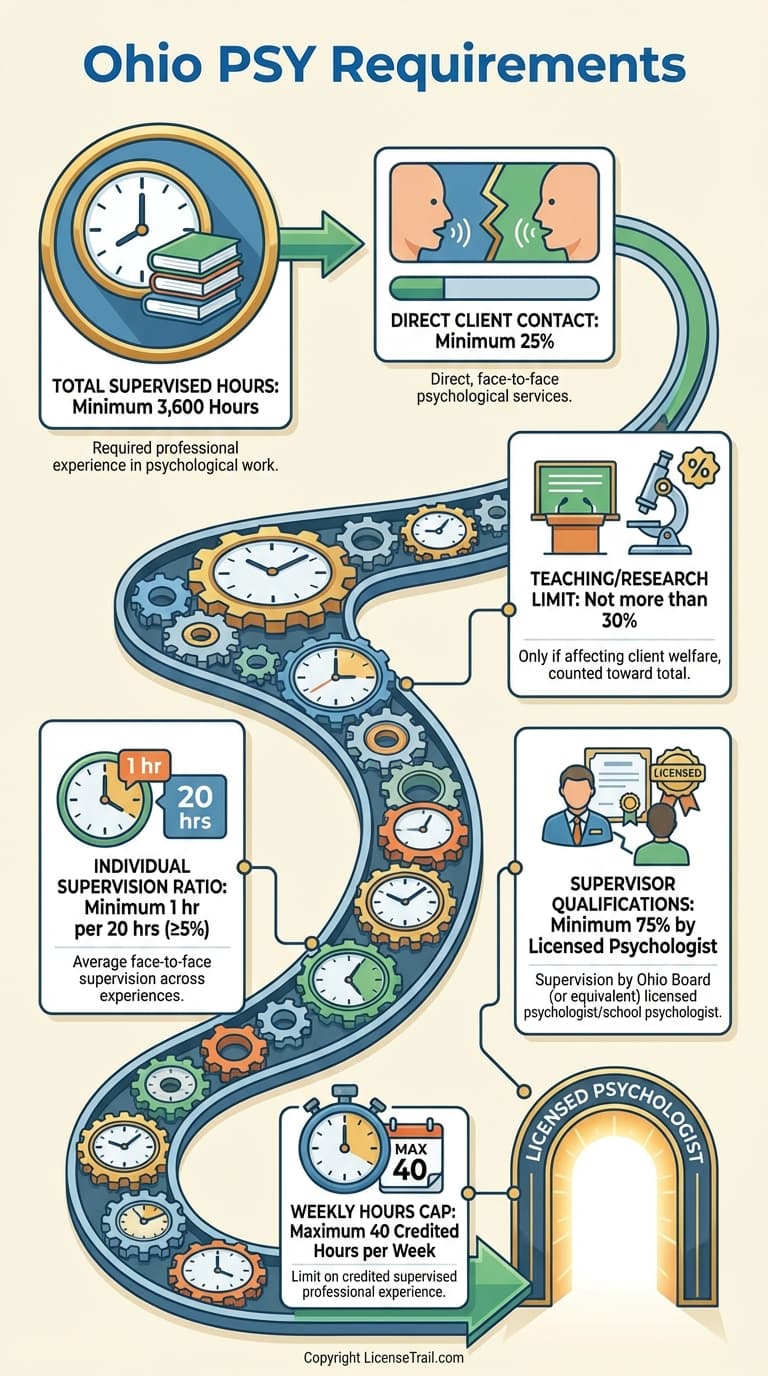
- Complete 3,600 hours (2 years) of supervised professional experience; 1 year = 1,800 hours
- Time-credit limits: max 40 hrs/week credit; no more than 1 year credit per any 12-month period; part-time can meet 1,800 hrs over ≤3 calendar years
- One supervised year must be a predoctoral internship (1,500–2,000 hrs, 12–24 months; ≥9 months for school psych)
- Direct service minimum: typically ≥25% of placement time in face-to-face client/patient services
- Supervision minimum: ≥1 hr individual face-to-face supervision per 20 hrs (advanced doctoral placements: 1 per 10); ≥75% supervision by licensed psychologist/school psychologist
- Training/learning activities: internship avg ≥2 hrs/week didactics; other sequences avg ≥1 hr/week additional learning activities
- Exams: eligible for EPPP after degree + qualifying internship; Ohio oral/jurisprudence exam after Board deems full 3,600-hr sequence sufficient (plus required background check)
License Details
Procedures
Becoming a Licensed Psychologist (PSY) through the Ohio Board of Psychology centers on a specific supervised‑experience sequence totaling 3,600 hours, plus required exams. The Board’s rules are contained in Ohio Administrative Code (OAC) Chapter 4732‑9 and related sections, most recently updated in late 2023 and early 2025. (codes.ohio.gov)
1. Basic eligibility
To be admitted to the psychologist licensure examination in Ohio, you must:
- Be at least 21 years old. (codes.ohio.gov)
- Hold an earned doctoral degree in psychology or school psychology from an appropriately accredited or designated program (APA, CPA, ASPPB/NR designation, or NASP approval for school psych doctorates). (codes.ohio.gov)
The Board’s rule states that, in addition to the doctoral degree, applicants must have “at least two years (thirty six hundred hours total) of supervised professional experience in psychological work of a type satisfactory to the board.” (codes.ohio.gov)
2. The core requirement: 3,600 hours of supervised psychological experience
Total volume and time frame
For standard psychologist licensure, Ohio requires:
- Total supervised experience: 3,600 hours (described as two years of supervised professional experience). (codes.ohio.gov)
- Definition of a “year” of experience:
Under OAC 4732‑9‑03, each year of supervised professional experience must include at least 1,800 hours of work completed:- Either within a single calendar year, or
- As part‑time work totaling at least 1,800 hours over no more than three calendar years. (codes.ohio.gov)
No applicant can receive credit for more than one year of supervised training in any 12‑month period, and 40 hours per week is the maximum that can be credited. (codes.ohio.gov)
Key point: All 3,600 hours must be supervised professional experience. Within those hours, the Board specifies minimum proportions of direct (face‑to‑face) client contact and supervision, but it does not split the sequence into “direct” versus “indirect” hours in fixed numerical blocks like 1,500 vs. 1,500. Instead, it structures the types of placements and their ratios.
3. Standard pathway (doctoral program accredited by APA/CPA/ASPPB/NR, OAC 4732.10(B)(2)(a))
For graduates of a Board‑recognized accredited or designated doctoral program, the 3,600 hours are generally built from:
- A qualifying pre‑doctoral internship, and
- A second supervised training sequence (post‑internship/postdoctoral and/or advanced doctoral placements).
3.1 Pre‑doctoral internship (required year)
OAC 4732‑9‑01(B)(1) requires that one of the two supervised‑experience years be a pre‑doctoral internship that meets specific criteria. Key expectations for an internship not automatically covered by APA/APPIC/CPA accreditation include: (codes.ohio.gov)
-
Hour range and duration
- Minimum 1,500 hours and maximum 2,000 hours.
- Completed in no less than 12 months and no more than 24 months (or a minimum of nine months for school psychology internships). (codes.ohio.gov)
-
Setting and structure
- Occurs in a practice, agency, institution, or similar setting that provides psychological or school psychological services.
- Must be a planned, structured, programmed sequence with depth and breadth beyond pre‑internship training.
-
Supervisory responsibility
- A clearly designated doctoral‑level psychologist or school psychologist, licensed in the jurisdiction where the internship occurs, is responsible for the integrity and quality of the internship and has an obvious presence at the site. (codes.ohio.gov)
-
Direct client contact requirement
- At least 25% of the intern’s time must be documented as face‑to‑face psychological services to patients/clients. (codes.ohio.gov)
-
Supervision ratios
- Regularly scheduled individual weekly face‑to‑face supervision at no less than 1 hour for every 20 internship hours.
- At least 75% of the individual supervision must be provided by a licensed psychologist or licensed school psychologist; up to 25% may be provided by other licensed mental health professionals (e.g., psychiatrists, professional clinical counselors, clinical social workers) or by a qualified post‑doctoral trainee under an umbrella supervision arrangement. (codes.ohio.gov)
-
Didactic and learning activities
- An average minimum of two hours per week in didactic activities such as seminars, case presentations, in‑service training, guided readings, or additional individual/group supervision. (codes.ohio.gov)
How this counts: This internship year typically contributes 1,500–2,000 supervised hours toward the 3,600‑hour sequence and is counted by the Board as one “year” of supervised professional experience.
3.2 Second supervised training sequence (remaining hours toward 3,600)
After counting the internship year, the applicant must complete a second sequence of supervised training experiences to reach the 3,600‑hour total. OAC 4732‑9‑01(B)(2) allows several combinations: (codes.ohio.gov)
-
Accredited postdoctoral training program
- Completion of a postdoctoral psychology training program accredited by APA or holding APPIC membership can supply part or all of the remaining supervised hours.
-
Post‑internship (including postdoctoral) training experiences
-
These may occur in the same or a different site from the internship but must:
- Be planned, structured, and programmed.
- Occur in a setting that provides psychological services.
- Use experiential supervised psychological service delivery as the primary training method. (codes.ohio.gov)
-
Face‑to‑face client contact: On average, at least 25% of weekly placement time must be scheduled as face‑to‑face patient/client contact. (codes.ohio.gov)
-
Supervision: Weekly individual face‑to‑face supervision devoted to the trainee’s cases must be provided at no less than 1 hour per 20 hours on site, with at least 75% of supervision by a licensed psychologist or licensed school psychologist. (codes.ohio.gov)
-
Additional learning: There must be, on average, at least one additional hour per week of learning activities (e.g., additional supervision, seminars, case conferences, guided readings). (codes.ohio.gov)
-
Teaching and research: Graduate‑level teaching or research directly affecting client welfare may count as part of the training up to 30% of total training time, but cannot replace the required direct client contact hours. (codes.ohio.gov)
-
-
Advanced doctoral training placements (“pre‑licensure” placements)
Some of the 3,600 hours can be met through advanced doctoral placements that occur before graduation, if they meet detailed criteria in OAC 4732‑9‑01(B)(2)(c). In summary: (codes.ohio.gov)- They must be part of a minimum 1,600‑hour training sequence of doctoral program placements.
- They must:
- Follow at least 48 semester hours (or 72 quarter hours) of graduate coursework taken for credit with satisfactory evaluation.
- Follow at least 400 hours of introductory practicum in applied professional psychology documented on graduate transcripts.
- Placements:
- Are outside the classroom (e.g., counseling centers, clinics, agencies).
- Generally last no less than 30 weeks with at least 15 on‑site hours per week.
- Require at least 25% of weekly time in face‑to‑face patient/client contact.
- Require weekly face‑to‑face supervision at no less than 1 hour per 10 hours on site, with at least half of that supervision as individual supervision by a licensed psychologist or licensed school psychologist.
- Include at least one additional hour per week in didactic/learning activities. (codes.ohio.gov)
These components (postdoctoral training, post‑internship placements, and qualifying doctoral placements) can be combined, as long as the total supervised experience reaches 3,600 hours, arranged in years as defined by OAC 4732‑9‑03 (1,800 hours per credited year, without exceeding one year of credit per any 12‑month period). (codes.ohio.gov)
4. Other supervision and experience pathways
4.1 Non‑accredited or non‑designated doctoral programs (OAC 4732.10(B)(2)(b) and (c))
Applicants whose doctoral programs are not accredited/designated by APA/CPA/ASPPB/NR must still demonstrate two years of supervised professional experience, “at least one year of which shall be subsequent to attainment of the doctoral degree.” (codes.ohio.gov)
Those post‑doctoral hours must meet the same structural and quality criteria described above: organized training sequence, appropriate setting, 25% face‑to‑face client contact, specified supervision ratios, and additional learning activities. (codes.ohio.gov)
4.2 Reciprocity and senior Canadian psychologists
Ohio also has routes for:
- Senior Canadian psychologists, who may be exempt from supervised‑experience rules if they demonstrate at least ten years of unrestricted independent licensure and satisfy other conditions. (codes.ohio.gov)
- U.S. license reciprocity, where an independently licensed psychologist from another state can be licensed in Ohio if that license is based on a qualifying doctoral degree, at least 3,000 hours of supervised experience, and a passing EPPP score, plus Ohio’s jurisprudence exam and background check. (codes.ohio.gov)
These alternative routes modify how prior supervised hours are accepted, but the underlying standard Ohio applies to new licensees is still built around the 3,600‑hour supervised training sequence.
5. Exam requirements linked to experience
OAC 4732‑9‑03 ties experience to exam eligibility: (codes.ohio.gov)
-
EPPP (Examination for Professional Practice in Psychology)
- The Board may admit psychology licensure candidates to the EPPP after it determines they have completed a qualifying doctoral degree and the required internship. (codes.ohio.gov)
- The passing score is set by the Board, in consultation with the Association of State and Provincial Psychology Boards (ASPPB).
-
Oral / jurisprudence examination
- The 3,600‑hour professional training sequence must be deemed sufficient by the Board before the candidate is admitted to the required oral examination on Ohio law and professional standards. (codes.ohio.gov)
6. How the hours actually look in practice
Putting the rules into a typical path for an APA‑accredited doctoral graduate:
-
Pre‑doctoral internship
- 1,500–2,000 hours over 12–24 months (minimum 9 months for school psych), counting as one year of supervised professional experience.
- At least 25% face‑to‑face psychological services; supervision 1 hour per 20 hours; majority of supervision by licensed psychologists. (codes.ohio.gov)
-
Second supervised year
- An additional 1,800 hours of qualifying supervised training (postdoctoral fellowship, post‑internship position, advanced doctoral placements, or a combination), arranged so that:
- The year is defined as ≥1,800 hours over no more than one calendar year full‑time or up to three years part‑time.
- The same minimums apply: 25% face‑to‑face client contact in placements, required supervision ratios, and weekly learning activities. (codes.ohio.gov)
- An additional 1,800 hours of qualifying supervised training (postdoctoral fellowship, post‑internship position, advanced doctoral placements, or a combination), arranged so that:
-
Total
- Internship + second sequence = 3,600 hours (“thirty six hundred hour professional training sequence”) before you can sit for the Ohio oral exam.
7. Step‑by‑step planning guide
Step 1 – Confirm doctoral program eligibility
- Enroll in or complete a doctoral program in psychology or school psychology that is APA/CPA‑accredited or ASPPB/NR‑designated (or meets the non‑accredited criteria) and verify that your program’s internships and placements are designed to meet OAC 4732‑9‑01 requirements. (codes.ohio.gov)
Step 2 – Plan your supervised experience sequence
Target a plan that clearly documents:
-
Pre‑doctoral internship year
- 1,500–2,000 hours
- 25% or more face‑to‑face client contact
- ≥1 hour individual supervision per 20 hours on site
- Didactic and learning activities as required
-
Second supervised year
- At least 1,800 additional supervised hours through:
- Postdoctoral fellowship or structured post‑internship experiences, and/or
- Qualifying doctoral training placements that meet the Board’s hour, supervision, and structure requirements.
- At least 1,800 additional supervised hours through:
Document for each placement:
- Total hours and dates (to show the 1,800‑hour “year” definition is met).
- Percentage of face‑to‑face client contact (must reach at least 25%).
- Supervision hours and who provided them (to show ratios and licensure status).
Step 3 – Apply to take the EPPP once degree and internship are complete
- When the Board verifies your doctoral degree and qualifying internship, you can be admitted to the EPPP. (codes.ohio.gov)
Step 4 – Complete the full 3,600‑hour sequence
- Finish your remaining supervised hours (postdoctoral/post‑internship and/or advanced doctoral placements), ensuring they meet:
- At least 25% direct client contact,
- Required supervision ratios,
- Required learning activities. (codes.ohio.gov)
Step 5 – Sit for Ohio’s oral/jurisprudence exam and complete background checks
- After the Board determines your 3,600‑hour sequence is sufficient, you become eligible for the oral exam on Ohio law and ethics and must complete the criminal records check before licensure. (codes.ohio.gov)
In Ohio’s terminology, the centerpiece of psychologist licensure is a “thirty six hundred hour professional training sequence” of supervised professional experience in psychological work of a type satisfactory to the board, built from a qualifying internship plus additional supervised training that meets strict requirements for client‑contact proportions and supervision intensity. (codes.ohio.gov)
Track your PSY hours with confidence
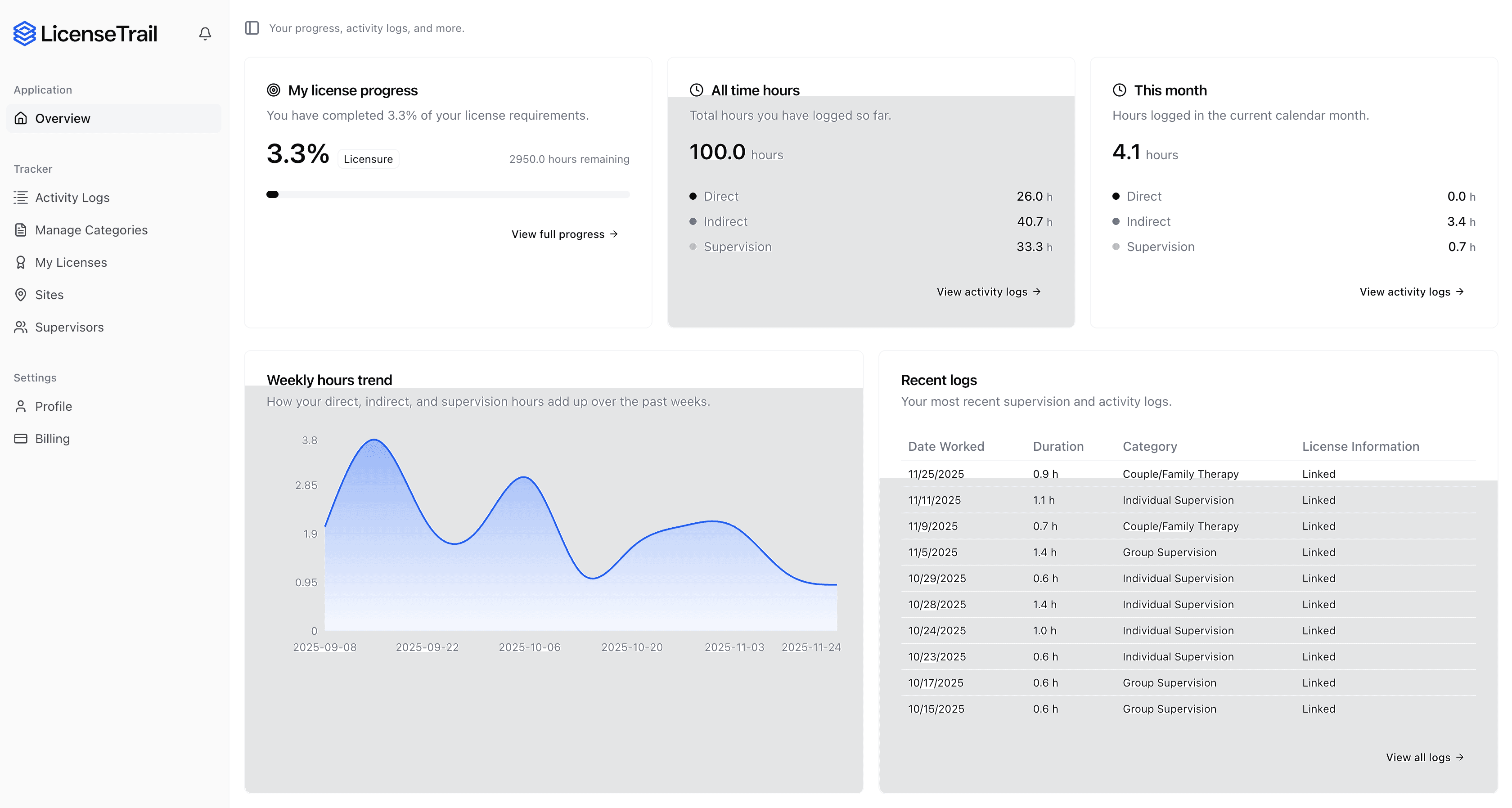
License Trail checks your direct, indirect, and supervision hours against Ohio PSY requirements continuously and flags mismatches before you submit.
 Start Tracking for Free
No credit card required · Free plan available
Is your spreadsheet hiding Ohio PSY risks?
Stop guessing if your categories match Ohio State Board of Psychology requirements. License Trail checks your direct, indirect, and supervision hours continuously and flags mismatches before you submit.
Import or log
Bring your spreadsheet or start fresh
Upload your existing tracking spreadsheet and we'll map every hour into the right Ohio State Board of Psychology categories automatically.
Verify against Ohio
Catch mismatches before the board does
License Trail checks your direct, indirect, and supervision hours against Ohio PSY requirements continuously.
Export board-ready
One-click clean reports
Generate professional, board-ready reports for supervision meetings and Ohio State Board of Psychology submissions in seconds.
No credit card required · Free plan available