
Oklahoma LBP Requirements: Hours, Exams & Step-by-Step Guide
Stop guessing if your categories match Oklahoma requirements. License Trail checks your direct, indirect, and supervision hours against LBP requirements continuously and flags mismatches before you submit.
No credit card required · Free plan available
Quick Requirements Overview
- Regulator: Oklahoma State Board of Behavioral Health Licensure (BBHL); governed by LBP Act (59 O.S. §§1930–1950) & OAC Title 86 Ch. 20
- Education: Master’s in psychology from regionally accredited school + 60 graduate semester hours (90 quarter) psychology/behavioral-science coursework
- Core coursework minimums: Assessment/Diagnosis 6; Intervention 9; Experimental Foundations 6; Psychopathology 6; Personality/Social 6 (incl. 3 multicultural); Ethics/Orientation 3; Biological Bases 3
- Degree practicum/internship: 300 clock hours (counts toward degree, not post-degree experience)
- Exam eligibility/app: Application+fee, practicum documentation, official transcripts (or verification), criminal background check; becomes LBP Candidate upon acceptance
- Exams: Practitioner’s Examination of Psychological Knowledge (or Board-equivalent) and LBP State Standards Test (OK law/rules)
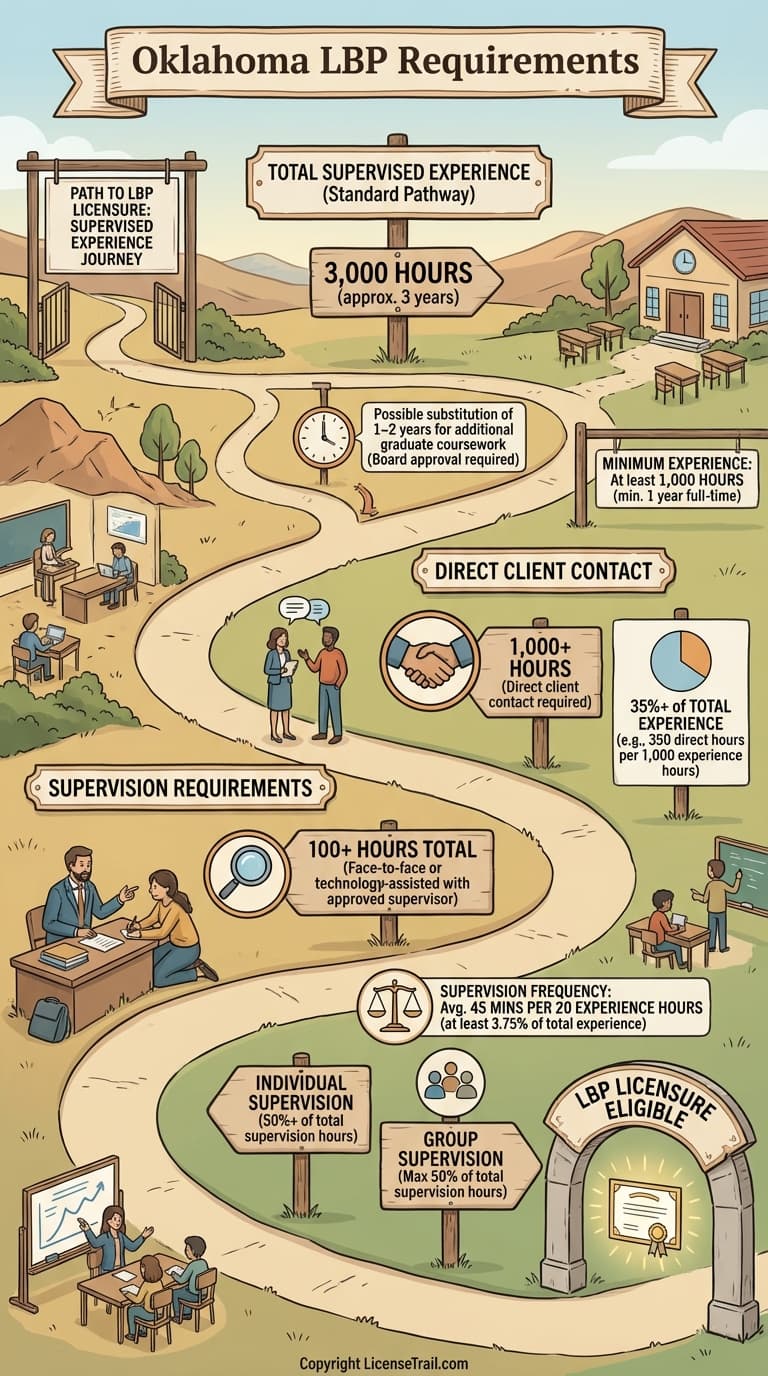
- Post-master supervised experience: 3,000 clock hours (or 3 years) supervised on-the-job; within it ≥1,000 direct client contact (and ≥350 direct/1,000 hours) + ≥100 supervision hours; supervision rate ≥45 min per 20 hours, ≤50% group
- Supervision admin/time limits: Board-approved Supervision Agreement required before hours count; complete experience within 60 months; semiannual evaluations/records required (late >60 days not credited)
License Details
Procedures
Becoming a Licensed Behavioral Practitioner (LBP) in Oklahoma involves meeting detailed academic, examination, and supervised‑experience requirements set by the Oklahoma State Board of Behavioral Health Licensure (BBHL) and by statute under the Licensed Behavioral Practitioner Act.
The sections below walk through those requirements, with emphasis on the exact types and amounts of hours the Board requires.
1. Oversight and Legal Framework
- Regulator: Oklahoma State Board of Behavioral Health Licensure (BBHL).
- Governing law: Licensed Behavioral Practitioner Act, 59 O.S. §§ 1930–1950.(law.justia.com)
- Implementing rules: Oklahoma Administrative Code (OAC) Title 86, Chapter 20, “Licensed Behavioral Practitioners,” especially:
- Subchapter 11 – Academic Requirements
- Subchapter 13 – Supervised Experience Requirement
- Subchapter 17 – Licensure Examination(law.cornell.edu)
2. Academic Requirements (Pre‑Licensure Education)
2.1 Degree and credit hours
The Board requires:
- At least a master’s degree from a program in psychology, from a regionally accredited college or university recognized by the U.S. Department of Education.(oklahoma.gov)
- Minimum 60 graduate semester hours (or 90 quarter hours) of behavioral‑science / psychology‑related coursework, including internship.(oklahoma.gov)
The Board further requires that the program:
- Be clearly identified in the catalog as a psychology program that trains master’s‑level practitioners.
- Have clearly described curriculum and psychology‑trained faculty.(oklahoma.gov)
2.2 Required coursework and practicum hours
The Board’s academic‑requirements page for LBP specifies minimum graduate semester hours in core behavioral areas (each course at least 3 semester credits unless otherwise noted):(oklahoma.gov)
-
Assessment and Diagnosis – at least 6 hours.
Measurement and assessment of psychological/behavioral functioning (e.g., psychopathology, personality, cognitive functioning). -
Intervention – at least 9 hours.
Empirically supported treatment modalities for behavioral/mental disorders and related adjustment problems. -
Experimental Foundations – at least 6 hours.
Research design, methods, and principles of experimental psychology. -
Psychopathology – at least 6 hours.
Descriptive characteristics, diagnosis, and etiology of mental and behavioral disorders. -
Personality and Social Psychology – at least 6 hours.
Individual and group differences and development; at least 3 of these hours must cover multicultural issues or cultural bases of behavior. -
Professional Orientation / Ethics – at least 3 hours.
Roles of behavioral health professionals, ethics, legal aspects of practice, and standards of preparation. -
Biological Bases of Behavior – at least 3 hours.
Physiological or genetic foundations of behavior. -
Practicum / Internship – at least 300 clock hours.
Organized practicum/internship providing a minimum of 300 clock hours of behavioral‑health services under university‑approved behavioral‑health supervisors.(oklahoma.gov)
Remaining coursework to reach 60 graduate hours can be electives drawn from these knowledge areas.
Important distinction:
These 300 practicum/internship hours are part of the degree and do not replace the separate 3,000‑hour supervised experience required after (or alongside) the degree for licensure.
3. Application and Eligibility to Sit for the LBP Exam
Under the LBP rules, you become an LBP Candidate once your application is accepted. An LBP Candidate is defined as an individual whose application has been accepted and who is under supervision for licensure as provided in the Act.(s3.amazonaws.com)
To be allowed to sit for the licensure examination, OAC 86:20‑17‑1.1 requires submission of:(s3.amazonaws.com)
- Application form and fee.
- Practicum/Internship Documentation Form.
- Official transcripts showing completion of all academic requirements listed in OAC 86:20‑11‑2 (the academic‑requirements rule), or a Board‑approved “Verification of Academic Standing” if you are about to graduate.
- Completed criminal background check.
The Board will not consider exam scores obtained before the date of application for certain re‑application situations; for new applicants you must meet the exam requirements specified by current rules and the Act.(s3.amazonaws.com)
4. Examination Requirements
State law (59 O.S. § 1935) requires LBP applicants to pass an examination under standards set by the Board.(law.justia.com)
Board rules specify two required exams for LBP licensure:
- Practitioner’s Examination of Psychological Knowledge (or another equivalent exam as determined by the Board).
- LBP State Standards Test (an Oklahoma jurisprudence / standards exam specific to LBP law and rules).(law.cornell.edu)
These two exams also appear whenever an application has to be restarted (e.g., when an application is voided for inactivity), which confirms they are the standard testing requirements for LBP.(law.cornell.edu)
5. Post‑Master Supervised Experience: Exact Hours and Structure
The supervised experience requirement is where most of the hour‑count detail appears. The key provisions are in OAC 86:20‑13‑2 and 86:20‑13‑5, as amended effective July 25, 2024.(s3.amazonaws.com)
5.1 Total supervised on‑the‑job experience
OAC 86:20‑13‑2(A) requires:
- Three (3) years OR 3,000 clock hours of full‑time, on‑the‑job experience, and
- All of that experience must be supervised by an approved LBP supervisor.(regulations.justia.com)
The Board defines “on‑the‑job experience” as actually performing behavioral‑health services described in the Act: applying psychological and mental‑health principles to assess, diagnose, and treat mental, emotional, or behavioral disorders; carrying out treatment plans; using behavioral treatment interventions; and related behavioral‑health research/consulting tasks in a professional therapeutic context.(s3.amazonaws.com)
The rules also define “full‑time practice” as at least five (5) hours per week of such work.(s3.amazonaws.com)
5.2 Direct client contact hours (within the 3,000 hours)
The rules break down those 3,000 clock hours as follows:
-
Minimum direct‑client hours.
- Within the 3,000 on‑the‑job hours, at least 1,000 hours must be “direct client contact” and count as direct clinical work with clients.(regulations.justia.com)
-
Ratio requirement (350 per 1,000).
- The July 25, 2024 rulemaking further specifies that for each 1,000 on‑the‑job hours, at least 350 hours must be direct client contact.(s3.amazonaws.com)
- If you complete the full 3,000 hours under this ratio, you will accrue at least about 1,050 direct client‑contact hours, which also satisfies the “minimum 1,000” requirement.
-
Definition of direct client contact.
- “Direct Client Contact Hours” are defined in the Board’s rules as performing therapeutic/clinical functions—diagnosis, assessment, and treatment of mental, emotional, and behavioral disorders—primarily through verbal interaction in the presence of one or more clients.(s3.amazonaws.com)
- In practice, this means actual face‑to‑face (or live telehealth, where allowed) clinical sessions, not staff meetings, record‑keeping, or training.
In plain numbers:
- Total supervised on‑the‑job experience: 3,000 hours
- Within that, minimum direct client contact: 1,000 hours (practically ≥ 1,050 under the 350‑per‑1,000 ratio)
- Remaining hours (approximate): up to ~2,000 hours can be other qualifying on‑the‑job behavioral‑health activities (documentation, consultation, testing, treatment planning, etc.), plus dedicated supervision time (see below).
5.3 Supervision hours (within the 3,000 hours)
The same rule also requires explicit supervision hours:
-
Minimum total supervision hours.
- At least 100 hours of face‑to‑face or technology‑assisted supervision must be included within the 3,000 supervised on‑the‑job hours.(regulations.justia.com)
-
Weekly supervision ratio.
- Weekly supervision with a Board‑approved LBP supervisor must be provided at a minimum of 45 minutes of supervision for every 20 hours of on‑the‑job experience.(s3.amazonaws.com)
- If you accrued exactly 3,000 on‑the‑job hours at that ratio, you would receive about 112–113 hours of supervision, which exceeds the 100‑hour minimum.
-
Individual vs. group supervision.
- No more than one‑half of your required supervision hours may be in group supervision.(s3.amazonaws.com)
- Group supervision is defined as 2–6 candidates with one supervisor; individual supervision is one candidate with one supervisor.(law.cornell.edu)
-
Technology‑assisted supervision.
- Supervision by secure video (technology‑assisted supervision) is allowed only if the Board has approved it in advance, considering factors such as distance, hardship, and supervisor specialty.(law.cornell.edu)
5.4 What counts as acceptable supervised experience
Under OAC 86:20‑13‑5, supervised experience is acceptable when:(law.cornell.edu)
- It consists of the performance of behavioral‑health services as described in the Act (assessment, diagnosis, treatment, behavioral interventions, etc.).
- Supervision focuses on the raw data of the candidate’s clinical practice (e.g., direct observation, co‑therapy, progress notes, audio/video recordings).
- Supervision is clearly distinguishable from personal psychotherapy and is structured around professional/clinical goals.
Settings where supervised hours may be accrued:
- Academic, governmental, or private‑practice settings are all allowed.(law.cornell.edu)
- In private for‑profit or not‑for‑profit practice:
- The candidate must be an employee of an agency that employs an appropriately licensed mental‑health professional (LPC, LMFT, LBP, psychologist, psychiatrist, clinical social worker, or LADC) who directs and is responsible for the candidate’s professional duties and is available whenever the candidate provides services.
- Formal LBP supervision for licensure can be provided by an approved LBP supervisor who does not have to be at the same physical location as the candidate.(law.cornell.edu)
5.5 Supervisor qualifications
LBP supervisors must meet specific criteria, including:(law.cornell.edu)
- Be licensed in Oklahoma as a Behavioral Practitioner, Professional Counselor, Marital and Family Therapist, Psychologist, Clinical Social Worker, or Physician.
- Have at least two years of post‑licensure practice in positions similar to the LBP candidate’s intended practice.
- Fulfill continuing‑education requirements, sign a supervision agreement, be available on a 24‑hour “on‑call” basis (with alternate coverage when unavailable), pass the LBP State Standards Test, and agree to teach the LBP Act and relevant OAC rules to the candidate.
Supervisors are generally limited to no more than 12 candidates at a time, unless they successfully petition the Board for an exception.(law.cornell.edu)
5.6 Time limits and documentation
Key timing and paperwork rules in Subchapter 13:(s3.amazonaws.com)
-
Supervision Agreement must be approved first.
- A Supervision Agreement Form between supervisor and candidate must be received and approved by the Board before any supervised hours can begin accruing.
- Hours worked before the approved date on the agreement do not count and the Board may treat them as a violation.
-
60‑month completion deadline.
- LBP candidates must complete supervised‑experience requirements within 60 months (5 years) from the date the first supervision agreement is approved; if not, the license application is voided.
-
Semiannual evaluations required.
- Supervisor and candidate must submit an “Evaluation of Supervised Experience” and a Record of Supervised Experience every six months.
- Evaluations received more than 60 days after the semiannual due date will not be credited toward the supervised‑experience requirement.
-
Observations by supervisor.
- Approved supervisors must conduct at least two live or recorded observations of the candidate every six months.
6. Putting the Hour Requirements Together
For an applicant who follows the standard route and does not “trade” extra graduate coursework for experience (which the Act allows to a limited degree), the Board’s basic post‑degree experiential requirements look like this:
- 3,000 hours of supervised, on‑the‑job behavioral‑health experience over at least 3 years, under an approved LBP supervisor.
- Within those 3,000 hours:
- At least 1,000–1,050+ hours of direct client contact (owing to the minimum 1,000‑hour requirement plus the 350‑per‑1,000 ratio).
- At least 100 hours of documented face‑to‑face or approved technology‑assisted supervision, provided at a minimum rate of 45 minutes per 20 on‑the‑job hours, with no more than half of those supervision hours in group settings.
This supervised experience is in addition to:
- The minimum 60 graduate semester hours of qualifying academic work, and
- The 300‑hour practicum/internship embedded in your degree program.
The Act allows one or two of the three years of supervised experience to be credited based on extra graduate coursework beyond the minimum hours, but you must still complete at least one full year (1,000 hours) of supervised on‑the‑job experience, regardless of how many graduate hours you have.(law.justia.com)
7. Final Licensure and License by Endorsement
7.1 Issuance of license
Once you have:
- Met the academic requirements,
- Passed both required exams,
- Completed and documented your supervised‑experience hours within the time limits, and
- Paid all required fees and cleared your background check,
the Board issues an LBP license certificate that includes your name, license number, and date of issuance.(regulations.justia.com)
7.2 Licensure by endorsement (coming from another state)
For applicants already licensed as behavioral practitioners in another jurisdiction, the Board may grant full endorsement if you:(law.cornell.edu)
- Hold an active behavioral‑practitioner license in good standing in another jurisdiction (no suspensions or revocations).
- Meet the general qualifications in 59 O.S. § 1935(A)–(B) (age, conduct, exam requirements, etc.).
- Have at least a master’s degree from a program in psychology from a regionally accredited institution.
- Pass the LBP State Standards Test (and, historically, the Board may also require the Practitioner’s Examination of Psychological Knowledge or a substantially equivalent exam).
8. Quick Checklist of Key Hour Requirements
Academic (pre‑licensure):
- 60 graduate semester hours (minimum) in psychology/behavioral science, including:
- 300 clock hours of practicum/internship in behavioral‑health services.(oklahoma.gov)
Post‑master supervised experience:
- 3,000 clock hours of supervised on‑the‑job behavioral‑health experience (full‑time practice ≥ 5 hrs/week).(regulations.justia.com)
- Within that:
- ≥ 1,000 hours direct client contact (practically ≥ 1,050 via 350‑per‑1,000 requirement).(s3.amazonaws.com)
- ≥ 100 hours of face‑to‑face or approved technology‑assisted supervision.(regulations.justia.com)
- Supervision at ≥ 45 minutes per 20 hours of on‑the‑job experience; no more than half of supervision in group format.(s3.amazonaws.com)
- Supervised experience must be fully completed within 60 months of approval of the first supervision agreement.(s3.amazonaws.com)
These are the core hour‑based and structural requirements defined by the Oklahoma State Board of Behavioral Health Licensure and the Licensed Behavioral Practitioner Act for becoming an LBP in Oklahoma.
Track your LBP hours with confidence
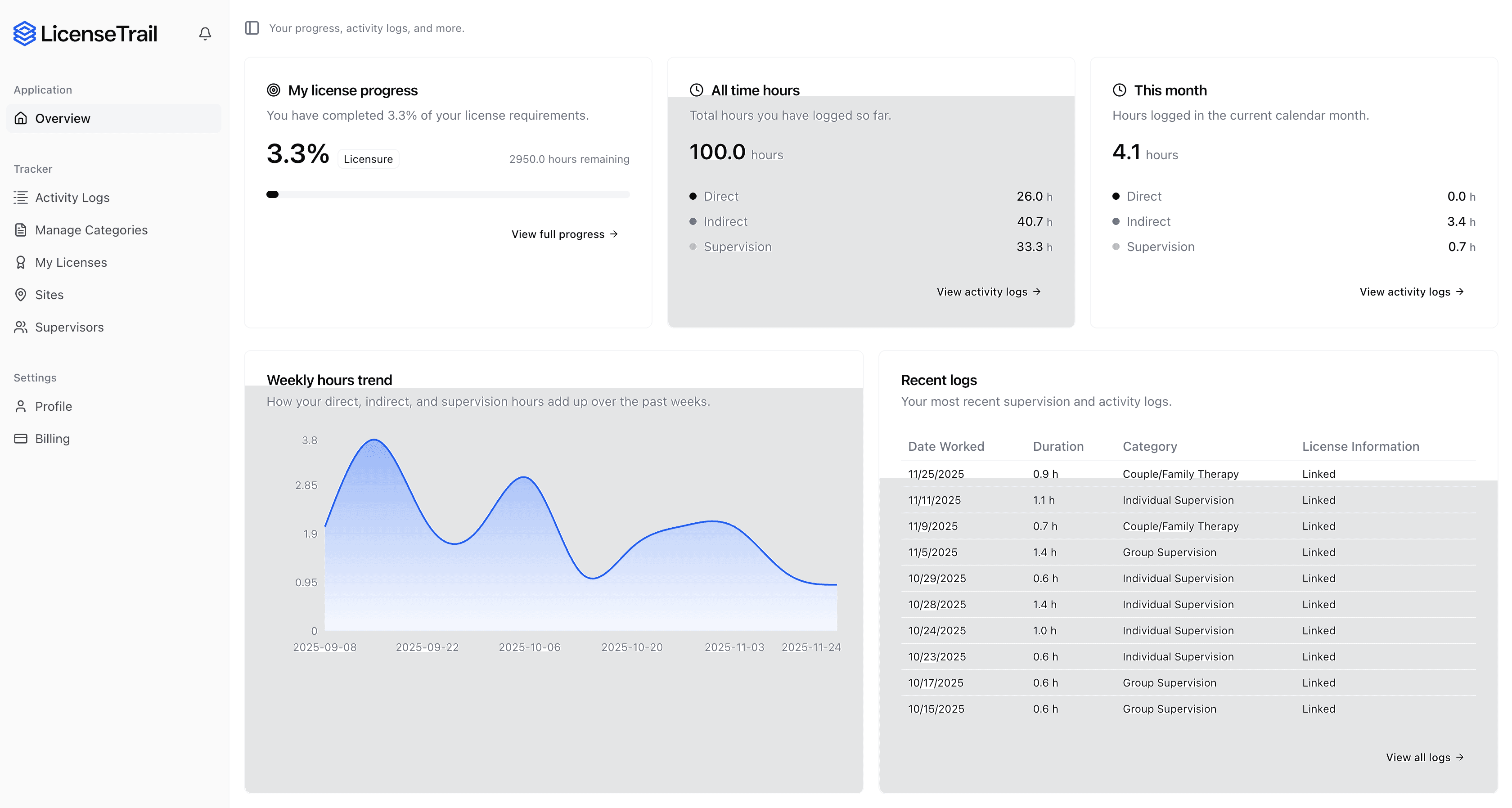
License Trail checks your direct, indirect, and supervision hours against Oklahoma LBP requirements continuously and flags mismatches before you submit.
 Start Tracking for Free
No credit card required · Free plan available
Is your spreadsheet hiding Oklahoma LBP risks?
Stop guessing if your categories match Oklahoma State Board of Behavioral Health Licensure requirements. License Trail checks your direct, indirect, and supervision hours continuously and flags mismatches before you submit.
Import or log
Bring your spreadsheet or start fresh
Upload your existing tracking spreadsheet and we'll map every hour into the right Oklahoma State Board of Behavioral Health Licensure categories automatically.
Verify against Oklahoma
Catch mismatches before the board does
License Trail checks your direct, indirect, and supervision hours against Oklahoma LBP requirements continuously.
Export board-ready
One-click clean reports
Generate professional, board-ready reports for supervision meetings and Oklahoma State Board of Behavioral Health Licensure submissions in seconds.
No credit card required · Free plan available