
Oklahoma LPC Requirements: Hours, Exams & Step-by-Step Guide
Stop guessing if your categories match Oklahoma requirements. License Trail checks your direct, indirect, and supervision hours against LPC requirements continuously and flags mismatches before you submit.
No credit card required · Free plan available
Quick Requirements Overview
- Education: Master’s/grad degree with 60 semester hours (90 quarter hours) in counseling or closely related field (regionally accredited)
- Degree practicum/internship: 300 clock hours in counseling (part of degree; does not count toward post‑master’s hours)
- Candidate status to start hours: Apply/approved as LPC Candidate; supervised experience begins only after academic requirements are complete + supervision agreement in place
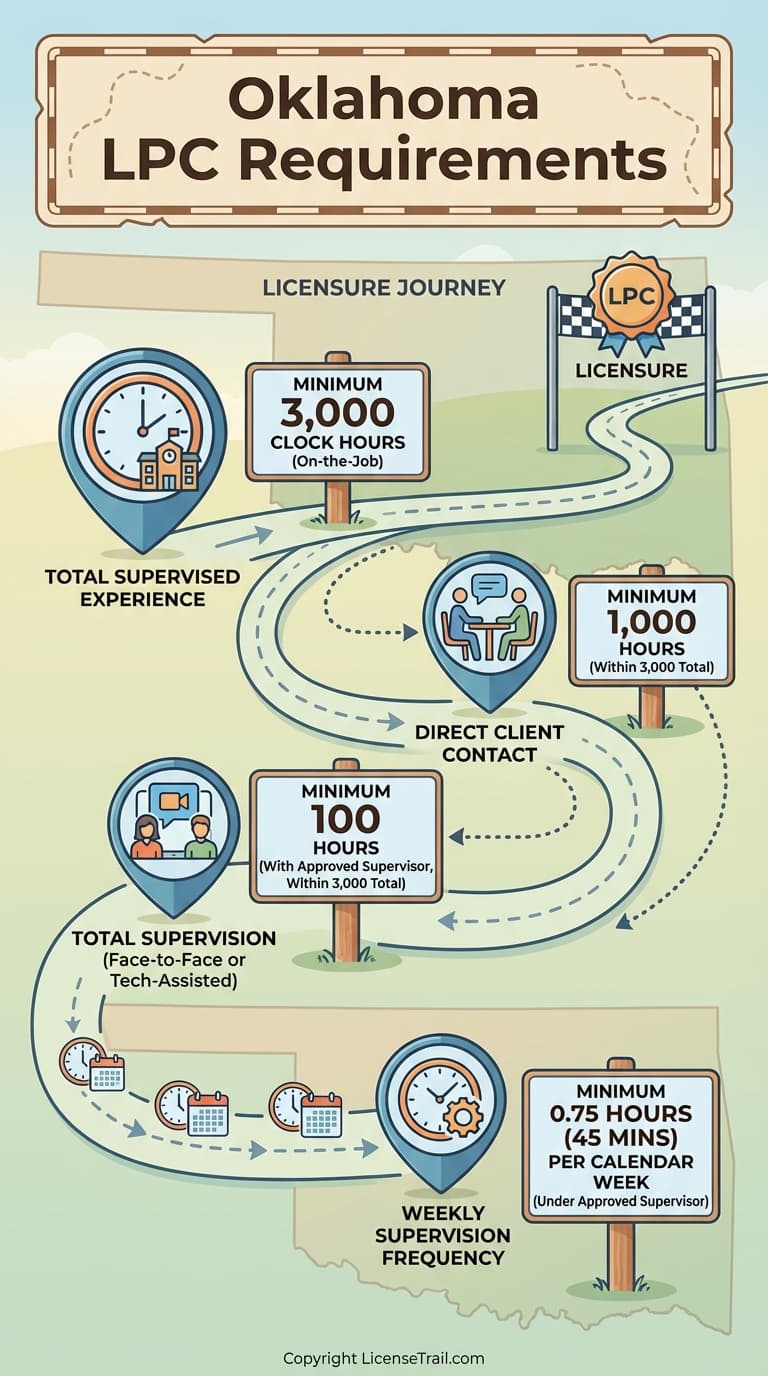
- Post‑master’s experience: 3,000 clock hours (≈3 years) of supervised “on‑the‑job” counseling experience
- Hour minimums within 3,000: 1,000 direct client contact + 100 supervision hours (face‑to‑face or approved technology‑assisted)
- Supervision cadence: At least 45 minutes weekly while accruing hours; group supervision allowed (2–6 supervisees)
- Time limit: Complete supervised experience within 60 months of first approved supervision agreement; remain supervised until fully licensed
- Exams/CE: Pass NCE (or Board‑approved equivalent) + OLERE; maintain license with 20 CE hours/year including 3 ethics
License Details
Procedures
Becoming a Licensed Professional Counselor (LPC) in Oklahoma is a multi‑step process governed by the Oklahoma State Board of Behavioral Health Licensure (BBHL) and codified in Title 86 of the Oklahoma Administrative Code (OAC). The heart of licensure is a defined graduate education plus very specific supervised “on‑the‑job experience” hour requirements.
Below is a structured guide focused on the types and amounts of hours the Board requires, using the Board’s own terminology where possible.
1. Educational foundation and practicum/internship
Graduate degree and credit hours
The Board requires at least 60 graduate semester hours (or 90 quarter hours) in counseling or a closely related mental health field from a regionally accredited institution. (law.cornell.edu)
Within those 60 hours, you must complete:
- Core coursework (at least one or more courses of 3+ credits) in each of these areas, among others:
- Human growth and development
- Abnormal human behavior
- Appraisal/assessment techniques (at least two courses)
- Counseling theories/methods (at least two courses)
- Professional orientation/ethics
- Research
- Additional counseling-related “knowledge area” courses to reach the 60‑hour minimum. (law.cornell.edu)
Practicum / internship hours (pre‑licensure clinical experience)
The Board’s academic rule requires “at least three hundred (300) clock hours in counseling” in an organized practicum/internship course under college‑ or university‑approved counseling supervisors. (law.cornell.edu)
These 300 practicum/internship hours are part of your degree and do not satisfy the Board’s post‑master’s supervised experience requirement (the 3,000 hours described below). Secondary sources and Board guidance consistently treat the 3,000 hours as post‑degree experience. (research.com)
2. Becoming an LPC Candidate and when supervised hours can begin
After your academic requirements are complete under Subchapter 9, you apply to the Board and, once accepted, become a Licensed Professional Counselor Candidate (LPC Candidate). (law.cornell.edu)
Key points:
- Supervised experience begins only after academic requirements are completed. The rule states that supervised experience begins “after all applicable academic requirements, as stated in LPC Regulations, Subchapter 9, have been completed.” (law.cornell.edu)
- You may accrue supervised hours in academic, governmental, private not‑for‑profit, or private for‑profit settings, with additional conditions if you’re in private practice settings (such as being an employee with an on‑site licensed behavioral health professional immediately available). (law.cornell.edu)
Before accruing post‑master’s hours, the Board expects you to have:
- A supervision agreement with an approved LPC supervisor
- On‑site supervisor verification (if applicable)
- A passing score on the Oklahoma Legal and Ethical Responsibilities Examination (OLERE)
- A completed LPC application and related forms (onlinecounselingprograms.com)
3. The core supervised experience requirement (3,000 hours)
The centerpiece of Oklahoma LPC licensure is the post‑graduate supervised experience defined in OAC 86:10‑11‑5 (Duration of supervision).
3.1 Total hours and minimums
The Board requires:
- Total supervised experience:
The rule requires “three (3) years or three‑thousand (3000) clock hours of full time, on‑the‑job experience” under an approved LPC supervisor. (regulations.justia.com)
Within those 3,000 hours, there are minimum sub‑requirements:
- Direct client contact: At least 1,000 hours must be “direct client contact” (i.e., face‑to‑face counseling/psychotherapy and other direct service activities with clients). (regulations.justia.com)
- Supervision hours: At least 100 hours must be face‑to‑face or technology‑assisted supervision with your approved LPC supervisor. (regulations.justia.com)
In practical terms, your 3,000 supervised post‑master’s hours break down as:
- 1,000+ hours – direct client contact
- 100+ hours – direct supervision (individual and/or group, face‑to‑face or approved technology‑assisted)
- Approximately 1,900 hours – other qualifying “on‑the‑job experience” (documentation, case consultation, treatment planning, outreach, etc., as defined below)
3.2 What counts as “on‑the‑job experience”?
The Board defines “on‑the‑job experience” as the performance of counseling activities described in the Professional Counselor Licensure Act and OAC 86:10‑11‑3. This includes, in paraphrased form: (law.cornell.edu)
- Applying mental health and developmental principles to facilitate human development and adjustment
- Preventing, diagnosing, or treating mental, emotional, or behavioral disorders and related distress
- Conducting assessments or diagnoses to establish treatment goals and objectives
- Planning, implementing, and evaluating treatment plans using counseling interventions
- Using cognitive, affective, behavioral, and systemic strategies, reflecting principles of development, wellness, and pathology in a pluralistic society
Any hours you count toward the 3,000 must fall within this scope and be performed under your supervision arrangement as an LPC Candidate.
4. Structure and timing of supervision
The Board sets out not just how many hours are needed, but how the supervision must be structured.
4.1 Weekly supervision requirement
The current version of OAC 86:10‑11‑5 requires that:
- Weekly supervision:
“Weekly, face‑to‑face supervision or technology‑assisted supervision shall be accrued … at a minimum of forty‑five (45) minutes of supervision every week.” (regulations.justia.com)
There is no longer a ratio in the rule linking supervision minutes to a specific number of on‑the‑job hours (older versions used “45 minutes for every 20 hours”). Under the current text, as long as you are accruing supervised experience, you must receive at least one 45‑minute supervision session every week you are working under supervision.
4.2 Definition of “full time”
For the purpose of this rule, “Full time” is defined very broadly:
- “Full time” means at least five (5) hours per week. (regulations.justia.com)
This definition allows candidates who work relatively few counseling hours each week to still be considered “full time” for the Board’s supervision rule, though it will naturally take longer to accumulate the full 3,000 hours.
4.3 Group vs. individual supervision
- Group supervision is defined as an assemblage of two to six supervisees with a supervisor. (regulations.justia.com)
- Individual supervision is one supervisor with one supervisee. (okrules.elaws.us)
The Board also regulates technology‑assisted supervision (e.g., video) and requires Board approval before you accrue hours that way. (okrules.elaws.us)
4.4 Time limits and continuation of supervision
- You must complete the 3,000‑hour supervised experience within 60 months of the approval date of your first supervision agreement; otherwise, the application is voided. (okrules.elaws.us)
- Even after you finish your 3,000 hours, you must remain under LPC supervision until you are fully licensed (unless exempted by statute). (okrules.elaws.us)
5. Supervisor qualifications
To count your hours, your supervisor must meet the Board’s “Supervisor qualifications” in OAC 86:10‑11‑4 and related guidance: (regulations.justia.com)
At a high level:
- The supervisor must be either:
- An Approved Clinical Supervisor (ACS) through NBCC, familiar with Oklahoma LPC Act and rules, or
- An LPC who has practiced in relevant positions for two years beyond the date their Oklahoma LPC was issued, and who has:
- Completed at least 45 contact hours in counselor supervision (coursework or Board‑approved equivalent), and
- Passed the Oklahoma Legal and Ethical Responsibilities Examination (OLERE).
- The supervisor must agree to be “on call” 24 hours a day to the supervisee and to arrange an alternate supervisor if unavailable. (oklahoma.gov)
6. Required examinations
The Board rule and register amendments specify that an LPC applicant must pass two examinations: (s3.amazonaws.com)
- National exam:
- The National Counselor Examination (NCE) or another equivalent national counseling exam as determined by the Board.
- State law and ethics exam:
- The Oklahoma Legal and Ethical Responsibilities Examination (OLERE).
For licensure by endorsement from another state, the Board also requires a passing OLERE score, even for already licensed counselors. (regulations.justia.com)
7. Applying for full LPC licensure
Once you have:
- Completed the required coursework (60 graduate semester hours with specified content) (law.cornell.edu)
- Logged 3,000 supervised post‑master’s hours, with:
- ≥ 1,000 hours of direct client contact, and
- ≥ 100 hours of face‑to‑face or technology‑assisted supervision (regulations.justia.com)
- Maintained weekly supervision of at least 45 minutes during the supervised period (regulations.justia.com)
- Stayed within the 60‑month completion window for supervised experience (okrules.elaws.us)
- Passed the NCE (or equivalent) and the OLERE (s3.amazonaws.com)
…you may submit a final application to the Board for full LPC licensure, including:
- Documentation of all supervised hours, signed by your supervisor(s)
- Practicum/Internship Documentation Form
- Official transcripts
- Exam score reports
- Any required fees and background check information (counselingschools.com)
Upon approval, the Board issues the Licensed Professional Counselor (LPC) credential, allowing independent practice as defined in the Professional Counselor Licensure Act. (law.cornell.edu)
8. After licensure: Continuing education (briefly)
To maintain the LPC license, the Board requires 20 clock hours of continuing education per year, including 3 hours specifically in counseling ethics from Board‑approved programs. (okrules.elaws.us)
Hour breakdown summary (post‑master’s, Oklahoma LPC)
For quick reference, Oklahoma’s LPC supervised experience requirement, as currently codified, is:
- 3,000 clock hours of supervised “on‑the‑job experience” over at least three years
- At least 1,000 hours of direct client contact
- At least 100 hours of face‑to‑face or technology‑assisted supervision
- Weekly supervision of ≥ 45 minutes with an approved LPC supervisor
- Supervision period completed within 60 months of first supervision agreement approval (regulations.justia.com)
All of these figures and terms—“on‑the‑job experience,” “direct client contact,” “full time,” “group supervision,” and the 3,000/1,000/100 breakdown—come directly from the Oklahoma State Board of Behavioral Health Licensure’s regulations in the Oklahoma Administrative Code and associated Board guidance.
Track your LPC hours with confidence
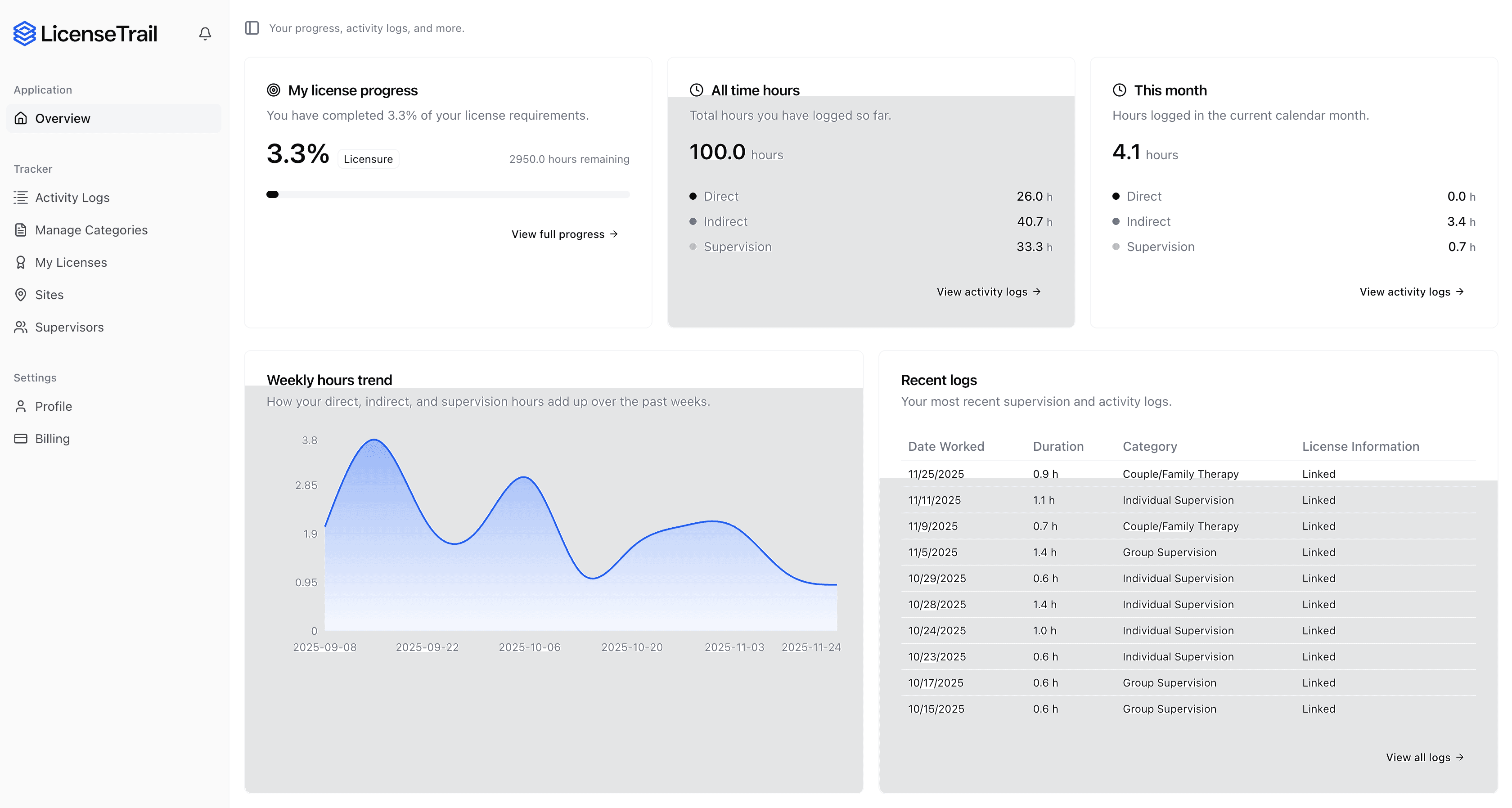
License Trail checks your direct, indirect, and supervision hours against Oklahoma LPC requirements continuously and flags mismatches before you submit.
 Start Tracking for Free
No credit card required · Free plan available
Is your spreadsheet hiding Oklahoma LPC risks?
Stop guessing if your categories match Oklahoma State Board of Behavioral Health Licensure requirements. License Trail checks your direct, indirect, and supervision hours continuously and flags mismatches before you submit.
Import or log
Bring your spreadsheet or start fresh
Upload your existing tracking spreadsheet and we'll map every hour into the right Oklahoma State Board of Behavioral Health Licensure categories automatically.
Verify against Oklahoma
Catch mismatches before the board does
License Trail checks your direct, indirect, and supervision hours against Oklahoma LPC requirements continuously.
Export board-ready
One-click clean reports
Generate professional, board-ready reports for supervision meetings and Oklahoma State Board of Behavioral Health Licensure submissions in seconds.
No credit card required · Free plan available