
Oklahoma LMFT Requirements: Hours, Exams & Step-by-Step Guide
Stop guessing if your categories match Oklahoma requirements. License Trail checks your direct, indirect, and supervision hours against LMFT requirements continuously and flags mismatches before you submit.
No credit card required · Free plan available
Quick Requirements Overview
- Degree: Master’s/Doctorate in MFT or Board-determined content-equivalent field; regionally accredited (COAMFTE automatically accepted).
- Coursework: Transcript must cover required MFT knowledge areas (theory, assessment/treatment, human development, ethics, research).
- Practicum (pre-degree): 300 clock hours organized MFT internship/practicum (verified via Board form).
- Apply before hours count: Submit application/fee, OSBI + FBI fingerprints, official transcript, practicum verification, 3 recommendations, and Board-approved Supervision Agreement (Candidate title used during accrual).
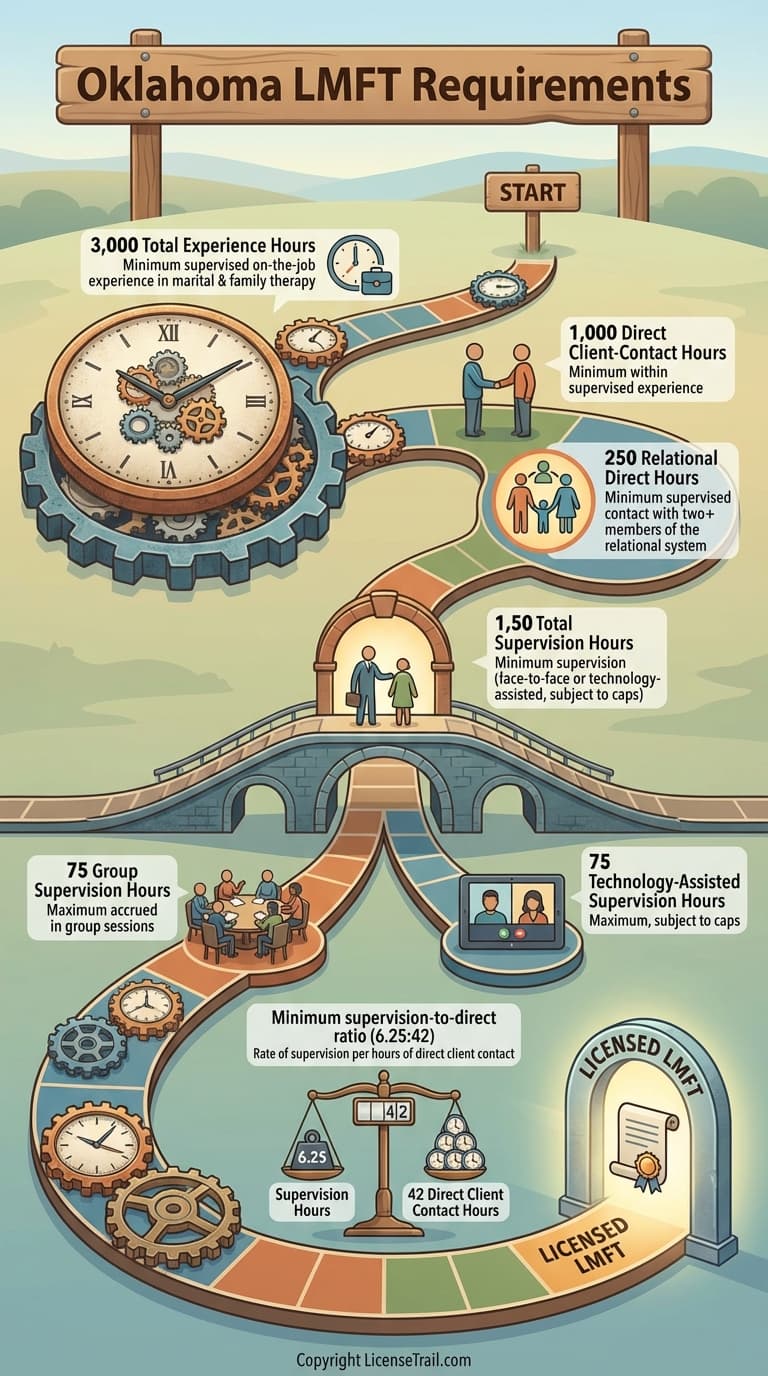
- Post-degree experience: 3,000 hours supervised MFT work over minimum 24 months.
- Hour minimums within 3,000: 1,000 direct client hours incl. 250 relational (2+ in session); supervision minimums include ≥100 hours counted toward 3,000 and ≥150 total face-to-face supervision (≤75 group; ≤75 technology-assisted).
- Exams: Pass AMFTRB National MFT Exam + Oklahoma LMFT (law/rules) exam.
- Renewal/CE: Initial license period ~2 years, then renew annually by Jan 1; 20 CE hours/year (ethics included).
License Details
Procedures
Becoming a Licensed Marital and Family Therapist (LMFT) in Oklahoma is a multi‑year process governed by the Marital and Family Therapist Licensure Act (MFTLA, 59 O.S. §1925.1 et seq.) and the Oklahoma Administrative Code (OAC Title 86, Chapter 15 – Licensed Marital and Family Therapists). The process involves:
- A qualifying graduate degree and practicum,
- A formal application and background checks,
- Two years of supervised post‑degree work (with specific hour types and minimums),
- Passing required examinations, and
- Ongoing renewal and continuing education.
The guide below follows the structure and language used by the Oklahoma State Board of Behavioral Health Licensure (the “Board”) as closely as possible while keeping it readable.
1. Understand the License and Legal Framework
What “Licensed Marital and Family Therapist” means
Under the Marital and Family Therapist Licensure Act, a “licensed marital and family therapist” is a person holding a current license issued under that Act. “Marital and family therapy” is defined as assessing, diagnosing, and treating cognitive, affective, or behavioral disorders within the context of marital and family systems, using family systems theories and techniques with individuals, couples, and families. (caselaw.findlaw.com)
Oklahoma has:
- Licensed Marital and Family Therapist (LMFT) – full independent license.
- Licensed Marital and Family Therapist Candidate (LMFT Candidate) – the title used while you are completing the required supervised experience. (aamft.org)
All powers to regulate LMFTs are placed under the State Board of Behavioral Health Licensure. (regulations.justia.com)
2. Step One – Meet Academic and Practicum Requirements
2.1 Qualifying degree
The Board’s LMFT rules and academic guide require that you: (regulations.justia.com)
-
Hold at least a master’s or doctoral degree in:
- Marital and family therapy, or
- A mental health, behavioral science, or counseling‑related field that is content‑equivalent to a graduate degree in marital and family therapy, as determined by the Board.
-
Regional accreditation is required. Your degree must be from a college or university accredited by one of the six regional accrediting associations recognized by the U.S. Department of Education (e.g., North Central, Southern, Western, etc.). (oklahoma.gov)
-
COAMFTE‑accredited programs (Commission on Accreditation for Marriage and Family Therapy Education) are automatically accepted and do not require additional academic review. (oklahoma.gov)
2.2 Required coursework (“knowledge areas”)
To be “content‑equivalent,” the graduate transcript must document specific coursework, generally with 3‑credit (45 classroom hour) courses in at least the following areas: (regulations.justia.com)
- Theoretical Foundations of Marital and Family Systems – at least three courses (e.g., family development, family life cycle, families under stress, cross‑cultural family systems).
- Assessment and Treatment in Marital and Family Therapy – at least three courses (e.g., family therapy methods, family assessment, systemic treatment models).
- Human Development – at least three courses (e.g., human development, personality theory, human sexuality, psychopathology/abnormal behavior).
- Ethics and Professional Studies – at least one course (e.g., ethics, professional roles, legal responsibilities, family law).
- Research – at least one course (e.g., research design, statistics, research in MFT).
The Board’s LMFT “Academic Worksheet” and “Licensed Marital and Family Therapist” page are used to confirm these requirements. (oklahoma.gov)
2.3 Graduate practicum / internship hours
The LMFT rules and Board academic guide require a minimum of 300 clock hours of organized practicum or internship in marital and family therapy: (regulations.justia.com)
- At least one formal practicum/internship course, and
- At least 300 clock hours of MFT practicum with:
- Classroom and field experience with clients, and
- Supervision by college or university–approved marital and family therapy professionals.
The Board’s general application page also states that all new applicants must verify at least 300 hours of internship and/or practicum in their qualifying graduate program via the Internship/Practicum Documentation Form. (oklahoma.gov)
3. Step Two – File Your Initial Application and Background Checks
Before any post‑degree supervision hours can count, you must formally apply and be approved.
3.1 Statutory application qualifications
Under 59 O.S. §1925.6, each LMFT applicant must: (law.justia.com)
- Be at least 21 years of age.
- Not have engaged in conduct that would be grounds for revocation or suspension of a license.
- Comply with the Board’s rules and regulations adopted under the MFTLA.
3.2 Board application package
For a new application (not by endorsement), the Board’s “Making Application” page specifies that you must submit, through the online applicant portal: (oklahoma.gov)
- Application for licensure.
- Application fee (non‑refundable).
- Fingerprint‑based criminal background checks:
- Oklahoma State Bureau of Investigation (OSBI), and
- FBI fingerprint‑based background check.
- Official graduate transcript sent directly to the Board.
- Internship/Practicum Documentation Form verifying the required 300 hours.
- Any required recommendation forms (see below).
3.3 Additional forms for supervised experience
Oklahoma’s LMFT supervision rules say that supervised experience is acceptable only when all of the following are in place: (regulations.justia.com)
- All academic requirements are completed (as in Subchapter 5/Academic Requirements).
- A supervision agreement has been approved by the Department (Board staff).
- An official application for licensure has been made, which includes:
- Application and fee,
- Internship/Practicum Documentation Form,
- Official graduate transcript,
- Three Documents of Recommendation,
- Completed criminal background check,
- On‑Site Supervisor Verification Form,
- Supervision Agreement.
In plain terms: post‑degree hours do not count until the Board has your completed application and has approved your supervision agreement.
Once that is done and you are working under supervision, you hold the title Licensed Marital and Family Therapist Candidate (LMFT Candidate) while accruing hours. (aamft.org)
4. Step Three – Complete Post‑Degree Supervised Experience
This is the core requirement where precise hour counts matter.
4.1 Overall duration and total clock hours
The MFT statute requires “two (2) calendar years of work experience in marital and family therapy” following receipt of the qualifying degree, under supervision meeting Board standards. (law.justia.com)
The LMFT rules implement this as: (regulations.justia.com)
- Total supervised on‑the‑job experience:
3,000 clock hours of on‑the‑job marital and family therapy experience,
supervised by an approved LMFT supervisor. - Minimum time span:
The work experience under supervision must extend over at least 24 months.
“On‑the‑job experience” means actual practice performing marital and family therapy services in an acceptable setting (academic, governmental, or private practice). (okrules.elaws.us)
4.2 Required types of hours inside the 3,000
Within those 3,000 clock hours of supervised on‑the‑job experience, the LMFT rules require the following minimums: (regulations.justia.com)
-
Direct client contact:
- At least 1,000 hours must be direct client contact.
- “Direct client contact” means you are providing therapy services directly to individuals, couples, or families (face‑to‑face or approved telehealth).
-
Relational (couples/family) contact:
- At least 250 of those direct client contact hours must be relational hours – sessions where two or more members of the relational system (e.g., partners, family members) are present in the session.
-
Supervision hours included in the 3,000:
- At least 100 hours of the 3,000 must be face‑to‑face or technology‑assisted supervision with an approved LMFT supervisor. (regulations.justia.com)
In shorthand, the Board’s hour structure for an LMFT Candidate is:
| Category | Minimum Required |
|---|---|
| Total supervised on‑the‑job experience | 3,000 clock hours |
| Direct client contact (all types) | 1,000 hours |
| Relational direct contact (within the 1,000) | 250 hours |
| Supervision hours counted toward 3,000 | 100 hours (min.) |
4.3 Additional supervision structure (beyond the 3,000‑hour breakdown)
Separate LMFT supervision rules further specify how that supervision must be structured. Taken together (from the LMFT chapters formerly codified at 310:400 and now at Title 86, Chapter 16), they require: (okrules.elaws.us)
-
Weekly supervision expectation
- Supervision is ordinarily scheduled weekly.
- When scheduled weekly, the standard is that you receive at least about 6.25 hours of supervision for each 42 hours of direct client contact, and you may count no more than 42 hours of direct client contact in any four‑week period toward that ratio. (This is another way of ensuring intensive, ongoing supervision while you accumulate the 1,000+ direct contact hours.)
-
Total face‑to‑face supervision hours:
- Over the entire candidacy, the total face‑to‑face supervision must be at least 150 hours.
- Of those 150 hours:
- No more than 75 hours may be group supervision.
- No more than 75 hours may be technology‑assisted supervision (e.g., secure video).
-
Observation requirement:
- Supervisors must complete at least two live or recorded (audio/video) observations of your clinical work in every six‑month evaluation period.
-
Supervisor–onsite supervisor coordination:
- If you work in a setting where your approved LMFT supervisor is off‑site, you must have an on‑site supervisor and the LMFT supervisor must consult with that on‑site supervisor at least once per reporting period. (okrules.elaws.us)
-
In‑person contact when using technology‑assisted supervision:
- If supervision is partly via technology, the LMFT supervisor must meet with the candidate in person at least once every six‑month evaluation period. (okrules.elaws.us)
Put simply, it is not enough just to hit 3,000 hours of work and 1,000 hours of direct client contact. You must also ensure that:
- Your supervision agreement is Board‑approved from the start,
- You accrue supervision weekly at the required intensity,
- You reach at least 150 face‑to‑face supervision hours, within the caps on group and technology‑assisted supervision.
5. Step Four – Eligible Supervised Settings
The LMFT rules describe when supervised experience is “acceptable”: (regulations.justia.com)
- It must begin only after:
- Academic requirements are completed, and
- The supervision agreement has been approved.
- It must involve performance of therapy activities described in the LMFT Act (assessment, diagnosis, and treatment within marital and family systems).
- Supervision must focus on “raw data” from your practice – live observation, co‑therapy, notes, or recordings – and is distinct from personal psychotherapy.
- Acceptable settings include academic, governmental, private non‑profit, and private for‑profit therapy settings.
If your approved LMFT supervisor is not on‑site, the employing agency must provide an on‑site supervisor (licensed in a qualifying mental health profession, such as LMFT, LPC, psychologist, clinical social worker, psychiatrist, or LADC) who is available whenever you are delivering services. (okrules.elaws.us)
6. Step Five – Pass the Required Examinations
The LMFT rules state that “Applicants must achieve a passing score on the LMFT examinations.” (regulations.justia.com)
Current Board‑aligned descriptions of those examinations show they are: (onlinegrad.pepperdine.edu)
-
The National Examination in Marital and Family Therapy
- The national AMFTRB examination used in many states.
-
The Oklahoma Licensed Marriage and Family Therapy Examination
- A state‑specific exam covering Oklahoma statutes and administrative rules (often called a legal and ethical responsibilities or jurisprudence exam).
The Board can, by rule, change exam vendors or formats, but you must pass both the national clinical exam and the Oklahoma law/regulation exam approved by the Board at the time you apply.
7. Step Six – Apply for Full LMFT Licensure
Once you have:
- Completed the qualifying graduate degree and 300‑hour practicum,
- Submitted a complete application and been approved as an LMFT Candidate,
- Accrued 3,000 clock hours of supervised on‑the‑job MFT experience (meeting all breakdowns and supervision rules), and
- Passed the required examinations,
you may apply to transition from LMFT Candidate to Licensed Marital and Family Therapist (LMFT).
The Board will require:
- Final documentation of all supervised experience (hour totals, direct/relational breakdown, supervision hours).
- Evaluation forms completed by the approved LMFT supervisor (and, if applicable, on‑site supervisor).
- Verification that you have passed the national and state exams.
The specific forms and exact submission process are handled through the Board’s licensee/applicant portal, but they are grounded in the requirements summarized above. (oklahoma.gov)
8. Step Seven – Maintain the LMFT License (Renewal & CE)
8.1 Renewal schedule
Under OAC 86:15‑13‑3: (law.cornell.edu)
- The initial license period runs for two years from the last day of the month in which your license was first issued.
- After that, LMFT licenses are renewed annually on or before January 1.
- The initial renewal is prorated so that future renewals align with the calendar year.
8.2 Continuing education
Board and AAMFT summaries indicate that: (oklahoma.gov)
- LMFTs must complete 20 contact hours of continuing education per year.
- Ethics content is required within those hours.
- LMFTs who are approved supervisors must also complete periodic supervision‑specific continuing education, in line with the Board’s CE guide for LPCs and LMFTs.
The Board maintains a list of pre‑approved CE providers (e.g., AAMFT, ACA, APA, NASW, ODMHSAS, etc.), and issues a detailed CE requirements guide for LPCs and LMFTs on its Continuing Education page. (oklahoma.gov)
9. Concise Hour Summary for Oklahoma LMFT Licensure
To focus specifically on the question of hour types and Board‑defined verbiage:
-
Graduate practicum/internship (pre‑degree)
- At least 300 clock hours of marital and family therapy practicum/internship within an organized course, under university‑approved MFT supervisors. (regulations.justia.com)
-
Post‑degree supervised experience (LMFT Candidate)
- 3,000 clock hours of supervised on‑the‑job marital and family therapy experience, over a minimum of 24 months, under an approved LMFT supervisor. (regulations.justia.com)
- Within those 3,000 hours:
- 1,000 hours must be direct client contact.
- 250 hours must be relational direct contact, with two or more members of the relational system present.
- At least 100 hours must be face‑to‑face or technology‑assisted supervision (counted within the 3,000 hours). (regulations.justia.com)
- Across the candidacy as a whole:
- ≥150 hours of face‑to‑face supervision total.
- ≤75 hours may be in group supervision.
- ≤75 hours may be technology‑assisted supervision.
- Weekly supervision is expected, at roughly 6.25 hours of supervision per 42 hours of direct client contact, with no more than 42 direct contact hours credited in a four‑week period. (okrules.elaws.us)
-
Examinations
- Pass the National Examination in Marital and Family Therapy.
- Pass the Oklahoma Licensed Marriage and Family Therapy Examination (Oklahoma law/rules exam). (regulations.justia.com)
These are the core, Board‑defined quantitative requirements that distinguish Oklahoma’s LMFT licensure process. Always cross‑check the Board’s website and the current Oklahoma Administrative Code for any rule changes before planning your own licensure pathway.
Track your LMFT hours with confidence
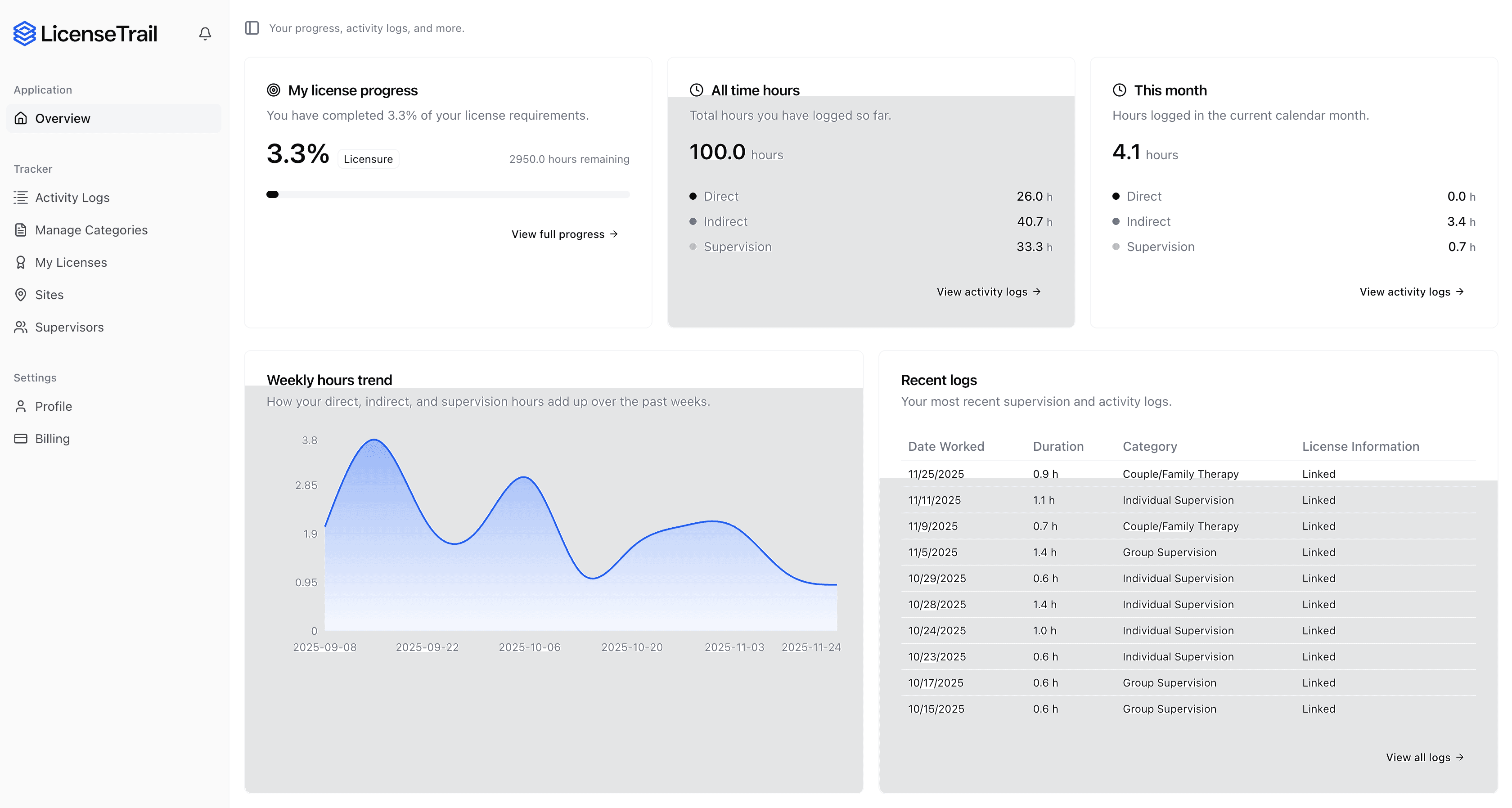
License Trail checks your direct, indirect, and supervision hours against Oklahoma LMFT requirements continuously and flags mismatches before you submit.
 Start Tracking for Free
No credit card required · Free plan available
Is your spreadsheet hiding Oklahoma LMFT risks?
Stop guessing if your categories match Oklahoma State Board of Behavioral Health Licensure requirements. License Trail checks your direct, indirect, and supervision hours continuously and flags mismatches before you submit.
Import or log
Bring your spreadsheet or start fresh
Upload your existing tracking spreadsheet and we'll map every hour into the right Oklahoma State Board of Behavioral Health Licensure categories automatically.
Verify against Oklahoma
Catch mismatches before the board does
License Trail checks your direct, indirect, and supervision hours against Oklahoma LMFT requirements continuously.
Export board-ready
One-click clean reports
Generate professional, board-ready reports for supervision meetings and Oklahoma State Board of Behavioral Health Licensure submissions in seconds.
No credit card required · Free plan available