
Oregon Registered Marriage and Family Therapist Associate Requirements: Hours, Exams & Step-by-Step Guide
Stop guessing if your categories match Oregon requirements. License Trail checks your direct, indirect, and supervision hours against Registered Marriage and Family Therapist Associate requirements continuously and flags mismatches before you submit.
No credit card required · Free plan available
Quick Requirements Overview
- Pre-licensure Registered Marriage & Family Therapist Associate status (not a license) under Oregon OBLPCT to earn hours toward LMFT
- Education: Master’s/doctorate in MFT or equivalent (COAMFTE/CACREP, regionally accredited, or approved foreign eval); submit official transcripts (and standards form if needed)
- Register first: Apply via portal + submit Associate Registration Plan (Form 7) with practice site(s) and board-approved supervisor(s); background check/fingerprints (within 90 days); other-state verifications if applicable
- Experience: 36 months supervised clinical experience incl. 1,900 hours supervised direct client contact; for LMFT, 750 hours must be with couples/families in the same session
- What counts: Direct client contact = therapy/assessment with clients (in person or electronic); excludes intake-only, case management, admin, research, training/teaching, and supervision time
- Supervision minimums: Same month as client hours; 2x/month in different weeks (≥1 hr each); monthly minimums 2 hrs (≤45 client hrs) or 3 hrs (≥46) with ≥50% of minimum supervision individual
- Reporting/renewal/time limits: Report hours via portal with supervisor-signed evaluations; renew annually; hours under an expired plan or months missing required supervision don’t count; 5-year limit to finish hours + exams (possible 1-year extension)
- Licensure exams: Pass national MFT exam (AMFTRB or CA MFT Clinical) + Oregon Law & Rules exam before LMFT issuance
License Details
Procedures
In Oregon, “Registered Marriage and Family Therapist Associate” is a pre‑licensure registration status, not a full license. It is the route you use to accrue supervised experience toward becoming a Licensed Marriage and Family Therapist (LMFT) under the Oregon Board of Licensed Professional Counselors and Therapists (OBLPCT). (oregon.gov)
The board’s rules are detailed, but they boil down to four pillars:
- A qualifying graduate degree in marriage and family therapy (or closely related field).
- Approval as a Registered Marriage and Family Therapist Associate via an “associate registration” application and plan.
- At least 3 years (36 months) of supervised clinical experience that includes 1,900 hours of supervised direct client contact, with 750 hours with couples and families for LMFT applicants.
- Required supervision frequency and structure during those hours, plus passing a national MFT exam and an Oregon law/rules exam before full licensure.
The sections below walk through these pieces in the board’s own terminology.
1. Educational foundation for LMFT/Associate status
To qualify educationally for LMFT licensure (and thus for LMFT‑track associate registration), Oregon requires a graduate degree (master’s or doctorate) in marriage and family therapy or an equivalent program: (oregon.gov)
- The degree must be from:
- A marriage and family therapy program approved by COAMFTE or a marital and family therapy program fully accredited by CACREP, or
- A program at a regionally accredited institution, or
- A foreign program evaluated by a credentialing body recognized by the Board.
- COAMFTE/CACREP programs must include at least 2 semester hours or 3 quarter hours in diagnosis of mental disorders.
- Non‑COAMFTE/CACREP or foreign programs must meet detailed coursework and practicum requirements listed in OAR 833‑040‑0011 (e.g., specific hours in human development, family systems, diagnostic and treatment courses, and a supervised practicum with at least 280 hours of direct client contact). (regulations.justia.com)
You demonstrate this to the Board with official transcripts and, if needed, a graduate degree standards form. (regulations.justia.com)
2. Becoming a Registered Marriage and Family Therapist Associate
2.1. The “associate registration” method
If you plan to earn your post‑degree supervised experience in Oregon, you must use the Associate Registration method. The Board describes this as the required method for applicants who “seek acceptance of post‑degree supervised work experience completed in Oregon after June 30, 2002.” (oregon.gov)
Key points:
- You apply online via the Applicant Portal.
- You submit an Associate Registration Plan (Form 7), which outlines:
- Your place(s) of practice.
- Your approved supervisor(s).
- How you will accrue hours and supervision.
- You must also provide:
- Official transcripts (primary source to the Board).
- A criminal background check and fingerprints (must be done within 90 days before applying).
- Any required licensure/registration verifications from other states, if applicable. (oregon.gov)
Importantly, hours accrued in Oregon on or after June 30, 2002 only count if you are in a Board‑approved associate registration plan. (oregon.gov)
2.2. Your official title
Oregon changed “registered interns” to “registered associates” effective August 6, 2021. The Board specifies that you must use only the following titles, as applicable: (oregon.gov)
- “Registered Associate”
- “Professional Counselor Associate”
- “Marriage and Family Therapist Associate”
You must not use abbreviations like “LMFT‑A,” “LMFTa,” “LPC‑Associate,” or similar, because registration is a pre‑licensed status, not a license. All signed materials, advertising, websites, and directories must also identify your supervisor by name and as “supervisor.” (law.cornell.edu)
3. How Oregon defines the types of hours
Oregon is very specific about what “counts” toward licensure. The key terms are:
3.1. “Clinical experience”
On its Experience page, the Board defines clinical experience as:
the professional practice of applying principles and methods to provide assessment, diagnosis, and treatment of individuals and families with mental health disorders. (oregon.gov)
This is the broad category within which your “direct client contact hours” sit.
3.2. “Direct client contact hours”
The Board uses both “direct client contact” and “client contact hours.” The definitions come from two places:
-
OAR 833‑050‑0071 (Direct Client Contact):
- Registered associates must complete no less than 1,900 hours of supervised direct client contact as part of at least three years (36 months) of supervised clinical experience to qualify for licensure. (regulations.justia.com)
- Direct client contact must be “face to face with a client or clients and/or contact via electronic communication.” (regulations.justia.com)
-
New Registered Associate Information – “Hours” section (board guidance):
- Client Contact Hours are defined as counseling/therapy hours in which the registered associate “provides clinical counseling or therapy directly to a client (individual, couple, family, and group).”
- Direct contact is described as face‑to‑face, voice‑to‑voice communication. (oregon.gov)
The Board explicitly lists what does not count as direct client contact / clinical work experience:
- Intake only
- Case management
- Advocacy
- Program administration
- Casual or social contact
- Research
- Receiving supervision
- Instruction or teaching
- Training
- Participation in discussion groups
- Counseling by correspondence (oregon.gov)
Only hours that are therapeutic or assessment‑plus‑therapy interactions directly with clients are “direct client contact hours.” (oregon.gov)
3.3. Group supervision
The Board’s New Registered Associate page defines group supervision as supervision with:
- No fewer than two and no more than six supervisees, led by a supervisor who maintains a leadership role.
- It must be a supervision group, not a general staff meeting, peer review, or group including non‑counselor staff.
- Group supervision hours are counted the same as individual supervision in terms of hour‑for‑hour credit for supervision (but they are still supervision, not client contact). (oregon.gov)
4. Required experience as a Registered MFT Associate (numbers at a glance)
Oregon does not use a split such as “1,500 hours of direct experience and 1,500 hours of other supervised experience.” Instead, the Board’s core requirement is:
- At least 3 years (36 months) of supervised clinical experience,
- Including no less than 1,900 hours of supervised direct client contact. (regulations.justia.com)
For those pursuing licensure as a Licensed Marriage and Family Therapist (LMFT), there is an additional specification:
- Of the 1,900 hours of supervised direct client contact, at least 750 hours must be “working with couples and families in the same session.” (regulations.justia.com)
4.1. Pre‑degree hours that can count
Oregon allows you to count some master’s‑level clinical work toward these totals, but only within strict limits:
- You may count up to one year of full‑time supervised clinical experience and up to 400 hours of supervised direct client contact from the clinical portion of your graduate program (typically your practicum/internship). (oregon.gov)
Those pre‑degree hours:
- Must be part of your program’s supervised clinical practicum or internship.
- Are credited hour‑for‑hour toward the 1,900 direct client contact hours and 36‑month requirement, but you still need to finish any remaining hours as a registered associate.
4.2. Change in required hours (effective July 1, 2023)
The Board reduced the direct client contact requirement from 2,400 to 1,900 hours, effective July 1, 2023. The Associate Registration page explicitly notes this change and ties it to the 36‑month supervised experience requirement. (oregon.gov)
5. Supervision structure while you accrue hours
Oregon regulates not just the totals, but how supervision must be scheduled and documented.
5.1. Frequency and format of supervision
According to the New Registered Associate page, supervision must follow these rules: (oregon.gov)
- Timing: Supervision of direct client contact must occur in the same calendar month as the client contact hours.
- Minimum frequency:
- Supervision sessions must occur at least twice per month,
- In different weeks,
- For at least one hour per meeting.
- Individual vs. group:
- At least 50% of the required minimum supervision for post‑degree hours must be individual (one‑on‑one) supervision.
- Supervision tied to monthly client hours:
- If you have 45 or fewer client contact hours in a month, you must receive at least 2 hours of supervision, with at least 1 hour individual.
- If you have 46 or more client contact hours in a month, you must receive at least 3 hours of supervision, with at least 1.5 hours individual. (oregon.gov)
The Board also emphasizes that extra supervision hours in one setting cannot be “carried over” to compensate for inadequate supervision in another month or site. Supervision is “measured by client contact level per site or supervisor.” (oregon.gov)
5.2. Consequences of inadequate supervision
The rules are strict:
- If in a given month you do not meet the supervision requirements, then none of the client contact hours for that month are credited toward licensure. (oregon.gov)
- If no hours are submitted for a reporting period, your associate registration expires, and hours accrued under an expired plan do not count and may be considered unlicensed practice. (oregon.gov)
5.3. What supervision is not
Hours spent receiving supervision do not count toward the 1,900 direct client contact hours; the Board explicitly excludes supervision from “clinical work experience” and direct client contact definitions. (oregon.gov)
6. Reporting, renewal, and time limits as an Associate
6.1. Reporting hours
Registered associates must:
- Report all direct client contact hours through the Licensee Portal.
- Upload a Registered Associate Supervisor Evaluation & Hours Report signed by both you and your supervisor:
- At each annual registration renewal, and
- At the conclusion of a supervision plan (e.g., when changing supervisors or sites). (oregon.gov)
Reports must reflect actual past hours; the Board will not accept future “projected” hours. (oregon.gov)
6.2. Renewal and expiration
Key timelines:
- Your registration must be renewed annually. The renewal is due by the first day of the month of initial registration.
- If you fail to renew on time:
- You may incur a delinquent fee if renewing within the month.
- If you do not renew by the end of that month, your registration expires, and you must re‑apply to practice as an associate. (oregon.gov)
Importantly:
- Hours accrued under an expired plan do not count toward licensure and can be treated as unlicensed practice, exposing you to possible sanctions. (oregon.gov)
6.3. Overall time limit to reach licensure
Associate registration is explicitly described as a “transitional step toward licensure” and “not intended as a means to avoid licensure.” (oregon.gov)
- You have five years from the date of initial registration to:
- Complete the experience requirement (36 months and 1,900 direct client hours, including 750 with couples/families for LMFTs), and
- Pass the required examinations.
- If you do not meet the requirements within five years:
- Your registration expires, and
- Your application file is closed.
- You may petition the Board for a one‑year extension (up to 6 years total) if you can show good cause, but you must request this no more than 30 days before your five‑year limit. (oregon.gov)
7. From Registered MFT Associate to LMFT
Once you:
- Meet the education requirements,
- Complete the 36 months & 1,900 supervised direct client contact hours (with 750 couples/family hours for LMFT),
- Satisfy the supervision structure described above,
the Board may invite you to submit a “promotion” application to become a fully Licensed Marriage and Family Therapist. (oregon.gov)
To obtain the LMFT license, you must also satisfy exam requirements:
-
Competency exam:
Oregon accepts:- The Association of Marital and Family Therapy Regulatory Boards (AMFTRB) Marital and Family Therapy exam, or
- The California Board of Behavioral Sciences’ MFT Written Clinical Examination. (oregon.gov)
-
Oregon Law and Rules Examination:
- An online, open‑book exam on Oregon statutes (ORS) and administrative rules (OAR) related to counseling and MFT practice.
- You receive a link after your application is approved; registered associates receive one email when their application is approved and a second when they have met the experience requirement. (oregon.gov)
Only after the Board has verified your education, supervised experience, and examination results will it issue the LMFT license. (regulations.justia.com)
8. Summary of hour requirements in Oregon’s own terms
Putting the state’s verbiage together for a Registered Marriage and Family Therapist Associate (LMFT‑track):
- You must complete at least three years (36 months) of supervised clinical experience. (regulations.justia.com)
- That clinical experience must include “no less than 1,900 hours of supervised direct client contact.” (regulations.justia.com)
- If you are applying for LMFT, those 1,900 hours must include “at least 750…working with couples and families in the same session.” (regulations.justia.com)
- You may count up to one year of full‑time supervised clinical experience and 400 direct client contact hours from your graduate internship toward those totals. (oregon.gov)
- Direct client contact means face‑to‑face or electronic therapy/assessment with clients, not case management, research, supervision, or administrative tasks. (oregon.gov)
These are the requirements you must meet while registered as a Marriage and Family Therapist Associate in order to ultimately qualify for Oregon LMFT licensure.
Track your Registered Marriage and Family Therapist Associate hours with confidence
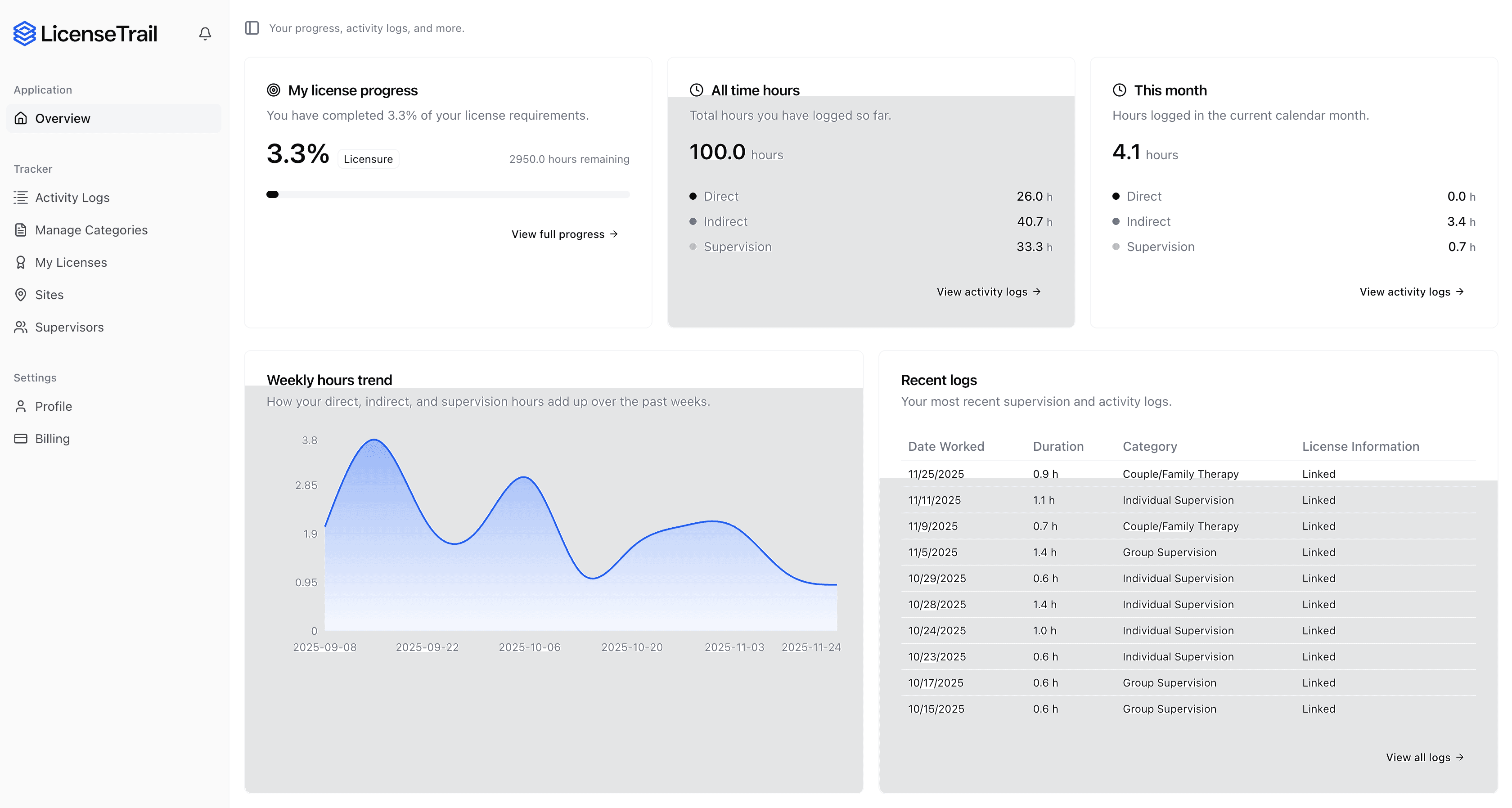
License Trail checks your direct, indirect, and supervision hours against Oregon Registered Marriage and Family Therapist Associate requirements continuously and flags mismatches before you submit.
 Start Tracking for Free
No credit card required · Free plan available
Is your spreadsheet hiding Oregon Registered Marriage and Family Therapist Associate risks?
Stop guessing if your categories match Oregon Board of Licensed Professional Counselors and Therapists requirements. License Trail checks your direct, indirect, and supervision hours continuously and flags mismatches before you submit.
Import or log
Bring your spreadsheet or start fresh
Upload your existing tracking spreadsheet and we'll map every hour into the right Oregon Board of Licensed Professional Counselors and Therapists categories automatically.
Verify against Oregon
Catch mismatches before the board does
License Trail checks your direct, indirect, and supervision hours against Oregon Registered Marriage and Family Therapist Associate requirements continuously.
Export board-ready
One-click clean reports
Generate professional, board-ready reports for supervision meetings and Oregon Board of Licensed Professional Counselors and Therapists submissions in seconds.
No credit card required · Free plan available