
Oregon Registered Professional Counselor Associate Requirements: Hours, Exams & Step-by-Step Guide
Stop guessing if your categories match Oregon requirements. License Trail checks your direct, indirect, and supervision hours against Registered Professional Counselor Associate requirements continuously and flags mismatches before you submit.
No credit card required · Free plan available
Quick Requirements Overview
- Pre-licensed Registered Associate / Professional Counselor Associate status (not an LPC); may not use license-implying abbreviations (e.g., “LPCa”).
- Education: graduate counseling degree meeting Board standards (CACREP/CORE or equivalent); post‑10/1/2014 generally 60 semester / 90 quarter credits.
- Program must include supervised practicum/internship with ≥280 direct client contact hours (≥240 if earlier degree).
- Apply via Applicant Portal + Associate Registration Plan (Form 7); Board approval required before Oregon post‑degree hours count.
- Experience for LPC: 36 months supervised clinical experience + 1,900 supervised direct client contact hours (up to 400 may be credited from qualifying pre‑degree hours).
- Direct client contact must be therapeutic/assessment+therapy face‑to‑face or voice‑to‑voice; excludes intake-only, case management, admin, research, advocacy, supervision, training, correspondence, etc.
- Supervision is separate from client hours; monthly minimums (2–3 hrs) tied to client hours, same month, at least 2 sessions in different weeks; missing supervision means that month’s client hours don’t count.
- Ongoing compliance: annual renewal + portal hour reporting; 5-year completion window (possible +1 year petition) and Custodian of Record designation within 60 days of registration.
License Details
Procedures
Oregon’s pathway to becoming a Professional Counselor Associate (Registered Associate) is tightly defined by the Oregon Board of Licensed Professional Counselors and Therapists (OBLPCT). The status is a pre‑licensed registration, not a full license, but it is the route most applicants use to earn supervised experience toward Licensed Professional Counselor (LPC) licensure. (oregon.gov)
Below is a step‑by‑step guide focused on the actual Board language and hour types you asked about.
1. Understand the Role and Title in Oregon
Oregon law no longer uses “Registered Intern.” The Board now uses “Registered Associate”, and requires that counselor-track registrants present themselves as:
- “Professional Counselor Associate” or
- “Registered Associate”
on all signed materials, letterhead, business cards, advertisements, websites, directory listings, and similar representations. (oregon.gov)
The Board explicitly states that abbreviations implying licensure are not allowed for associates (for example, “LPCa,” “LPC-Associate,” or similar). Registration is a pre‑licensed status, so those titles are considered misleading. (oregon.gov)
2. Meet the Educational Requirements (LPC Track)
To register as a Professional Counselor Associate, you must be on an LPC pathway and meet LPC educational standards.
Degree requirements
For LPC licensure, Oregon requires a graduate degree (master’s or doctorate) in counseling or a closely aligned field from one of the following: (oregon.gov)
- A counseling program accredited by CACREP or CORE, or
- A program at a regionally accredited institution (with specific course and credit requirements), or
- A foreign program evaluated by a credentialing body recognized by the Board.
For non‑CACREP/CORE or foreign programs, the degree must be at least two academic years and include at least 60 semester hours or 90 quarter hours if the degree was granted on or after October 1, 2014 (48/72 for earlier degrees). (oregon.gov)
Required supervised practicum/internship (pre‑degree)
The graduate program must include a supervised clinical practicum or internship with a minimum of direct client contact:
- At least 280 direct client contact hours for degrees granted on or after October 1, 2014 (240 hours for earlier degrees). (oregon.gov)
Up to 400 of these pre‑degree direct client contact hours can later be credited toward the post‑degree licensure requirement, if they meet Board criteria. (oregon.gov)
3. Apply Using the “Associate Registration” Method
To become a Professional Counselor Associate (Registered Associate), you use the Associate Registration method. This is required if you want Oregon to accept post‑degree supervised experience completed in Oregon after June 30, 2002. (oregon.gov)
Core application pieces
The Board specifies that Associate Registration requires: (oregon.gov)
- An online application submitted through the Applicant Portal, and
- An Associate Registration Plan (Form 7), uploaded through the portal.
That plan lays out your proposed supervised work experience: where you will practice, who will supervise you, and how you will meet hour and supervision requirements. The Board must approve this plan before Oregon post‑degree hours will count toward licensure. (oregon.gov)
4. Understand the Experience and Hour Requirements
Oregon’s requirements combine time in supervised practice and a specific number of direct client contact hours.
a. Time requirement: supervised clinical experience
For the LPC pathway using associate registration, the Board’s “basic requirement” for licensure is:
- At least three years (36 months) of supervised clinical experience. (oregon.gov)
“Clinical experience” is defined by the Board as the professional practice of applying counseling principles and methods to provide assessment, diagnosis, and treatment to individuals and families with mental health disorders. (oregon.gov)
b. Direct client contact requirement
Within those 36 months, you must complete:
- At least 1,900 hours of supervised direct client contact in counseling. (oregon.gov)
For registered associates, the Board reiterates that they “must complete a minimum of 36 months and 1,900 hours of direct client contact” to meet the experience requirement for licensure. (oregon.gov)
How pre‑degree hours fit in
Up to 400 hours of that 1,900 may come from the qualifying graduate program’s clinical portion (practicum/internship), as long as those hours meet the Board’s criteria and are documented appropriately. (oregon.gov)
So in practice, an LPC-track associate typically needs:
- Total supervised direct client contact hours required: 1,900
- Maximum that can be pre‑degree: 400
- Minimum that must be completed post‑degree as a Registered Associate (or other qualifying setting): 1,500 direct client contact hours.
The Board does not set a separate, numeric requirement like “X total clinical hours plus Y direct hours.” Instead, it sets 36 months of supervised clinical experience plus 1,900 supervised direct client contact hours within that timeframe. (oregon.gov)
5. Know Exactly What Counts as “Direct Client Contact Hours”
The Board uses specific terminology and exclusions.
Direct client contact hours
“Direct client contact hours” are defined as those clinical hours that are therapeutic or a combination of assessment and subsequent therapeutic interaction with clients, including individuals, couples, families, and groups. These must involve face‑to‑face or voice‑to‑voice communication. (oregon.gov)
Activities that do not count
The Board is explicit that the following do not count as direct client contact hours and are instead considered “related activities” or non‑clinical work: (oregon.gov)
- Intake‑only interactions
- Case management
- Casual or social contact
- Program administration
- Research
- Advocacy
- Receiving supervision
- Instruction or teaching
- Training and discussion groups
- Counseling by correspondence or similar indirect means
Only the portion of your work that is truly counseling/therapy directly with clients (assessment + treatment in live contact) can be reported toward the 1,900 hours.
6. Supervision Requirements and “Supervision Hours”
Oregon treats supervision as a separate category from direct client contact hours. Supervision time itself does not count toward the 1,900 direct client contact hours, but you must meet minimum supervision requirements each month or risk losing that month’s client hours.
Who can supervise
- You may choose an Approved Supervisor (LPC or LMFT) from the Board’s Supervisor Registry, or
- Another licensed mental health professional (e.g., psychologist, clinical social worker) who meets Board qualifications. (oregon.gov)
Supervision can be on‑site or off‑site and may be provided by your employer or through a private contract. (oregon.gov)
Minimum supervision structure
For Registered Associates, the Board sets the following supervision structure tied to client hours: (oregon.gov)
- Supervision must occur in the same calendar month as the direct client contact hours it covers.
- Supervision meetings must:
- Take place at least twice per month,
- Occur in different weeks,
- Be at least one hour in length.
- At least 50% of the required minimum supervision for post‑degree hours must be individual (one‑on‑one) supervision.
The Board then sets minimum monthly supervision hours based on your monthly client contact hours: (oregon.gov)
-
45 or fewer client contact hours in a month
- Minimum 2 hours of supervision that month
- At least 1 hour must be individual supervision
-
46 or more client contact hours in a month
- Minimum 3 hours of supervision that month
- At least 1.5 hours must be individual supervision
If the required supervision minimums are not met in a particular month, all direct client contact hours for that month are disallowed and will not count toward licensure. (oregon.gov)
In other words, Oregon does not say “you must have 1,500 hours of supervision”; instead it requires supervision to be ongoing and proportional to your client workload each month.
7. Supervised Work Plan and Practice Conditions
When you register, you enter into a Registered Associate Supervised Work Plan, an agreement between you, your supervisor, and the Board. (oregon.gov)
Key conditions include:
- The Board only accepts hours obtained under the conditions of an approved plan (or approved modifications). Hours accrued before plan approval, or at a site/supervisor not in your plan, will not be accepted. (oregon.gov)
- You must practice only under supervision pursuant to your registration plan until all license requirements are met and your LPC license is actually issued. (oregon.gov)
- Any significant interruption or termination of supervision must be reported to the Board within 14 days, and plan changes (new supervisor, new practice site) must be pre‑approved. (oregon.gov)
8. Maintaining Registration and Reporting Hours
Annual renewal
Your registration renews annually based on your initial registration month. The Board sends courtesy reminders, but it is your responsibility to renew on time. If you miss the timeline, your registration expires and your application is closed; hours accrued under an expired plan do not count toward licensure and may be considered unlicensed practice. (oregon.gov)
Hour reporting
To get credit for hours:
- You must submit your hours via the Licensee Portal.
- At each renewal, and at the conclusion of any approved plan, you must upload a completed Registered Associate Supervisor Evaluation & Hours Report signed by both you and your supervisor. (oregon.gov)
- Reports with projected (future, not yet completed) hours are not accepted. (oregon.gov)
If you do not receive the minimum required supervision in any month, no client contact hours from that month are credited. (oregon.gov)
9. Time Limits, Extensions, and Re‑application
Registered Associate status is intended as a transitional step toward licensure, not a permanent status. Oregon gives you a five‑year window to complete your supervised direct client contact hours and required examinations. (oregon.gov)
- If you do not meet the experience requirements within five years, your registration expires and your application file is closed.
- You may petition the Board for up to one additional year of registration for good cause, but this must be requested shortly before the five‑year limit. (oregon.gov)
- After closure, re‑application is allowed but is evaluated under the rules in place at the time of re‑application, not the old rules. (oregon.gov)
10. Custodian of Record Requirement
All Registered Associates must designate a Custodian of Record who will manage client records and referrals if the registrant dies or becomes incapacitated. This designation must be completed within 60 days of registration. (oregon.gov)
11. What Happens After You Complete Hours
Once you have:
- Completed 36 months of supervised clinical experience,
- Accrued 1,900 supervised direct client contact hours (with up to 400 pre‑degree if applicable), and
- Met all other education and ethical requirements,
the Board will notify you when you are eligible to submit a Promotion Application from Registered Associate to LPC licensee. You must also meet examination requirements (a national counseling exam and an Oregon laws and rules exam) as outlined on the “Apply for a License” and Exams pages. (oregon.gov)
You must maintain your registration and submit supervision reports until the LPC license is actually issued; if registration expires before that, you must reapply. (oregon.gov)
Summary of the Key Hour Requirements (LPC / Professional Counselor Associate Route)
-
Time in supervised clinical experience:
- Minimum 36 months (3 years) of supervised clinical counseling experience.
-
Direct client contact hours:
- 1,900 supervised direct client contact hours required.
- Up to 400 hours may come from qualifying pre‑degree practicum/internship.
- Remaining hours (usually about 1,500) must be completed post‑degree under a Board‑approved Associate Registration Plan. (oregon.gov)
-
Supervision hours (structure, not a single fixed total):
- Supervision must occur in the same calendar month as the client hours.
- At least two one‑hour sessions in different weeks per month;
- Monthly minimum supervision based on client hours (2 or 3 hours), with at least half of post‑degree supervision time being individual, one‑on‑one.
- If monthly supervision minimums are not met, no client hours for that month are credited. (oregon.gov)
These are the core, hour‑related requirements and definitions that govern Registered Professional Counselor Associates in Oregon on the LPC pathway.
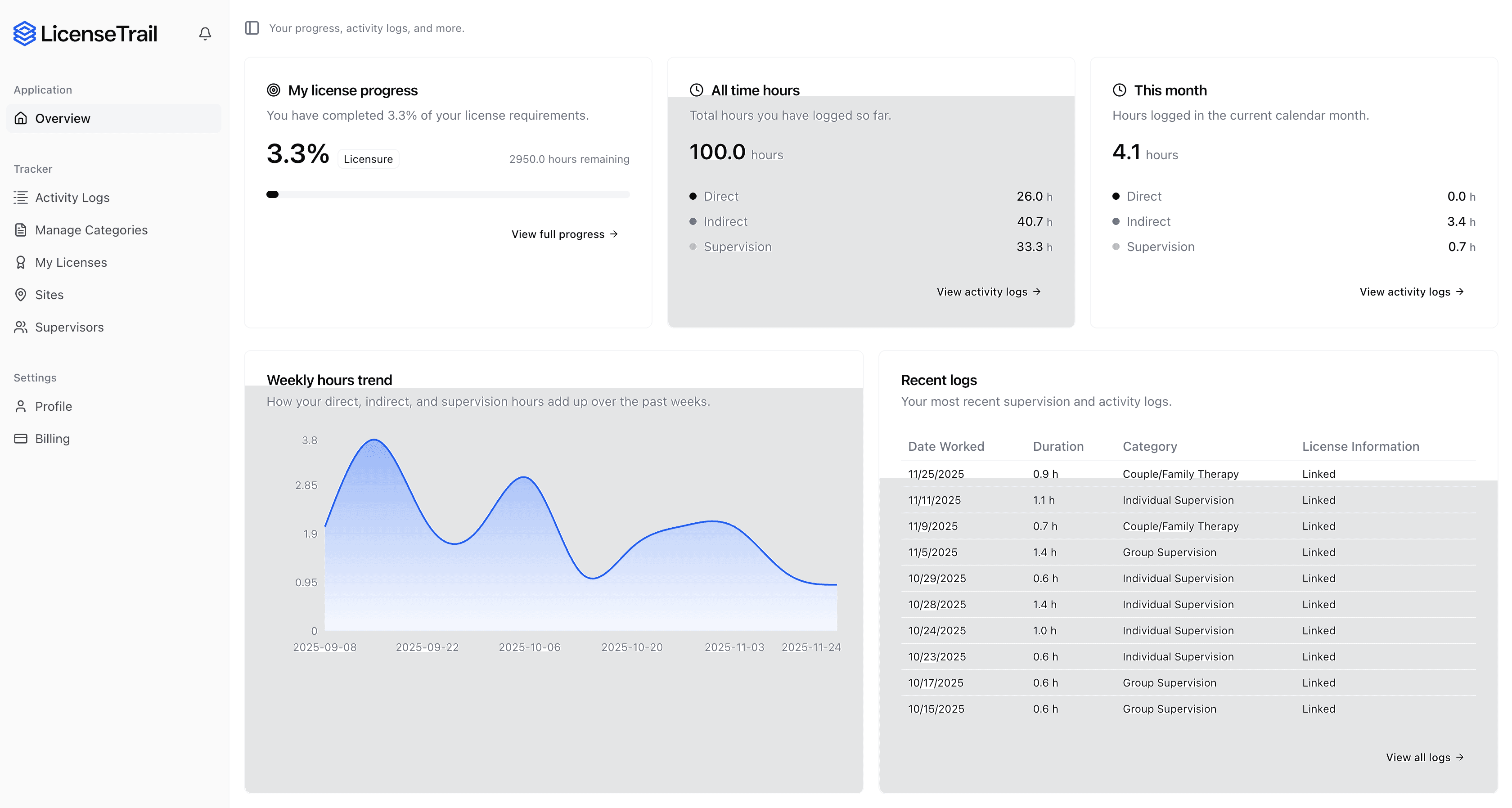
Track your Registered Professional Counselor Associate hours with confidence
License Trail checks your direct, indirect, and supervision hours against Oregon Registered Professional Counselor Associate requirements continuously and flags mismatches before you submit.
 Start Tracking for Free
No credit card required · Free plan available
Is your spreadsheet hiding Oregon Registered Professional Counselor Associate risks?
Stop guessing if your categories match Oregon Board of Licensed Professional Counselors and Therapists requirements. License Trail checks your direct, indirect, and supervision hours continuously and flags mismatches before you submit.
Import or log
Bring your spreadsheet or start fresh
Upload your existing tracking spreadsheet and we'll map every hour into the right Oregon Board of Licensed Professional Counselors and Therapists categories automatically.
Verify against Oregon
Catch mismatches before the board does
License Trail checks your direct, indirect, and supervision hours against Oregon Registered Professional Counselor Associate requirements continuously.
Export board-ready
One-click clean reports
Generate professional, board-ready reports for supervision meetings and Oregon Board of Licensed Professional Counselors and Therapists submissions in seconds.
No credit card required · Free plan available