
South-carolina LAC Requirements: Hours, Exams & Step-by-Step Guide
Stop guessing if your categories match South-carolina requirements. License Trail checks your direct, indirect, and supervision hours against LAC requirements continuously and flags mismatches before you submit.
No credit card required · Free plan available
Quick Requirements Overview
- Two-stage path: Addiction Counselor Associate → Licensed Addiction Counselor (LAC); Associate must practice only under Board-approved supervision
- Education: CACREP addiction counseling grad or master’s/specialist/doctorate (≥48 grad semester hrs) in counseling/related field from appropriately accredited program/institution
- Coursework (non-CACREP route): ≥27 of 48 hrs across Board content areas including ≥6 hrs addiction/SUD-specific coursework
- Practicum/Internship: 100-hr supervised practicum + 600-hr internship (≥300 hrs primarily with SUD population, incl. ≥120 direct client contact; deficits may be made up post-grad)
- Exam: pass NAADAC MAC or IC&RC AADC
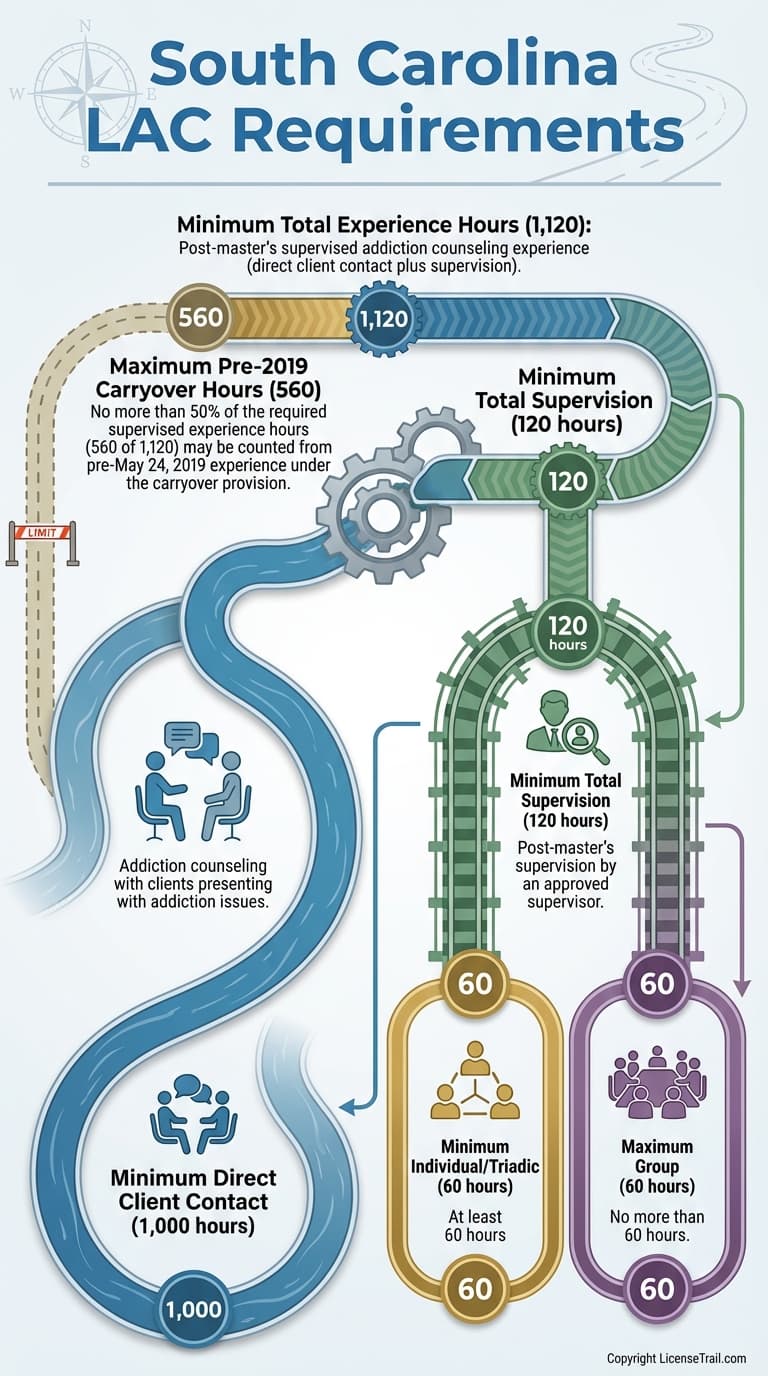
- Post-master’s for LAC: 1,120 hrs minimum over ≥2 years while licensed as Associate
- Hour breakdown: ≥1,000 direct client contact with addiction clients + ≥120 supervision (≥60 individual/triadic; remaining up to 60 may be individual/triadic or group)
- Upgrade application: submit Associate→LAC application, supervision logs, and supervisor confirmation form(s); supervision by LACS or Board-approved QLMHP
License Details
Procedures
Becoming a Licensed Addiction Counselor (LAC) in South Carolina is a two-stage process: you first become an Addiction Counselor Associate, then, after supervised practice, you upgrade to full Licensed Addiction Counselor status. The South Carolina Board of Examiners sets detailed requirements for education, practicum/internship, examination, and supervised post‑master’s experience.
Below is a step‑by‑step outline, using the Board’s own terminology where it matters.
1. Licensure structure in South Carolina
Under South Carolina law and Board regulation, addiction counseling licensure is organized as follows:
- Addiction Counselor Associate – entry‑level license for those who have met education (and exam) requirements but have not yet completed the required supervised clinical experience. Associates may only practice under supervision as approved by the Board. (llr.sc.gov)
- Licensed Addiction Counselor (LAC) – independent license granted after you complete the required post‑master’s supervised clinical experience and supervision in the practice of addiction counseling. (llr.sc.gov)
South Carolina law defines the “practice of addiction counseling” as providing professional services designed to change substance use or addictive behavior, involving specialized knowledge about addictions, including functions like gathering information through structured interviews, participating in treatment planning, providing client and family education, counseling individuals and groups, and maintaining professional and ethical standards. (scstatehouse.gov)
The term “supervision” is defined in statute as the supervision of clinical services under an approved supervisor, in accordance with Board standards. (scstatehouse.gov)
2. Educational foundation
To qualify for Addiction Counselor Associate (the first step toward LAC), you must meet one of the Board’s educational pathways.
2.1 CACREP‑accredited addiction counseling program
You can qualify by showing evidence of graduation from an addiction counseling program accredited by CACREP (Council for Accreditation of Counseling & Related Educational Programs) at the time of graduation. (llr.sc.gov)
2.2 Non‑CACREP programs
If your program is not CACREP‑accredited in addiction counseling, you must show: (llr.sc.gov)
- A master’s, specialist, or doctoral degree with at least 48 graduate semester hours primarily in counseling or a related field; and
- The degree must be from a program accredited by NASAC, CACREP, or a program with similar educational standards, and from a college or university accredited by:
- The Commission on Colleges of the Southern Association of Colleges and Schools or a similar regional association,
- The Association of Theological Schools in the United States and Canada, or
- Another regionally accredited institution.
On your graduate transcript(s), 27 of the 48 hours must be in the following content areas (any combination, as long as at least 27 hours total are represented): (llr.sc.gov)
- Human growth and development
- Social and cultural foundations
- Counseling theory
- Family systems theory
- Career theory
- Group dynamics
- Screening, assessment, and clinical diagnosis within behavioral health
- Research and evaluation
- Professional orientation (roles, ethics, standards, credentialing)
- Plus: at least 6 semester hours of Substance Use Disorder / Addiction‑specific coursework
3. Required practicum and internship (built into the degree)
The Board requires that your degree program (or accepted equivalents) include specific field experiences: (llr.sc.gov)
-
Practicum
- At least one supervised 100‑hour counseling practicum.
-
Internship
- An internship of at least 600 hours;
- Of those 600 hours, at least 300 hours must be “working primarily with the substance use disordered population”;
- Within those 300 hours, you must complete a minimum of 120 hours of direct client contact.
- If the 300‑hour / 120‑direct‑contact requirement is not met within the 600‑hour internship, the Board allows a post‑graduate experience to make up the deficit.
“Direct client contact” here refers to face‑to‑face (or synchronous telehealth) clinical services where you are directly providing counseling or related therapeutic services to clients, as opposed to purely administrative or support activities; this meaning is consistent with how South Carolina describes similar requirements for other counseling licenses. (llr.sc.gov)
4. Examination requirement
The Board requires addiction counseling candidates to pass one of two national specialty exams: (llr.sc.gov)
- NAADAC Master Addiction Counselor (MAC) Exam, or
- IC&RC Advanced Alcohol and Drug Counselor (AADC) Exam.
On the Board’s addiction counselor page, you’ll see this under “Examination,” and earlier on that same page they state that Addiction Counselor Associate applicants must meet education and examination requirements. (llr.sc.gov)
In practice, most candidates:
- Submit their Addiction Counselor Associate application and supervision plan, and
- Take and pass the MAC or AADC to secure the Associate license. (llr.sc.gov)
5. Step 1 license: Addiction Counselor Associate
Once you meet the education and exam criteria, you apply for Addiction Counselor Associate with the Board. Key points from the Board’s requirements: (llr.sc.gov)
- You submit:
- The Addiction Counselor Associate Application, and
- A “Plan for Clinical Supervision of Post‑Master’s Clinical Experience in Counseling” form (often labeled “LAC Plan for Clinical Supervision…” on the Board’s site).
- The Associate license is initially a two‑year license.
- If you have not finished your required post‑master’s clinical experience and supervision within the two‑year period, you must apply for an Associate Extension before the Associate license expires. (llr.sc.gov)
- As the Board explains, “An Addiction Counselor Associate cannot provide professional counseling services until the supervision plan is submitted to the Board and approved and the Associate license is issued.” (llr.sc.gov)
During this stage, all clinical practice in addiction counseling is performed under supervision (either by a Licensed Addiction Counselor Supervisor or another Board‑approved Qualified Licensed Mental Health Practitioner).
6. Core supervised experience for full LAC
This is the part where the Board’s exact hours and terminology matter most.
6.1 Total post‑master’s hours
To become a Licensed Addiction Counselor (LAC), the Board requires documentation of: (llr.sc.gov)
“a minimum of one thousand one hundred twenty (1120) hours of post-master's clinical experience and post master's clinical supervision in the practice of addiction counseling performed over a period of not fewer than two (2) years.”
Important points:
- 1120 hours is the entire post‑master’s supervised package, not 1,500 + 1,500 or similar; it is one integrated requirement consisting of:
- Direct client contact, and
- Supervision hours.
- The timeframe is at least two years; you cannot compress the hours into a shorter period.
6.2 Breakdown of the 1,120 hours
Within those 1,120 total hours, the Board further specifies: (llr.sc.gov)
-
Direct client contact with addiction clients
- Minimum 1,000 hours of “direct client contact with clients presenting with addiction issues.”
- These hours focus on you actually providing addiction counseling services (assessment, individual and group counseling, relapse prevention, family education, etc.) to clients whose primary concerns involve substance use or addictive behaviors.
-
Supervision hours
- Minimum 120 hours of clinical supervision by a:
- Licensed Addiction Counselor Supervisor (LACS), or
- Other Qualified Licensed Mental Health Practitioner (QLMHP) approved by the Board. (llr.sc.gov)
- The Board breaks these 120 hours down as:
- At least 60 hours must be “individual/triadic” supervision (one supervisor with one supervisee, or one supervisor with two supervisees), and
- The remaining 60 hours may be individual/triadic or group supervision.
- Minimum 120 hours of clinical supervision by a:
These 1,120 hours are explicitly described by the Board as “post-master's clinical experience and post master's clinical supervision in the practice of addiction counseling” and are obtained while you hold the Associate license. (llr.sc.gov)
6.3 Who can supervise you
The Board specifies that your supervision must be provided by: (llr.sc.gov)
- A Licensed Addiction Counselor Supervisor (LACS), or
- Another Qualified Licensed Mental Health Practitioner (QLMHP) approved by the Board.
For supervisory purposes, the Board describes a QLMHP as someone who is:
- A Licensed Professional Counselor Supervisor,
- A Marriage and Family Therapy Supervisor,
- An Addiction Counselor Supervisor,
- A licensed Psychologist, or
- A licensed Medical Doctor,
provided the person is Board‑approved and has the knowledge and expertise necessary to provide addiction counseling supervision, including diagnosis and treatment of serious problems as categorized in standard diagnostic nomenclature.
Supervision itself must focus on your clinical services—case consultation, treatment planning, ethics, professional development—rather than merely administrative oversight.
7. Upgrading from Associate to Licensed Addiction Counselor
After you complete:
- The required 1,120 hours (with at least 1,000 direct client contact hours and 120 supervision hours over a minimum of two years), and
- Any remaining Board requirements,
you apply to the Board to convert your license from Addiction Counselor Associate to Licensed Addiction Counselor.
The Board requires: (llr.sc.gov)
- The LAC Associate to Licensed Addiction Counselor electronic application,
- Your Associate Supervision Log(s) documenting clinical experience and supervision, and
- The LAC Confirmation of Clinical Supervision form (one from each supervisor, if you had more than one).
Once the Board verifies your education, exam, and the full supervised clinical requirement, it issues the Licensed Addiction Counselor (LAC) license.
8. Additional statutory context and definitions
A few additional points from South Carolina law and regulation that frame the LAC role:
- Licensure requirement: It is unlawful to practice as an addiction counselor in South Carolina without being licensed; using titles such as “licensed addiction counselor” or “addiction counselor” without Board licensure is defined as practicing without a license. (scstatehouse.gov)
- Scope of practice: The “practice of addiction counseling” definition (quoted above) makes clear that LACs provide professional addiction‑focused services, including structured interviewing, treatment planning, counseling, client and family education, and participation on multidisciplinary teams. (scstatehouse.gov)
- Confidentiality: Addiction counselors must comply with all applicable state and federal confidentiality laws related to alcohol or drug treatment records, and client communications with addiction counselors are treated as privileged under South Carolina law. (scstatehouse.gov)
9. Numeric summary of the supervised experience for LAC
For quick reference, the post‑degree supervised requirement for Licensed Addiction Counselor (LAC) in South Carolina is:
- Total post‑master’s clinical experience + supervision:
- 1,120 hours minimum, over not fewer than 2 years.
- Within that 1,120 hours:
- 1,000 hours minimum of direct client contact with clients presenting with addiction issues;
- 120 hours minimum of documented supervision, of which:
- At least 60 hours must be individual/triadic supervision;
- Up to 60 hours may be individual/triadic or group supervision. (llr.sc.gov)
These figures are the Board’s current requirements for LAC (addiction counseling) and are not the same as the 1,500‑hour models used for some other counseling licenses in South Carolina.
Because requirements can change, it is always wise to confirm details directly with the South Carolina Board of Examiners (via the LLR website) before submitting applications or making long‑term plans.
Track your LAC hours with confidence
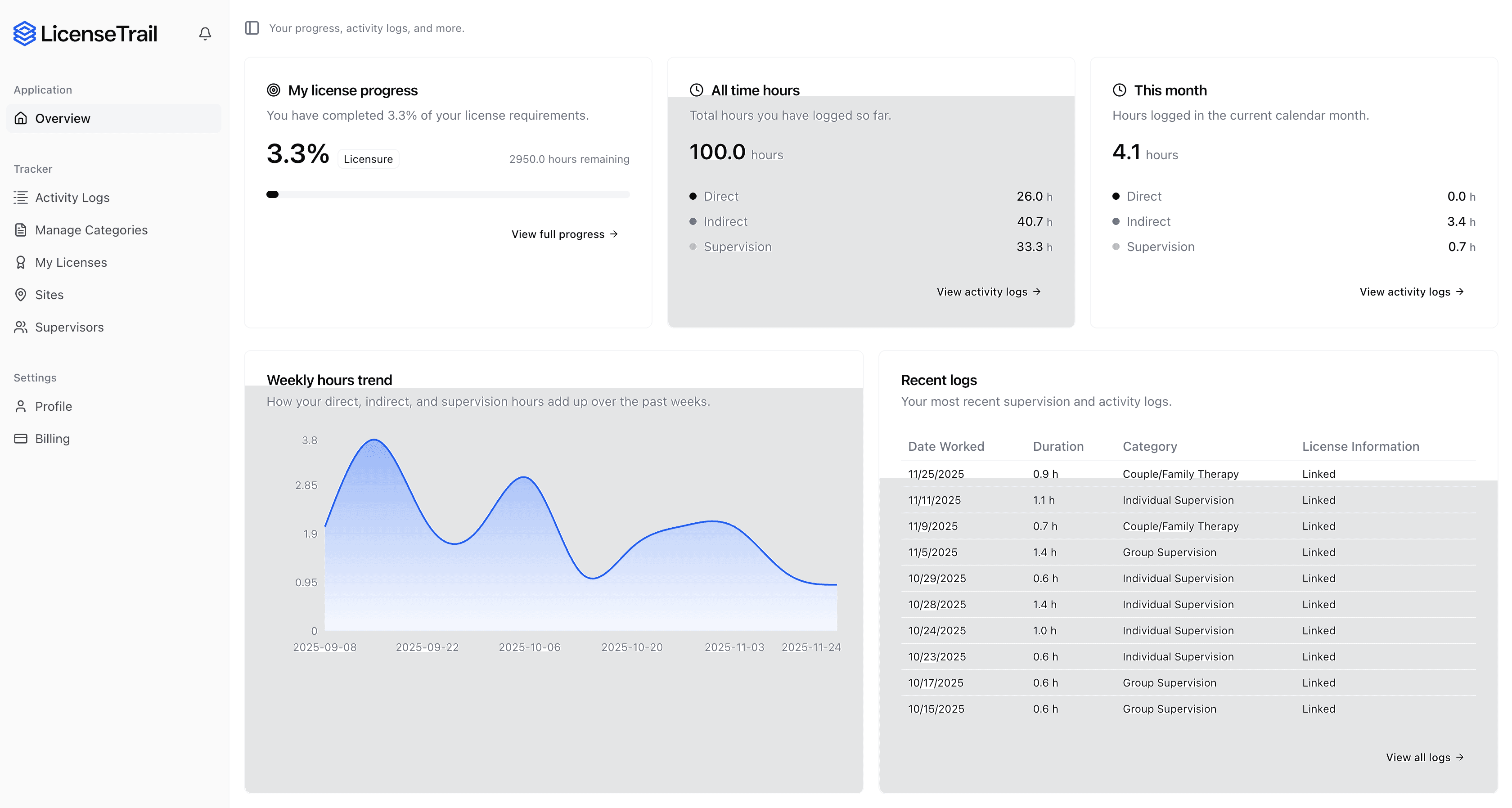
License Trail checks your direct, indirect, and supervision hours against South-carolina LAC requirements continuously and flags mismatches before you submit.
 Start Tracking for Free
No credit card required · Free plan available
Is your spreadsheet hiding South-carolina LAC risks?
Stop guessing if your categories match South Carolina Board of Examiners for Licensure of Professional Counselors, Marriage and Family Therapists, Addiction Counselors and Psycho-Educational Specialists requirements. License Trail checks your direct, indirect, and supervision hours continuously and flags mismatches before you submit.
Import or log
Bring your spreadsheet or start fresh
Upload your existing tracking spreadsheet and we'll map every hour into the right South Carolina Board of Examiners for Licensure of Professional Counselors, Marriage and Family Therapists, Addiction Counselors and Psycho-Educational Specialists categories automatically.
Verify against South-carolina
Catch mismatches before the board does
License Trail checks your direct, indirect, and supervision hours against South-carolina LAC requirements continuously.
Export board-ready
One-click clean reports
Generate professional, board-ready reports for supervision meetings and South Carolina Board of Examiners for Licensure of Professional Counselors, Marriage and Family Therapists, Addiction Counselors and Psycho-Educational Specialists submissions in seconds.
No credit card required · Free plan available