
South-carolina LMFT Requirements: Hours, Exams & Step-by-Step Guide
Stop guessing if your categories match South-carolina requirements. License Trail checks your direct, indirect, and supervision hours against LMFT requirements continuously and flags mismatches before you submit.
No credit card required · Free plan available
Quick Requirements Overview
- Education: Master’s/specialist/doctorate with ≥60 graduate semester hours in MFT (COAMFTE/CACREP MFT specialty, or Board-approved “substantially similar” program; non-accredited programs submit additional documentation/transcripts).
- Associate license required: Must obtain LMFT Associate (application + fee + education verification + Board-approved exam).
- Exam: Pass the National Marital & Family Therapy Examination (PTC) as approved by the Board.
- Supervision plan before practice: Cannot begin providing services until the completed supervision plan is submitted to and received by the Board (effective after Associate licensure).
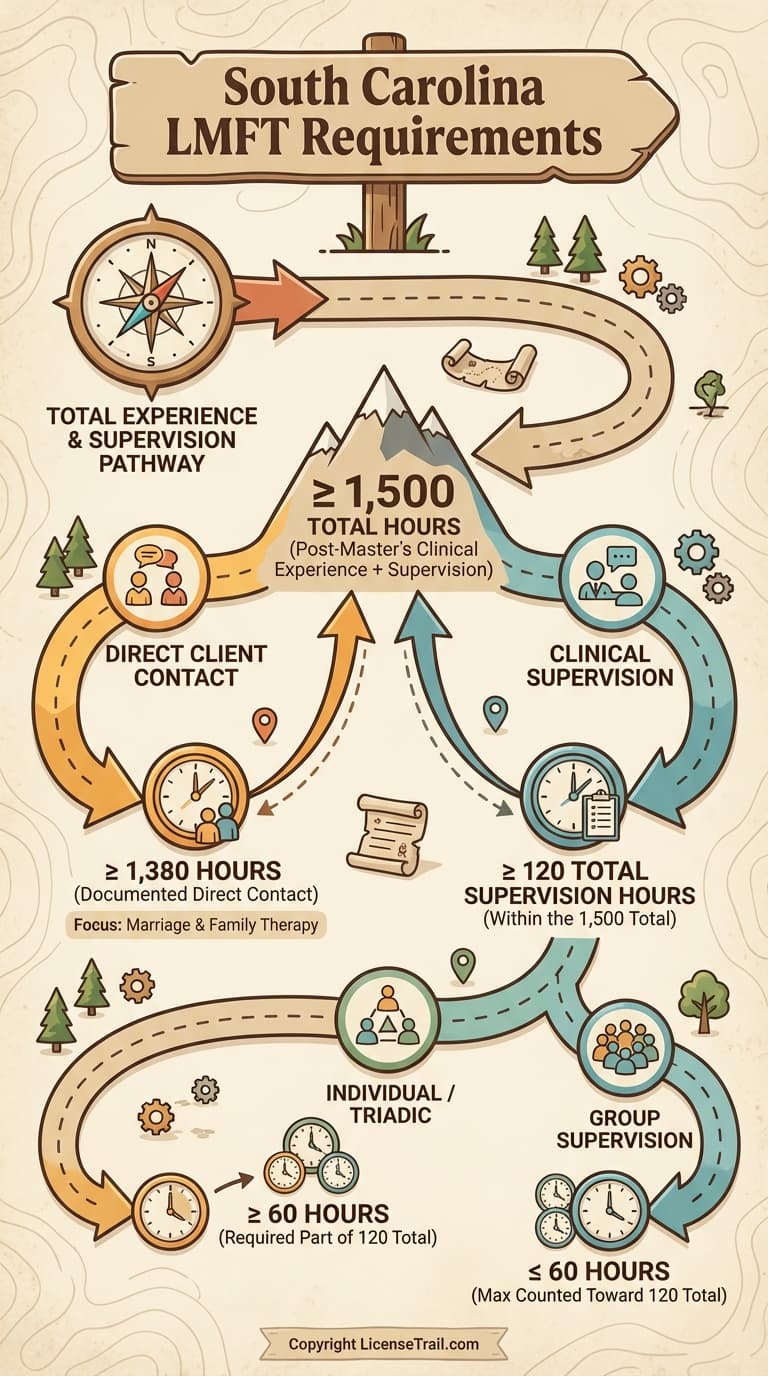
- Post-master’s requirement for full LMFT: 1,500 total hours post-master’s clinical experience/supervision over ≥2 years, earned while licensed as an Associate under an approved plan.
- Hour breakdown (within 1,500): 1,380 direct client contact hours (clinical hour = ≥50 minutes direct contact) + 120 supervision hours.
- Supervision specifics: Supervisor must be LMFT-S or Board-approved QLMHP; ≥60 hours individual/triadic; remaining ≤60 may be individual/triadic or group (group: max 6 supervisees; ≥2 hours/session).
- After licensure (renewal): 40 CE hours every 2 years ( 34 license-related + 6 ethics; first renewal period typically exempt for new licensees).
License Details
Procedures
Licensure as a Licensed Marriage and Family Therapist (LMFT) in South Carolina requires moving through an associate license, a nationally standardized exam, and a precisely defined block of supervised post‑master’s clinical experience. The South Carolina Board of Examiners for Licensure of Professional Counselors, Marriage and Family Therapists, Addiction Counselors and Psycho‑Educational Specialists sets all requirements in Regulation Chapter 36 and on its LMFT webpage. (scstatehouse.gov)
Below is a step‑by‑step guide with the hour requirements and the Board’s own terminology highlighted.
1. Educational foundation
To be eligible for LMFT Associate (the pre‑LMFT license), you must complete graduate education that meets Regulation 36‑07. (scstatehouse.gov)
Degree level and credits
You must have at least a master’s, specialist, or doctoral degree with a minimum of 60 graduate semester hours in marriage and family therapy, from one of the following:
-
COAMFTE / CACREP‑accredited route
- A program of at least sixty (60) graduate semester hours accredited by:
- COAMFTE or
- A marriage, couple and family counseling specialty program accredited by CACREP. (scstatehouse.gov)
- A program of at least sixty (60) graduate semester hours accredited by:
-
Non‑COAMFTE / non‑CACREP route (substantially similar program)
- A master’s, specialist, or doctoral degree with a minimum of sixty (60) graduate semester hours in marriage and family therapy from a program:
- Accredited by a “national educational accrediting body” such as COAMFTE or CACREP, or
- Determined by the Board to follow substantially similar educational standards, and
- From a college or university accredited by:
- The Commission on Colleges of the Southern Association of Colleges and Schools,
- One of its regional transfer associations,
- The Association of Theological Schools in the U.S. and Canada, or
- Another regionally accredited institution of higher learning. (scstatehouse.gov)
- A master’s, specialist, or doctoral degree with a minimum of sixty (60) graduate semester hours in marriage and family therapy from a program:
If your program is not COAMFTE/CACREP‑accredited, you must submit the Board’s “MFT Non‑Accredited Education” documentation package and transcripts so the Board can verify that your coursework meets its “substantially similar” standard. (llr.sc.gov)
2. Obtain the LMFT Associate license
2.1. Core requirements for LMFT Associate
Regulation 36‑07 and the Board’s website describe the LMFT Associate requirements. An applicant for initial licensure as a Marriage and Family Therapy Associate must: (scstatehouse.gov)
- Submit an application and fee on Board‑approved forms.
- Meet the education requirements described above (COAMFTE/CACREP or Board‑approved equivalent).
- Pass an examination approved by the Board – currently the National Marital and Family Therapy Examination administered via Professional Testing Corporation (PTC). (llr.sc.gov)
- Submit a supervision plan, “satisfactory to the Board,” designed to take effect after notice of licensure as a Licensed Marriage and Family Therapy Associate. (scstatehouse.gov)
Very important Board condition:
- “An associate cannot begin providing marriage and family therapy services until a completed supervision plan is submitted to and received by the Board.” (scstatehouse.gov)
2.2. Nature and duration of the Associate license
The Board notes that: (llr.sc.gov)
- The Marriage and Family Therapy Associate license is a two‑year license.
- If post‑master’s clinical experience has not been completed within that two‑year period, you must apply for an Associate Extension before the license expires, using the Board’s extension form and updated supervision documents.
All post‑master’s supervised hours for LMFT must be earned while you hold this Associate license and under an approved supervision plan.
3. Understanding key Board definitions
Regulation 36‑01 supplies definitions that matter when you count hours: (scstatehouse.gov)
-
“Supervision” – direct contact between a supervisor and supervisee (associate), done in person or via HIPAA‑compliant technology, where:
- The supervisee presents diagnosis and treatment of each client,
- The supervisor provides oversight and guidance in diagnosing, treating, and dealing with clients, and
- The supervisor evaluates the supervisee’s performance, using raw clinical data (notes, observation, recordings, etc.).
-
“Group supervision” – a regularly scheduled meeting with no more than six supervisees and one supervisor for at least two hours.
-
“Individual/triadic supervision” – a meeting of one or two supervisees with a supervisor for at least a one‑hour session.
-
“Clinical contact hour” – defined as a minimum of 50 minutes of direct client contact.
-
“Qualified licensed mental health practitioner” (QLMHP) – a person licensed as a:
- Professional Counselor Supervisor,
- Marriage and Family Therapy Supervisor,
- Addiction Counselor Supervisor,
- Psychologist, or
- Medical Doctor,
who has been approved by the Board and has the “knowledge and expertise necessary” to provide structured supervision in diagnosis and treatment of “serious problems as categorized in standard diagnostic nomenclature” (e.g., DSM conditions). (scstatehouse.gov)
These definitions govern what counts as supervision and client contact for your licensure hours.
4. Post‑master’s supervised clinical experience: hour requirements and breakdown
The core LMFT hour requirement is set in Regulation 36‑08 and mirrored on the Board’s LMFT webpage. (scstatehouse.gov)
4.1. Total hours and time frame
To qualify for full LMFT licensure, you must:
- Complete a minimum of 1,500 hours of post‑master’s clinical experience and post‑master’s clinical supervision in marriage and family therapy.
- Accumulate these hours “over a period of no fewer than two (2) years.” (scstatehouse.gov)
These 1,500 hours are one combined total, not separate piles of “1,500 experience + 1,500 supervision.” The breakdown within the 1,500 is:
- 1,380 documented direct client contact hours, and
- 120 documented hours of supervision by a qualified supervisor.
4.2. Direct client contact hours (1,380 hours)
The regulation and Board site require “a minimum of one thousand three hundred eighty (1,380) documented direct client contact hours.” (scstatehouse.gov)
Using the Board’s definition of a clinical contact hour (50 minutes of direct client contact), these 1,380 hours must be:
- Actual face‑to‑face clinical work with clients in a marriage and family therapy context – individuals, couples, families, or groups.
- Documented in a way that can be confirmed to the Board (logs, employer records, etc.).
While the regulation does not micromanage the mix of individuals vs. couples vs. families, these hours are explicitly “direct client contact” and must be post‑master’s, obtained under your approved LMFT Associate supervision plan. (scstatehouse.gov)
4.3. Supervision hours (120 hours)
Out of the same 1,500 total, you must have “a minimum of one hundred twenty (120) documented hours of supervision” that meets all of the following: (scstatehouse.gov)
-
Who can supervise you
Supervision must be provided by either:
- A licensed Marriage and Family Therapy Supervisor (LMFT‑S), or
- Another qualified licensed mental health practitioner (QLMHP) who:
- Holds one of the qualifying licenses (Professional Counselor Supervisor, Addiction Counselor Supervisor, Psychologist, or Medical Doctor), and
- Has been approved by the Board as meeting its QLMHP definition – that is, having the required knowledge and expertise to supervise diagnosis and treatment of serious mental health conditions. (scstatehouse.gov)
The Board emphasizes that the LMFT‑S or QLMHP must be approved before supervision begins, and must have the expertise “necessary to provide marriage and family therapy supervision, including diagnosis and treatment of more serious problems categorized in standard diagnostic nomenclature.” (llr.sc.gov)
-
Content of supervision
Your supervised experience must include work assessing and treating clients with more serious problems (e.g., DSM disorders), not only adjustment‑level or “normal lifecycle” issues. This is explicit in the regulation’s requirement that supervision include experience with “the more serious problems as categorized in standard diagnostic nomenclature.” (scstatehouse.gov)
-
Format of the 120 supervisory hours
Of the 120 total supervision hours:
- At least 60 hours must be individual/triadic supervision (one or two supervisees with the supervisor, for minimum 1‑hour sessions).
- The remaining 60 hours may be individual/triadic or group supervision (up to six supervisees, at least 2 hours per session). (scstatehouse.gov)
In other words:
- 60 hours – must be individual/triadic.
- Up to 60 hours – flexible: can be additional individual/triadic or group.
4.4. Putting the hours together
In Board language, LMFT eligibility requires, at minimum: (scstatehouse.gov)
-
Total:
- 1,500 hours post‑master’s clinical experience and post‑master’s clinical supervision in marriage and family therapy, over ≥ 2 years.
-
Within the 1,500:
- 1,380 hours of documented direct client contact;
- 120 hours of documented supervision (≥ 60 individual/triadic; remaining 60 individual/triadic or group).
South Carolina does not require, for example, “1,500 hours of direct experience and 1,500 hours of supervised experience” as separate, additive totals. Instead, it mandates one structured block of 1,500 hours that is internally divided into 1,380 client contact and 120 supervision hours.
5. How the hours must be obtained (status and structure)
Several structural conditions are just as important as the raw numbers:
-
Status during hours
- All 1,500 hours must be post‑master’s and accrued while you hold a current, active, and unrestricted Marriage and Family Therapy Associate license, under your approved supervision plan. (scstatehouse.gov)
-
Minimum time frame
- The 1,500 hours must be completed over at least two (2) years. Accumulating the hours more quickly does not waive the time requirement: you cannot compress the post‑master’s experience into, say, 12 months.
-
Supervision relationship
- Supervision sessions must satisfy the Board’s definition of “supervision,” focusing on case material, diagnostic and treatment decisions, and performance evaluation, not personal psychotherapy. (scstatehouse.gov)
- Supervision may be conducted in person or via a HIPAA‑compliant technological medium.
-
Nature of cases
- Your caseload should include sufficient exposure to “serious problems” (DSM‑level conditions) so that your supervisor can attest you have gained knowledge and skills in diagnosis and treatment of such conditions, as required by the definition of QLMHP supervision and Regulation 36‑08. (scstatehouse.gov)
-
Documentation
The Board requires specific forms to document compliance:- MFT Plan for Clinical Supervision of Post‑Master’s Clinical Experience in Marriage and Family Therapy (initial plan).
- Associate Supervision Log Form (ongoing record of your hours).
- MFT Confirmation of Clinical Supervision of Post‑Master’s Client Contact Form (final supervisor attestation). (llr.sc.gov)
All of these are available under the Marriage and Family Therapist section of the Board’s website.
6. Applying for full LMFT licensure
After you complete the required education, pass the national exam, and log the 1,500 hours with the required breakdown and time frame, you move from LMFT Associate to full LMFT.
6.1. Baseline conditions in Regulation 36‑08
Regulation 36‑08 states that an applicant for licensure as a Marriage and Family Therapist must: (scstatehouse.gov)
- Submit an application and fee on Board‑approved forms.
- Hold a current, active, and unrestricted Marriage and Family Therapy Associate license (unless applying via licensure by endorsement).
- Submit documentation of completion of the 1,500 hours of post‑master’s clinical experience and supervision, with the 1,380 / 120 breakdown and proper supervision configuration, as described above.
6.2. What you actually submit
On the Board’s LMFT page, the transition from Associate to LMFT is handled via online forms: (llr.sc.gov)
- MFT Associate to Licensed Marriage and Family Therapist Electronic Application (submitted online through the Board’s e‑service portal).
- Associate Supervision Log (detailing client contact and supervision hours).
- MFT Confirmation of Clinical Supervision (completed and signed by your LMFT‑S or QLMHP supervisor).
The Board will review your education, exam result, hours, and supervision documentation to confirm that you have satisfied Regulation 36‑07 and 36‑08.
7. Licensure by endorsement (for already‑licensed MFTs from other states)
If you already hold an MFT license in another state, South Carolina has a licensure by endorsement pathway under Regulation 36‑14 and the Board’s “Marriage and Family Therapist / Marriage and Family Therapist Supervisor by Endorsement” application. (scstatehouse.gov)
Key points:
- You must hold a current, active, unrestricted license in good standing elsewhere.
- You must have no current or pending investigations in the state where you are currently licensed.
- You submit an endorsement application and any additional documentation the Board requests (often including evidence that your education and supervised experience meet or exceed South Carolina standards).
- You can only be endorsed at an equivalent credential level (e.g., LMFT to LMFT).
The endorsement process allows the Board to accept substantially equivalent education and supervised experience in lieu of re‑doing the South Carolina LMFT Associate and 1,500‑hour sequence, if your prior state’s requirements are judged comparable.
8. After licensure: continuing education (for completeness)
Once you are licensed as an LMFT, you must meet the Board’s continuing education (CE) requirement in Regulation 36‑16:
- 40 hours of Board‑approved CE every two‑year licensure period,
- 34 hours related to your professional license (marriage and family therapy), and
- 6 hours specifically in ethics for your license. (law.cornell.edu)
First‑time licensees are exempt from CE for the initial period in which the license is first issued; after your first renewal, these CE requirements apply.
Summary of key hour requirements in Board language
-
Associate phase:
- Hold LMFT Associate license, work under an approved supervision plan, and cannot practice until plan is on file and license is issued. (scstatehouse.gov)
-
Post‑master’s supervised experience (LMFT requirement): (scstatehouse.gov)
- 1,500 hours total over at least two years, consisting of:
- 1,380 hours documented direct client contact; and
- 120 hours documented supervision by an LMFT‑S or Board‑approved QLMHP, including:
- ≥ 60 hours individual/triadic supervision;
- ≤ 60 hours that may be individual/triadic or group.
- 1,500 hours total over at least two years, consisting of:
Taken together, these requirements outline the complete path set by the South Carolina Board to become — and remain — a Licensed Marriage and Family Therapist in the state.
Track your LMFT hours with confidence
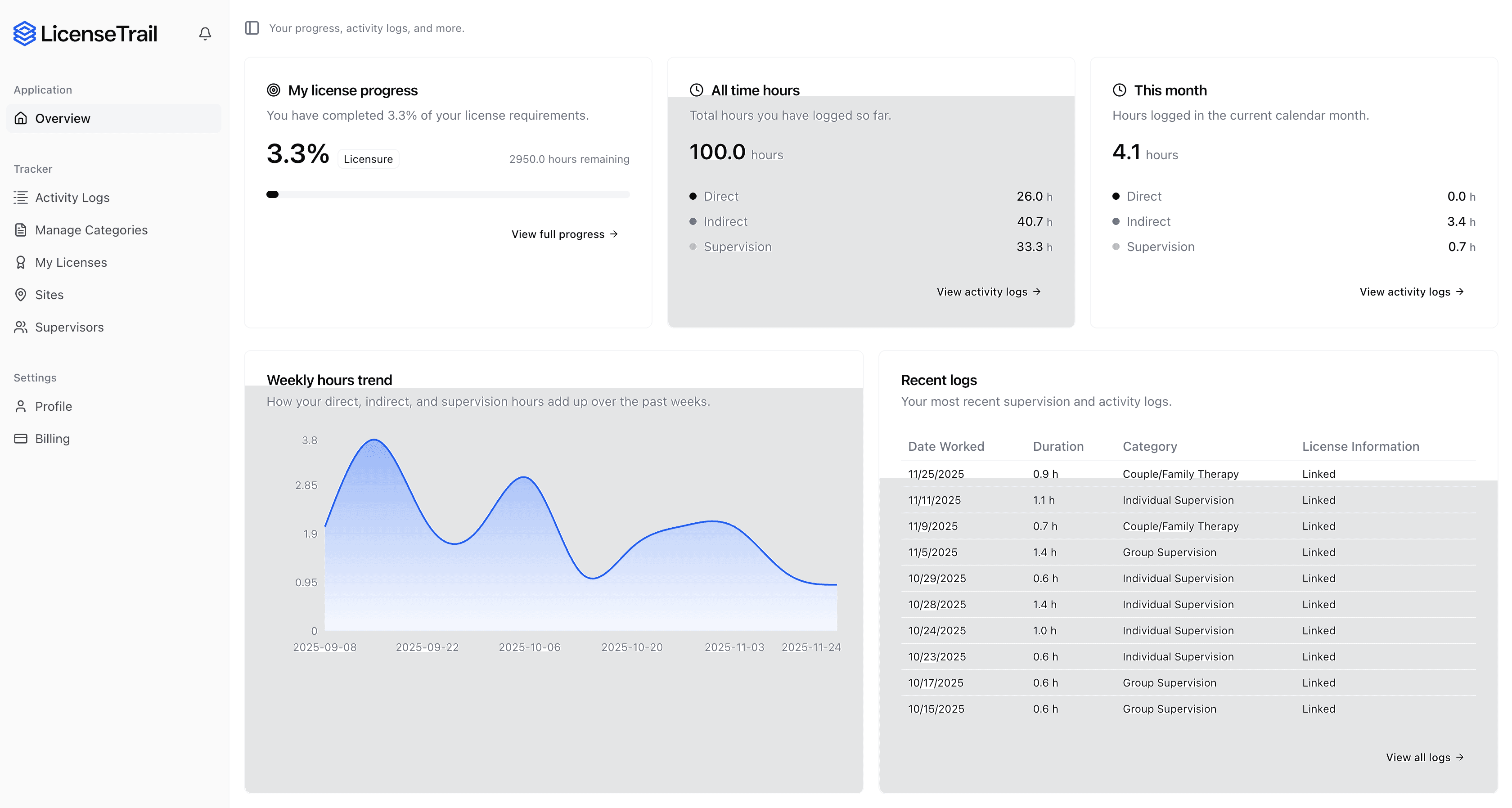
License Trail checks your direct, indirect, and supervision hours against South-carolina LMFT requirements continuously and flags mismatches before you submit.
 Start Tracking for Free
No credit card required · Free plan available
Is your spreadsheet hiding South-carolina LMFT risks?
Stop guessing if your categories match South Carolina Board of Examiners for Licensure of Professional Counselors, Marriage and Family Therapists, Addiction Counselors and Psycho-Educational Specialists requirements. License Trail checks your direct, indirect, and supervision hours continuously and flags mismatches before you submit.
Import or log
Bring your spreadsheet or start fresh
Upload your existing tracking spreadsheet and we'll map every hour into the right South Carolina Board of Examiners for Licensure of Professional Counselors, Marriage and Family Therapists, Addiction Counselors and Psycho-Educational Specialists categories automatically.
Verify against South-carolina
Catch mismatches before the board does
License Trail checks your direct, indirect, and supervision hours against South-carolina LMFT requirements continuously.
Export board-ready
One-click clean reports
Generate professional, board-ready reports for supervision meetings and South Carolina Board of Examiners for Licensure of Professional Counselors, Marriage and Family Therapists, Addiction Counselors and Psycho-Educational Specialists submissions in seconds.
No credit card required · Free plan available