
South-carolina LPC Requirements: Hours, Exams & Step-by-Step Guide
Stop guessing if your categories match South-carolina requirements. License Trail checks your direct, indirect, and supervision hours against LPC requirements continuously and flags mismatches before you submit.
No credit card required · Free plan available
Quick Requirements Overview
- Board: SC Board of Examiners (LLR) regulates LPC licensure
- Education: CACREP Clinical Mental Health Counseling degree or non-CACREP with ≥60 graduate semester hours primarily in counseling + Board coursework/practicum review forms
- Exam: Pass NCE or NCMHCE (NBCC) after Board approval
- Associate first: Must hold Professional Counselor Associate license; practice only under a Board-approved supervision plan (no counseling until plan approved + license issued)
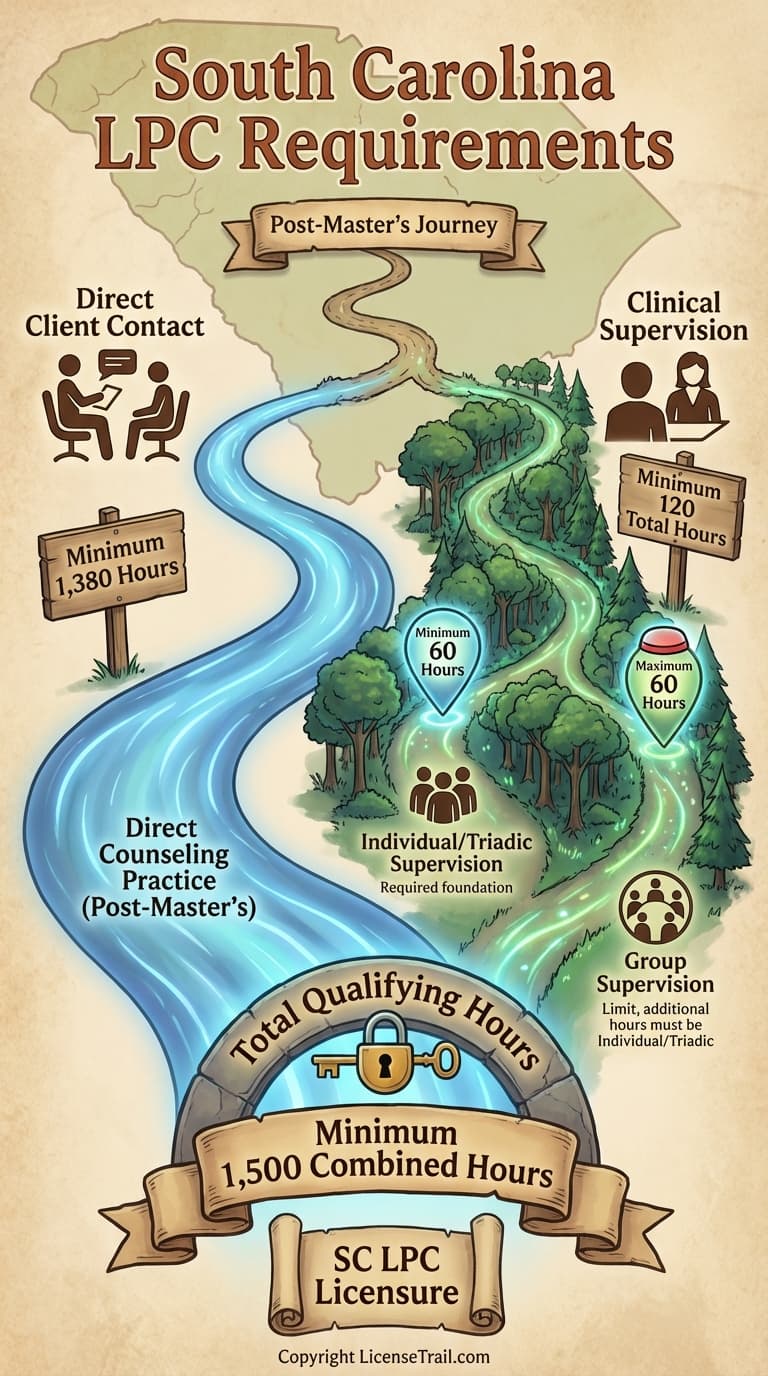
- Post-master’s hours (as Associate): 1,500 total over ≥2 years
- Hour breakdown: 1,380 direct client contact + 120 clinical supervision (included in the 1,500)
- Supervision format: ≥60 hours individual/triadic; remaining 60 individual/triadic or group
- Supervisor: LPCS or Board-approved QLMHP (e.g., LMFT Supervisor, Addiction Counselor Supervisor, psychologist, MD); maintain Board logs/forms to upgrade to LPC
License Details
Procedures
Licensure as a Licensed Professional Counselor (LPC) in South Carolina is regulated by the South Carolina Board of Examiners for Licensure of Professional Counselors, Marriage and Family Therapists, Addiction Counselors and Psycho-Educational Specialists. The Board sets specific education, examination, and supervised experience requirements, including an exact breakdown of post‑master’s clinical and supervision hours.
Below is a step‑by‑step outline, with the key hour requirements and the Board’s own categorizations highlighted.
1. Understand the Overall LPC Pathway in South Carolina
To become a fully licensed LPC, you will generally:
- Complete an approved graduate counseling degree.
- Pass a national counseling exam (NCE or NCMHCE).
- Obtain a Professional Counselor Associate license.
- Complete required post‑master’s supervised clinical experience and supervision hours as an Associate.
- Apply to convert your Associate license to a full Licensed Professional Counselor license.
All requirements and hours are set and administered by the South Carolina Board. (llr.sc.gov)
2. Meet the Education Requirements
2.1 CACREP‑accredited route
You can satisfy the Board’s education requirement by graduating from a Clinical Mental Health Counseling program accredited by the Council for Accreditation of Counseling and Related Educational Programs (CACREP) at the time of graduation. (llr.sc.gov)
In this case, the Board treats your program as having already met the required coursework and internship/practicum standards.
2.2 Non‑CACREP route (60‑hour minimum)
If your program is not CACREP‑accredited, you must show:
- A master’s, specialist, or doctoral degree primarily in counseling.
- At least sixty (60) graduate semester hours primarily in counseling from a program:
- Accredited by a national educational accrediting body such as CACREP or one that follows substantially similar standards, and
- Housed in a college or university with recognized regional or equivalent accreditation (e.g., Southern Association of Colleges and Schools, Association of Theological Schools, or another regionally accredited institution). (llr.sc.gov)
You must also submit the Board’s Coursework Description and Verification Form and Practicum and Internship Review Form, with catalog descriptions or syllabi, so the Board can verify that your non‑CACREP coursework meets its content and practicum/internship expectations. (llr.sc.gov)
3. Pass the Required National Examination
South Carolina requires you to pass one of the following Board‑approved examinations, both administered by NBCC: (llr.sc.gov)
- NCE – National Counselor Examination for Licensure and Certification, or
- NCMHCE – National Clinical Mental Health Counseling Examination.
The Board must first approve your education and application; then it provides instructions on how to register for the exam (if you have not already passed it).
4. Apply for the Professional Counselor Associate License
Before you can accrue post‑master’s hours toward full LPC licensure, you must be licensed as a Professional Counselor Associate.
4.1 Associate status and supervision plan
Key points from the Board’s Associate provisions: (llr.sc.gov)
- Associate applicants must meet education and examination requirements.
- Associates can only practice under supervision, according to a Board‑approved Plan for Clinical Supervision of Post‑Master’s Clinical Experience in Counseling.
- A Professional Counselor Associate cannot provide professional counseling services until:
- The supervision plan has been submitted to the Board and approved, and
- The Associate license has been issued.
You submit an electronic Associate application and include (or subsequently submit) your supervision plan, which must be effective once you have passed your exam and your Associate license is active. (llr.sc.gov)
5. Complete Post‑Master’s Clinical Experience and Supervision Requirements
This is the core of the LPC licensure requirements and where the specific hour breakdown matters most. South Carolina’s Board uses the following exact framework for LPC licensure:
5.1 Total post‑master’s hours required
To obtain the LPC license, you must document completion of at least 1,500 hours of combined post‑master’s clinical experience and post‑master’s clinical supervision in professional counseling. These hours: (llr.sc.gov)
- Must be post‑master’s.
- Must be performed over a period of not fewer than two (2) years.
- Must be obtained as a Professional Counselor Associate.
In other words, you cannot compress all of the required experience into less than two calendar years, and the hours are tied specifically to your time as an Associate.
5.2 Direct client contact vs. supervision hours
Within the required 1,500 total hours, the Board divides the hours into two main categories:
-
Direct client contact
- Minimum required: 1,380 hours
- Defined by the Board as “documented direct client contact” – i.e., face‑to‑face (or live telehealth) counseling interactions where you are directly assessing and treating clients within the scope of professional counseling.
-
Clinical supervision
- Minimum required: 120 hours of documented supervision.
Both categories are part of the same 1,500‑hour total, not separate additional blocks. So, the breakdown is:
- 1,380 hours – direct client contact
- 120 hours – clinical supervision
- 1,500 hours – total post‑master’s clinical experience + supervision (llr.sc.gov)
This means that South Carolina does not require 1,500 hours of direct experience plus a separate 1,500 hours of supervision. Instead, the Board requires 1,500 total hours, of which 1,380 must be direct client contact and 120 must be supervision.
5.3 Required format of the 120 supervision hours
The 120 required supervision hours are further divided:
- At least 60 hours must be individual/triadic supervision (one supervisor with one or two supervisees).
- The remaining 60 hours may be individual/triadic or group supervision.
This internal breakdown is explicitly specified by the Board and must be reflected in your supervision logs and confirmation forms. (llr.sc.gov)
5.4 Who can supervise
Supervision must be provided by: (llr.sc.gov)
- A Licensed Professional Counselor Supervisor (LPCS), or
- Another Qualified Licensed Mental Health Practitioner (QLMHP) approved by the Board.
The Board’s definition of QLMHP for LPC supervision includes:
- Licensed Marriage and Family Therapy Supervisor
- Addiction Counselor Supervisor
- Psychologist
- Medical Doctor (physician)
The supervisor must be:
- Approved by the Board, and
- Demonstrably knowledgeable and experienced in providing professional counseling supervision, including diagnosis and treatment of “more serious problems as categorized in standard diagnostic nomenclature.”
You should verify that your chosen supervisor is on the Board‑recognized list or otherwise documented as Board‑approved to avoid any risk of hours not being accepted.
6. Timeframe and Practical Planning for Hours
Because the 1,500 hours must be completed across not fewer than two years, you should plan a realistic caseload and supervision schedule. For instance:
- Spreading 1,380 direct hours over 24 months is roughly:
- About 690 direct client hours per year, or
- Around 13–14 direct client hours per week (assuming 50 working weeks per year).
- Spreading 120 supervision hours over 24 months:
- 60 hours per year, or
- About 2.5 supervision hours per month.
Your actual pace may be faster or slower, but you cannot become eligible for LPC until at least two full years of post‑master’s supervised practice have elapsed while you are licensed as an Associate. (llr.sc.gov)
7. Documenting Experience: Logs and Board Forms
Throughout your Associate period, you and your supervisor must keep meticulous records. The Board provides specific forms, including: (llr.sc.gov)
- Associate Supervision Log – where you track client contact and supervision hours.
- LPC Plan for Clinical Supervision of Post‑Master's Clinical Experience in Counseling – your initial supervision plan.
- LPC Confirmation of Clinical Supervision of Post‑Master’s Client Contact – completed by your supervisor at the end of the supervision period, verifying that you have met:
- 1,500 total post‑master’s hours,
- 1,380 direct client contact hours, and
- 120 supervision hours with the required breakdown of individual/triadic and group.
Accurate logging is critical; if your documentation does not show the proper hour categories and ratios, the Board can delay or deny your upgrade to full LPC.
8. Apply to Upgrade from Associate to LPC
Once you have:
- Completed the 1,500 hours with proper breakdown and timeframe,
- Ensured all logs and confirmation forms are signed and accurate, and
- Remain in good standing with the Board,
you may apply online to transition from Professional Counselor Associate to full Licensed Professional Counselor.
The Board’s site calls this the “LPC Associate to Licensed Professional Counselor Electronic Application.” You submit this along with your: (llr.sc.gov)
- Associate Supervision Log; and
- LPC Confirmation of Clinical Supervision of Post‑Master's Client Contact Form.
Upon approval, the Board issues your LPC license, and you may practice independently within the legal scope of professional counseling in South Carolina (subject to ongoing renewal and continuing education requirements).
9. Quick Reference: South Carolina LPC Hour Requirements
Post‑master’s clinical experience and supervision (must be as an Associate):
-
Total required:
- 1,500 hours of combined post‑master’s clinical experience and post‑master’s clinical supervision in professional counseling.
-
Within the 1,500 hours:
- 1,380 hours – direct client contact (documented direct counseling work with clients).
- 120 hours – documented clinical supervision.
-
Within the 120 supervision hours:
- 60 hours minimum – individual/triadic supervision.
- Remaining 60 hours – may be individual/triadic or group supervision.
-
Timeframe requirement:
- All 1,500 hours must be completed over not fewer than two (2) years.
All of these categories and hour minimums come directly from the South Carolina Board’s published LPC associate supervision requirements and current state‑level licensure disclosures. (llr.sc.gov)
Track your LPC hours with confidence
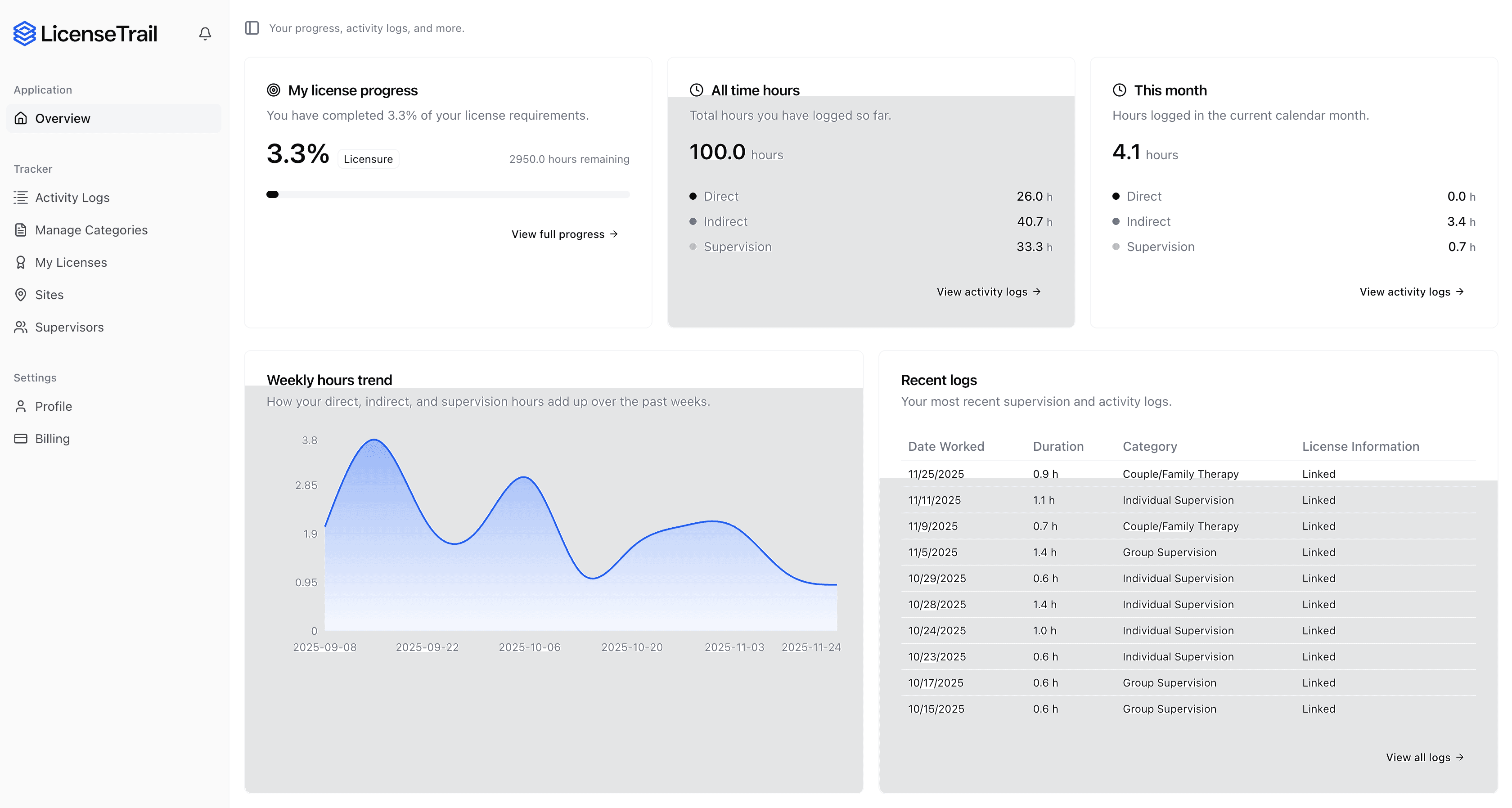
License Trail checks your direct, indirect, and supervision hours against South-carolina LPC requirements continuously and flags mismatches before you submit.
 Start Tracking for Free
No credit card required · Free plan available
Is your spreadsheet hiding South-carolina LPC risks?
Stop guessing if your categories match South Carolina Board of Examiners for Licensure of Professional Counselors, Marriage and Family Therapists, Addiction Counselors and Psycho-Educational Specialists requirements. License Trail checks your direct, indirect, and supervision hours continuously and flags mismatches before you submit.
Import or log
Bring your spreadsheet or start fresh
Upload your existing tracking spreadsheet and we'll map every hour into the right South Carolina Board of Examiners for Licensure of Professional Counselors, Marriage and Family Therapists, Addiction Counselors and Psycho-Educational Specialists categories automatically.
Verify against South-carolina
Catch mismatches before the board does
License Trail checks your direct, indirect, and supervision hours against South-carolina LPC requirements continuously.
Export board-ready
One-click clean reports
Generate professional, board-ready reports for supervision meetings and South Carolina Board of Examiners for Licensure of Professional Counselors, Marriage and Family Therapists, Addiction Counselors and Psycho-Educational Specialists submissions in seconds.
No credit card required · Free plan available