
South-dakota LMFT Requirements: Hours, Exams & Step-by-Step Guide
Stop guessing if your categories match South-dakota requirements. License Trail checks your direct, indirect, and supervision hours against LMFT requirements continuously and flags mismatches before you submit.
No credit card required · Free plan available
Quick Requirements Overview
- Graduate degree (MA/PhD) in MFT/equivalent: ≥48 semester credits from COAMFTE/CACREP (MFT specialty) or Board-approved equivalent
- Graduate practicum ≥1 academic year with ≥300 client contact hours
- Board-approved Plan of Supervision required before counting any post-grad hours; submit transcript + supervisor; $100 nonrefundable fee
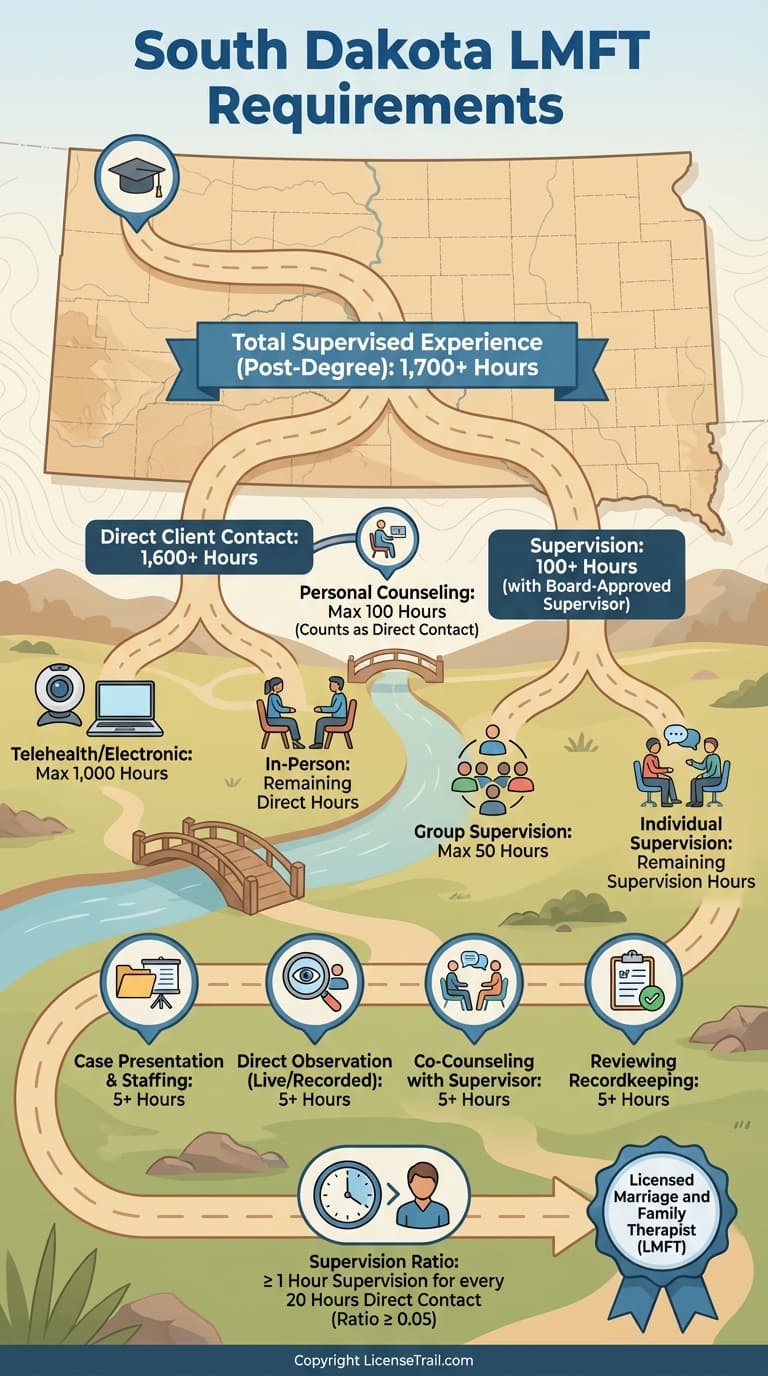
- Post-grad supervised experience: 1,700 hours within 4 years before application (extensions possible for good cause)
- Hour breakdown: 1,600 direct client contact (synchronous); ≤1,000 may be telehealth; ≥600 in-person
- Supervision: 100 hours with Board-approved supervisor; ≥1 hour per 20 direct client contact hours; ≤50 group (≥50 individual)
- Supervision must include ≥5 hours each: case presentation/staffing, direct observation, co-counseling, recordkeeping review
- Pass AMFTRB National MFT Exam; then apply with documentation (hours, transcripts, exam); $225 license fee; renewal Nov 30 even years with 40 CE/2 years (≥4 ethics)
License Details
Procedures
Becoming a Licensed Marriage and Family Therapist (LMFT) in South Dakota is governed by the South Dakota Board of Examiners for Counselors and Marriage and Family Therapists and by South Dakota Codified Laws chapter 36‑33 and Administrative Rules chapter 20:71. The process centers on the right degree, an approved Plan of Supervision, clearly defined supervised hours, and the national MFT exam.
Below is a structured guide focused on the exact hour and supervision requirements, using the Board’s and state’s own language where it matters.
1. Big‑picture overview of LMFT licensure in South Dakota
To qualify for LMFT licensure, you must:
- Earn a qualifying graduate degree (at least 48 semester credits) in marriage and family therapy or an equivalent program. (law.justia.com)
- Complete a graduate practicum that includes at least 300 client contact hours. (law.justia.com)
- Obtain Board approval for an LMFT Plan of Supervision before counting any post‑graduate hours. (dss.sd.gov)
- Complete 1,700 hours of supervised experience in marriage and family therapy under that approved plan, within a specified time frame. (law.justia.com)
- Within those 1,700 hours, meet the specific breakdown set in the supervision rule:
- 1,600 hours of direct client contact, and
- 100 hours of supervision with a Board‑approved supervisor. (law.cornell.edu)
- Pass the National Examination in Marital and Family Therapy (the AMFTRB MFT exam). (dss.sd.gov)
- Submit a full LMFT application with documentation of education, supervised experience, and the exam. (law.cornell.edu)
2. Educational requirements
2.1 Degree and coursework
State law requires at least a master’s or doctoral degree of 48 semester credit hours in marriage and family therapy or an equivalent course of study from:
- A COAMFTE‑accredited MFT program,
- A CACREP‑accredited program with specialty training in MFT, or
- A regionally accredited graduate program with an equivalent MFT course of study approved by the Board. (law.justia.com)
The statute specifies required content areas (marriage and family studies, marriage and family therapy, human development, professional studies, research, and practicum). (law.justia.com)
2.2 Graduate practicum hours
Your graduate program must include a practicum (supervised clinical practice) of at least one academic year in which you:
- Work about 15 hours per week,
- Average roughly 8–10 hours per week of direct clinical contact with individuals, couples, and families, and
- Accumulate a minimum of 300 client contact hours. (law.justia.com)
These practicum hours are part of your educational requirement and are separate from the post‑graduate supervised experience required for licensure.
3. Step 1 – LMFT Plan of Supervision
Before you can count any post‑graduate experience toward LMFT licensure, you must obtain Board approval for a Plan of Supervision. The Board’s LMFT page states that: (dss.sd.gov)
- You must submit:
- Official transcript showing a qualifying 48‑credit (or more) master’s or doctoral degree in marriage and family therapy; and
- A proposed Board‑approved supervisor to oversee your supervision and direct client contact hours.
- You must pay a non‑refundable $100 Plan of Supervision application fee.
- No supervision or direct client contact hours count toward LMFT licensure before the date of an approved Plan of Supervision.
Once your Plan of Supervision is approved and you have your supervisor in place, you can begin accruing supervised experience hours.
4. Key definitions used by the Board and rules
The supervision rules in ARSD 20:71:05 define several important terms: (law.cornell.edu)
- Contact hour – at least 50 minutes with a client; may be built from 15–20 minute increments.
- Direct client contact – “synchronous contact with a client” (the rule’s wording).
- In person – client and therapist are physically present in the same place and time.
- Synchronous – interaction in real time, whether in person or via allowed electronic means.
- Supervisee – an applicant for LMFT licensure acquiring post‑graduate supervision under a Board‑approved plan.
- Supervisor – a licensee approved by the Board to provide post‑graduate LMFT supervision.
These definitions control what counts as direct client contact and supervision hours.
5. Step 2 – Post‑graduate supervised experience requirements
State law and Board rules work together to define both the total supervised experience and the type of hours required.
5.1 Total supervised experience hours
South Dakota Codified Laws § 36‑33‑43 (current version) provides that, within the four years preceding the LMFT application, the applicant must have completed 1,700 hours of supervised experience in marriage and family therapy under a Board‑approved plan of supervision, after receiving the qualifying degree. (law.justia.com)
This 1,700‑hour figure is the overarching requirement in statute.
5.2 Breakdown of the 1,700 hours in Board rule
The Board’s supervision rule (ARSD 20:71:05:02, most recently amended effective November 24, 2022) breaks these 1,700 hours down as follows: (law.cornell.edu)
-
Direct client contact hours – 1,600 hours minimum
- You must complete at least 1,600 hours of direct client contact as that term is defined in the rule (synchronous contact with a client).
- Up to 1,000 of these 1,600 hours may be through counseling provided by electronic means (telehealth) that meet the Board’s telepractice rule (chapter 20:71:08).
- The remaining 600 or more direct client contact hours must be in‑person.
-
Supervision hours – 100 hours minimum
- You must complete at least 100 hours of supervision with a Board‑approved supervisor.
- The rule requires a ratio of at least one hour of supervision for every 20 hours of direct client contact.
- Supervision can be individual or group:
- Individual supervision – supervisor with up to two supervisees.
- Group supervision – supervisor with three or more supervisees.
- No more than 50 of the 100 required supervision hours may be group supervision; at least 50 must be individual (one or two supervisees).
Under current rules, then, the core post‑graduate requirement is:
- 1,600 hours of direct client contact, and
- 100 hours of supervision,
- For a total of 1,700 supervised experience hours.
5.3 Required methods within the 100 supervision hours
The rule also specifies that supervision must include at least five hours of each of the following methods: (law.cornell.edu)
- Case presentation and staffing of cases,
- Direct observation of the supervisee (in‑person or recorded sessions),
- Co‑counseling with the supervisee, and
- Review of the supervisee’s recordkeeping.
Supervision can be delivered in person or via synchronous electronic means (real‑time tele‑supervision that complies with the telepractice rule). (law.cornell.edu)
5.4 Personal therapy that can count toward direct client contact
An unusual feature of South Dakota’s rule is that it allows up to 100 hours of your own personal counseling or therapy to count toward the 1,600 direct client contact hours, if specific conditions are met: (law.cornell.edu)
- The personal counseling or therapy must be with a:
- Professional counselor,
- Professional counselor–mental health,
- Certified social worker–private independent practice,
- Psychologist, or
- Psychiatrist.
- It is subject to verification by the Board.
- It cannot be with your own approved supervisor.
- It may be received in person or through synchronous electronic means that comply with telepractice rules.
5.5 Time limit for completing supervision
State law provides a four‑year window for completing the 1,700 hours of supervised experience preceding the LMFT application, though the Board may allow more time for good cause. (law.justia.com)
6. Step 3 – National MFT examination
South Dakota requires you to pass the National Examination in Marital and Family Therapy (administered by the Association of Marital and Family Therapy Regulatory Boards, AMFTRB). (dss.sd.gov)
Key points from the Board:
- The exam is computer‑based and offered in regular testing windows.
- You must contact the Board to request approval for the exam; once approved, the Board provides an approval code and links to the testing contractor’s online system. (dss.sd.gov)
- A passing score on this exam is required before you can be approved for full LMFT licensure. (dss.sd.gov)
7. Step 4 – Application for full LMFT license
Once you have:
- Completed your Board‑approved LMFT Plan of Supervision,
- Accrued the required supervised hours (1,600 direct client contact + 100 supervision), and
- Passed the national MFT exam,
you may apply for full LMFT licensure.
7.1 What must be submitted
Under ARSD 20:71:02:06, an applicant for LMFT licensure must submit: (law.cornell.edu)
- A completed LMFT application form.
- The applicable license fee.
- Official transcripts showing a master’s or doctoral degree in marriage and family therapy of at least 48 credit hours.
- Official verification of a passing score on the National Examination in Marital and Family Therapy.
- Documentation of 1,700 hours of Board‑approved supervision (that is, the supervised experience described in § 20:71:05:02) obtained after the degree.
- License verifications from other states (if applicable).
- Statements regarding criminal record and any prior discipline (if applicable).
- A recent photograph.
The Board also has an Attachment A: Supervised Experience with Board Approved Supervisor form that your supervisor completes to document your hours when you’re ready to apply. (dss.sd.gov)
7.2 Fees
From current Board information:
- Plan of Supervision application fee – $100 (non‑refundable). (dss.sd.gov)
- LMFT license fee (when applying for full licensure) – $225 (listed as refundable if the application is denied). (dss.sd.gov)
(Always confirm the current fee schedule on the Board’s site before applying, as fees can change.)
8. License renewal and continuing education
After initial licensure, you must maintain your LMFT license through timely renewal and continuing education.
8.1 Renewal cycle
The Board states that: (dss.sd.gov)
- LMFT licenses must be renewed by November 30 of even‑numbered years.
8.2 Continuing education
The Board’s continuing education page specifies that: (dss.sd.gov)
- You must complete 40 hours of continuing education every two years,
- At least 4 of those hours must be in ethics as it relates to counseling/therapy,
- These CE hours are reported during the online renewal process in even‑numbered years,
- Board‑approved supervisors must also complete supervision‑specific CE.
The required number of hours may be prorated if you were first licensed partway through a renewal cycle, so new licensees should check the Board’s CE chart for their specific first cycle. (dss.sd.gov)
9. Reconciling numbers you might see elsewhere
You may see older or secondary sources that still list requirements such as 1,700 hours of direct clinical contact and 200 hours of supervision. Those figures reflect a previous version of South Dakota law and/or rules. The current controlling requirements, as of late 2025, are: (law.cornell.edu)
- 1,700 total hours of supervised experience in marriage and family therapy within the four‑year period preceding your application;
- Broken down by rule into:
- 1,600 hours of direct client contact, and
- 100 hours of supervision with a Board‑approved supervisor (with specified ratios and methods).
When in doubt, rely on:
- SDCL 36‑33‑43 (statutory requirement for 1,700 hours of supervised experience), and
- ARSD 20:71:05:02 (detailed breakdown of direct client contact and supervision hours).
Those are the authoritative sources the Board itself applies.
Track your LMFT hours with confidence
License Trail checks your direct, indirect, and supervision hours against South-dakota LMFT requirements continuously and flags mismatches before you submit.
 Start Tracking for Free
No credit card required · Free plan available
Is your spreadsheet hiding South-dakota LMFT risks?
Stop guessing if your categories match South Dakota Board of Examiners for Counselors and Marriage and Family Therapists requirements. License Trail checks your direct, indirect, and supervision hours continuously and flags mismatches before you submit.
Import or log
Bring your spreadsheet or start fresh
Upload your existing tracking spreadsheet and we'll map every hour into the right South Dakota Board of Examiners for Counselors and Marriage and Family Therapists categories automatically.
Verify against South-dakota
Catch mismatches before the board does
License Trail checks your direct, indirect, and supervision hours against South-dakota LMFT requirements continuously.
Export board-ready
One-click clean reports
Generate professional, board-ready reports for supervision meetings and South Dakota Board of Examiners for Counselors and Marriage and Family Therapists submissions in seconds.
No credit card required · Free plan available