
South-dakota LPC-MH Requirements: Hours, Exams & Step-by-Step Guide
Stop guessing if your categories match South-dakota requirements. License Trail checks your direct, indirect, and supervision hours against LPC-MH requirements continuously and flags mismatches before you submit.
No credit card required · Free plan available
Quick Requirements Overview
- Must already hold an active South Dakota LPC (LPC‑MH is second‑tier/independent practice level).
- Graduate degree (master’s/specialist/doctorate) in counseling with a mental health counseling emphasis (CACREP or equivalent; includes specified MH content areas).
- Exam: Pass NCMHCE (NCE is part of the earlier LPC path).
- Plan of Supervision: Board‑approved LPC‑MH Plan of Supervision required before any hours count; $100 non‑refundable application fee.
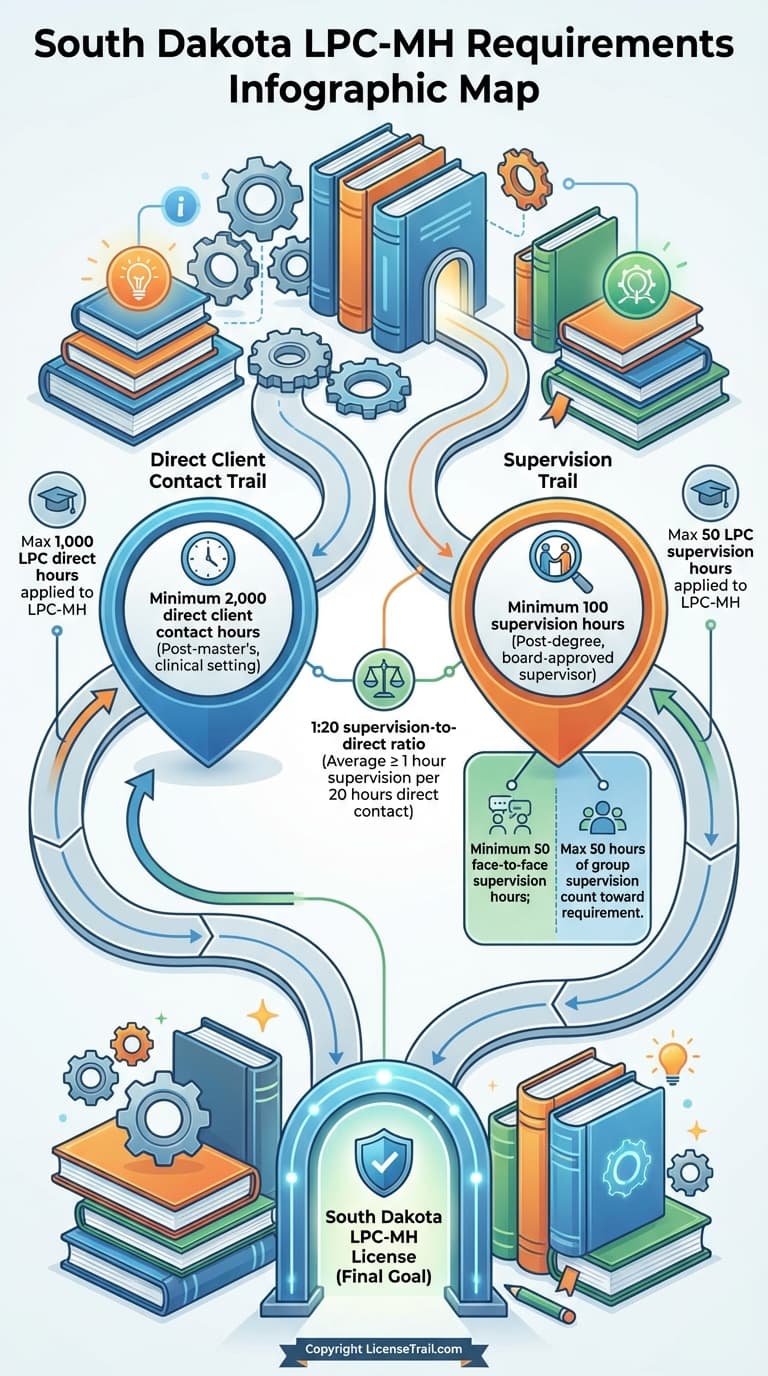
- Experience: 2,000 hours direct client contact in a clinical setting (post‑degree; over ≥ 2 years).
- Supervision: 100 hours direct supervision; ≥ 50 hours face‑to‑face (remaining may be secure phone/video).
- Supervisor: Must be a Board Approved Supervisor and a licensed mental health professional at the highest licensure level in their profession.
- LPC hour carryover cap: Up to 1,000 direct client hours + 50 supervision hours may apply if prior LPC supervision meets LPC‑MH standards.
License Details
Procedures
South Dakota’s Licensed Professional Counselor – Mental Health (LPC‑MH) credential is the state’s higher counseling license, allowing independent mental health practice under the South Dakota Board of Examiners for Counselors & Marriage and Family Therapists. It is a second‑tier license: you must already be a Licensed Professional Counselor (LPC) before you can qualify as an LPC‑MH. (dss.sd.gov)
Below is a step‑by‑step guide focused on the exact types and amounts of hours the state requires, using the Board’s own wording and the South Dakota Codified Laws.
1. Prerequisite: Hold a South Dakota LPC License
Before you can even apply for an LPC‑MH Plan of Supervision, you must already be licensed as an LPC in South Dakota. (law.justia.com)
For context (because some LPC hours can later roll into LPC‑MH), the Board summarizes LPC licensure as requiring:
- At least a 48‑credit master’s in counseling from an accredited institution. (dss.sd.gov)
- A board‑approved LPC Plan of Supervision on file before any LPC hours count. (dss.sd.gov)
- At least 2,000 hours of post‑graduate supervised experience and 100 hours of supervision (with a portion face‑to‑face). (dss.sd.gov)
You must complete this and hold an active LPC before moving on to LPC‑MH.
2. Education Requirements Specific to LPC‑MH
The LPC‑MH is not a separate degree, but the law requires your graduate program to have a mental health counseling emphasis.
Under South Dakota Codified Law § 36‑32‑42, the Board must license an LPC‑MH applicant who: (law.justia.com)
- Already holds LPC licensure under Chapter 36‑32.
- Completes a master’s, specialist, or doctoral degree in counseling “with an emphasis in mental health counseling” from a CACREP‑approved program or an equivalent program.
- For an “equivalent” program, your coursework must include studies in six specific mental‑health content areas, including:
- Etiology, diagnosis, treatment, and prevention of mental and emotional disorders.
- Assessment and identification of mental illness using appropriate tests and the DSM.
- Theories of psychotherapy across settings and modalities.
- Psychopharmacology basics (classification, indications, contraindications of commonly prescribed psychotropic medications).
- Intake and mental‑health history for case planning and management.
- Mental‑health education, outreach, prevention, and promotion concepts. (law.justia.com)
The Board’s LPC‑MH webpage also indicates your transcripts must show graduation from a CACREP program or a 48‑hour master’s degree in counseling from an accredited institution. (dss.sd.gov)
3. Required Examinations
Two different NBCC exams are involved in the LPC → LPC‑MH path:
-
For LPC (already completed before LPC‑MH):
- National Counselor Examination (NCE). (dss.sd.gov)
-
For LPC‑MH:
- National Clinical Mental Health Counseling Examination (NCMHCE). (dss.sd.gov)
The Board notes that a South Dakota LPC‑MH license‑trainee may take the NCMHCE “at any time during their training process” by applying directly through NBCC. (dss.sd.gov)
4. File an LPC‑MH Plan of Supervision
The Board treats LPC‑MH as a supervised post‑graduate training credential. Before any LPC‑MH hours count, you must have a Plan of Supervision – Professional Counselor‑Mental Health approved by the Board.
From the Board’s LPC‑MH page: (dss.sd.gov)
To be approved for an LPC‑MH Plan of Supervision, you must:
- Hold a valid South Dakota LPC license.
- Provide transcripts showing graduation from a CACREP program or a 48‑hour master’s degree in counseling from an accredited institution.
- Propose a Board Approved Supervisor to oversee the required supervision and direct client contact hours.
Critically, the Board states:
“No supervision or direct client contact hours will be counted towards licensure before the date of an approved Plan of Supervision.” (dss.sd.gov)
You submit this plan with the required $100 non‑refundable application fee. (dss.sd.gov)
5. Clinical Experience and Supervision Hours for LPC‑MH
This is the core of what you asked: the exact types and amounts of hours required.
5.1 Overall statutory requirement
South Dakota Codified Law § 36‑32‑42(3) sets out the experiential and supervision requirement for LPC‑MH:
- You must complete “two years of clinical experience and supervision under a licensed mental health professional after receiving a master’s degree.”
- The supervising mental health professional must hold the highest level of licensure within that supervisor’s profession. (law.justia.com)
The law then specifies the exact hours and types:
-
Clinical Experience (Client Hours)
The statute requires that clinical experience “must consist of two thousand hours of direct client contact in a clinical setting.” (law.justia.com)That means:
- All 2,000 hours must be direct, face‑to‑face clinical services with clients (individual, group, couples, family, etc.) in a clinical setting.
- These are not generic “work hours” or indirect tasks; they are explicitly framed as direct client contact hours.
-
Supervision Hours (Formal Supervision Sessions)
The same provision states that supervision “must consist of one hundred hours of direct supervision, at least fifty hours of which shall be face‑to‑face.” (law.justia.com)Breaking that down:
- Total supervision required: 100 hours of direct supervision focussed on your clinical work.
- Minimum face‑to‑face requirement: at least 50 of those supervision hours must be face‑to‑face.
- Remaining 50 supervision hours:
The law allows the balance to be face‑to‑face or by telephone conferencing or interactive video conferencing, provided the technology is secure so that the conference cannot reasonably be intercepted by unauthorized persons. (law.justia.com)
The Board’s own FAQ summarizes this in plain language: to “get the LPC‑MH” you must have “completed at least 2,000 hours of Direct Client Contact in a clinical setting and 100 hours of supervision, and passed the [NCMHCE].” (dss.sd.gov)
5.2 Timing and post‑graduate requirement
South Dakota’s administrative rules make clear these hours must be accrued after your counseling graduate degree and under board‑approved supervision:
- ARSD 20:73:01:06 requires “documentation of 2,000 hours of board approved supervision … obtained subsequent to the granting of the applicant’s masters or doctoral degree in counseling.” (law.cornell.edu)
Combined with § 36‑32‑42, that means:
- The 2,000 direct client contact hours and 100 supervision hours must be:
- Accrued after the degree is awarded.
- Accrued under an approved LPC‑MH Plan of Supervision (or qualifying LPC supervision that meets the LPC‑MH standards—see below).
- Completed over at least two years of clinical experience and supervision. (law.justia.com)
5.3 Who can supervise?
The statute requires a “licensed mental health professional” who holds the highest level of licensure in that profession. (law.justia.com)
Administrative Rule 20:73:04:07 then defines approved supervisors more specifically. An approved supervisor must be licensed in South Dakota and be one of the following, meeting additional experience/CE requirements: (regulations.justia.com)
- LPC‑MH (often also an Approved Clinical Supervisor), or
- LPC‑MH, LMFT, Certified Social Worker–Private Independent Practice, psychologist, or psychiatrist in good standing, with required years of licensure and documented supervision‑specific continuing education, or
- An LMFT who is an AAMFT‑approved clinical supervisor.
In practice, for LPC‑MH hours you can expect to work under an LPC‑MH, LMFT, CSW‑PIP, psychologist, or psychiatrist who has been pre‑approved by the Board as a Board Approved Supervisor.
6. Using LPC Hours Toward LPC‑MH Requirements
South Dakota law allows you to apply some of your LPC supervised experience toward the LPC‑MH requirements, but with strict caps.
Under SDCL § 36‑32‑44: (law.justia.com)
-
Supervision and direct client contact “received in pursuit of licensure as a licensed professional counselor” may be applied to LPC‑MH licensing requirements, if:
- Your LPC supervisor met the LPC‑MH mental health supervision standard (i.e., held the highest level of licensure in that profession, etc.). (mylrc.sdlegislature.gov)
-
However, the law caps what can be carried over:
- No more than 50 hours of such supervision may be applied to the LPC‑MH requirements.
- No more than 1,000 hours of such clinical experience (direct client contact) may be applied to LPC‑MH. (law.justia.com)
So in practical terms:
-
Total LPC‑MH requirements remain:
- 2,000 hours of direct client contact in a clinical setting.
- 100 hours of direct supervision.
-
Maximum that can come from LPC hours:
- Up to 1,000 of the 2,000 direct client contact hours.
- Up to 50 of the 100 supervision hours.
-
Minimum additional hours you must earn under an LPC‑MH‑qualifying plan:
- At least 1,000 additional direct client contact hours.
- At least 50 additional supervision hours.
The Board’s FAQ and independent summaries echo this, noting that “up to 1,000 hours of work experience and 50 hours of supervision earned for the LPC license may be used” toward LPC‑MH, when the LPC supervision met LPC‑MH conditions. (dss.sd.gov)
7. Apply for Full LPC‑MH Licensure
Once you have:
- An active LPC license,
- Completed the required mental‑health‑specific coursework,
- Accrued 2,000 hours of direct client contact and 100 hours of supervision (with any allowable LPC carry‑over),
- Passed the NCMHCE,
you may submit the Application for Licensure for LPC‑MH. (dss.sd.gov)
Key points at this stage:
- You will submit your completed application, documentation of your supervised experience (often via the supervisor‑completed tracking/verification form), and the $225 licensure fee (refundable if licensure is not granted). (dss.sd.gov)
If approved, the Board issues your LPC‑MH license.
8. Maintaining LPC‑MH Licensure
For completeness, the Board also sets renewal and continuing education requirements:
- Renewal cycle: LPC and LPC‑MH licenses must be renewed by November 30 of even‑numbered years. (dss.sd.gov)
- Continuing education: You must complete 40 hours of continuing education every two years, including at least 4 hours of ethics. (dss.sd.gov)
The LPC‑MH must also abide by the American Counseling Association Code of Ethics and Standards of Practice. (dss.sd.gov)
Summary of Hour Requirements for LPC‑MH in South Dakota
Using the Board’s and statutes’ own structure:
- Prerequisite: Current South Dakota LPC license.
- Education: Master’s/specialist/doctoral degree in counseling with an emphasis in mental health counseling, meeting specific content‑area requirements. (law.justia.com)
- Exams: NCE (for LPC, already completed) and NCMHCE (for LPC‑MH). (dss.sd.gov)
- Experience & supervision for LPC‑MH:
- 2,000 hours of “direct client contact in a clinical setting” (all hours must be direct client work). (law.justia.com)
- 100 hours of “direct supervision,” at least 50 hours face‑to‑face; up to 50 hours may be via secure phone or interactive video. (law.justia.com)
- Hours must be post‑master’s, over at least two years, and under a Board Approved Supervisor who is a qualified licensed mental health professional. (law.justia.com)
- Carry‑over from LPC: Up to 1,000 of the 2,000 direct client hours and up to 50 of the 100 supervision hours may come from qualifying LPC supervised experience. (law.justia.com)
That is the current, statute‑ and Board‑defined framework for becoming a Licensed Professional Counselor – Mental Health (LPC‑MH) in South Dakota.
Track your LPC-MH hours with confidence
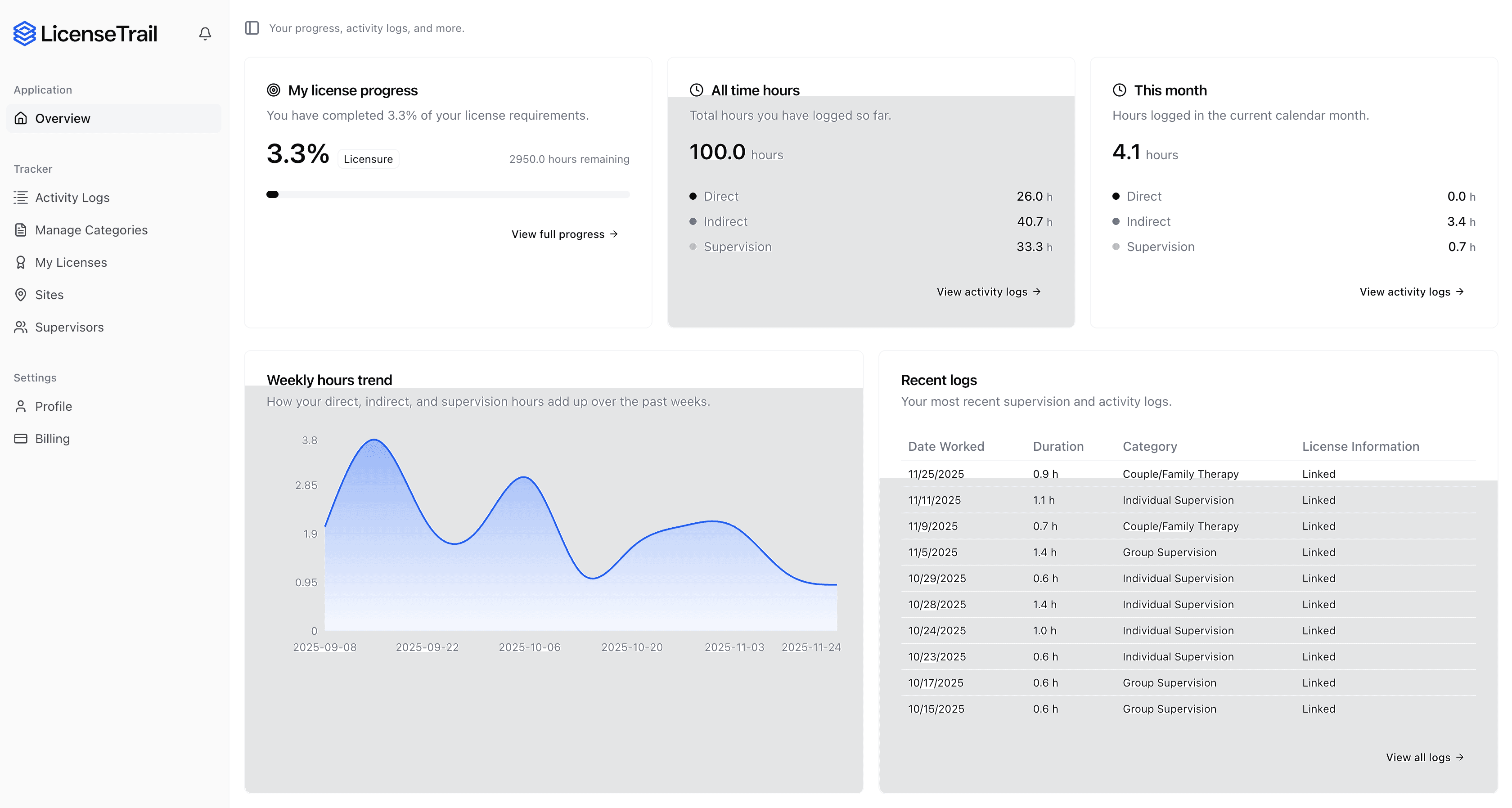
License Trail checks your direct, indirect, and supervision hours against South-dakota LPC-MH requirements continuously and flags mismatches before you submit.
 Start Tracking for Free
No credit card required · Free plan available
Is your spreadsheet hiding South-dakota LPC-MH risks?
Stop guessing if your categories match South Dakota Board of Examiners for Counselors and Marriage and Family Therapists requirements. License Trail checks your direct, indirect, and supervision hours continuously and flags mismatches before you submit.
Import or log
Bring your spreadsheet or start fresh
Upload your existing tracking spreadsheet and we'll map every hour into the right South Dakota Board of Examiners for Counselors and Marriage and Family Therapists categories automatically.
Verify against South-dakota
Catch mismatches before the board does
License Trail checks your direct, indirect, and supervision hours against South-dakota LPC-MH requirements continuously.
Export board-ready
One-click clean reports
Generate professional, board-ready reports for supervision meetings and South Dakota Board of Examiners for Counselors and Marriage and Family Therapists submissions in seconds.
No credit card required · Free plan available