
Texas LMSW Requirements: Hours, Exams & Step-by-Step Guide
Stop guessing if your categories match Texas requirements. License Trail checks your direct, indirect, and supervision hours against LMSW requirements continuously and flags mismatches before you submit.
No credit card required · Free plan available
Quick Requirements Overview
- Degree: CSWE-accredited MSW (or acceptable doctoral SW degree) with documented social work field placement on transcript
- Exams: Pass ASWB Master’s exam (Master required; Advanced Generalist/Clinical not accepted as substitute)
- Jurisprudence: Pass TX Social Work Jurisprudence exam; certificate ≤ 6 months old at application submission
- Hours (for LMSW license): No post-graduate supervised practice hours required for initial LMSW
- Application items: Submit online application, official transcript, fees, and complete fingerprint-based background check (plus possible NPDB/out-of-state verifications if applicable)
- Optional: Temporary LMSW available before ASWB attempt; valid 6 months or until exam attempt
- If pursuing LMSW-IPR (independent non-clinical): 3,000 hrs supervised SW experience over ≥ 2 years + 100 supervision hrs (cap 10 supervision hrs/month) with approved supervisor
- If pursuing LCSW later: 3,000 hrs supervised clinical practice over ≥ 24 months + 100 supervision hrs with LCSW-S
License Details
Procedures
In Texas, the Licensed Master Social Worker (LMSW) credential is a general (non‑clinical) social work license that does not require post‑graduate practice hours to obtain the license itself. Hours come into play later if you want independent non‑clinical practice recognition (LMSW‑IPR) or to move on to the clinical license (LCSW).
The Texas State Board of Social Worker Examiners (under the Texas Behavioral Health Executive Council, or BHEC) sets the rules for LMSW licensure in 22 Texas Administrative Code (TAC) §781.401 and related guidance. (law.cornell.edu)
Below is a structured guide that tracks closely to the Board’s own wording and rule structure.
1. Core legal requirements for a Texas LMSW
1.1 Education and field placement
Under 22 TAC §781.401(a)(2), an applicant for the Licensed Master Social Worker (LMSW) must:
- Hold either:
- A master’s degree in social work from a CSWE‑accredited program, or
- A doctoral degree in social work from an accredited university acceptable to the Council. (law.cornell.edu)
- Have university transcript documentation showing successful completion of a field placement in social work as part of that degree. (law.cornell.edu)
The rule does not specify a particular number of field‑placement hours (e.g., 900 hours); that is determined by the CSWE‑accredited program.
1.2 Examination requirements
From BHEC’s “Applying for a License – Examinations” (Social Work FAQs): (bhec.texas.gov)
To qualify for an LMSW, you must:
-
Pass the ASWB Master’s Examination
- Texas allows some students to sit for the ASWB Master exam while still in a qualifying MSW program.
- Texas specifically requires the ASWB Master exam; it does not accept the ASWB Advanced Generalist or Clinical exams in place of it.
-
Complete the Texas Social Work Jurisprudence Exam
- All social work license applicants must pass this online jurisprudence exam on Texas laws and rules.
- The completion certificate must be no more than 6 months old at the time your LMSW application is received. (bhec.texas.gov)
The Administrative Code also reiterates that all applicants for a license must complete the Council’s jurisprudence examination and submit proof of completion at the time of application. (law.cornell.edu)
1.3 Background check and other application elements
BHEC’s application instructions add several standard requirements that apply to LMSW applicants, including: (bhec.texas.gov)
- Fingerprint‑based criminal background check (initiated via instructions you receive after submitting your online application).
- Official graduate transcript sent directly from the school to BHEC (electronic or sealed paper).
- Fee payment according to Council Rule 885.1 (license and application fees).
- In some situations, a National Practitioner Data Bank (NPDB) self‑query report and verification of any out‑of‑state licenses may be required.
These are process requirements rather than “hours” requirements, but they are part of becoming licensed.
1.4 No post‑degree practice‑hours requirement for basic LMSW licensure
Critically, the Texas Administrative Code section that defines LMSW qualifications lists:
- Education (CSWE‑accredited MSW or DSW + field placement), and
- Passing the ASWB Master’s exam, and
- Completing the jurisprudence exam,
but it does not impose any post‑graduate, supervised practice‑hour requirement to obtain the LMSW license itself. (law.cornell.edu)
So, you do not need (for example) “1,500 hours of direct experience and 1,500 hours of supervised experience” in order to be initially licensed as an LMSW in Texas. Your only “hours” before licensure are the field placement hours required by your CSWE‑accredited MSW or doctoral program.
2. Step‑by‑step path to becoming an LMSW in Texas
Step 1 – Complete a CSWE‑accredited MSW (or qualifying DSW/PhD) with field placement
- Enroll in and graduate from a CSWE‑accredited master’s program in social work (or an acceptable doctoral social work program). (bhec.texas.gov)
- Successfully finish your program’s supervised field placement in social work (internship/practicum). This is documented on your official transcript and is the only pre‑licensure practice‑hours requirement in rule for an LMSW.
Step 2 – Take and pass the Texas Social Work Jurisprudence Exam
- Complete the Texas SW Jurisprudence Exam online through the Council’s vendor.
- Ensure the completion date is within 6 months before you submit your LMSW application; otherwise you must retake it. (bhec.texas.gov)
Step 3 – Take and pass the ASWB Master’s Examination
- Register for the ASWB Master exam using Texas’s process.
- Sit for and pass the exam; ASWB then sends your score to BHEC.
At this point you have:
- A qualifying degree plus field placement, and
- Passed the ASWB Master exam, and
- A current jurisprudence exam certificate.
These three together satisfy the core substantive qualifications for LMSW licensure in 22 TAC §781.401(a)(2) plus the jurisprudence requirement in §781.401(c). (law.cornell.edu)
Step 4 – Submit the LMSW application to BHEC
Using the Online Licensing System, you then:
- Complete the LMSW application.
- Upload or arrange for:
- Official transcript (sent directly by the school).
- Jurisprudence exam certificate.
- Any required NPDB self‑query report.
- Any out‑of‑state license verifications, if applicable.
- Pay the required fees.
- Complete fingerprinting for the criminal background check following the instructions emailed after submission. (bhec.texas.gov)
Optional – Temporary LMSW license before passing the ASWB exam
Texas also allows a temporary social work license (including at the master level) before any attempt at the ASWB exam, as long as you meet all other LMSW requirements except the exam. The temporary license is valid for six months or until you attempt the exam, whichever comes first. (bhec.texas.gov)
3. Where “hours” actually come in for an LMSW
Although initial LMSW licensure has no post‑degree hour requirement, Texas law does attach specific supervised‑experience hour requirements to two things that involve LMSWs:
- Independent Non‑clinical Practice Recognition (LMSW‑IPR), and
- Clinical supervised experience toward the LCSW (which you can pursue only as an LMSW).
Because many people ask about “how many hours an LMSW needs,” it is important to distinguish these clearly.
3.1 Independent Non‑clinical Practice Recognition (LMSW‑IPR)
This is a specialty recognition that allows an LMSW to practice independently in non‑clinical social work (e.g., case management, administration, some macro practice) without LCSW clinical privileges.
Under 22 TAC §781.401(b), the Board’s rules for Independent Non‑clinical Practice (which includes LMSW‑IPR) state that the social worker must: (law.cornell.edu)
- Hold an active Texas LBSW or LMSW license.
- Complete 3,000 hours of supervised full‑time social work experience over at least two years, or equivalent if done in another state.
- This is not broken into “direct” vs “indirect” hours in rule; it is broadly “supervised full‑time social work experience.”
- Accumulate at least 100 hours of supervision over those 3,000 hours.
- Supervision must be provided by a Council‑approved supervisor.
- Have all supervised professional experience comply with §781.404 (supervision rules) and all other applicable laws and rules.
The Board’s FAQ on Non‑clinical Supervised Experience for Independent Practice Recognition further explains how supervision is expected to line up with hours: (bhec.texas.gov)
- Supervision is “in proportion to the number of actual hours worked.”
- As an example, working at least 30 hours per week over 24 months with one hour of supervision per week yields about 104 supervision hours (1 hour × 52 weeks × 2 years).
- Supervisors may adjust frequency/duration if you work less than 30 hours per week, but the plan must still produce at least 100 supervision hours by the time you reach 3,000 work hours.
- You cannot count more than 10 hours of supervision in any one month (30‑day period), even if you meet more often.
So, in Texas terminology for LMSW‑IPR:
- Experience requirement: “3,000 hours of supervised full‑time social work experience over a minimum two‑year period.”
- Supervision requirement: “A minimum of 100 hours of supervision over the course of the 3,000 hours of experience,” provided by a Council‑approved supervisor, following the supervision rules in §781.404. (law.cornell.edu)
There is no further subdivision (for example, “1,500 hours direct” and “1,500 indirect”); Texas uses a total‑hours model plus minimum supervision hours.
3.2 Clinical supervised experience toward LCSW (while an LMSW)
If you intend to become a Licensed Clinical Social Worker (LCSW), you must first be an LMSW and then complete a clinical supervised‑experience period.
The rules in 22 TAC §781.401(a)(1) and the BHEC clinical supervision FAQ say that an LCSW applicant must: (law.cornell.edu)
- Accrue 3,000 hours of supervised social work practice providing clinical social work.
- Complete at least 100 hours of supervision with a Texas LCSW Supervisor (LCSW‑S) over those 3,000 hours.
- Spread these hours over no less than 24 full months.
- Follow all supervision rules in §781.404, including meeting frequently enough that supervision remains in proportion to practice hours and does not exceed the maximum countable hours per month.
Again, Texas does not break this 3,000 hours into a specific number of “direct client contact” vs “administrative” hours in the rule text; the key is that the work qualifies as clinical social work under the definition in §781.102, and that the required 3,000/100 hours and 24‑month minimum are met under LCSW‑S supervision. (law.cornell.edu)
4. Quick comparison of hour requirements involving the LMSW title
| Purpose | What you’re applying for | Experience hours required by rule | Supervision hours required | Time frame minimum | Notes |
|---|---|---|---|---|---|
| Initial LMSW license | LMSW only | No post‑degree practice hours. Must have completed MSW field placement as part of degree. | None beyond normal field supervision within the degree program. | N/A | Requirements are degree (CSWE MSW/DSW), field placement, ASWB Master exam, jurisprudence exam, background and administrative checks. (law.cornell.edu) |
| Independent non‑clinical practice | LMSW‑IPR (Independent Non‑clinical Practice) | 3,000 hours of supervised full‑time social work experience while fully licensed (LBSW or LMSW). (law.cornell.edu) | Minimum 100 hours of supervision with a Council‑approved supervisor, in proportion to hours worked. (law.cornell.edu) | At least 2 years (24 months). | Allows independent non‑clinical practice. No separate “direct vs indirect” hour split in rule. |
| Clinical independent practice | LCSW (clinical license) | 3,000 hours of supervised clinical social work practice under an LCSW‑S. (law.cornell.edu) | Minimum 100 hours of supervision with the LCSW‑S. | At least 24 full months. | Requires passing ASWB Clinical exam after (or near completion of) hours; represents full clinical independent practice. |
5. Key takeaways specific to your question
- The Texas State Board of Social Worker Examiners does not require a fixed number of post‑graduate hours (such as 1,500 “direct” and 1,500 “supervised”) to become an LMSW.
- To become an LMSW, you must:
- Earn a CSWE‑accredited MSW (or qualifying DSW/PhD) with a field placement,
- Pass the ASWB Master exam,
- Complete the Texas Social Work Jurisprudence Exam, and
- Meet administrative requirements (application, fees, background check, transcripts, etc.). (law.cornell.edu)
- Hour requirements of 3,000 experience hours + 100 supervision hours appear only when:
- You, as an LMSW, seek Independent Non‑clinical Practice Recognition (LMSW‑IPR), or
- You are an LMSW accumulating clinical experience for the LCSW.
Understanding this distinction helps you plan your path:
- If your goal is simply to become an LMSW, focus on finishing the CSWE‑accredited degree with its field placement and then completing the ASWB Master and jurisprudence exams plus the application process.
- If your long‑term goal is independent practice (non‑clinical or clinical), be prepared for the 3,000 hours + 100 supervision hours structure that Texas uses for those post‑LMSW credentials.
Track your LMSW hours with confidence
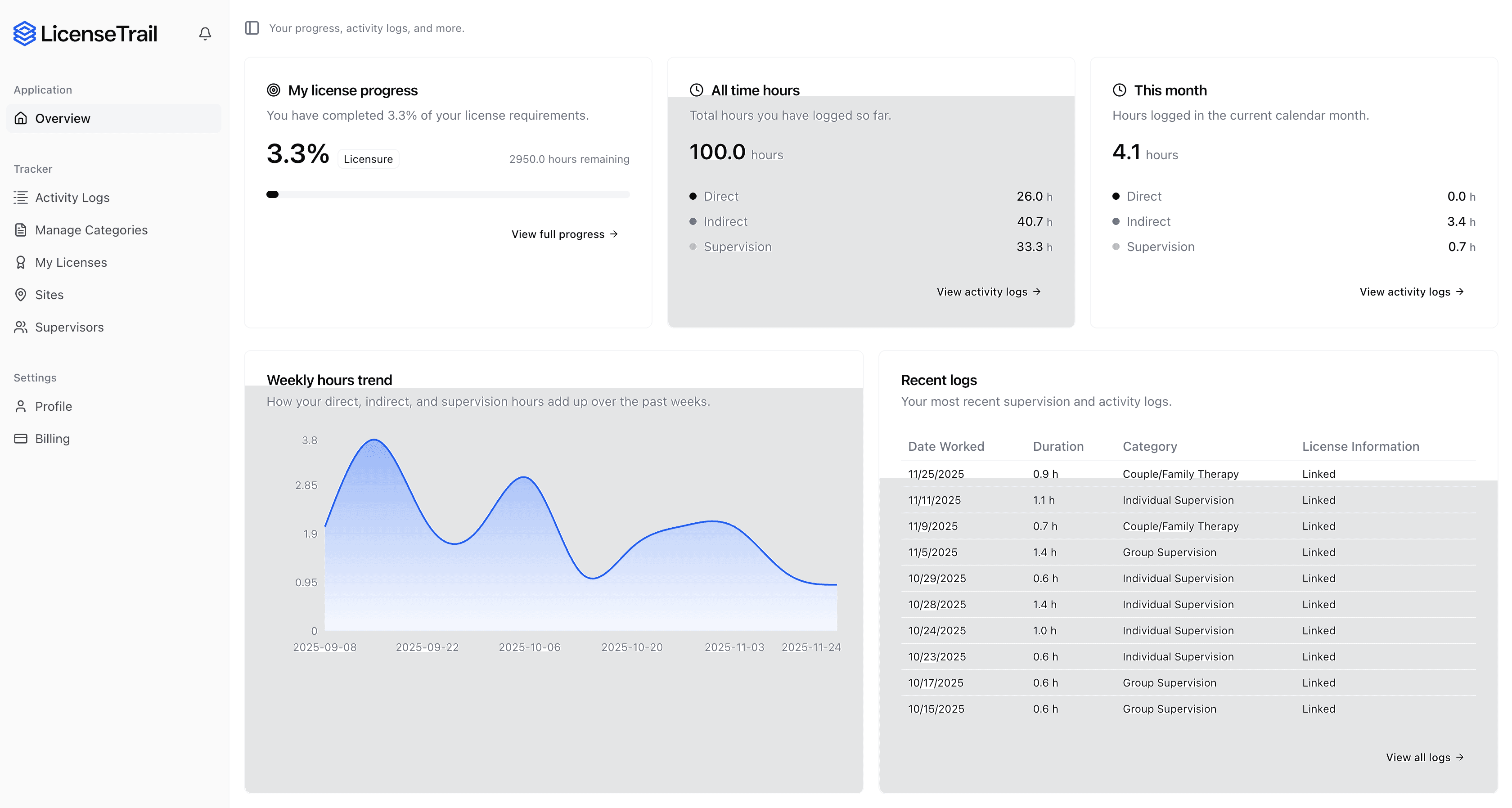
License Trail checks your direct, indirect, and supervision hours against Texas LMSW requirements continuously and flags mismatches before you submit.
 Start Tracking for Free
No credit card required · Free plan available
Is your spreadsheet hiding Texas LMSW risks?
Stop guessing if your categories match Texas State Board of Social Worker Examiners requirements. License Trail checks your direct, indirect, and supervision hours continuously and flags mismatches before you submit.
Import or log
Bring your spreadsheet or start fresh
Upload your existing tracking spreadsheet and we'll map every hour into the right Texas State Board of Social Worker Examiners categories automatically.
Verify against Texas
Catch mismatches before the board does
License Trail checks your direct, indirect, and supervision hours against Texas LMSW requirements continuously.
Export board-ready
One-click clean reports
Generate professional, board-ready reports for supervision meetings and Texas State Board of Social Worker Examiners submissions in seconds.
No credit card required · Free plan available