
Texas LMSW-AP Requirements: Hours, Exams & Step-by-Step Guide
Stop guessing if your categories match Texas requirements. License Trail checks your direct, indirect, and supervision hours against LMSW-AP requirements continuously and flags mismatches before you submit.
No credit card required · Free plan available
Quick Requirements Overview
- Status (TX): LMSW‑AP is a specialty recognition on an LMSW; no new LMSW‑AP recognitions after 9/1/2017 (only limited grandfathered completions); Texas now directs applicants to LMSW‑IPR instead
- Prerequisite: Hold an active Texas LMSW (CSWE MSW/DSW, ASWB Master’s exam, TX jurisprudence exam, fingerprint/background + NPDB self‑query, license verifications as applicable)
- Scope: Non‑clinical social work only; may practice independently (contract/bill/third‑party billing) within non‑clinical scope
- Experience: 3,000 hours of post‑LMSW supervised non‑clinical social work experience
- Duration: 3,000 hours must span ≥ 24 months (no “finish early” even if hours accrue faster)
- Supervision: ≥ 100 hours with a Council‑approved supervisor during the 3,000 hours; ≤ 10 supervision hours/month; individual and/or group allowed
- Supervisor eligibility (non‑clinical track): Council‑approved supervisors (e.g., LMSW‑AP‑S, LMSW‑IPR‑S, or LCSW‑S) in good standing with required experience
- Additional exam for AP: ASWB Advanced Generalist exam (beyond the ASWB Master’s exam for LMSW)
License Details
Procedures
Within Texas social work regulation, the LMSW‑AP (Licensed Master Social Worker – Advanced Practitioner) is a specialty recognition attached to an LMSW license. It was created as the highest non‑clinical, independent-practice credential for master’s‑level social workers.
Two key realities come first:
- The Texas Administrative Code defines LMSW‑AP as a “Licensed Master Social Worker with the Advanced Practitioner specialty recognition for non-clinical practice.” (txrules.elaws.us)
- That same definition states that this specialty “will no longer be conferred after September 1, 2017,” though LMSWs who were already under an approved supervision plan before that date were allowed to finish. (txrules.elaws.us)
- The Behavioral Health Executive Council (BHEC) now notes that only “a few Texas licensees hold LMSW‑AP” and that “Texas no longer offers the Advanced Practitioner specialty recognition.” (bhec.texas.gov)
So you cannot newly start the LMSW‑AP track today. However, the underlying requirements are still spelled out in Board rules and guidance. What follows lays out those requirements in the Board’s own terms, with emphasis on the hours and supervision structure.
1. Baseline: You must first qualify as an LMSW
LMSW‑AP is layered on top of the LMSW license. The LMSW requirements are in 22 TAC §781.401(a)(2) and BHEC’s “How to Become an LMSW” guidance. In brief, an LMSW applicant must: (law.cornell.edu)
- Hold a master’s or doctoral degree in social work from a CSWE‑accredited program, with a documented social work field placement.
- Pass the ASWB Master’s Examination.
- Complete the Texas Social Workers Jurisprudence Exam and submit proof with the application.
- Undergo a fingerprint background check, provide a National Practitioner Data Bank (NPDB) self‑query, and have any out‑of‑state licenses verified.
Only once you meet LMSW requirements and hold (or fully qualify for) that license can you add the Advanced Practitioner specialty recognition.
2. What the LMSW‑AP authorization actually allows
The scope of practice is laid out in 22 TAC §781.302(d), “Advanced Non‑Clinical Practice of LMSWs.” An LMSW who is recognized as an Advanced Practitioner (LMSW‑AP): (txrules.elaws.us)
- May provide any non‑clinical social work services either as an employee or in an independent practice setting.
- May work under contract, bill directly for services, and bill third parties for reimbursement.
- Must restrict practice to non‑clinical social work services (clinical psychotherapy remains the domain of LCSWs).
“Non‑clinical social work” is separately defined in §781.102 as professional social work that includes activities such as locating resources, advocacy, administering programs, community organizing, research, supervision, policy development, and similar non‑clinical tasks, rather than psychotherapy or treatment of mental disorders. (txrules.elaws.us)
3. Experience and supervision hours for the LMSW‑AP
The Texas rules that are still in force primarily spell out hour requirements for:
- Clinical licensure (LCSW), and
- Independent Non‑Clinical Practice Recognition (IPR) at the LBSW or LMSW level.
LMSW‑AP used the same basic experience structure as Independent Non‑Clinical Practice Recognition, but added an advanced examination requirement. Board rules and official/derivative guidance converge on the same numbers.
3.1. Total experience: 3,000 hours of supervised non‑clinical social work
For non‑clinical specialty recognition, §781.401(b)(2) requires that, while fully licensed: (law.cornell.edu)
- The social worker complete “3000 hours of supervised full‑time social work experience over a minimum two‑year period” (or equivalent if in another state).
“Full‑time experience” is defined elsewhere in §781.102 as providing social work services 30 or more hours per week. (txrules.elaws.us)
For the LMSW‑AP, BHEC‑aligned summaries (drawing directly from Texas rules) describe this specifically as:
- 3,000 hours of supervised professional non‑clinical social work experience at the LMSW level; and
- Those hours must be LMSW‑level practice (not pre‑licensure student field work). (publichealthonline.org)
Important nuance:
The Board does not split those 3,000 hours into “direct” vs “indirect” the way it does for some other professions (e.g., LPCs). For LMSW‑AP, the rule talks about:
- “Supervised full‑time social work experience” (the work you do with or on behalf of clients, communities, and systems), and
- Separate but related supervisory hours (discussed below).
There is no requirement like “1,500 direct client hours and 1,500 other hours” for LMSW‑AP. All 3,000 are practice hours; supervision is counted separately.
3.2. Supervisory sessions: minimum 100 hours
For non‑clinical specialty recognition, §781.401(b)(3) adds: (law.cornell.edu)
- The social worker “has had a minimum of 100 hours of supervision, over the course of the 3000 hours of experience, with a Council‑approved supervisor.”
BHEC’s own supervision FAQs describe how this is expected to accrue in practice: over a 24‑month period working at least 30 hours per week, meeting about one hour per week of supervision yields roughly 104 hours; supervisors may adjust frequency for part‑time workers, but “no more than 10 hours of supervision may be counted in any one month, or 30‑day period.” (bhec.texas.gov)
Those 100 hours are professional-development supervision (case discussion, ethics, role development, etc.), not additional “practice” hours.
3.3. Timeframe: at least 24 months
The supervision rule, §781.404(9)(E), provides the timing standard for supervision toward licensure or specialty recognition: (txrules.elaws.us)
- Supervision “must extend over a full 3000 hours over a period of not less than 24 full months” for LCSW or Independent Practice Recognition.
- Even if 3,000 practice hours and 100 supervision hours are technically completed sooner, the supervision still must span at least 24 full months from start to finish.
Historically, Board and school guidance often described this as a 24–48 month window for completing LCSW or LMSW‑AP hours; current rule text clearly sets a 24‑month minimum, and does not impose a hard maximum. In practice, most descriptions still assume roughly 2–4 years to accumulate the hours. (onlinemswdegrees.org)
3.4. Type of work that counts toward the 3,000 hours
Because LMSW‑AP is non‑clinical, the 3,000 hours are expected to be:
- Work that falls under the “non‑clinical social work” definition in §781.102 (e.g., case management, resource coordination, administration, policy, research, community practice, non‑clinical supervision). (txrules.elaws.us)
- Performed while fully licensed as an LMSW (post‑degree, post‑exam). (law.cornell.edu)
The Board does not label some of these 3,000 hours “direct” and others “supervised.” Instead:
- All 3,000 hours are supervised practice hours.
- Within that 3,000‑hour period you must log at least 100 hours of formal supervision sessions with a Council‑approved supervisor.
So if you are trying to map the requirement to numbers like your example, it is more accurate to say:
- 3,000 hours of supervised non‑clinical social work practice, plus
- 100 hours of supervisory sessions (individual and/or group),
rather than any 1,500/1,500 “direct vs supervised” split.
4. Supervision structure and definitions
4.1. Who can supervise LMSW‑AP‑track hours
Under §781.404 and BHEC guidance, non‑clinical hours toward independent non‑clinical practice or advanced practitioner recognition are supervised by Council‑approved supervisors with appropriate credentials. Specifically: (txrules.elaws.us)
- An LMSW‑AP‑S (Advanced Practitioner with supervisor status) may supervise non‑clinical experience toward Independent Practice Recognition.
- An LMSW‑IPR‑S (LMSW with Independent Practice Recognition and supervisor status) or LCSW‑S may also supervise non‑clinical LMSW hours for independent practice.
- The supervisor must be “actively licensed in good standing” and must have practiced at that level for at least two years.
4.2. What “supervision for specialty recognition” means
The definitions section, §781.102, and the supervision rule clarify: (txrules.elaws.us)
- Individual supervision for licensure or specialty recognition is one‑on‑one supervision during a scheduled session.
- Group supervision is 2–6 supervisees in a session.
- Supervision toward LCSW, IPR, or LMSW‑AP “may occur in one‑on‑one sessions, in group sessions, or in a combination” and can be in person or via secure technologies that meet confidentiality and legal standards.
- Supervision “shall occur in proportion to the number of actual hours worked” toward the 3,000 hours, with no more than 10 supervision hours creditable in any one month. (txrules.elaws.us)
The Board explicitly frames this as supervision “which promotes professional growth,” focused on case‑based discussion, ethics, and practice development, not just administrative oversight. (txrules.elaws.us)
5. Examination requirement specific to LMSW‑AP
Beyond the LMSW requirements, the Advanced Practitioner recognition added a higher‑level examination:
- Candidates for LMSW‑AP must pass the ASWB Advanced Generalist Examination, not just the Master’s exam required for the LMSW. (publichealthonline.org)
The Texas rules themselves attach exam requirements to license categories (LBSW, LMSW, LCSW) in §781.401(a). Specialty recognitions such as LMSW‑AP are treated as add‑ons; BHEC‑aligned licensing guides explain the AP route as:
- LMSW in good standing;
- 3,000 hours of supervised, non‑clinical LMSW‑level practice over a minimum of two years with at least 100 hours of supervision; and
- Passing the ASWB Advanced Generalist exam. (publichealthonline.org)
6. Application documentation for the LMSW‑AP recognition
When LMSW‑AP was still being conferred, applicants typically had to submit (to the Board/BHEC): (publichealthonline.org)
- A completed application to add the LMSW‑AP specialty recognition, with applicable fees.
- Evidence of current Texas LMSW licensure in good standing.
- Employment history documenting qualifying LMSW‑level non‑clinical positions during which the 3,000 hours were earned.
- Supervision Verification Form(s) completed and signed by Council‑approved supervisors, documenting:
- 3,000 hours of supervised non‑clinical social work practice; and
- At least 100 hours of supervisory sessions, within Board limits (≤10 per month).
- Proof of passing the ASWB Advanced Generalist Exam (scores transmitted from ASWB).
- Any required supporting documents (e.g., verification of out‑of‑state licenses, if applicable).
Because the specialty is now closed to new applicants, current Board web pages direct anyone interested in non‑clinical independent practice toward LMSW‑IPR rather than LMSW‑AP. The hour and supervision structure, however, is effectively the same: 3,000 supervised hours, minimum 100 supervision hours over at least 24 months. (law.cornell.edu)
7. Recap in plain language
Putting it all together, the Texas State Board of Social Worker Examiners’ framework for an LMSW‑AP (when it was available) was:
- Base license: You must fully qualify as an LMSW (CSWE‑accredited MSW/DSW, ASWB Master’s exam, jurisprudence exam, background check, NPDB, etc.). (law.cornell.edu)
- Type of practice: Non‑clinical social work only, but with the ability to work independently, contract, and bill for services within that non‑clinical scope. (txrules.elaws.us)
- Experience requirement:
- 3,000 hours of supervised, post‑licensure, non‑clinical social work experience at the LMSW level.
- These are not split into “direct vs indirect” categories in rule. (law.cornell.edu)
- Supervision requirement:
- At least 100 hours of professional-development supervision by a Council‑approved supervisor, accrued proportionally over the same 3,000‑hour period, with no more than 10 supervision hours counted in any month and spanning at least 24 months. (law.cornell.edu)
- Exam requirement:
- ASWB Advanced Generalist Examination, in addition to the Master’s exam already passed for LMSW. (publichealthonline.org)
For anyone planning a non‑clinical independent practice pathway in Texas today, the practical route is the LMSW‑IPR recognition, which uses the same 3,000‑hour / 100‑supervision‑hour framework; the LMSW‑AP title itself is reserved to those who were already in the pipeline before September 1, 2017. (txrules.elaws.us)
Track your LMSW-AP hours with confidence
License Trail checks your direct, indirect, and supervision hours against Texas LMSW-AP requirements continuously and flags mismatches before you submit.
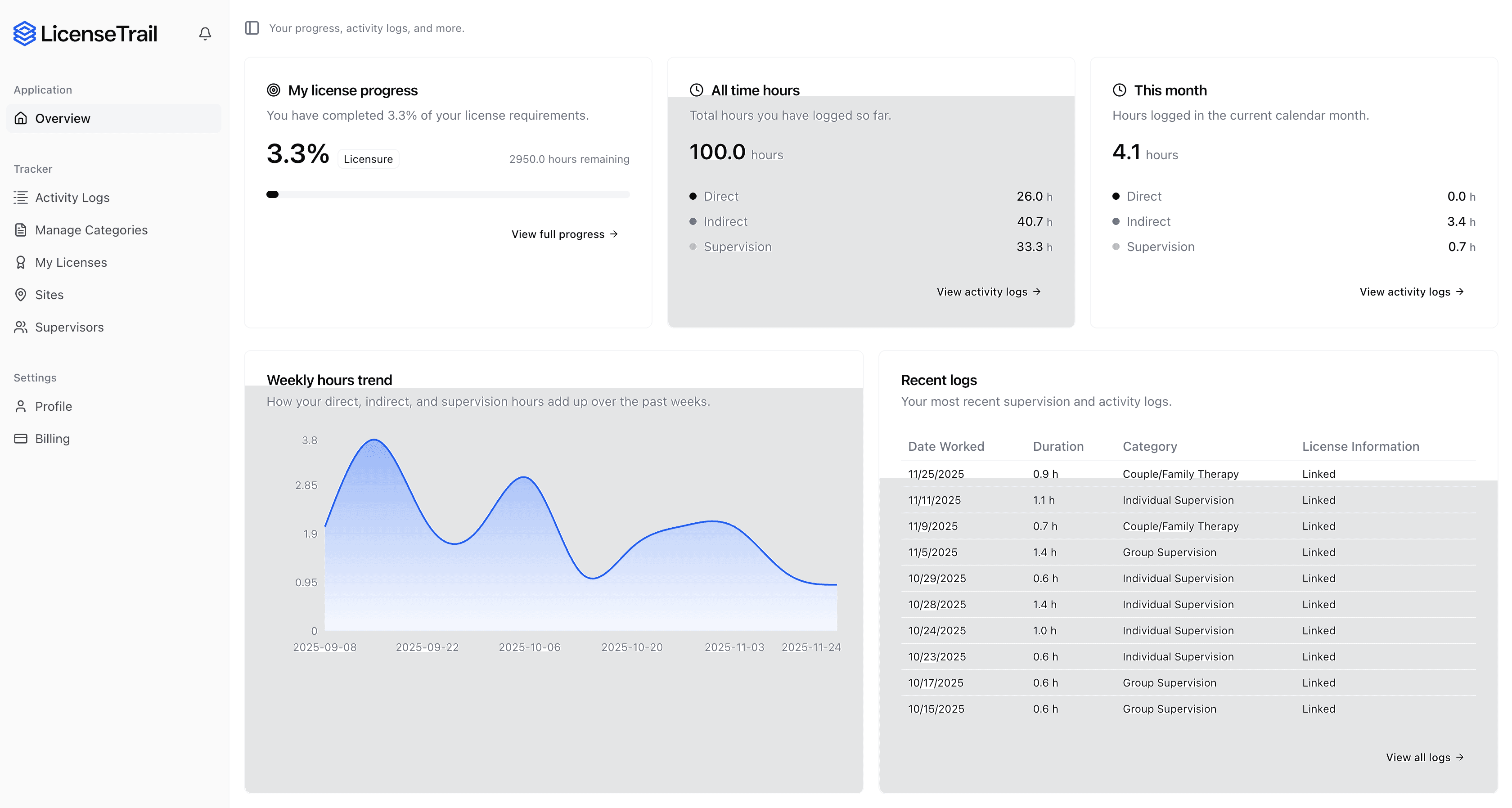 Start Tracking for Free
No credit card required · Free plan available
Is your spreadsheet hiding Texas LMSW-AP risks?
Stop guessing if your categories match Texas State Board of Social Worker Examiners requirements. License Trail checks your direct, indirect, and supervision hours continuously and flags mismatches before you submit.
Import or log
Bring your spreadsheet or start fresh
Upload your existing tracking spreadsheet and we'll map every hour into the right Texas State Board of Social Worker Examiners categories automatically.
Verify against Texas
Catch mismatches before the board does
License Trail checks your direct, indirect, and supervision hours against Texas LMSW-AP requirements continuously.
Export board-ready
One-click clean reports
Generate professional, board-ready reports for supervision meetings and Texas State Board of Social Worker Examiners submissions in seconds.
No credit card required · Free plan available