
Texas LMSW-IPR Requirements: Hours, Exams & Step-by-Step Guide
Stop guessing if your categories match Texas requirements. License Trail checks your direct, indirect, and supervision hours against LMSW-IPR requirements continuously and flags mismatches before you submit.
No credit card required · Free plan available
Quick Requirements Overview
- Hold an active TX LMSW (regular, not temporary) before starting IPR supervision.
- LMSW requires CSWE-accredited MSW/DSW, ASWB Master’s exam, and TX SW Jurisprudence exam (plus standard application/fees/background check).
- Earn 3,000 hours of supervised non-clinical social work experience over ≥ 24 months (no TX “direct vs indirect” hour split specified).
- Complete ≥ 100 hours of supervision with a Council-approved supervisor, concurrent with the 3,000 hours; max 10 supervision hours/month count.
- Supervisor must be Council-approved and licensed as LMSW‑IPR, LMSW‑AP, or LCSW (for LMSW‑IPR applicants).
- Maintain required supervision plan + logs; supervisor keeps file and completes the Non-clinical Verification Form for IPR.
- Apply to BHEC for Independent Practice Recognition (Non-clinical) with verification and fees; authorization is non-clinical only (no independent clinical/psychotherapy—requires LCSW).
License Details
Procedures
In Texas, “LMSW‑IPR” is a Licensed Master Social Worker who has been granted Independent Practice Recognition (non‑clinical) by the Texas State Board of Social Worker Examiners (through the Behavioral Health Executive Council, BHEC). This recognition lets an LMSW practice non‑clinical social work independently (including billing directly), but it does not authorize clinical/psychotherapy practice—only an LCSW may practice independently at the clinical level. (sos.texas.gov)
Below is a step‑by‑step outline of what the Board’s rules and FAQs currently require (updated November 2025).
1. Hold a Texas LMSW license
Before you can pursue LMSW‑IPR, you must already be licensed as a Licensed Master Social Worker (LMSW) in Texas.
Education
For LMSW licensure, the Board requires: (bhec.texas.gov)
- A master’s degree in social work from a program accredited by the Council on Social Work Education (CSWE),
or a doctoral degree in social work from an accredited university.
Exams
To become an LMSW, you must: (bhec.texas.gov)
- Pass the ASWB Master’s Examination (Texas does not accept Advanced Generalist or Clinical exams instead of the Master’s exam).
- Complete the Texas Social Work Jurisprudence Exam.
- Apply to BHEC for the LMSW license and meet all general application requirements (forms, fees, background checks, etc.).
Only after you hold a regular (non‑temporary) LMSW license can you begin accruing hours toward independent practice recognition. A person with only a temporary license is explicitly prohibited from starting supervision toward independent non‑clinical practice until the regular license is issued. (bhec.texas.gov)
2. Understand what the Independent Practice Recognition (non‑clinical) is
The independent practice recognition is a specialty recognition, not a separate license class. The rules call it “Independent Practice Recognition (Non‑Clinical)” and state that: (bhec.texas.gov)
- An LBSW or LMSW may seek this specialty recognition.
- Once recognized, an LMSW‑IPR may provide any non‑clinical social work services in either an employment or independent practice setting.
- An LMSW‑IPR may work under contract, bill clients directly, and bill third‑party payers for non‑clinical social work services.
- The LMSW‑IPR must restrict practice to non‑clinical services (no diagnosis, treatment of mental disorders, psychotherapy, etc.—those are reserved for LCSWs).
3. Meet the experience and supervision requirements for LMSW‑IPR
The hour requirements for non‑clinical Independent Practice Recognition are laid out in 22 TAC §781.401(b) (Qualifications for Licensure – Specialty Recognition). (bhec.texas.gov)
These requirements apply to both LBSW‑IPR and LMSW‑IPR; for your purposes, think of them as the minimum to become LMSW‑IPR.
3.1. Total supervised practice hours
To qualify for independent non‑clinical practice recognition, an LMSW must:
- Be currently licensed in Texas as an LBSW or LMSW; and
- Have completed 3,000 hours of supervised full‑time social work experience over a minimum of two years (or an equivalent part‑time arrangement if the experience was completed in another state). (bhec.texas.gov)
Key points about these 3,000 hours:
- The rule refers to these as “supervised full‑time social work experience” while fully licensed—not as a split between “direct” and “indirect” hours.
- Unlike LPC or LMFT requirements, the social work rules do not divide these 3,000 hours into separate categories such as:
- “X hours of direct client contact” and
- “Y hours of other professional activities.”
- Instead, all 3,000 hours must be supervised social work practice consistent with the defined scope of Baccalaureate or Master’s Social Work practice (e.g., assessment, case management, counseling within non‑clinical limits, advocacy, policy work, etc.). (sos.texas.gov)
In other words, there is one total requirement:
3,000 hours of supervised social work practice (non‑clinical), over at least 24 months.
There is no Texas rule that breaks this into “1,500 direct experience + 1,500 other experience” for LMSW‑IPR.
3.2. Required supervision hours
In addition to the 3,000 hours of practice, the Board requires: (bhec.texas.gov)
- At least 100 hours of supervision with a Council‑approved supervisor,
- These 100 hours are accumulated over the same 3,000 hours of practice.
- Supervised experience must comply with the supervision rules in §781.404 and all other applicable laws and rules.
The BHEC Social Work FAQs further clarify how often this supervision typically occurs for those working toward IPR: (bhec.texas.gov)
- Supervision should occur in proportion to the number of hours worked.
- Example given by the Board:
- Over 24 months, working at least 30 hours per week,
- With 1 hour of supervision per week,
- A supervisee would accrue about 104 hours of supervision (1 hour × 52 weeks × 2 years), which covers the 100‑hour minimum.
- If you work less than 30 hours per week, the supervisor can adjust supervision frequency/duration so that:
- You still reach 100 hours of supervision around the time you complete 3,000 hours of supervised practice.
- No more than 10 hours of supervision may be counted in any one month (30‑day period).
So, in the format you requested:
- 3,000 hours of supervised non‑clinical social work experience (while fully licensed LMSW or LBSW),
- 100 hours of formal supervision with a Council‑approved supervisor,
- Spread over at least 24 months.
There is no additional “unsupervised” component beyond this; by definition, all the 3,000 qualifying hours are supervised experience.
4. Who can supervise you toward LMSW‑IPR?
The rules and FAQs specify who may supervise LBSWs and LMSWs working toward independent non‑clinical practice: (bhec.texas.gov)
For an LMSW accruing hours toward LMSW‑IPR, the supervisor must:
- Be Council‑approved as a supervisor under §781.404, and
- Hold one of the following licenses/recognitions:
- LMSW‑IPR (Independent Practice Recognition, non‑clinical),
- LMSW‑AP (Advanced Practitioner, non‑clinical), or
- LCSW.
For an LBSW working toward LBSW‑IPR, permissible supervisors include:
- LBSW‑IPR‑S (LBSW‑IPR with supervisor status),
- LMSW‑IPR‑S, LMSW‑AP‑S, or LCSW‑S (supervisory LCSW).
All such supervisors must be Council‑approved supervisors, not just license holders. (bhec.texas.gov)
5. How you document and accrue the supervised experience
The rules in §781.402(d) describe how supervised experience for IPR is tracked, and the FAQs give the practical pieces: (bhec.texas.gov)
To accrue hours toward LMSW‑IPR, you must:
-
Complete a supervision plan form
- Use a Council‑prescribed non‑clinical supervision plan or a form with equivalent information.
- The form must be signed by both you (LMSW) and your Council‑approved supervisor.
-
Have your supervisor maintain a supervision file that includes:
- The supervision plan,
- A list of locations where you provide supervised services,
- A log of experience and supervision hours you earn.
-
Have your supervisor verify your hours when you apply:
- At the time you apply for LMSW‑IPR, your supervisor completes and signs the Non‑clinical Verification Form for IPR, which is the official record BHEC uses to verify both:
- The 3,000 supervised practice hours, and
- The 100 supervision hours.
- At the time you apply for LMSW‑IPR, your supervisor completes and signs the Non‑clinical Verification Form for IPR, which is the official record BHEC uses to verify both:
-
Submit your LMSW‑IPR application:
- Once you meet the hours and supervision requirements, you submit:
- The application for Independent Practice Recognition,
- The completed Non‑clinical Verification Form for IPR, and
- Any required fees, to BHEC. (bhec.texas.gov)
- Once you meet the hours and supervision requirements, you submit:
6. Additional guardrails while you are accruing hours
A few important rules that apply while you are working toward LMSW‑IPR:
- You cannot begin IPR supervision using only a temporary license; you must hold the regular LMSW license first. (bhec.texas.gov)
- If you are an LMSW planning to pursue the LCSW, you are not allowed to open an independent clinical practice to provide clinical social work services while you are still accruing supervised clinical hours. Independent clinical practice is tied to the LCSW, not the LMSW‑IPR. (bhec.texas.gov)
- An LBSW or LMSW without independent practice recognition may only practice in an agency employment setting or under contract unless they are under an approved non‑clinical supervision plan (i.e., working toward IPR). (sos.texas.gov)
7. What you can do once recognized as LMSW‑IPR
After the Board grants Independent Practice Recognition (non‑clinical) and you are designated LMSW‑IPR:
- You may practice independent non‑clinical social work within the scope of Master’s Social Work practice. (sos.texas.gov)
- You may:
- Operate your own practice or work as an independent contractor,
- Bill clients directly,
- Bill third‑party payers (insurers, etc.) for eligible non‑clinical services.
- You must limit your practice to non‑clinical services—you still may not independently diagnose or treat mental disorders; that remains the province of LCSWs.
8. Condensed checklist of hour requirements (LMSW‑IPR)
To obtain LMSW‑IPR (non‑clinical Independent Practice Recognition) in Texas, you must:
-
Already hold a Texas LMSW license, based on:
- CSWE‑accredited MSW (or qualifying DSW),
- Passing the ASWB Master’s exam and Texas SW jurisprudence exam. (bhec.texas.gov)
-
Accrue supervised non‑clinical social work experience:
- 3,000 hours of supervised full‑time social work experience (non‑clinical)
- Completed over at least 24 months, while fully licensed as LBSW or LMSW. (bhec.texas.gov)
-
Receive formal supervision:
- At least 100 hours of supervision with a Council‑approved supervisor,
- Supervision usually at about 1 hour per week over two years (no more than 10 hours credited per month). (bhec.texas.gov)
-
Ensure proper supervision structure:
- Supervisor must be a Council‑approved supervisor and hold one of: LMSW‑IPR, LMSW‑AP, or LCSW (for LMSW‑IPR applicants). (bhec.texas.gov)
-
Document and apply:
- Supervision plan and logs maintained by the supervisor,
- Supervisor completes the Non‑clinical Verification Form for IPR,
- You submit the Independent Practice Recognition application and required fees to BHEC. (bhec.texas.gov)
Those are the current, Board‑defined requirements for becoming an LMSW‑IPR in Texas, including the exact types and amounts of hours required.
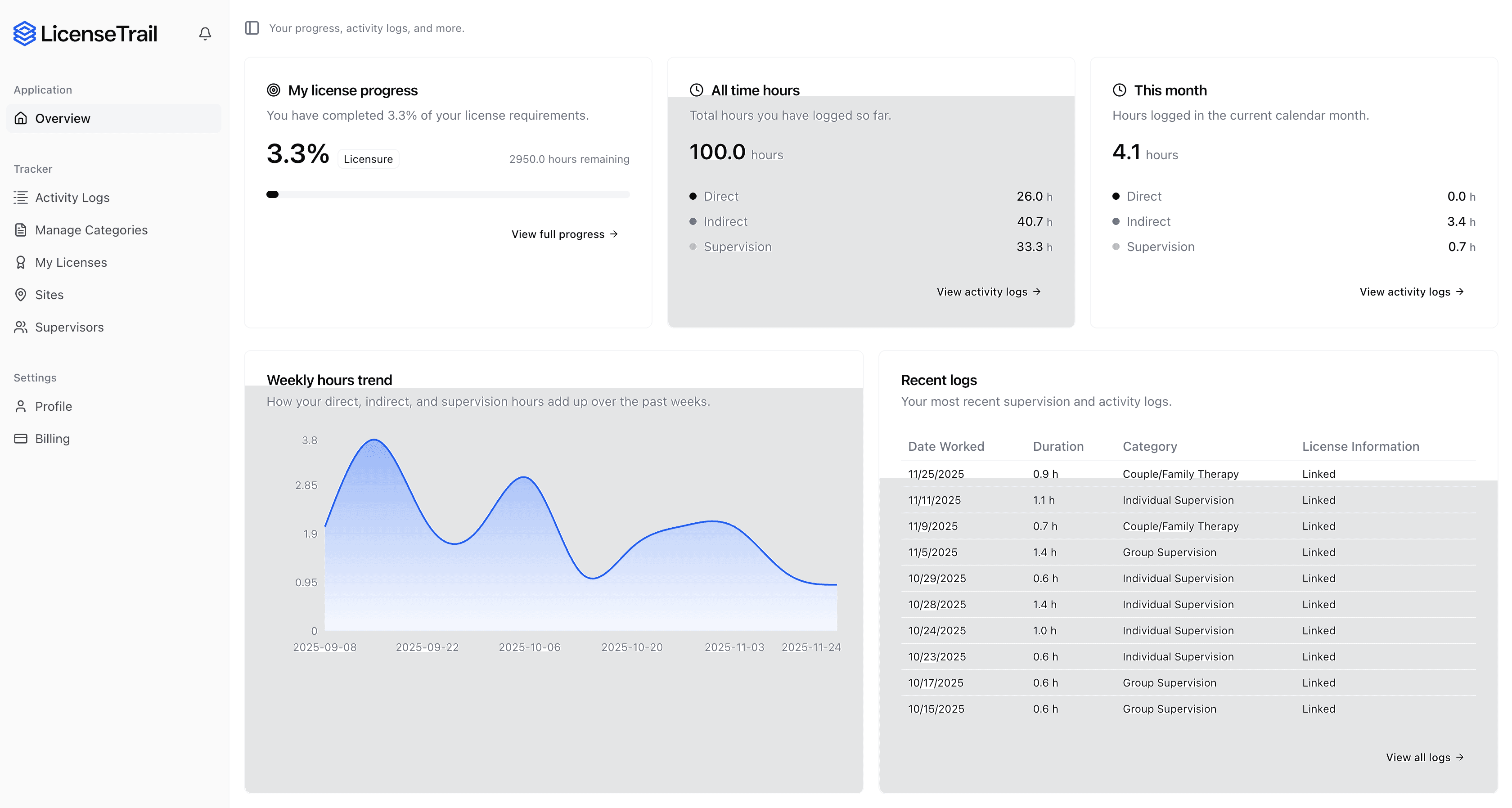
Track your LMSW-IPR hours with confidence
License Trail checks your direct, indirect, and supervision hours against Texas LMSW-IPR requirements continuously and flags mismatches before you submit.
 Start Tracking for Free
No credit card required · Free plan available
Is your spreadsheet hiding Texas LMSW-IPR risks?
Stop guessing if your categories match Texas State Board of Social Worker Examiners requirements. License Trail checks your direct, indirect, and supervision hours continuously and flags mismatches before you submit.
Import or log
Bring your spreadsheet or start fresh
Upload your existing tracking spreadsheet and we'll map every hour into the right Texas State Board of Social Worker Examiners categories automatically.
Verify against Texas
Catch mismatches before the board does
License Trail checks your direct, indirect, and supervision hours against Texas LMSW-IPR requirements continuously.
Export board-ready
One-click clean reports
Generate professional, board-ready reports for supervision meetings and Texas State Board of Social Worker Examiners submissions in seconds.
No credit card required · Free plan available