
Texas LPC-A Requirements: Hours, Exams & Step-by-Step Guide
Stop guessing if your categories match Texas requirements. License Trail checks your direct, indirect, and supervision hours against LPC-A requirements continuously and flags mismatches before you submit.
No credit card required · Free plan available
Quick Requirements Overview
- Hold qualifying graduate degree in counseling/counseling-related field: 48 sem hrs (program began pre‑8/1/2017) or 60 sem hrs (began on/after 8/1/2017) + required course content
- Complete degree practicum/internship: 300 clock hrs, including 100 direct client counseling hrs (documented by school)
- Pass NCE or NCMHCE + complete TX LPC Jurisprudence Exam (certificate dated within 6 months of application)
- Apply via BHEC with fees, official transcripts, exam results, practicum documentation, supervisory agreement (LPC‑S), plus NPDB self‑query and fingerprints
- Practice only under LPC‑Supervisor (no independent practice); hours do not count until LPC‑A is issued
- Supervised experience for full LPC: 3,000 clock hrs total, incl. ≥1,500 direct client counseling hrs, over ≥18 months
- Supervision while accruing hours: ≥4 hrs/month; ≤50% group supervision; max 2 supervisors at a time
- LPC‑A license expires in 60 months; remain supervised until full LPC is issued
License Details
Procedures
In Texas, the Licensed Professional Counselor Associate (LPC-Associate or LPC-A) is the provisional license you must hold while you complete the supervised experience required for full LPC licensure. The requirements are set in the Texas Occupations Code and in the Texas Administrative Code, Title 22, Chapter 681, as administered by the Texas Behavioral Health Executive Council (BHEC) and the Texas State Board of Examiners of Professional Counselors. (bhec.texas.gov)
Below is an organized guide to what you must do and the exact hour requirements and terminology used by the board.
1. What an LPC-Associate Is Allowed (and Not Allowed) to Do
Under Texas rules:
- An LPC Associate may only provide counseling services under supervision of a Licensed Professional Counselor Supervisor (LPC‑S) and “shall not engage in independent practice.” (regulations.justia.com)
- To practice counseling in Texas, you must obtain an LPC Associate license before beginning or continuing an internship, and “hours obtained by an unlicensed person in any setting will not count toward the supervised experience requirements.” (regulations.justia.com)
- An LPC Associate license is time‑limited: it expires 60 months (5 years) from the date of issuance. (regulations.justia.com)
BHEC also emphasizes that a person physically located in Texas must be served by a clinician holding Texas licensure; there is no reciprocity or temporary LPC license. (bhec.texas.gov)
2. Academic Requirements You Must Meet Before Applying
Texas rules distinguish between general academic requirements, degree requirements, and specific course content.
2.1 Degree level and total semester hours
Under 22 TAC §681.82 (“Academic Requirements”): (regulations.justia.com)
- You must hold a graduate degree in counseling or a counseling‑related field from an accredited program.
- Semester‑hour requirements depend on when you started your qualifying program:
- If you began the program before August 1, 2017: at least 48 semester hours.
- If you began the program on or after August 1, 2017: at least 60 semester hours.
The degree must also satisfy the detailed “Academic Course Content” rules in §681.83 (e.g., human growth and development, counseling theories, group counseling, assessment, ethics, practicum, etc.). (txrules.elaws.us)
2.2 Practicum / internship during the degree
Texas specifies minimum practicum hours as part of the academic content:
- You must complete “at least 300 clock‑hours” of practicum (or internship) experience.
- Of those, “at least 100 hours must be direct client counseling.” (txrules.elaws.us)
- The practicum must be documented on your official graduate transcript or equivalent documentation from the university. (txrules.elaws.us)
These hours are part of your degree and are separate from the 3,000 post‑graduate supervised experience hours you must complete as an LPC‑Associate.
3. Examination Requirements
To qualify for LPC‑Associate licensure, Texas requires both a national counseling exam and a jurisprudence exam.
3.1 National exam (NCE or NCMHCE)
Under board rules and BHEC’s exam FAQ: (bhec.texas.gov)
- You must pass either:
- the National Counselor Examination (NCE), or
- the National Clinical Mental Health Counseling Examination (NCMHCE),
both administered by the National Board for Certified Counselors (NBCC).
- NBCC sends official exam results to the board. These official results are one of the “Required Application Materials” for LPC Associate under §681.72. (law.cornell.edu)
3.2 Texas LPC Jurisprudence Examination
- You must complete the Texas LPC jurisprudence exam.
- Your completion certificate must be dated no more than six months before the date the LPC‑Associate application is received. (bhec.texas.gov)
4. Required Application Materials for LPC-Associate
Rule 22 TAC §681.72(a) (“Required Application Materials”) lists what must be submitted to apply for LPC Associate: (law.cornell.edu)
To apply for an LPC‑Associate license, you must submit:
- The Council’s application form (online via BHEC’s licensing system). (bhec.texas.gov)
- All applicable fees.
- Official examination results from NBCC showing a passing score on the NCE or NCMHCE.
- Completion certificate for the Texas jurisprudence exam (dated within 6 months of application).
- Official graduate transcript(s) sent directly from the school to the board. (bhec.texas.gov)
- Practicum / graduate intern documentation form confirming you completed the required degree practicum hours. (bhec.texas.gov)
- Supervisory Agreement Form – signed by you and a board‑approved LPC‑Supervisor (LPC‑S).
- If you hold a license equivalent to a Texas LPC‑Associate from another jurisdiction, official license verification and verification of any supervised experience recognized by that jurisdiction.
BHEC’s LPC‑Associate page currently also requires: (bhec.texas.gov)
- Texas Jurisprudence Exam certificate (as above)
- Practicum Documentation Form (can be completed by program faculty or practicum site)
- Supervisory Agreement Form
- National Practitioner Data Bank (NPDB) self‑query report
- Fingerprinting (instructions sent after application)
- Official transcripts (electronic or sealed hard copy sent directly from the school)
5. Conditions for Issuance of the LPC-Associate License
Rule 22 TAC §681.91 (“LPC Associate License”) specifies when the Council may issue an LPC‑Associate license: (regulations.justia.com)
The Council may issue an LPC‑Associate license to an applicant who has:
- Filed all application forms and paid all applicable fees.
- Met all of the academic requirements for licensure (see §§681.81–681.83). (regulations.justia.com)
- Completed the required examinations (NCE or NCMHCE and the Texas jurisprudence exam) with the requisite score. (law.cornell.edu)
- Entered into a supervisory agreement with an LPC‑S.
- Not yet completed the supervised experience described in §681.92 (“Experience Requirements”).
Once the LPC‑Associate license is granted:
- You must maintain that license during the supervised experience period.
- You may have no more than two Council‑approved LPC supervisors at any given time. (regulations.justia.com)
6. Supervised Experience Requirements as an LPC-Associate
This is where the hour breakdown becomes critical. The main rule is 22 TAC §681.92 (“Experience Requirements”), together with BHEC’s “Supervised Experience” FAQ. (txrules.elaws.us)
6.1 Total hours and minimum time frame
The rule states that “all applicants for LPC licensure must complete supervised experience… of 3,000 clock‑hours under a Council‑approved supervisor.” (txrules.elaws.us)
Key points:
- Total supervised experience required:
- 3,000 clock‑hours of supervised experience (post‑graduate, under an LPC‑S).
- Minimum time frame:
- An LPC Associate may not complete the required 3,000 clock‑hours in less than 18 months. (txrules.elaws.us)
6.2 Direct client counseling hours vs. other supervised experience
The rule further requires that the 3,000 hours include a specific minimum of direct counseling:
- The supervised experience “must include at least 1,500 clock‑hours of direct client counseling contact. Only actual time spent counseling may be counted.” (txrules.elaws.us)
In practice, this means:
-
Direct client counseling hours (minimum 1,500):
- Time in face‑to‑face (including telehealth) counseling sessions with clients—individual, couple, family, or group—where you are actively providing counseling services.
- BHEC clarifies that only the actual time spent providing counseling services to clients counts as direct experience; paperwork, phone calls, and meetings about clients do not count toward the direct 1,500. (bhec.texas.gov)
-
Other supervised experience hours (up to 1,500):
- The remaining hours (out of 3,000) may be indirect or related professional activities performed in your LPC‑Associate role—such as documentation, case notes, consultation, treatment planning meetings, and other counseling‑related work that occurs under supervision.
- The rules state that the experience must consist “primarily of the provision of direct counseling services within a professional relationship to clients” using counseling principles and methods to support clients’ development and adjustment. (txrules.elaws.us)
In other words, Texas does not require 1,500 direct and 1,500 additional “supervised” hours as separate categories; instead, it requires:
- 3,000 total supervised hours,
- of which at least 1,500 must be direct client counseling contact.
6.3 Monthly supervision requirements
During the time you are accruing the 3,000 supervised hours, the board also requires structured supervision:
- An LPC Associate “must receive direct supervision consisting of a minimum of four (4) hours per month” while engaged in counseling. (txrules.elaws.us)
- Supervision can occur:
- In individual format (up to two Associates with the supervisor), and/or
- In group format (three or more Associates).
- No more than 50% of the total supervision hours may be received in group supervision. (txrules.elaws.us)
- An LPC Associate may have up to two supervisors at one time. (txrules.elaws.us)
6.4 Time limits and continuation of supervision
Additional timing and supervision rules:
- The LPC‑Associate license expires 60 months from the date of issuance. If you do not complete the required 3,000 hours within that 60‑month window, you must reapply for licensure to continue accruing hours; hours already gained may carry over if properly documented. (regulations.justia.com)
- You must continue to be supervised after completing the 3,000 hours until you receive your full LPC license; supervision ends only when the LPC license is issued. (regulations.justia.com)
7. Step‑by‑Step Path from Student to LPC-Associate to LPC
Putting the rules together, the path typically looks like this:
- Complete a qualifying graduate degree in counseling or a counseling‑related field that meets Texas academic and practicum requirements (48/60+ hours and at least 300 practicum hours with at least 100 direct). (regulations.justia.com)
- Pass a national exam (NCE or NCMHCE) and complete the Texas Jurisprudence Exam (jurisprudence certificate must be within 6 months of application). (bhec.texas.gov)
- Secure a board‑approved LPC‑Supervisor and complete the Supervisory Agreement Form. (bhec.texas.gov)
- Gather and submit all required LPC‑Associate application materials, including: application, fees, exam results, jurisprudence certificate, official transcripts, practicum documentation form, supervisory agreement, NPDB self‑query, and fingerprints, following BHEC’s instructions. (bhec.texas.gov)
- Receive your LPC‑Associate license from BHEC.
- Do not begin counting supervised experience hours toward licensure until the LPC‑Associate license is issued; unlicensed hours do not count. (regulations.justia.com)
- Work as an LPC‑Associate under supervision to complete:
- 3,000 total supervised clock hours,
- at least 1,500 clock‑hours of direct client counseling contact,
- at least 18 months in duration (you cannot finish faster),
- at least 4 hours of supervision per month, with no more than 50% of supervision in group format. (txrules.elaws.us)
- Maintain your LPC‑Associate license (within the 60‑month limit) while accruing hours and continue under supervision even after you reach 3,000 hours, until your full LPC license is issued. (regulations.justia.com)
- Submit supervised experience documentation (Supervised Experience Documentation Form completed by your supervisor) and apply for upgrade from Associate to LPC once all requirements are met. (bhec.texas.gov)
In summary, to become licensed as an LPC‑Associate in Texas you must first meet the graduate education, practicum, and examination requirements, then apply with the specific materials listed in rule §681.72 and BHEC’s LPC‑Associate checklist. Once licensed as an LPC‑Associate, you must accrue 3,000 clock‑hours of supervised experience, including at least 1,500 clock‑hours of direct client counseling contact, over no less than 18 months, under ongoing supervision of at least 4 hours per month, before you can qualify for full LPC licensure. (txrules.elaws.us)
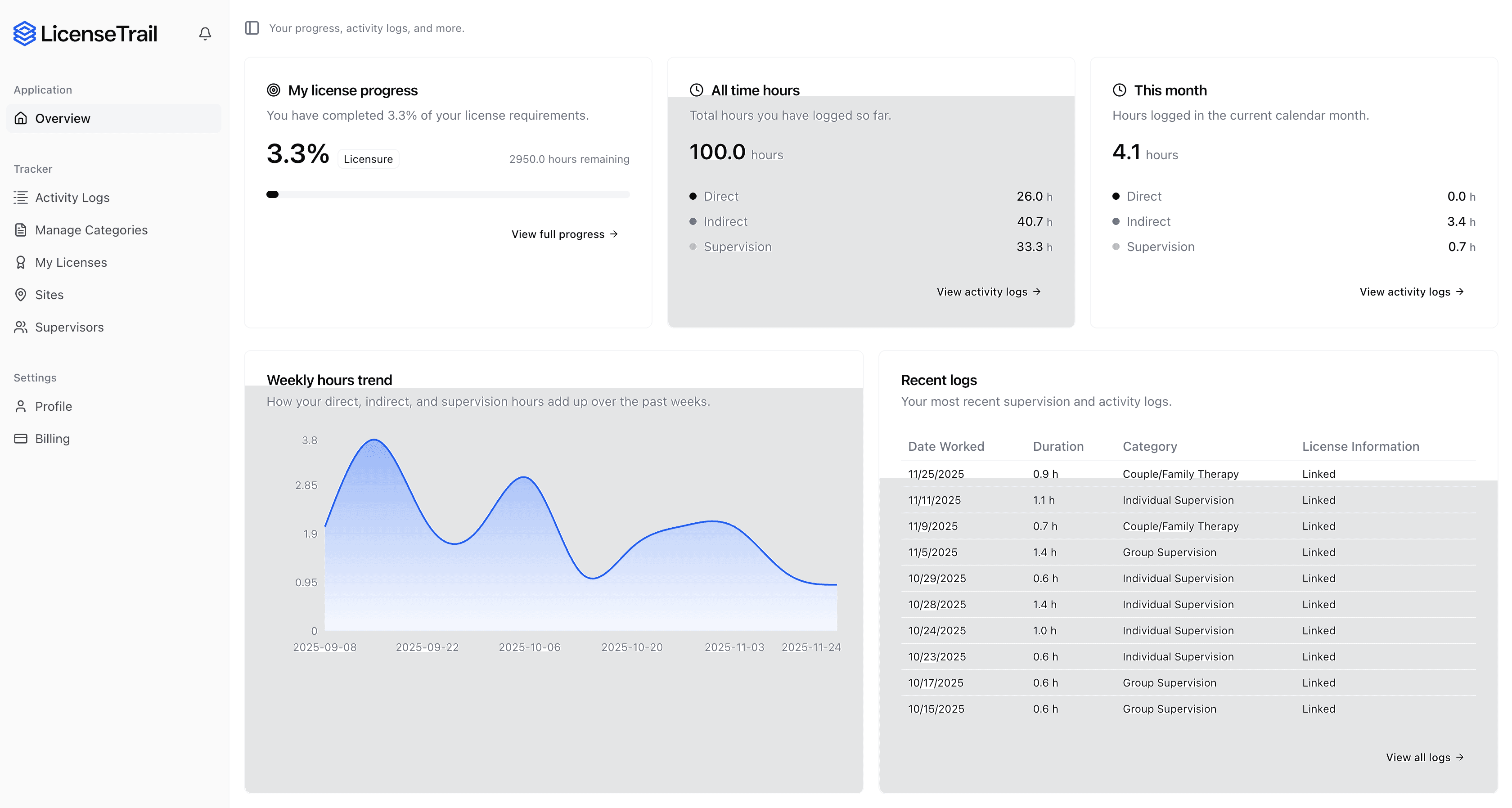
Track your LPC-A hours with confidence
License Trail checks your direct, indirect, and supervision hours against Texas LPC-A requirements continuously and flags mismatches before you submit.
 Start Tracking for Free
No credit card required · Free plan available
Is your spreadsheet hiding Texas LPC-A risks?
Stop guessing if your categories match Texas State Board of Examiners of Professional Counselors requirements. License Trail checks your direct, indirect, and supervision hours continuously and flags mismatches before you submit.
Import or log
Bring your spreadsheet or start fresh
Upload your existing tracking spreadsheet and we'll map every hour into the right Texas State Board of Examiners of Professional Counselors categories automatically.
Verify against Texas
Catch mismatches before the board does
License Trail checks your direct, indirect, and supervision hours against Texas LPC-A requirements continuously.
Export board-ready
One-click clean reports
Generate professional, board-ready reports for supervision meetings and Texas State Board of Examiners of Professional Counselors submissions in seconds.
No credit card required · Free plan available