
Texas LPA Requirements: Hours, Exams & Step-by-Step Guide
Stop guessing if your categories match Texas requirements. License Trail checks your direct, indirect, and supervision hours against LPA requirements continuously and flags mismatches before you submit.
No credit card required · Free plan available
Quick Requirements Overview
- Governed by Texas State Board of Examiners of Psychologists (BHEC); key rule 22 TAC §463.8
- Education: Graduate degree major in psychology with ≥60 graduate semester credit hours
- Practicum cap: ≤12 of the 60 semester hours may be practicum/internship/structured experience
- In-program supervised training: ≥6 semester credit hours practicum/internship/structured experience within the degree, supervised by a Licensed Psychologist or LSSP
- Exams: Pass EPPP and Texas Jurisprudence Exam
- Application items: online application/fees, official transcripts, Coursework Identification Form, and fingerprints/background check
- Practice status: LPA practice is supervised by a Licensed Psychologist unless/ until independent practice authority is granted
- Independent Practice Authority (optional): 3,000 post-licensure supervised hours (degree hours don’t count), completed in 24–48 consecutive months, ≤3 placements, supervised by a Licensed Psychologist; board approval required (no direct/indirect hour split specified)
License Details
Procedures
Licensure as a Licensed Psychological Associate (LPA) in Texas is governed by the Texas State Board of Examiners of Psychologists, operating under the Texas Behavioral Health Executive Council (BHEC). The key rule is 22 TAC §463.8, and BHEC also publishes plain‑language summaries and FAQs that clarify how the rule is applied. (bhec.texas.gov)
Below is a structured, step‑by‑step description of what the Board requires, with special focus on the types and amounts of hours.
1. Role of the LPA in Texas
- An LPA is a master’s‑level psychology license in Texas.
- By default, LPAs must practice under the supervision of a Licensed Psychologist.
- LPAs may later apply for “independent practice authority”, which requires substantial supervised post‑graduate hours (described in Section 4). (bhec.texas.gov)
2. Educational Requirements and Practicum/Internship Hours
2.1 Degree requirements (semester credit hours)
The Board’s rule (22 TAC §463.8) and BHEC guidance specify that an applicant must have: (bhec.texas.gov)
- A graduate degree in psychology (major in psychology).
- At least 60 graduate semester credit hours in psychology.
- No more than 12 of those 60 hours may be in practicum, internship, or other structured experience.
In other words:
- Minimum total: 60 semester hours.
- Max that can be counted from practicum/internship/structured experience toward that 60: 12 semester hours.
BHEC has also clarified that the former “less than 60 hours” grandfathering provision ended August 31, 2021; new LPA applicants now must meet the 60‑hour standard. (bhec.texas.gov)
2.2 Required practicum/internship/structured experience within the degree
Within those 60 hours, the Board requires a minimum amount of supervised, structured training, described in rule‑based summaries as: (bhec.texas.gov)
- At least 6 semester credit hours of:
- practicum,
- internship, or
- other “structured experience”
- This experience must be completed within the graduate degree program.
- It must occur under the supervision of either:
- a Licensed Psychologist, or
- a Licensed Specialist in School Psychology (LSSP) (this supervision option was added by a 2023 rule amendment). (search.sos.texas.gov)
Important nuance about “hours” here:
- For initial LPA licensure, the Board does not specify a required number of direct client contact clock‑hours (e.g., “1,500 direct hours”) the way it does for other licenses (such as LPC).
- Instead, it defines the pre‑licensure training quantitatively in semester credit hours (6+ hours of supervised practicum/internship/structured experience) rather than in total clock‑hours of direct service. (bhec.texas.gov)
Individual graduate programs may internally equate those 6+ credits to specific numbers of practicum hours, but that conversion is a program policy, not a Board‑mandated figure.
3. Examination and Administrative Requirements
For licensure as an LPA, the Board requires two examinations, plus standard application steps. (bhec.texas.gov)
3.1 Required exams
-
EPPP – Examination for Professional Practice in Psychology
- A standardized national exam developed by the Association of State and Provincial Psychology Boards (ASPPB).
- Applicants must achieve at least the Board‑defined minimum passing score.
-
Texas Jurisprudence Examination
- A state‑specific, online exam testing knowledge of Texas psychology statutes, rules, and ethical requirements.
Both exams are required for Licensed Psychologists and LPAs. (bhec.texas.gov)
3.2 Other typical application elements
While not “hours,” these are part of the licensure process:
- Official graduate transcripts sent directly from the institution to BHEC. (bhec.texas.gov)
- Coursework Identification Form (LPA) to show how your coursework matches the rule’s required content areas. (bhec.texas.gov)
- Background check and fingerprints, as required by BHEC’s standard licensing procedures (applies across behavioral health boards).
- Completion of the online application through BHEC’s licensing portal, with associated fees. (bhec.texas.gov)
4. Post‑Licensure Hours for Independent Practice Authority
This is the area where specific “hour” requirements appear for LPAs.
After becoming licensed as an LPA, an individual who wants to practice independently (without ongoing, formal supervision by a Licensed Psychologist) must obtain independent practice authority. The rules and BHEC guidance describe this requirement in terms of post‑graduate, supervised experience hours. (bhec.texas.gov)
4.1 When these hours can begin
- The supervised hours that count toward independent practice can only be accrued after the LPA license has been issued.
- Any hours of internship or practicum completed as part of the degree program do not count toward the 3,000 post‑degree hours for independent practice. (bhec.texas.gov)
4.2 Total number of supervised hours
To qualify for independent practice authority as an LPA, the Board requires:
- A minimum of 3,000 hours of post‑graduate degree supervised experience. (bhec.texas.gov)
The rule and its preamble emphasize that these 3,000 hours must involve delivering psychological services under supervision of a Licensed Psychologist. (search.sos.texas.gov)
4.3 Timeframe and practice settings
The 3,000 supervised hours must be: (bhec.texas.gov)
- Obtained within 24 to 48 consecutive months (i.e., between 2 and 4 years).
- Completed in no more than three separate placements (e.g., three distinct employers or practice settings).
The Board’s reasoning (in the Texas Register preamble) is that this ensures LPAs have at least about two years of supervised practice before being allowed to practice independently. (search.sos.texas.gov)
4.4 Supervisor requirements and location
- The hours must be supervised by a Licensed Psychologist.
- If the LPA also holds a Licensed Specialist in School Psychology (LSSP) credential, certain supervision hours obtained in school settings can count if the supervisor is licensed both as a Psychologist and as an LSSP. (bhec.texas.gov)
- Supervision may be obtained outside Texas, but only if it meets Texas rules for supervision and documentation. (bhec.texas.gov)
4.5 Type of hours (direct vs indirect)
Unlike some other licenses (e.g., Texas LPC, which requires 3,000 hours with at least 1,500 hours of direct counseling experience), the LPA rule:
- Does not break the 3,000 hours into “direct client contact” versus “indirect” hours in the text of 22 TAC §463.8 or the BHEC summaries.
- Instead, it refers to “supervised experience delivering psychological services” under a Licensed Psychologist, and leaves fine‑grained categorization (direct vs administrative, assessment vs therapy) to be addressed in supervision arrangements and documentation forms. (bhec.texas.gov)
So there is no requirement like “1,500 direct + 1,500 other hours” for LPAs. The key numerical standard is a single total of 3,000 supervised hours, within the specified timeframe, under appropriate supervision.
4.6 Application for independent practice authority
Once the 3,000 hours are completed and properly documented, the LPA must: (bhec.texas.gov)
- Submit the “LPA Independent Practice Authority” application to the Board.
- Provide Supervised Experience Documentation Forms completed by the supervising psychologist(s).
- Await Board approval before holding oneself out as independently practicing.
Independence is not automatic when the 3,000 hours are finished; formal Board approval is required.
5. Step‑by‑Step Summary (Initial LPA + Independent Practice)
5.1 To become a Licensed Psychological Associate (LPA)
-
Complete a qualifying graduate degree in psychology
- At least 60 graduate semester hours.
- No more than 12 hours of practicum/internship/structured experience counted toward the 60. (bhec.texas.gov)
-
Include supervised practicum / internship within the degree
- At least 6 semester credit hours of practicum, internship, or structured experience.
- Supervised by a Licensed Psychologist or LSSP. (bhec.texas.gov)
-
Pass required exams
- EPPP (national psychology licensing exam).
- Texas Jurisprudence Examination. (bhec.texas.gov)
-
Submit application to BHEC / TSBEP
- Online application, fees.
- Official transcripts and Coursework Identification Form (LPA).
- Background check and fingerprints per BHEC procedures. (bhec.texas.gov)
-
Receive LPA license
- At this stage, you are licensed but must practice under supervision of a Licensed Psychologist.
5.2 To obtain Independent Practice Authority as an LPA (optional)
-
Accrue supervised post‑graduate experience
- At least 3,000 hours of post‑degree supervised experience delivering psychological services.
- All hours must be after the LPA license is issued.
- Hours must be supervised by a Licensed Psychologist (with the LSSP dual‑licensure exception for school‑based LPAs).
- Hours must be completed within 24–48 consecutive months and in no more than 3 placements. (bhec.texas.gov)
-
Document supervision
- Supervising psychologist(s) complete BHEC’s Supervised Experience Documentation Form (Psychological Associate). (bhec.texas.gov)
-
Apply for independent practice authority
- Submit the LPA Independent Practice Authority application plus documentation of the 3,000 hours.
- Await Board approval before practicing independently. (bhec.texas.gov)
6. Key Takeaways About “Hours” for Texas LPA Licensure
-
Pre‑licensure (within the degree)
- Measured in semester credit hours, not specific clock‑hours:
- Minimum 6 semester hours of supervised practicum/internship/structured experience, under a Licensed Psychologist or LSSP. (bhec.texas.gov)
- Measured in semester credit hours, not specific clock‑hours:
-
Post‑licensure (for independent practice authority)
- Measured in clock‑hours of supervised practice:
- 3,000 hours of post‑graduate degree, supervised experience delivering psychological services under a Licensed Psychologist.
- Completed in 24–48 months, in no more than 3 placements. (bhec.texas.gov)
- Measured in clock‑hours of supervised practice:
-
No split into “direct” vs “indirect” hours is specified for LPAs, unlike the LPC rules that explicitly require 1,500 direct counseling hours out of 3,000 total. For the LPA, the Board focuses on total supervised hours and appropriate supervision rather than codifying a direct/indirect breakdown. (bhec.texas.gov)
This structure reflects the current Texas State Board of Examiners of Psychologists / BHEC rules and guidance as of November 23, 2025.
Track your LPA hours with confidence
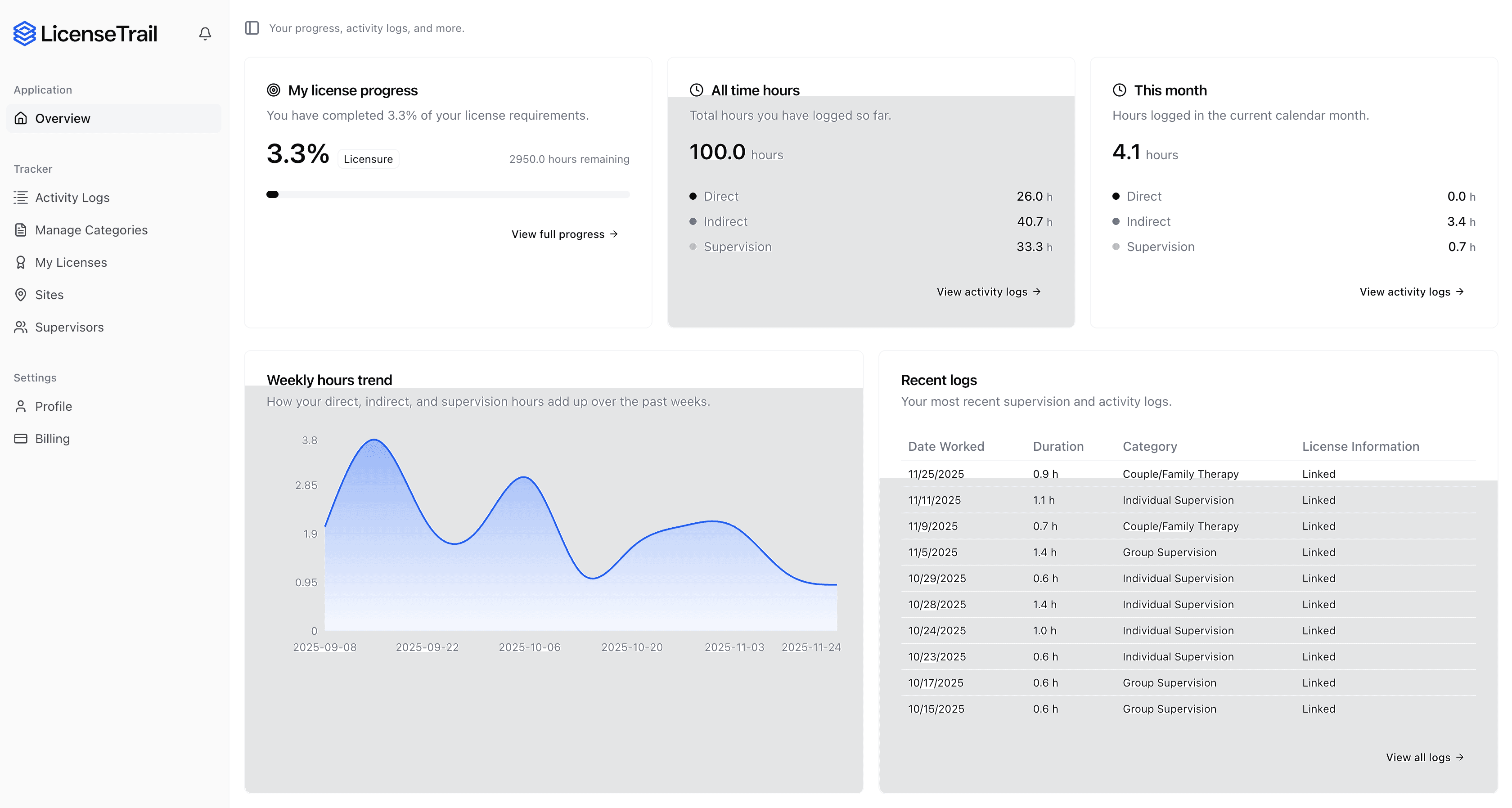
License Trail checks your direct, indirect, and supervision hours against Texas LPA requirements continuously and flags mismatches before you submit.
 Start Tracking for Free
No credit card required · Free plan available
Is your spreadsheet hiding Texas LPA risks?
Stop guessing if your categories match Texas State Board of Examiners of Psychologists requirements. License Trail checks your direct, indirect, and supervision hours continuously and flags mismatches before you submit.
Import or log
Bring your spreadsheet or start fresh
Upload your existing tracking spreadsheet and we'll map every hour into the right Texas State Board of Examiners of Psychologists categories automatically.
Verify against Texas
Catch mismatches before the board does
License Trail checks your direct, indirect, and supervision hours against Texas LPA requirements continuously.
Export board-ready
One-click clean reports
Generate professional, board-ready reports for supervision meetings and Texas State Board of Examiners of Psychologists submissions in seconds.
No credit card required · Free plan available