
Texas PLP Requirements: Hours, Exams & Step-by-Step Guide
Stop guessing if your categories match Texas requirements. License Trail checks your direct, indirect, and supervision hours against PLP requirements continuously and flags mismatches before you submit.
No credit card required · Free plan available
Quick Requirements Overview
- Board/Rules: Texas BHEC/Texas State Board of Examiners of Psychologists; 22 TAC §463.10 & §463.11
- Degree: Doctoral degree in psychology (regionally accredited; transcript shows major in psychology for degrees ≥ 1/1/1979)
- Total supervised experience: 3,500 hours minimum = 1,750 internship (doctoral program) + 1,750 post‑doc (typically while PLP)
- Internship structure (key minimums): ≥25% direct client contact; 2 hrs/week scheduled individual face‑to‑face supervision + 4 hrs/week additional structured learning activities
- PLP purpose/eligibility: Issued when all LP requirements met except EPPP and/or post‑doc hours; practice only under supervision of a licensed psychologist
- PLP limits: One-time, non‑renewable, max 2 years; expires if full LP not completed
- Exams for full LP: Must pass EPPP + Texas Jurisprudence Exam to upgrade to LP
License Details
Procedures
Becoming a provisionally licensed psychologist (often called a PLP) in Texas is essentially the first stage of being licensed as a Licensed Psychologist (LP). The Texas State Board of Examiners of Psychologists, operating under the Texas Behavioral Health Executive Council (BHEC), issues a “Licensed Psychologist with Provisional Status” once you meet almost all LP requirements, then upgrades you to full LP after you finish your post‑doctoral hours and exams. (bhec.texas.gov)
This guide focuses on:
- What “provisional status” actually is in Texas
- The exact hours and types of hours required (internship + post‑doctoral supervised experience)
- How those hours must be structured under 22 TAC §§463.10 and 463.11
1. Regulatory framework and terminology
The key rules are:
- 22 Texas Administrative Code (TAC) §463.10 – Licensed Psychologists
- 22 TAC §463.11 – Supervised Experience Required for Licensure as a Psychologist (txrules.elaws.us)
BHEC’s own guidance on becoming licensed as a psychologist mirrors these rules and emphasizes that licensure generally requires: (bhec.texas.gov)
- A doctoral degree in psychology
- Passing the EPPP (national exam)
- Passing the Texas Jurisprudence Exam
- 1,750 hours of supervised experience in a formal internship within a doctoral program
- 1,750 hours of supervised experience after the doctoral degree
The provisional license (your PLP period) is the mechanism Texas uses to let you gain those post‑doctoral hours and/or finish the EPPP.
2. Big picture of the hours
For full psychologist licensure in Texas, the law requires a minimum of 3,500 hours of supervised experience: (txrules.elaws.us)
- 3,500 total supervised hours, made up of:
- At least 1,750 hours in a formal internship that occurs within your doctoral degree program; and
- At least 1,750 hours received as a provisionally licensed psychologist (or under older “provisional trainee” status) after the doctoral degree is conferred.
So, in practice:
- Your doctoral internship covers the first 1,750 hours.
- Your PLP period is where you normally earn the second 1,750 hours.
There is no separate numeric requirement like “1,500 direct + 1,500 supervised” for psychologists in Texas. Instead, the rules:
- Set the 3,500‑hour total and the 1,750 / 1,750 split, and
- Define what kinds of activities and supervision must make up those hours (percentages of direct client contact, service‑related activities, supervision requirements, etc.).
3. Educational and degree requirements before PLP
Before you can ever be granted provisional status as a psychologist, you must already meet the education and degree requirements for LP:
-
Doctoral degree in psychology
- You must hold a doctoral degree in psychology from a college or university accredited by a regional accrediting organization. (txrules.elaws.us)
- For degrees conferred on or after January 1, 1979, your transcript must explicitly designate a major in psychology. (txrules.elaws.us)
-
Doctoral program accreditation / equivalence
- Texas does not require that every program be APA/CPA/PCSAS accredited, but those accreditations matter because they determine how much of your doctoral‑program experience (internship + practicum) can be counted toward your post‑doctoral 1,750 hours (explained below). (txrules.elaws.us)
Without the qualifying doctoral degree, you are not eligible for a psychologist license application and thus cannot be given the “Licensed Psychologist with Provisional Status” license.
4. Supervised experience: the formal internship (first 1,750 hours)
4.1 Required internship hours
Rule 463.11 requires that, to qualify for licensure, you show at least 1,750 hours of supervised experience obtained through a formal internship within your doctoral program. (txrules.elaws.us)
Key points:
- The internship must be a formal, organized training program near the end of your doctoral training. (txrules.elaws.us)
- If your doctoral degree was conferred before September 1, 2017, a formal internship completed after the degree may still be accepted if it otherwise meets the rule. (txrules.elaws.us)
4.2 What “type” of hours must the internship include?
Rule 463.11(d) and (b)(1)(B) describe how internship and practicum hours must be structured. In summary: (txrules.elaws.us)
- The internship must provide training in a range of assessment and intervention activities conducted directly with clients.
- At least 25% of the intern’s time must be direct patient/client contact.
- The internship must include a minimum of 2 hours per week of scheduled, face‑to‑face individual supervision, plus at least 4 additional hours per week of structured learning activities (e.g., case conferences, seminars, group supervision, co‑therapy with a supervisor).
- For practicum hours that you wish to count toward post‑doctoral requirements (if your program is APA/CPA/PCSAS‑accredited or substantially equivalent), the rule specifies that:
- At least 50% of practicum hours must be “service‑related activities” (treatment/intervention, assessment, interviews, report‑writing, case presentations, consultations).
- Individual face‑to‑face supervision must be at least 25% of the time you spend on those service‑related activities.
- At least 25% of total practicum hours must be face‑to‑face patient or client contact.
- Practicum must be at least 15 hours per week and conducted under the direction of appropriately licensed psychologists. (txrules.elaws.us)
These criteria determine what “counts” as qualifying supervised experience, and they matter if you want to apply some doctoral‑program practicum and excess internship hours toward the post‑doctoral 1,750 hours.
5. Supervised experience after the doctorate (second 1,750 hours)
5.1 Core requirement
Rule 463.11 requires that at least 1,750 hours of supervised experience be earned after the doctoral degree is conferred, and it states that this 1,750 hours must be received as a provisionally licensed psychologist (or earlier “provisional trainee” status). (txrules.elaws.us)
In practice, this means:
- Once your LP application is approved, you are issued a Licensed Psychologist with Provisional Status (PLP). (bhec.texas.gov)
- You then earn your post‑doctoral supervised experience hours under that provisional license.
5.2 What qualifies as those post‑doctoral 1,750 hours?
Under 463.11(a)(3), the post‑doctoral requirement is flexible about setting, as long as it is properly supervised by a licensed psychologist: (txrules.elaws.us)
- Post‑doctoral hours can be earned:
- As a provisionally licensed psychologist in typical clinical, counseling, school, or other practice settings;
- While employed delivering psychological services in an “exempt” setting (e.g., a governmental or educational setting exempt from licensure),
- While licensed or authorized in another jurisdiction and practicing under that jurisdiction’s rules, or
- While practicing as a Licensed Psychological Associate or Licensed Specialist in School Psychology in Texas, provided the experience is under the supervision of a licensed psychologist.
All of it must be:
- Obtained after official enrollment in a doctoral program and, for the post‑doctoral portion, after the doctoral degree is conferred; (txrules.elaws.us)
- Supervised by a psychologist who is licensed when the supervision occurs and trained in the area being supervised;
- Conducted in no more than two placements over no more than 24 consecutive months for each period of supervised experience; and
- In compliance with all Board and Council rules on supervision, including clear supervisory titles and disclosure to clients. (txrules.elaws.us)
5.3 Counting some doctoral hours toward the 1,750 post‑doc hours
Under 463.11(b), applicants from APA/CPA/PCSAS‑accredited (or substantially equivalent) doctoral programs may count certain doctoral experiences toward the post‑doctoral 1,750 hours: (txrules.elaws.us)
- Internship hours beyond the required 1,750 may be applied toward the post‑doc requirement.
- Qualifying practicum hours that meet the detailed criteria (sequential, organized training; formal training plan; 50% service‑related activities; 25% direct client contact; supervision ratios, etc.) may also be credited toward the post‑doctoral 1,750 hours.
BHEC’s public guidance explicitly notes that graduates of accredited or substantially equivalent programs “may be able to count certain experience acquired in their doctoral program toward” the post‑doctoral requirement and points you back to Rule 463.11 for the details. (bhec.texas.gov)
6. What “provisional status” (PLP) is and who qualifies
6.1 Legal definition of the provisional license
Under 22 TAC §463.10(f): (txrules.elaws.us)
- An applicant who has not yet passed the required examinations (EPPP and/or Jurisprudence) or
- An applicant who is seeking to acquire the supervised experience required under §463.11
may practice under the supervision of a licensed psychologist as a provisionally licensed psychologist for no more than two years, if they meet all other licensing requirements (primarily, the qualifying doctoral degree and other statutory qualifications).
BHEC’s FAQ summarizes this plainly: applicants for a psychologist license who have completed all licensure requirements except post‑doctoral supervised experience and passage of the EPPP may receive a one‑time provisional license for a two‑year period. (bhec.texas.gov)
BHEC’s “How to Become a Licensed Psychologist” page adds that, upon approval of an application, first‑time LP applicants receive a non‑renewable license as a “Licensed Psychologist with Provisional Status,” valid for 2 years, which allows them to complete the post‑doctoral supervised experience and pass the EPPP. (bhec.texas.gov)
6.2 Key features and limits of PLP status
From 463.10(f) and BHEC guidance: (txrules.elaws.us)
- Time limit:
- The provisional LP (PLP) status is valid for no more than 2 years, and it is non‑renewable.
- One‑time only:
- A provisional license cannot be issued if you already had a provisional license in connection with a prior psychologist application.
- Supervised practice:
- You must practice under the supervision of a licensed psychologist during this period (unless a separate statute or rule explicitly allows independent practice based on prior independent licensure in another jurisdiction). (texas.public.law)
- Full applicability of law:
- While provisionally licensed, you are fully subject to all laws and rules governing the practice of psychology; you can be the subject of eligibility or disciplinary actions.
- Expiration:
- If you have not qualified for full licensure as a psychologist after the two‑year provisional period, the provisional license expires and cannot simply be renewed. (txrules.elaws.us)
7. Step‑by‑step path to PLP and then full LP (with hours broken down)
Step 1 – Complete your qualifying doctoral degree and formal internship
- Earn your doctoral degree in psychology from a regionally accredited institution, with a transcript showing a major in psychology (or substantial equivalent when allowed). (txrules.elaws.us)
- Complete a formal internship that provides at least 1,750 supervised hours, satisfying the structure and supervision requirements in Rule 463.11(d). (txrules.elaws.us)
Step 2 – Apply for a Texas Licensed Psychologist license (initial LP application)
- Use BHEC’s online licensing system to file an LP application. This is not a separate “PLP application;” rather, the PLP is built into the LP process as provisional status. (bhec.texas.gov)
- Submit transcripts and any required internship/practicum documentation.
- You may apply even if you have not yet:
- Completed the 1,750 post‑doctoral hours, and/or
- Passed the EPPP, though you must meet all other licensing qualifications.
Step 3 – Receive your “Licensed Psychologist with Provisional Status” (PLP)
- Once BHEC determines that you meet all requirements except the post‑doctoral supervised experience and/or EPPP, the Board will issue a Licensed Psychologist with Provisional Status, valid for 2 years. (bhec.texas.gov)
- This status legally corresponds to being a “provisionally licensed psychologist” under 22 TAC §463.10(f). (txrules.elaws.us)
Step 4 – During PLP: complete your supervised post‑doctoral hours (target: 1,750 hours)
While provisionally licensed:
- Aim to complete at least 1,750 hours of supervised experience that meet Rule 463.11 requirements. (txrules.elaws.us)
- Structure your experience to satisfy the general supervised‑experience rules, including: (txrules.elaws.us)
- No more than two placements for each supervised‑experience period,
- All supervision from appropriately licensed psychologists,
- Supervision in the same substantive area as your practice,
- Clear disclosure to clients that you are under supervision and use of appropriate titles (including “provisionally licensed psychologist” and/or intern/resident/trainee).
- If you graduated from an APA/CPA/PCSAS‑accredited (or substantially equivalent) program, consider whether: (txrules.elaws.us)
- Internship hours in excess of 1,750, and
- Qualifying practicum hours
can be applied toward the 1,750‑hour post‑doctoral requirement, using the Board’s forms (e.g., “Request to Count Excess Doctoral Internship Hours Toward Post‑Doc Requirement”). (bhec.texas.gov)
Step 5 – Pass the examinations
At some point during or before the PLP period:
- Pass the Examination for Professional Practice in Psychology (EPPP); and
- Pass the Texas Jurisprudence Examination. (bhec.texas.gov)
Rule 463.10 makes passage of “all examinations required by the agency” a condition of full licensure. (txrules.elaws.us)
Step 6 – Upgrade from provisional status to full Licensed Psychologist
Once you have:
- Completed the full 3,500 hours of qualifying supervised experience (internship + post‑doc), and
- Passed the EPPP and Jurisprudence Exam,
you submit the “Request for License Issuance” application with documentation of your post‑doctoral supervised experience (or proof of exemption, if applicable). (bhec.texas.gov)
If the Board approves:
- Your “Licensed Psychologist with Provisional Status” is effectively replaced with a full Licensed Psychologist license, and the provisional period ends.
8. The 1,500/1,500 scenario and remediation (how it appears in the rules)
The numbers 1,500 + 1,500 do appear in the psychology rules, but not as the default requirement; they show up in a remediation context in Rule 463.11(g). That subsection allows an applicant who: (txrules.elaws.us)
- Has completed at least 1,500 hours in a formal internship and
- 1,500 hours of supervised experience after the doctorate,
but still does not fully meet all supervised‑experience qualifications, to petition to remediate deficiencies (for example, if some experience did not meet all structural requirements). The Council may approve or deny such requests and can require specific remedial steps.
That 1,500/1,500 pattern is therefore:
- A minimum threshold for considering remediation, not the standard requirement;
- The standard remains 3,500 hours divided as 1,750 internship + 1,750 post‑doctoral.
9. Snapshot summary of the hour and “type of hour” requirements
For clarity, the Texas State Board/BHEC rules currently require, for a first‑time in‑state applicant:
- 3,500 hours of supervised experience total, consisting of: (txrules.elaws.us)
- 1,750 hours in a formal internship within your doctoral program;
- 1,750 hours after the doctorate, typically while you hold provisional LP (PLP) status.
With these “types” of hours and structures:
-
Internship/practicum:
- Substantial direct patient/client contact (≥25% of time).
- At least 50% of practicum hours are service‑related clinical activities.
- Individual face‑to‑face supervision equal to at least 25% of service‑related time.
- Regular weekly supervision and additional structured learning (case conferences, seminars, etc.). (txrules.elaws.us)
-
Post‑doctoral/PLP:
- At least 1,750 supervised hours, obtained after the doctorate, in no more than two placements, over no more than 24 consecutive months per supervised‑experience period.
- Supervision by licensed psychologists, trained in the relevant area, with proper disclosure to clients of your supervised status and appropriate use of titles such as “provisionally licensed psychologist.” (txrules.elaws.us)
Those are the core, Board‑defined hour requirements and hour‑type definitions you need to navigate to become a Provisionally Licensed Psychologist (Licensed Psychologist with Provisional Status) and then a fully Licensed Psychologist in Texas.
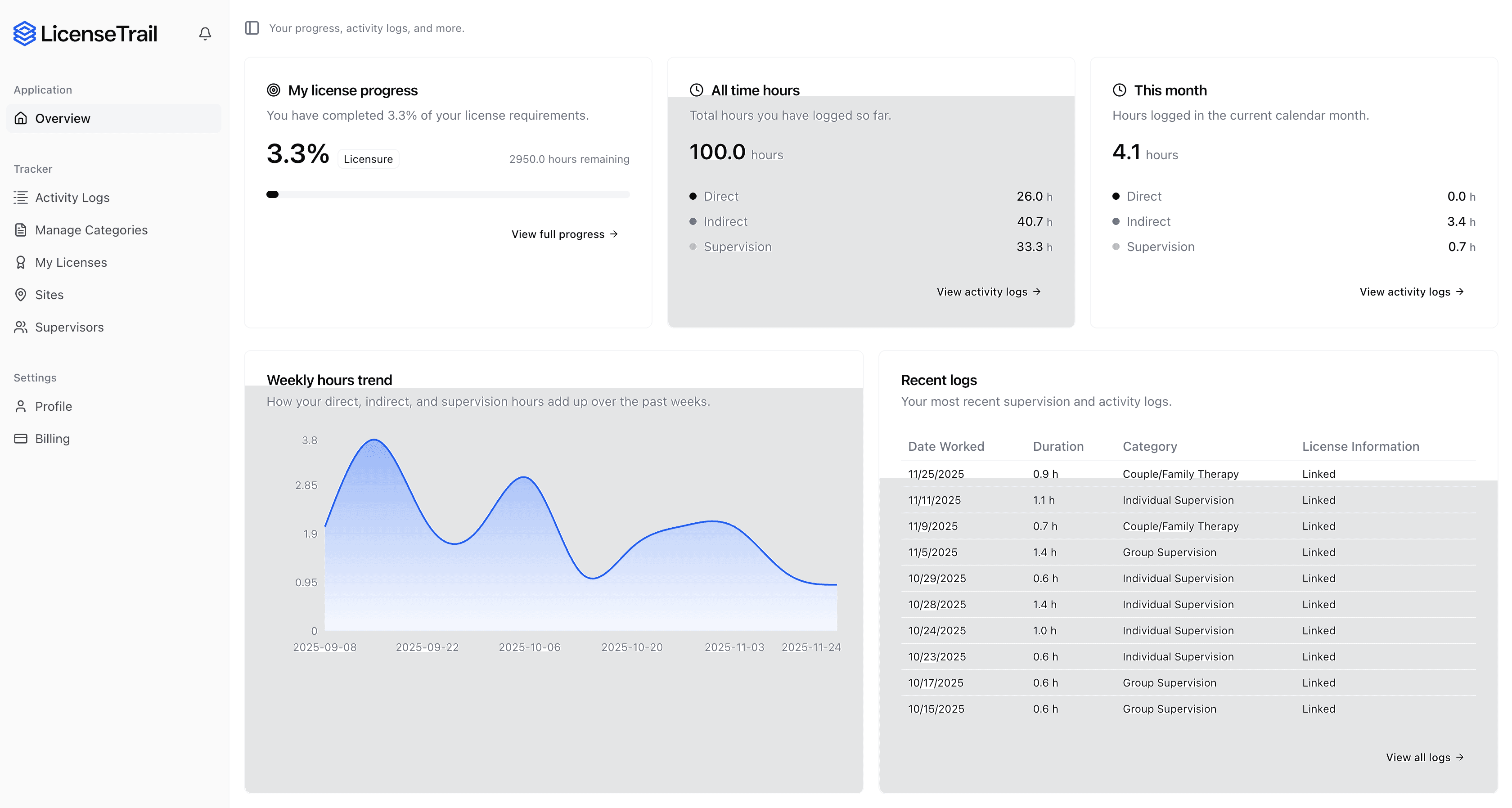
Track your PLP hours with confidence
License Trail checks your direct, indirect, and supervision hours against Texas PLP requirements continuously and flags mismatches before you submit.
 Start Tracking for Free
No credit card required · Free plan available
Is your spreadsheet hiding Texas PLP risks?
Stop guessing if your categories match Texas State Board of Examiners of Psychologists requirements. License Trail checks your direct, indirect, and supervision hours continuously and flags mismatches before you submit.
Import or log
Bring your spreadsheet or start fresh
Upload your existing tracking spreadsheet and we'll map every hour into the right Texas State Board of Examiners of Psychologists categories automatically.
Verify against Texas
Catch mismatches before the board does
License Trail checks your direct, indirect, and supervision hours against Texas PLP requirements continuously.
Export board-ready
One-click clean reports
Generate professional, board-ready reports for supervision meetings and Texas State Board of Examiners of Psychologists submissions in seconds.
No credit card required · Free plan available