
Utah CPP Requirements: Hours, Exams & Step-by-Step Guide
Stop guessing if your categories match Utah requirements. License Trail checks your direct, indirect, and supervision hours against CPP requirements continuously and flags mismatches before you submit.
No credit card required · Free plan available
Quick Requirements Overview
- Must first hold full Utah psychologist licensure (CPP is an added certification under Title 58 Ch. 61 / R156‑61)
- Doctoral program must include ≥400 practicum hrs (≥150 direct service; ≥20 scheduled supervision) and ≥2,000 internship hrs
- For psychologist licensure: ≥4,000 hrs “psychology training” (approved; within 4 years post‑doctorate; supervised 1:20 predoc / 1:40 postdoc)
- Complete a Master’s in Clinical Psychopharmacology: ≥30 didactic credits over ≥4 semesters (specified biomedical/assessment content)
- CPP post‑master’s requirement: ≥4,000 hrs postdoctoral supervised clinical prescribing training over ≥2 years, directed by a licensed physician
- If claiming specialty populations: include ≥1 year prescribing to ≤17, ≥65, and/or comorbid medical patients (physician-certified)
- Pass ASPPB PEP (or equivalent by rule) and complete criminal background check; no active/pending discipline; maintain liability insurance; pay fees/board review if requested
- Ongoing: 48 CE hours per 2‑year renewal cycle (psychologist CE rules apply to CPPs)
License Details

Procedures
Utah has created a distinct prescriptive-psychology credential called the Certified Prescribing Psychologist (CPP), regulated under the Psychologist Licensing Act (Utah Code Title 58, Chapter 61) and the Psychologist Licensing Act Rule (Utah Admin. Code R156‑61). What follows walks through the requirements in the order you would encounter them, with emphasis on the specific hour requirements and the state’s own terminology.
1. License category and regulatory framework
-
Utah law now recognizes:
- Certified Prescribing Psychologist and
- Provisional Prescribing Psychologist
as certification classifications under the Psychologist Licensing Act. (law.cornell.edu)
-
The same rules that govern psychologists (Rule R156‑61) now explicitly apply to “a psychologist, including a certified prescribing psychologist or a certified provisional prescribing psychologist” for matters like continuing education. (regulations.justia.com)
A CPP credential is therefore an additional certification layered on top of full licensure as a Utah psychologist.
2. Step One: Become a fully licensed Utah psychologist
2.1 Doctoral program requirements (includes practicum and internship hours)
To qualify for psychologist licensure—and also later for CPP—you must have a doctoral degree in psychology from a program that meets the approval criteria in R156‑61‑302a. Key points include:
- The program must be an integrated, graduate‑level psychology program with:
- At least three academic years of full‑time graduate study. (law.cornell.edu)
- It must include:
- Supervised practicum “appropriate to the practice of psychology” of at least 400 hours, including at least:
- 150 hours of direct service experience, and
- 20 hours of formally scheduled supervision. (law.cornell.edu)
- A supervised internship appropriate to the practice of psychology with:
- A full‑time calendar year (or two half‑time years), and
- At least 2,000 experience hours for clinical, counseling, or school psychology internships. (law.cornell.edu)
- Supervised practicum “appropriate to the practice of psychology” of at least 400 hours, including at least:
These practicum and internship hours are part of, and feed into, the broader 4,000‑hour “psychology training” requirement below.
2.2 “Psychology training” hours for psychologist licensure
Utah’s experience rule, R156‑61‑302b, implements Utah Code §58‑61‑304(1)(d):
- You must complete at least 4,000 hours of “psychology training” approved by the Division and Board. (regulations.justia.com)
- “Psychology training” is defined in R156‑61‑102(11) as practical, supervised training that provides direct services in the practice of mental health therapy and psychology, and includes full‑time internship and postdoctoral positions devoted solely to mental health delivery. (law.cornell.edu)
The rule further specifies how these hours must be structured:
- The 4,000 hours must be:
- Completed within four years after the doctoral degree (unless extended for extenuating circumstances). (regulations.justia.com)
- Accrued while:
- Enrolled in an approved doctoral program or
- Licensed as a certified psychology resident. (regulations.justia.com)
- Conducted under an approved psychologist supervisor (R156‑61‑302d). (regulations.justia.com)
- Supervision ratios:
- Predoctoral training: at least 1 hour of supervision for every 20 hours of training.
- Postdoctoral training: at least 1 hour of supervision for every 40 hours of training. (regulations.justia.com)
In addition, to be authorized for mental health therapy as a psychologist, the statute requires not less than 1,000 hours of supervised training in mental health therapy, with specified direct supervision ratios; this 1,000 hours can be counted inside the 4,000 total psychology‑training hours. (le.utah.gov)
Summary of pre‑CPP hour requirements (psychologist level)
- 400+ hours supervised practicum
- 150 hours direct client service
- 20 hours formally scheduled supervision
- 2,000+ hours supervised internship
- These and additional supervised experiences must add up to at least 4,000 hours of “psychology training” that is:
- Direct‑service‑oriented
- Supervised according to the 1:20 (predoc) / 1:40 (postdoc) rules
- Completed within 4 years post‑doctorate
Once you have met the education, training, and exam requirements, you are licensed as a Utah psychologist. Only then can you pursue CPP.
3. Additional education for prescriptive authority: Master’s in Clinical Psychopharmacology
Utah Code §58‑61‑304(4)(c) imposes additional education requirements specific to prescribing psychologists:
- You must complete a master’s degree in clinical psychopharmacology from an institution whose program:
- Includes at least 30 credit hours of didactic coursework
- Occurs over no fewer than four semesters
- Meets approval criteria set by rule and includes core instruction in:
- Neuroscience, pharmacology, psychopharmacology, physiology, pathophysiology
- Appropriate physical and laboratory assessment
- Basic sciences (general biology, microbiology, cell and molecular biology, human anatomy, human physiology, biochemistry, genetics) either as part of or prior to the program. (law.justia.com)
This master’s degree is separate from, and in addition to, your psychology doctorate.
4. Postdoctoral supervised prescribing training: the CPP‑specific hours
The most CPP‑specific hour requirement is the postdoctoral supervised training in prescribing psychology. Utah Code §58‑61‑304(4)(c)(iii) requires that, after the psychopharmacology master’s is completed, an applicant for certified prescribing psychologist must have:
-
Postdoctoral supervised training in prescribing psychology under the direction of a licensed physician, as defined in division rule, that includes: (law.justia.com)
- At least 4,000 hours of supervised clinical training,
- Spanning a minimum of two years.
-
For applicants seeking to specialize in certain populations, that supervised training must also include:
-
At least one year of prescribing psychotropic medications to:
- Children 17 or younger, and/or
- Persons 65 or older, and/or
- Persons with comorbid medical conditions,
with that year of prescribing to special populations certified by the supervising physician. (le.utah.gov)
-
A few important clarifications based on the exact statutory wording:
- The law speaks specifically of “postdoctoral supervised training … in prescribing psychology under the direction of a licensed physician” and explicitly labels the required hours as “supervised clinical training.” (law.justia.com)
- Unlike the 4,000 general psychology‑training hours, this prescriptive‑psychology requirement does not break the 4,000 hours into sub‑categories such as:
- “direct” vs. “indirect” hours, or
- separate minimums for assessment vs. medication‑management tasks.
- The governing text, at present, only specifies:
- Total volume: at least 4,000 supervised clinical hours
- Timeframe: spread over no fewer than two years
- Supervisor: a licensed physician directing the training
- Optional specialization: one year of prescribing to special populations if you intend to claim that specialty.
So if you are looking for language like “1,500 hours of direct psychotropic management and 1,500 hours of supervised observation,” Utah’s current statute and rules do not go to that level of granularity for prescribing psychology hours. They stay at the level of “not less than 4,000 hours of supervised clinical training throughout a period of at least two years.”
5. Examination requirements specific to CPP
In addition to having already met the psychologist‑licensing exams, a CPP applicant must pass a psychopharmacology exam:
- Utah Code §58‑61‑304(4)(d) requires you to pass:
- The Psychopharmacology Examination for Psychologists (PEP) developed by the Association of State and Provincial Psychology Boards (ASPPB), or
- An equivalent examination defined by division rule. (law.justia.com)
You must also clear a criminal background check tied to this certification process. (law.justia.com)
6. Professional and administrative requirements
For certification as a Certified Prescribing Psychologist (CPP), §58‑61‑304(4) also requires that you: (law.justia.com)
- Hold authority to practice psychology in Utah (i.e., be licensed under §58‑61‑301).
- Pay the prescribed fee to the Division of Professional Licensing.
- Have no pending or active disciplinary action against:
- Your psychologist license, or
- Any other license that authorizes you to prescribe.
- Consent to a criminal background check.
- Commit to maintaining professional liability insurance while acting as a certified prescribing psychologist.
- Meet with the Psychologist Licensing Board on request, for evaluation of your qualifications.
For Provisional Prescribing Psychologist certification, the education requirements (doctoral degree + psychopharmacology master’s) and non‑discipline / background check / insurance obligations are similar, but without the completed 4,000‑hour prescriptive training; the statute allows the Division to impose “further requirements” by rule at this provisional stage. (law.justia.com)
7. Ongoing requirements: continuing education for CPPs
Once certified as a prescribing psychologist (or provisional), you remain bound by psychologist CE rules.
Under R156‑61‑403, during each two‑year renewal cycle (starting October 1 of each even‑numbered year):
- A psychologist, including a certified prescribing psychologist or certified provisional prescribing psychologist, must complete at least 48 hours of continuing education. (regulations.justia.com)
The rule also requires that a portion of those hours be in ethics and law, and limits how many can be obtained via distance learning or informal activities, although it does not assign a separate CE quota exclusively to prescribing‑related topics in the current text.
8. Putting the hours in sequence
For a typical psychologist aiming to become a CPP in Utah, the hour‑based pathway looks like this:
-
During doctoral training
- ≥ 400 hours supervised practicum
- 150 direct client contact
- 20 supervision
- ≥ 2,000 hours supervised internship
- These, combined with other supervised clinical activities, contribute to:
- ≥ 400 hours supervised practicum
-
Pre‑licensure / early postdoc
- ≥ 4,000 hours “psychology training”
- Direct clinical services under supervision
- Supervision ratios 1:20 (predoc) and 1:40 (postdoc)
- Completed within four years after the doctorate
- ≥ 4,000 hours “psychology training”
-
After licensure as a psychologist
- Complete a master’s in clinical psychopharmacology (≥ 30 didactic credits over ≥ 4 semesters in specified basic and applied sciences).
- Then complete postdoctoral supervised training in prescribing psychology:
- ≥ 4,000 hours of supervised clinical training
- Spanning at least two years
- Under the direction of a licensed physician
- Optional: ≥ one year prescribing to special‑population groups if you want that specialty designation.
-
Examination and certification
- Pass the PEP (or equivalent), pass background check, document insurance, and apply to the Division for Certified Prescribing Psychologist status.
9. What Utah does and does not specify about CPP hours
-
Clearly specified for CPP:
- Minimum 4,000 hours
- Must be clinical, supervised, and postdoctoral
- Must occur over no fewer than two years
- Must be in prescribing psychology under a physician’s direction
- Additional one‑year prescribing requirement for those claiming specialization in children, older adults, or patients with comorbid medical conditions.
-
Not spelled out in current statute/rule:
- A breakdown of those 4,000 hours into:
- “direct” vs. “indirect” service,
- minimum physical‑exam hours,
- minimum lab‑ordering hours, etc.
- A breakdown of those 4,000 hours into:
The board instead uses the broader label “supervised clinical training” in prescribing psychology and leaves the fine‑grained clinical mix to be defined by rule and by the supervising physician’s documentation, rather than by fixed hour‑subtotals.
These are the current, codified requirements as of the 2024–2025 updates to Utah Code §58‑61‑304 and Utah Admin. Code R156‑61. For any application, Utah’s Division of Professional Licensing (DOPL) materials and the Psychologist Licensing Board remain the final word on interpretation and implementation.
Track your CPP hours with confidence
License Trail checks your direct, indirect, and supervision hours against Utah CPP requirements continuously and flags mismatches before you submit.
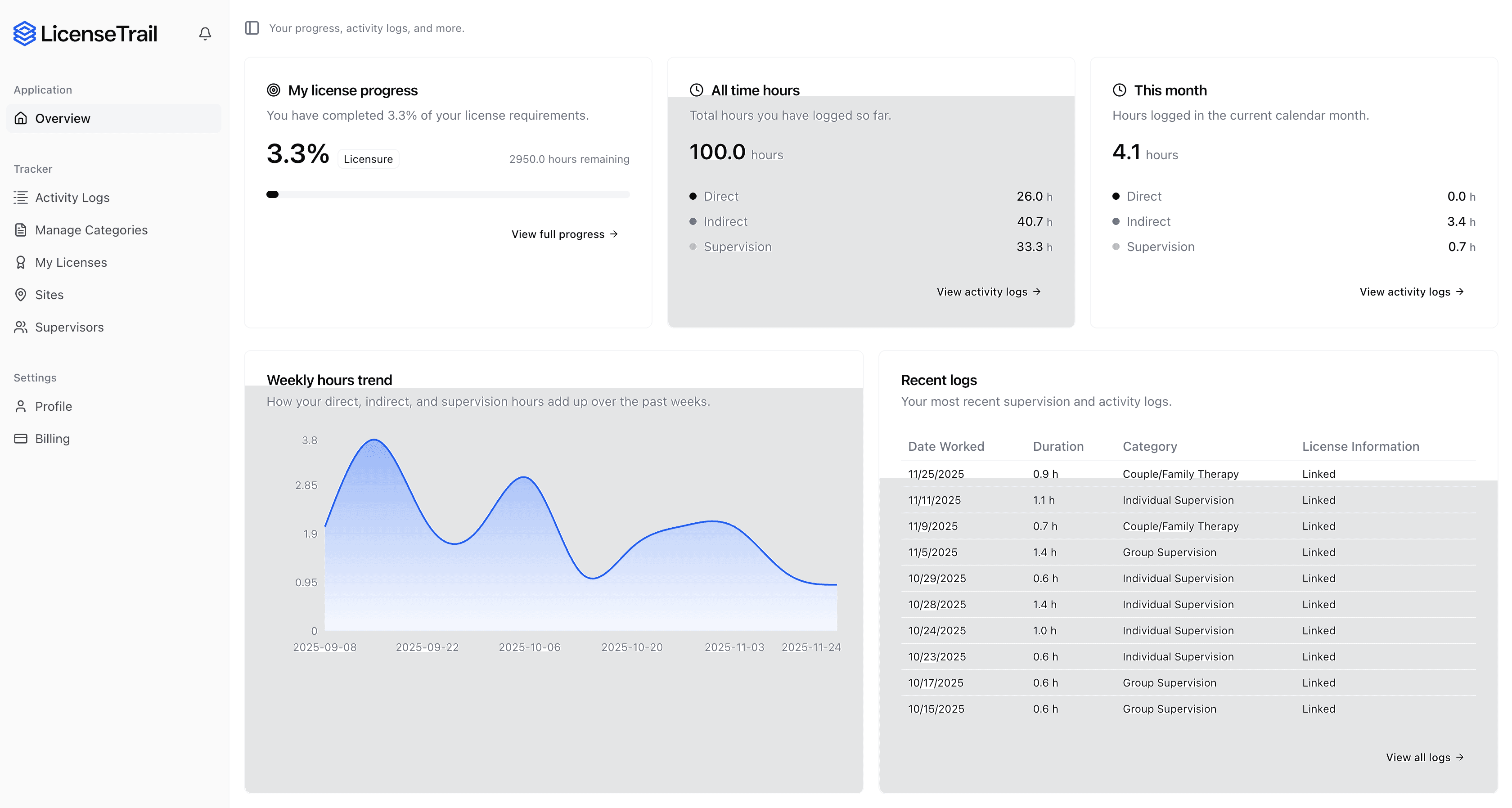 Start Tracking for Free
No credit card required · Free plan available
Related Licenses
Is your spreadsheet hiding Utah CPP risks?
Stop guessing if your categories match Utah Psychologist Licensing Board requirements. License Trail checks your direct, indirect, and supervision hours continuously and flags mismatches before you submit.
Import or log
Bring your spreadsheet or start fresh
Upload your existing tracking spreadsheet and we'll map every hour into the right Utah Psychologist Licensing Board categories automatically.
Verify against Utah
Catch mismatches before the board does
License Trail checks your direct, indirect, and supervision hours against Utah CPP requirements continuously.
Export board-ready
One-click clean reports
Generate professional, board-ready reports for supervision meetings and Utah Psychologist Licensing Board submissions in seconds.
No credit card required · Free plan available