
Utah LP Requirements: Hours, Exams & Step-by-Step Guide
Stop guessing if your categories match Utah requirements. License Trail checks your direct, indirect, and supervision hours against LP requirements continuously and flags mismatches before you submit.
No credit card required · Free plan available
Quick Requirements Overview
- Regulator: Utah DOPL / Psychologist Licensing Board (Title 58, Ch. 61)
- Education: Doctoral degree in psychology from an approved/substantially equivalent program
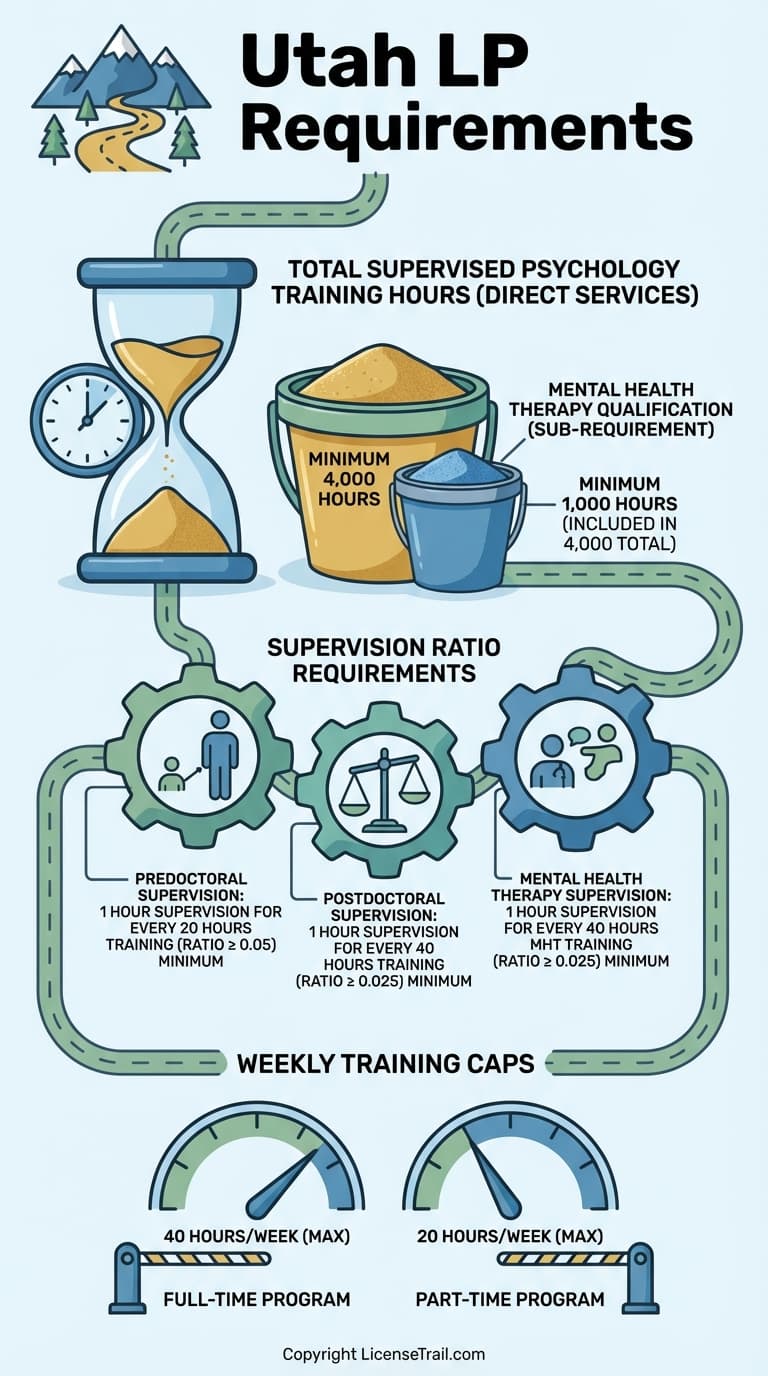
- Experience (core): 4,000 hours of supervised “psychology training” (practical, direct psychology/clinical services; excludes coursework, role-plays, billing/business/admin, non-psych activities)
- Timing/caps: Must take ≥ 2 years; complete within 4 years after doctorate (extensions possible); countable hours capped at 40 hrs/wk full-time or 20 hrs/wk part-time
- Pre- vs postdoc: Any portion may be predoctoral and/or postdoctoral; postdoc must be under Utah psychology resident certification/appropriate credentialing
- Supervision ratios: Predoc 1 hr supervision / 20 hrs training; Postdoc 1 / 40
- Supervisor eligibility: “Approved psychologist supervisor” = licensed psychologist in good standing + ≥ 4,000 practice hours over ≥ 2 years
- Mental Health Therapy qualification (optional): Within the 4,000 hours, document ≥ 1,000 supervised mental health therapy hours (after master’s level education) with 1 hr supervision / 40 hrs under direct psychologist supervision; Exams: EPPP + Utah Law & Ethics (≥75%)
License Details
Procedures
Utah’s psychologist license (often abbreviated “LP” for “licensed psychologist”) is regulated by the Utah Division of Occupational and Professional Licensing (DOPL) under the Psychologist Licensing Act and the Psychologist Licensing Board. The core of Utah’s model is a single doctoral-level “psychologist” license, with an optional qualification to practice “mental health therapy.”
Below is a structured guide to the current requirements, with emphasis on the types of hours, how they are defined, and how Utah actually uses terms like “psychology training,” “mental health therapy,” and “supervision.”
1. License type and basic framework
- Title of license: “Psychologist” under the Psychologist Licensing Act (Title 58, Chapter 61). This is the license typically referred to as “LP” in practice settings.
- Regulator: Utah Division of Occupational and Professional Licensing (DOPL), Psychologist Licensing Board. (codes.findlaw.com)
- Two key variants:
- Psychologist (not necessarily qualified for mental health therapy); and
- Psychologist qualified to engage in the practice of mental health therapy (what most clinicians want, because it allows diagnosis, treatment planning, and psychotherapy). (codes.findlaw.com)
The supervised experience rules are written to cover both, with additional requirements if you want the mental health therapy qualification.
2. Education requirement (high level)
Utah requires:
- A doctoral degree in psychology from a program that meets standards set by rule (e.g., APA or ASPPB/National Register–designated, or substantially equivalent). (codes.findlaw.com)
The specifics of coursework and program designation are detailed in R156‑61‑302a and 58‑61‑304(1)(c), but they do not affect the hour counts directly, so they’re not detailed here.
3. Core supervised experience requirement
3.1 Total hours
Utah uses a single total-hour requirement of 4,000 hours of “psychology training”:
- The statute requires “a minimum of 4,000 hours of psychology training” under supervision of an approved psychologist supervisor. (codes.findlaw.com)
- The rule echoes this and states that to qualify for licensure as a psychologist (with or without mental health therapy qualification) you must “complete at least 4,000 hours of psychology training approved by the Division in collaboration with the Board.” (regulations.justia.com)
Utah does not divide this into something like “1,500 direct service + 1,500 supervised experience” the way some states do. Instead, all 4,000 hours must be counted as “psychology training,” and supervision hours are embedded via specified ratios (see below).
3.2 What “psychology training” means
The Board explicitly defines “psychology training” in rule. In substance, it means:
- Practical training that provides direct services in the practice of mental health therapy and psychology under supervision.
- Activities that are not directly related to the practice of psychology do not count toward the 4,000 hours. Examples the rule gives as not counting include:
- Psychology coursework
- Role‑plays or other “analog” clinical exercises
- Activities done for business purposes (e.g., billing)
- Supervising people in non‑psychology activities (e.g., supervising adolescents in wilderness programs)
- Teaching psychology that is not of a professional/clinical nature (rules.utah.gov)
This is the key “verbiage” of the Board around what kinds of hours qualify. In practice, your 4,000 hours must be spent doing actual psychological and mental health services under supervision, not academic or administrative tasks.
4. Structure and timing of the 4,000 hours
4.1 Predoctoral vs postdoctoral
Utah allows substantial flexibility in when hours are accrued:
- You may accrue any portion of the 4,000 hours in a predoctoral program (practicum/internship) and/or postdoctoral residency. (law.cornell.edu)
- Postdoctoral supervised clinical work must be done when you are certified as a psychology resident in Utah or otherwise properly credentialed. (law.cornell.edu)
In contrast to some states, Utah does not set a fixed split (e.g., “2,000 predoctoral + 2,000 postdoctoral”). The only hard requirement is the overall 4,000 hours that meet the definitions and supervision standards.
4.2 Timeframe requirements
The experience rule requires that the 4,000 hours of psychology training:
- Take at least two years to complete; and
- Be completed within four years after the doctoral degree is awarded, unless DOPL and the Board approve an extension for extenuating circumstances. (law.cornell.edu)
The time clock is tied to the doctoral graduation date as reflected on your official transcript.
4.3 Weekly hour limits
For training to count toward the 4,000 hours, it must occur as part of a “supervised psychology training program” that does not exceed:
- 40 hours per week for full‑time internships or postdoctoral positions; or
- 20 hours per week for part‑time internships or postdoctoral positions. (law.cornell.edu)
If you work more than those caps, the extra hours do not count toward the 4,000.
5. Supervision requirements (how the “supervised experience” portion works)
Utah handles supervision via ratios, not a separate “supervision‑only hour” requirement.
5.1 Predoctoral supervision ratio
For hours earned while you are still a doctoral student (practicum/internship):
- You must receive at least 1 hour of supervision for every 20 hours of predoctoral training and experience. (law.cornell.edu)
This effectively means a minimum of 5% of your predoctoral training time is direct supervision.
5.2 Postdoctoral supervision ratio
For hours earned after the doctorate (postdoctoral residency):
- You must receive at least 1 hour of supervision for every 40 hours of postdoctoral training and experience. (law.cornell.edu)
So, for postdoc work, supervision must be at least 2.5% of your training hours.
5.3 Additional supervision rule for mental health therapy hours
When you seek the mental health therapy qualification on the psychologist license (see section 6), there is an extra supervision requirement for those specific hours:
- For the mental health therapy portion, the law requires “not less than one hour of supervision for each 40 hours of supervised training” in mental health therapy, under the direct supervision of a psychologist. (codes.findlaw.com)
In practice, this is usually satisfied by your internship and/or postdoctoral mental health therapy work under a licensed psychologist.
5.4 Who can supervise (approved psychologist supervisor)
To count under Utah’s rules, hours must be supervised by an “approved psychologist supervisor.” The Board defines this as someone who:
- Is currently licensed in good standing as a psychologist in the jurisdiction where the supervised training occurs; and
- Has practiced as a licensed psychologist for at least 4,000 hours over a period of not less than two years. (law.cornell.edu)
Any hours done under a supervisor who does not meet this standard cannot be counted toward the 4,000 psychology training hours. (regulations.justia.com)
The Board also details the duties of the supervisor, including being professionally responsible for your work, reviewing your records, ensuring legal/ethical practice, and supervising no more than three full‑time‑equivalent supervisees without specific approval. (law.cornell.edu)
6. Extra requirement to be qualified for “mental health therapy”
Utah separates being licensed as a psychologist from being qualified to practice “mental health therapy” under the Mental Health Professional Practice Act.
6.1 What “mental health therapy” means
The statute defines “practice of mental health therapy” as treatment or prevention of mental illness, including:
- Evaluating an individual’s mental health condition
- Establishing a diagnosis
- Prescribing a plan for prevention or treatment
- Conducting professional intervention including psychotherapy using generally recognized methods (law.justia.com)
6.2 Extra hour requirement
To be licensed as a psychologist qualified to engage in mental health therapy, you must document:
- At least 1,000 hours of supervised training in mental health therapy,
- Obtained after completion of a master’s level education in psychology,
- Which may be included within the same 4,000 hours of psychology training (i.e., they are not necessarily additional hours on top of the 4,000), and
- With at least 1 hour of supervision for every 40 hours of this mental health therapy training, under the direct supervision of a psychologist. (codes.findlaw.com)
So the basic breakdown, if you want the mental health therapy qualification, is:
- 4,000 total hours of psychology training,
- Of which at least 1,000 hours must be mental health therapy,
- All meeting the relevant supervision ratios and definitions.
Again, Utah does not split this as “1,500 direct therapy + 1,500 other supervised experience.” Instead, all qualifying hours are “psychology training” (direct clinical/psychological services), and then within that, 1,000 must specifically meet the mental health therapy definition.
7. Examinations
To become licensed, Utah requires passing two exams:
- EPPP (Examination for Professional Practice in Psychology) – the national licensing exam, in the two‑part format adopted by ASPPB, with a passing score at least at the ASPPB‑recommended cutoff. (law.cornell.edu)
- Utah Psychologist Law and Ethics Examination – a state‑specific exam on Utah law and ethics, with a required passing score of 75% or higher. (law.cornell.edu)
You are only admitted to these exams once you have met the prerequisites in 58‑61‑305 and have been authorized by DOPL. (law.cornell.edu)
8. Application process and documentation (brief)
The DOPL psychologist application portal and forms summarize the steps, which typically include: (dopl.utah.gov)
- Submit application for psychologist licensure (online or paper) and pay required fees.
- Provide official transcripts documenting your doctoral degree in psychology.
- Document your 4,000 hours of psychology training, including:
- Settings and dates (practicum, internship, postdoc)
- Role and activities (showing they meet the “psychology training” definition)
- Supervision documentation and supervisor qualifications
- If seeking mental health therapy qualification, specifically document:
- The 1,000+ hours of mental health therapy training after master’s level completion
- The required supervision ratio and that the supervisor was a qualified psychologist
- Complete fingerprint‑based criminal background check per DOPL instructions. (dopl.utah.gov)
- Obtain DOPL approval, take and pass the EPPP and Utah Law & Ethics Exam.
- On successful completion of all requirements, DOPL issues the psychologist license, with or without the mental health therapy qualification depending on what you documented.
9. Out‑of‑state and non‑traditional paths (high‑level note)
For applicants licensed elsewhere:
- Utah allows licensure by endorsement if your original state’s education, supervised experience, and exams were substantially equivalent to Utah’s requirements at the time you were licensed, and you can show at least 2,000 hours / one year of active practice. (codes.findlaw.com)
For all applicants, Utah may accept supervised training completed outside Utah as long as you can show it is equivalent to Utah’s training requirements in both content and supervision (e.g., supervisor qualifications, supervision ratios). (regulations.justia.com)
10. Summary of hours in Utah terms
Putting the hour requirements into the exact conceptual buckets Utah uses:
- 4,000 hours of “psychology training” – defined as supervised, practical training that provides direct services in psychology and mental health therapy, excluding coursework, billing, role‑plays, etc. (rules.utah.gov)
- These 4,000 hours must:
- Be spread over at least 2 years and no more than 4 years after the doctoral degree.
- Occur while you are in an approved doctoral program or licensed as a certified psychology resident.
- Be supervised by an approved psychologist supervisor (licensed psychologist, 4,000+ hours of practice over at least 2 years).
- Stay within 40 hrs/week full‑time or 20 hrs/week part‑time training caps.
- Include supervision at 1:20 (pre‑doc) and 1:40 (post‑doc) minimum ratios.
- If you want the mental health therapy qualification:
- Within those 4,000 hours, at least 1,000 hours must be mental health therapy (assessment, diagnosis, treatment planning, psychotherapy, etc., as defined in statute), obtained after master’s level education in psychology, with 1:40 supervision by a psychologist. (codes.findlaw.com)
Utah’s system is built around these definitions and ratios, rather than a simple “X hours direct + Y hours supervised” split. Understanding the Board’s language about “psychology training,” “practice of mental health therapy,” and supervision ratios is crucial when planning or documenting your experience for LP psychologist licensure in Utah.
Track your LP hours with confidence
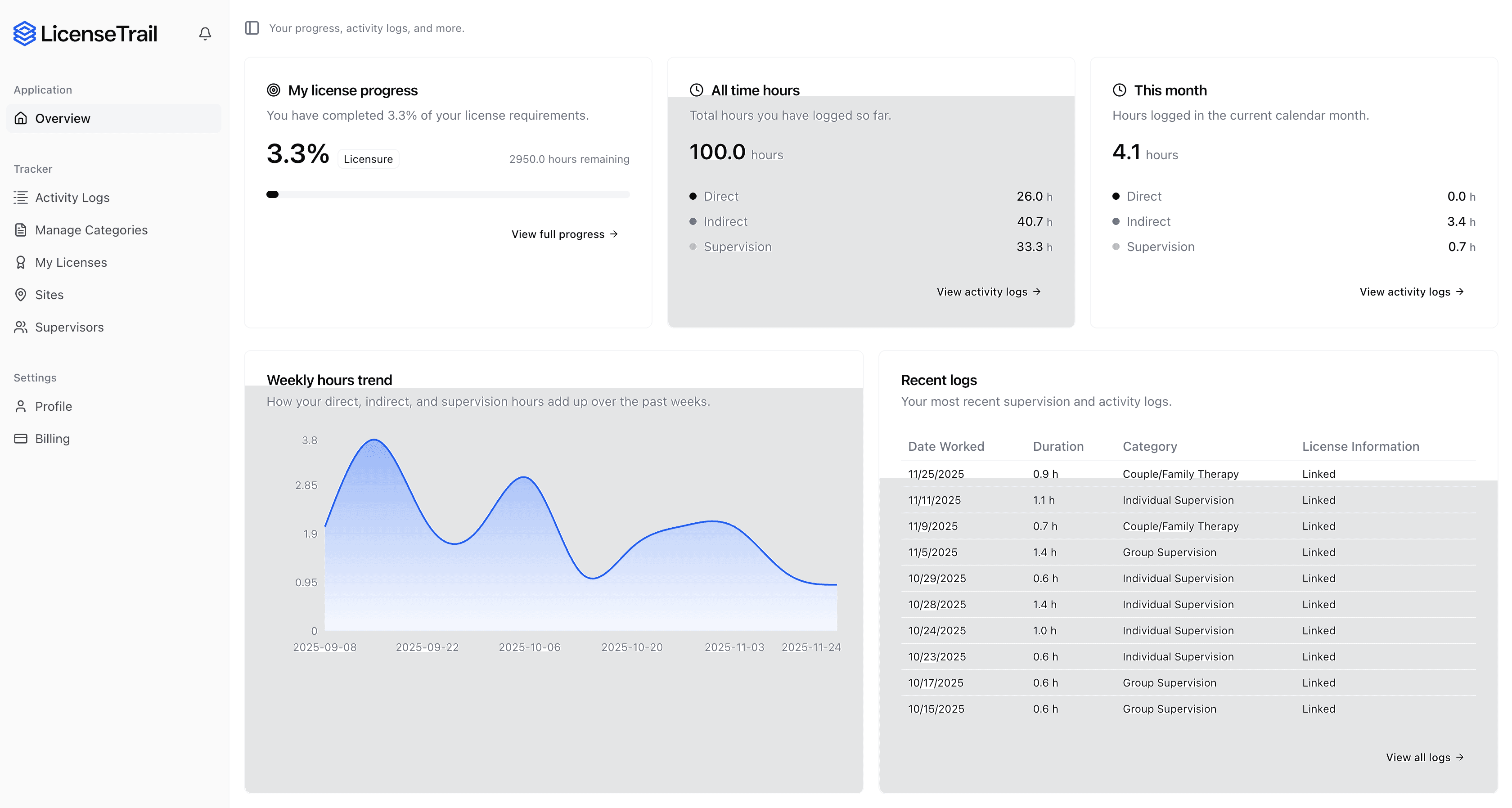
License Trail checks your direct, indirect, and supervision hours against Utah LP requirements continuously and flags mismatches before you submit.
 Start Tracking for Free
No credit card required · Free plan available
Is your spreadsheet hiding Utah LP risks?
Stop guessing if your categories match Utah Psychologist Licensing Board requirements. License Trail checks your direct, indirect, and supervision hours continuously and flags mismatches before you submit.
Import or log
Bring your spreadsheet or start fresh
Upload your existing tracking spreadsheet and we'll map every hour into the right Utah Psychologist Licensing Board categories automatically.
Verify against Utah
Catch mismatches before the board does
License Trail checks your direct, indirect, and supervision hours against Utah LP requirements continuously.
Export board-ready
One-click clean reports
Generate professional, board-ready reports for supervision meetings and Utah Psychologist Licensing Board submissions in seconds.
No credit card required · Free plan available