
Utah LSPP Requirements: Hours, Exams & Step-by-Step Guide
Stop guessing if your categories match Utah requirements. License Trail checks your direct, indirect, and supervision hours against LSPP requirements continuously and flags mismatches before you submit.
No credit card required · Free plan available
Quick Requirements Overview
- Degree: Master’s (or equivalent approved program) in school psychology with 60 semester / 90 quarter hours (accredited institution)
- Program content: Must document required school psychology training domains (assessment/intervention, ethics/law, consultation, etc.) via transcripts/program description
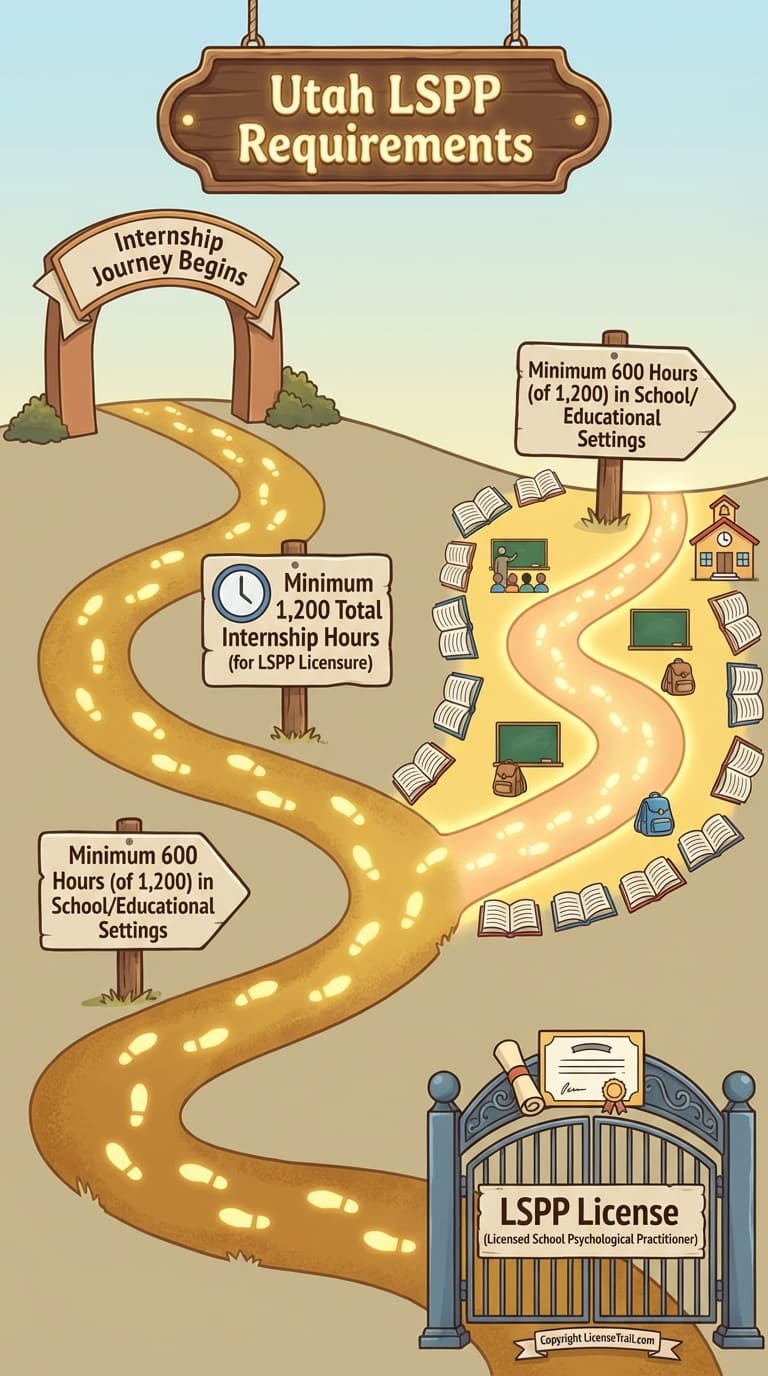
- Internship: 1 school-year (or equivalent) school psychology internship totaling 1,200 clock hours
- Internship setting: Of the 1,200 hours, ≥600 hours must be in a school/educational setting
- Experience: 5 years of successful experience as a school psychologist in Utah (post-internship)
- Recommendations: Letters from (1) training institution and (2) one or more Utah LEAs employing applicant during the 5 years
- Exam: No separate LSPP exam specified in statute/rules or DOPL checklist
- CE (after licensure): 48 CE hours / 2-year cycle, including ≥6 hours ethics & law; maintain records 2 years post-cycle
License Details
Procedures
Licensure Requirements for Utah’s Licensed School Psychological Practitioner (LSPP)
Utah created the Licensed School Psychological Practitioner (LSPP) license in 2024 as a new classification under the Psychologist Licensing Act, overseen by the Utah Division of Professional Licensing (DOPL) and the Psychologist Licensing Board. (utahpta.org)
This license is designed for experienced school psychologists who want a state professional license (separate from the educator license issued by the Utah State Board of Education) with a defined, school-focused scope of practice.
Below is a step‑by‑step guide to what the Board and DOPL currently require, with emphasis on hours and experience.
1. Understand the Role and Scope of an LSPP
Under Utah Code § 58‑61‑308(3), an individual licensed as a licensed school psychological practitioner may:
- Provide services outside of a school setting if the services are:
- Provided in line with current NASP professional standards, and
- Related to:
- Academic, behavioral, and mental health support;
- Academic evaluation, assessment, and data analysis; or
- Consultation with educators or families. (law.justia.com)
However, the statute explicitly prohibits an LSPP from:
- Diagnosing,
- Practicing mental health therapy,
- Conducting psychological evaluations,
- Conducting neuropsychological assessments or evaluations. (law.justia.com)
The license is intentionally narrower than a psychologist license: it formalizes advanced school-based practice, but does not authorize independent mental health therapy or psychological diagnosis.
2. Educational Requirement: Master’s Degree / Equivalent in School Psychology
The foundational requirement is a master’s degree (or equivalent certification program) in school psychology that meets Utah Code § 58‑61‑304(7)(c). (law.justia.com)
The statute and DOPL specify:
-
Degree level and credit hours
- A master’s degree or equivalent certification program approved by the division.
- At least 60 semester hours or 90 quarter hours in school psychology from an accredited institution. (law.justia.com)
-
Required training content areas
Your program must include training in (paraphrased from statute): (law.justia.com)- How schools are organized, administered, and operated; roles of school personnel; curriculum development.
- Conducting psychological and psycho‑educational assessments and interventions across areas of exceptionality.
- Individual and group intervention and remediation, including consultation, behavioral methods, counseling, and primary prevention.
- Ethical, legal, and professional practice issues in school psychology.
- Social psychology topics such as interpersonal relations, communication, and consultation with students, parents, and professionals.
- Coordination and collaboration with community–school and multicultural programs, including related assessments.
- Test and measurement use and evaluation, developmental psychology, affective and cognitive processes, social and biological bases of behavior, personality, and psychopathology.
The Board will expect your transcripts and program description to clearly document that the 60/90‑hour program covers these domains.
3. Required Internship Hours in School Psychology
The LSPP license has a specific, hour‑based internship requirement written into statute. There is no split such as “X hours direct” and “Y hours supervised” like you might see for clinical psychology; instead, Utah uses a single clock‑hour requirement for school psychology internship.
Under Utah Code § 58‑61‑304(7)(d)(i), you must document: (law.justia.com)
- A one school‑year internship, or the equivalent, in school psychology.
- A minimum of 1,200 clock hours in school psychology.
- Of those 1,200 clock hours, at least 600 hours must be in a school setting or other setting with an educational component.
In practical terms:
- Clock hours = actual hours spent performing school psychology duties as an intern (assessment, consultation, intervention, meetings, etc.), not merely enrollment time.
- The law does not break these 1,200 hours into separate categories such as “direct client contact” vs. “indirect” or “supervised” hours. All 1,200 are considered internship (“school psychology”) hours, with the built‑in requirement that at least half (600) occur in a bona fide school/educational environment.
- “One school‑year internship, or equivalent” allows for:
- A traditional full‑time school year internship, or
- A structured equivalent (e.g., half‑time over two school years) as long as the 1,200 total hours and 600‑in‑school requirements are met.
DOPL’s LSPP application checklist summarizes this simply as “one‑year school internship as outlined in Utah Code § 58‑61‑304(7)(d)(i).” (dopl.utah.gov)
4. Post‑Internship Practice Experience: Five Years as a School Psychologist in Utah
In addition to the 1,200‑hour internship, Utah requires substantial post‑internship experience:
- You must show that you have “completed at least five years of successful experience as a school psychologist in the state.” (law.justia.com)
Important points about this requirement:
- The statute is phrased in years of “successful experience”, not in additional hours.
- The experience must be:
- As a school psychologist, and
- In Utah.
- DOPL’s site reiterates this as “Five years as a school psychologist in Utah” tied directly to § 58‑61‑304(7)(d)(ii). (dopl.utah.gov)
The law does not define this five‑year requirement in terms of a specific number of additional hours (e.g., 1,500 direct + 1,500 supervised). Instead, the two key quantitative elements for LSPP are:
- Internship – minimum 1,200 clock hours in school psychology, with at least 600 hours in a school/educational setting.
- Experience – five years of successful practice as a school psychologist in Utah (measured in years, not specified hours).
5. Recommendations Required by the Board
Utah Code § 58‑61‑304(7)(e) requires two sets of recommendations to support your application: (law.justia.com)
- Academic recommendation
- A recommendation from the institution where you completed the qualifying master’s/certification program in school psychology.
- Employer / LEA recommendation(s)
- A recommendation from one or more local education agencies (LEAs)—as defined in Utah Code § 53E‑1‑102—that employed you as a school psychologist for the required five‑year period.
DOPL’s application page reflects this as:
- “Recommendation letter from the institution that awarded the master’s degree,” and
- “Recommendation letter from one or more Utah education agencies … where employed as a school psychologist.” (dopl.utah.gov)
These letters function as the Board’s primary verification of both the quality of your training and the “successful” nature of your practice experience.
6. Application Process with the Utah Division of Professional Licensing
Putting the statutory elements together, an applicant for LSPP must do the following under Utah Code § 58‑61‑304(7) and DOPL’s published checklist: (law.justia.com)
-
Submit the LSPP application form
- Use the official School Psychological Practitioner Application provided by DOPL (paper/manual or in‑person as of the latest posting). (dopl.utah.gov)
-
Pay the required fee
- The amount is set “under Section 63J‑1‑504”; DOPL’s general fee schedule provides current dollar amounts (these can change, so check the latest schedule). (law.justia.com)
-
Provide official transcripts
- Documenting:
- A qualifying master’s (or equivalent) program in school psychology, and
- A minimum of 60 semester or 90 quarter hours in school psychology, including the required content areas. (law.justia.com)
- Documenting:
-
Document internship hours
- Evidence of a one‑school‑year (or equivalent) internship with 1,200 clock hours in school psychology, at least 600 hours in a school/educational setting. (law.justia.com)
-
Document five years of successful experience
- Employment history as a school psychologist in Utah, typically supported by:
- LEA HR documentation, and
- The required LEA recommendation letter(s). (law.justia.com)
- Employment history as a school psychologist in Utah, typically supported by:
-
Submit the required recommendations
- One from your graduate program institution.
- One or more from Utah LEAs that employed you as a school psychologist for the required five‑year period. (law.justia.com)
Is there a separate psychology board exam for LSPPs?
As of November 23, 2025:
- The Psychologist Licensing Act Rule’s examination section, R156‑61‑302c, describes exams only for psychologist licensure (EPPP and the Utah Psychologist Law and Ethics Exam). It does not reference a separate exam for LSPPs. (regulations.justia.com)
- Utah Code § 58‑61‑304(7), which sets LSPP qualifications, also does not include an examination requirement. (law.justia.com)
- DOPL’s LSPP application checklist lists degree, internship, five years of experience, and recommendations—but no license‑specific exam. (dopl.utah.gov)
That means the core quantitative hurdles for LSPP are the 1,200 internship clock hours and five years of successful school psychologist experience in Utah, not an additional psychologist‑style licensure exam through the Psychologist Licensing Board.
7. Continuing Education Requirements After Licensure
Once licensed, an LSPP is subject to the Psychologist Licensing Act Rule’s continuing education requirements in Utah Admin. Code R156‑61‑403. (regulations.justia.com)
Key CE provisions include:
-
Total hours per renewal cycle
- Every two‑year renewal cycle (starting October 1 of even‑numbered years), a licensed school psychological practitioner must complete at least 48 hours of continuing education. (regulations.justia.com)
-
Content and format
- CE must:
- Be clearly related to the practice of psychology/school psychology,
- Be delivered in a competent, organized manner by qualified presenters. (regulations.justia.com)
- Within the 48 hours:
- At least 6 hours must be in ethics and law. (regulations.justia.com)
- Up to 6 hours may be counted for clinical readings related to practice.
- Up to 18 hours may be online/distance courses with an exam and completion certificate from APA or state/provincial psych associations.
- Up to 6 hours may come from properly documented peer consultation/review or meetings. (regulations.justia.com)
- CE must:
-
Record‑keeping
- You must keep documentation sufficient to prove CE compliance for two years after the end of the renewal cycle. (regulations.justia.com)
8. Summary of “Hours” and Experience Requirements for LSPP
For clarity, the key quantitative requirements as currently defined by Utah statute, rule, and the DOPL application materials are:
-
Graduate education
- At least 60 semester hours / 90 quarter hours in a school psychology master’s or equivalent certification program, including specific content areas. (law.justia.com)
-
Internship
- Minimum 1,200 clock hours in school psychology internship.
- At least 600 of those hours must be in a school or other educational setting.
- Structured as one school‑year, or an equivalent arrangement that meets the hour and setting requirements. (law.justia.com)
-
Post‑degree experience
- Five years of successful experience as a school psychologist in Utah (measured in years, not additional specified hours). (law.justia.com)
-
Continuing education (after licensure)
- 48 CE hours every two years, including at least 6 hours in ethics and law, with specified caps on reading, distance learning, and peer consultation hours. (regulations.justia.com)
Unlike some psychologist licenses that explicitly separate “direct” vs. “supervised” hours (e.g., 1,500 direct and 1,500 supervised), Utah’s LSPP license is built around:
- A single quantified internship requirement (1,200 clock hours with a setting requirement), and
- A time‑based practice requirement (five years of successful school psychologist experience in Utah),
all within the framework of a NASP‑consistent, school‑focused scope of practice.
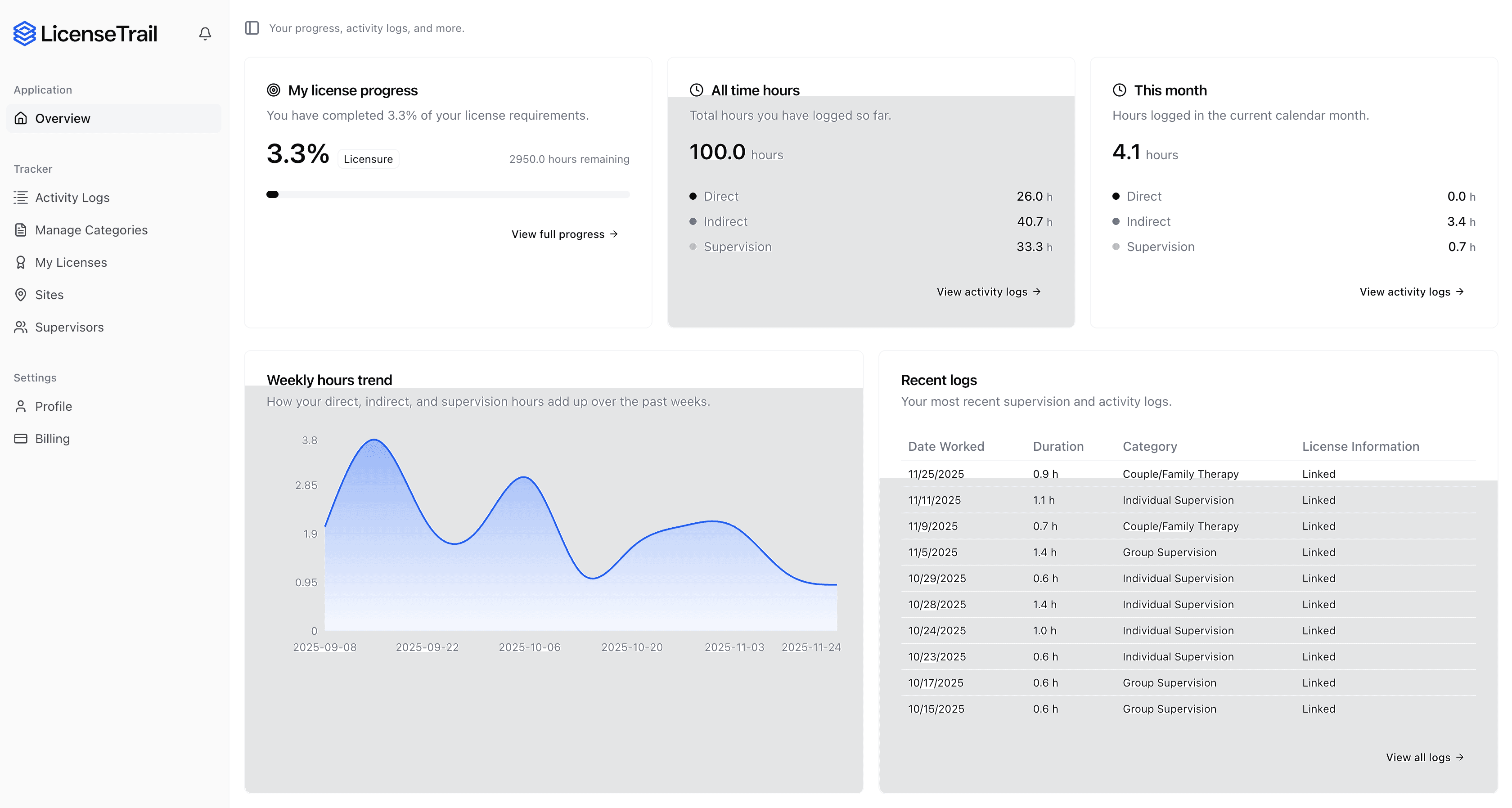
Track your LSPP hours with confidence
License Trail checks your direct, indirect, and supervision hours against Utah LSPP requirements continuously and flags mismatches before you submit.
 Start Tracking for Free
No credit card required · Free plan available
Related Licenses
Is your spreadsheet hiding Utah LSPP risks?
Stop guessing if your categories match Utah Psychologist Licensing Board requirements. License Trail checks your direct, indirect, and supervision hours continuously and flags mismatches before you submit.
Import or log
Bring your spreadsheet or start fresh
Upload your existing tracking spreadsheet and we'll map every hour into the right Utah Psychologist Licensing Board categories automatically.
Verify against Utah
Catch mismatches before the board does
License Trail checks your direct, indirect, and supervision hours against Utah LSPP requirements continuously.
Export board-ready
One-click clean reports
Generate professional, board-ready reports for supervision meetings and Utah Psychologist Licensing Board submissions in seconds.
No credit card required · Free plan available