
Vermont RNNC Requirements: Hours, Exams & Step-by-Step Guide
Stop guessing if your categories match Vermont requirements. License Trail checks your direct, indirect, and supervision hours against RNNC requirements continuously and flags mismatches before you submit.
No credit card required · Free plan available
Quick Requirements Overview
- Required if you practice “psychotherapy” in VT and are not otherwise licensed/certified (unless an exemption applies); must be entered on the RNNC roster before practicing.
- RNNC is a registration/roster status (not a license); do not represent yourself as “licensed,” “certified,” “clinical,” “registered,” or “State‑approved” based on roster status.
- Administered by VT OPR/Board of Allied Mental Health Practitioners; subject to discipline for unprofessional conduct.
- Eligibility: must meet the nonlicensed/noncertified definition and be ineligible if you have a suspended or permanently revoked allied mental‑health license in any jurisdiction.
- Fees/term: $95 initial entry; $175 biennial renewal; update OPR in writing within 30 days of any changes; renew every 2 years (reinstatement possible with penalties).
- Core requirement: provide and maintain a detailed client disclosure document (education, training, experience, scope/orientation, unprofessional‑conduct info, rules notice, complaint process); send dated versions to OPR when first used/when revised.
- Supervised hours toward CMHC/MFT licensure must be accrued while on RNNC; hours are not accepted if you weren’t rostered for the entire supervised‑practice period.
- CMHC/MFT supervised practice (for later licensure): 3,000 hours over ≥2 years; 2,000 direct service; 100 hours face‑to‑face supervision (≥50 individual) with a 1 hour supervision per ≤30 practice hours ratio (MFT: ≥50% of direct hours with couples/families).
License Details
Procedures
In Vermont, anyone who practices psychotherapy but does not yet hold a mental‑health license is generally required to be entered on the “Roster of Psychotherapists Who Are Nonlicensed and Noncertified,” administered by the Board of Allied Mental Health Practitioners through the Office of Professional Regulation (OPR). (legislature.vermont.gov)
This roster is not a license in itself. It is a registration status that allows you to lawfully practice psychotherapy (within your competence and scope) and, for many people, to accrue supervised hours toward a later license as a Clinical Mental Health Counselor (CMHC) or Marriage and Family Therapist (MFT).
Below is a structured guide focused on (1) how to get onto the roster, and (2) how the supervised‑practice hour requirements for CMHC and MFT licensure are defined, because those hours must be completed while you are on the roster.
1. How Vermont Defines a “Psychotherapist Who Is Nonlicensed and Noncertified”
Under 26 V.S.A. § 4082, a “psychotherapist who is nonlicensed and noncertified” is someone who practices psychotherapy but is not:
- a licensed psychologist,
- a licensed clinical social worker,
- a licensed clinical mental health counselor,
- a certified marriage and family therapist, or
- a psychoanalyst. (legislature.vermont.gov)
“Psychotherapy” is defined in statute as providing treatment, diagnosis, evaluation, or counseling services to individuals or groups, for a fee, for the purpose of alleviating mental disorders, using therapeutic techniques to work with motivation, conflicts, or behaviors, typically over a period of time (or in brief interventions). (legislature.vermont.gov)
If your work meets that definition and you do not already hold one of the listed licenses/certifications, Vermont law requires that you be on the roster before practicing — unless you fall under one of the detailed exemptions (for example, clergy acting within ministerial duties, certain Agency of Human Services employees, some body‑work or coaching roles, etc.). (legislature.vermont.gov)
2. The Nature of the RNNC Roster (Not a License)
Key statutory points:
- You may not practice psychotherapy unless you are entered on the Roster (or independently licensed). (legislature.vermont.gov)
- Being on the roster does not permit you to call yourself “licensed,” “certified,” “clinical,” “registered,” or “State‑approved,” nor to suggest State endorsement based solely on roster status. (legislature.vermont.gov)
- The Board can take disciplinary action (warnings, limitations, suspension, revocation, etc.) against rostered psychotherapists for unprofessional conduct, just as it can for licensees. (legislature.vermont.gov)
Think of the roster as:
- A legal gateway to practice psychotherapy without a license, and
- The mandatory status for accruing supervised hours toward CMHC or MFT licensure in Vermont. (regulations.justia.com)
3. Eligibility to Be Entered on the RNNC Roster
To be eligible:
- You must be a psychotherapist who is nonlicensed and noncertified, as defined above. (legislature.vermont.gov)
- You cannot have a suspended or revoked allied‑mental‑health license (psychologist, clinical social worker, CMHC, MFT, psychoanalyst, or other allied mental‑health practitioner) in Vermont or any other jurisdiction. If such a license has been suspended or permanently revoked, you are ineligible for roster entry. (legislature.vermont.gov)
- You must submit the required application, fee, and documentation to OPR/Board of Allied Mental Health. (law.cornell.edu)
There is no minimum number of clinical hours or years of experience required simply to be placed on the roster. The Board instead requires full disclosure of your education, training, and experience so consumers know exactly what background you do (and do not) have. (regulations.justia.com)
4. Fees and Renewal for the RNNC Roster
By statute, the current statutory fees for the roster are: (legislature.vermont.gov)
- Initial roster entry: $95
- Biennial roster re‑entry (renewal): $175
Additional process points:
- Entry procedure. A nonlicensed/noncertified psychotherapist must apply on the form provided by the Director (OPR), provide the information and professional data the Director requires, and submit the specified fee. (legislature.vermont.gov)
- Updates. Once on the roster, you must notify OPR in writing of changes in any previously provided information within 30 days of the change. (legislature.vermont.gov)
- Renewal. Entries are renewed every two years by submitting a new roster form with the renewal fee. (legislature.vermont.gov)
If a roster entry expires, you may apply for reinstatement and pay applicable penalty and renewal fees. (regulations.justia.com)
5. Mandatory Disclosure Document: The Core Substantive Requirement
The most substantive requirement for rostered psychotherapists is a detailed client disclosure document.
5.1 Board rules on disclosure
Under statute, the Board must require rostered psychotherapists to disclose their professional qualifications and experience, what counts as unprofessional conduct, and how clients can file complaints. (legislature.vermont.gov)
The Board’s administrative rules in Part 5 spell out what must be in your disclosure: (regulations.justia.com)
-
Formal education
- Institution name
- Dates attended
- Degrees awarded (if any)
-
Training (for each training program):
- Title of training
- Name/address of trainer or training institute
- Dates (start and end)
- Content of the program
- Credentials awarded (if any)
-
Experience in psychotherapy (for each practice setting):
- Description of the practice
- Location
- Dates (start and end)
- Whether practice was full‑time or part‑time
- Whether supervision or peer consultation occurs, and how often
-
Scope of practice:
- Therapeutic orientation
- Areas of specialization
- Treatment methods
-
Copy of statutory unprofessional‑conduct definitions (3 V.S.A. § 129a and 26 V.S.A. § 4093).
-
A specific statement that your practice is governed by the Rules of the Board of Allied Mental Health Practitioners and that it is unprofessional conduct to violate those rules, with a note that clients may obtain a copy of the rules from the Board or its website.
-
Information on how to file a complaint or make a consumer inquiry to the Board.
You must:
- Give clients disclosure consistent with the timing requirements that apply to all regulated professionals (generally, documentation of disclosure no later than the third visit). (regulations.justia.com)
- Send a dated copy of each version of your disclosure form to OPR when first used and whenever revised.
- Keep dated copies of all versions. (regulations.justia.com)
There is no Board‑mandated continuing education for rostered psychotherapists; the rules explicitly state that Vermont law does not require CE for psychotherapists, though the Board “encourages” ongoing education and reminds practitioners not to provide services beyond their education, training, capabilities, or scope. (regulations.justia.com)
6. Step‑by‑Step Path Onto the RNNC Roster
Putting the statutes and rules together, the practical steps are:
-
Determine whether your work is “psychotherapy.”
- Compare your job duties to the statutory psychotherapy definition (treatment/diagnosis/evaluation/counseling to alleviate mental disorders using psychotherapeutic techniques). (legislature.vermont.gov)
- Check whether you fall into an exemption (e.g., clergy, certain Agency of Human Services employees, some non‑clinical wellness/education roles). (legislature.vermont.gov)
-
Confirm you are eligible to be rostered.
- You must not already be licensed as a psychologist, clinical social worker, CMHC, MFT, psychoanalyst, or other allied mental‑health practitioner. (legislature.vermont.gov)
- You must not have a suspended or permanently revoked mental‑health license/registration/endorsement in any jurisdiction. (legislature.vermont.gov)
-
Draft your mandatory disclosure statement.
- Include the specific elements set out in Rule 5.4 (education, training, experience, scope, statutory unprofessional‑conduct language, rules‑governance statement, complaint process). (regulations.justia.com)
-
Apply online via the OPR Allied Mental Health portal.
- Use the “Roster of Non‑Licensed, Non‑Certified Psychotherapists” application within OPR’s Online Services System. (sos.vermont.gov)
- Upload or otherwise provide your disclosure form and any other supporting documentation requested. (regulations.justia.com)
- Pay the initial roster‑entry fee (currently $95 by statute). (legislature.vermont.gov)
-
Wait for OPR processing and maintain good standing.
- Processing times vary; you can monitor status through your online account. (sos.vermont.gov)
- Once entered, update information within 30 days of changes, keep your disclosure current, and renew every two years with the applicable fee. (legislature.vermont.gov)
7. How Supervised‑Practice Hours Interact with the RNNC Roster
The roster itself does not require you to complete a specific number of hours to get on it. However, if your goal is licensure as a Clinical Mental Health Counselor or Marriage and Family Therapist under the Board of Allied Mental Health Practitioners, the supervised‑practice hours you must complete are tightly defined and must be completed while you are on the roster.
7.1 Clinical Mental Health Counselor (CMHC) supervised‑practice hours
Under Board rules for CMHCs (Part 3 of the rules): (regulations.justia.com)
-
Total supervised practice required:
- 3,000 hours of post‑master’s supervised practice in clinical mental health counseling.
- These hours must be completed over no fewer than two years.
- Only hours earned within five years of the final licensure decision are counted.
-
Distribution of practice hours:
- 2,000 of the 3,000 hours must be “direct service.”
- The remaining 1,000 hours may be either continued clinical practice or “related services” (indirect work that supports clinical practice). (regulations.justia.com)
-
Definitions of “direct” and “indirect” (Board verbiage)
The rules define: (regulations.justia.com)- Direct service as time spent directly with the client or consulting with another professional about the client (including phone or emergency contact), essentially “being with the client or the client’s other service providers.”
- Indirect services as case notes, staff meetings, supervision, workshops, general consultation, case‑management activities, and other work related to counseling that is not direct client contact.
-
Supervision requirements:
- At least 100 hours of face‑to‑face supervision are required.
- No more than 30 hours of practice may occur without at least one hour of face‑to‑face supervision; this 1:30 ratio is mandatory.
- Of the 100 supervision hours, at least 50 must be individual (one‑to‑one) supervision; the rest may be in group settings (up to six supervisees per group). (regulations.justia.com)
-
Roster requirement for those hours:
- “No supervised practice may occur within the State of Vermont until the prospective licensee has been entered on the roster of nonlicensed and noncertified psychotherapists.” (regulations.justia.com)
- OPR’s own site reiterates that supervision hours will not be accepted if you were not on the roster for the entire time you were engaged in supervised practice. (sos.vermont.gov)
So for CMHC licensure the relevant breakdown is:
- 3,000 total post‑master’s supervised hours, at least 2,000 direct service and 1,000 related/indirect,
- 100 hours of face‑to‑face supervision (at least 50 individual), with no more than 30 practice hours per 1 hour of supervision,
- All accrued while you are on the RNNC roster.
7.2 Marriage and Family Therapist (MFT) supervised‑practice hours
For licensure as a Marriage and Family Therapist (Part 4 of the rules): (regulations.justia.com)
-
Total supervised practice required:
- 3,000 hours of post‑degree supervised practice “with individual, couple, family or group therapy from a systems perspective” over at least two years. (regulations.justia.com)
-
Distribution of practice hours:
- 2,000 hours must be direct service, and 50% of those direct hours must be with couples and/or families.
- The remaining 1,000 hours must be continued clinical practice or indirect services related to or supporting clinical services. (regulations.justia.com)
-
Supervision requirements:
- At least 100 hours of face‑to‑face supervision.
- Again, no more than 30 hours of practice without at least one hour of face‑to‑face supervision.
- At least 50 of the 100 supervision hours must be individual (one supervisor / one supervisee). (regulations.justia.com)
-
Roster requirement for those hours:
- “No supervised practice may occur within the State of Vermont until the prospective licensee has been entered on the Roster of Psychotherapists who are Nonlicensed and Noncertified.” (regulations.justia.com)
So for MFT licensure the relevant breakdown is:
- 3,000 total supervised hours over at least two years,
- 2,000 direct‑service hours, with at least 1,000 of those direct hours with couples and/or families,
- 1,000 hours of additional clinical or indirect services,
- 100 hours of face‑to‑face supervision, at least 50 individual,
- All hours earned while you are on the RNNC roster.
7.3 Additional hour requirement for reinstating a long‑lapsed CMHC license
One more place where the roster and hours intersect:
- If a CMHC license has lapsed for more than five years, and the person has not been practicing under another U.S. or Canadian license, the Board will not reinstate the license until the person has:
- Registered on the RNNC roster,
- Completed six months of supervised practice with at least 750 hours, under the same supervision standards used for pre‑licensure practice, and
- Passed the Vermont statutes and rules exam. (regulations.justia.com)
Again, the extra 750 supervised hours in that reinstatement scenario must be done while rostered.
8. No “1,500 + 1,500” Hour Split for the Roster Itself
Using your example: Vermont does not set a requirement such as “1,500 hours of direct experience and 1,500 hours of supervised experience” for entry on the RNNC roster.
Instead:
- Roster entry is based on your eligibility plus full disclosure of whatever education/training/experience you already have, along with payment of the initial entry fee. There is no minimum hour threshold in statute or the Part 5 rules for merely being rostered. (regulations.justia.com)
- Licensure as a CMHC or MFT then requires 3,000 hours of supervised practice with the specific distributions and supervision ratios described above, all completed while you are on the roster. (regulations.justia.com)
This summary reflects the current statutory and rule text available as of late 2025. It is informational only and not legal advice; for application‑specific questions, OPR or a Vermont attorney should be consulted.
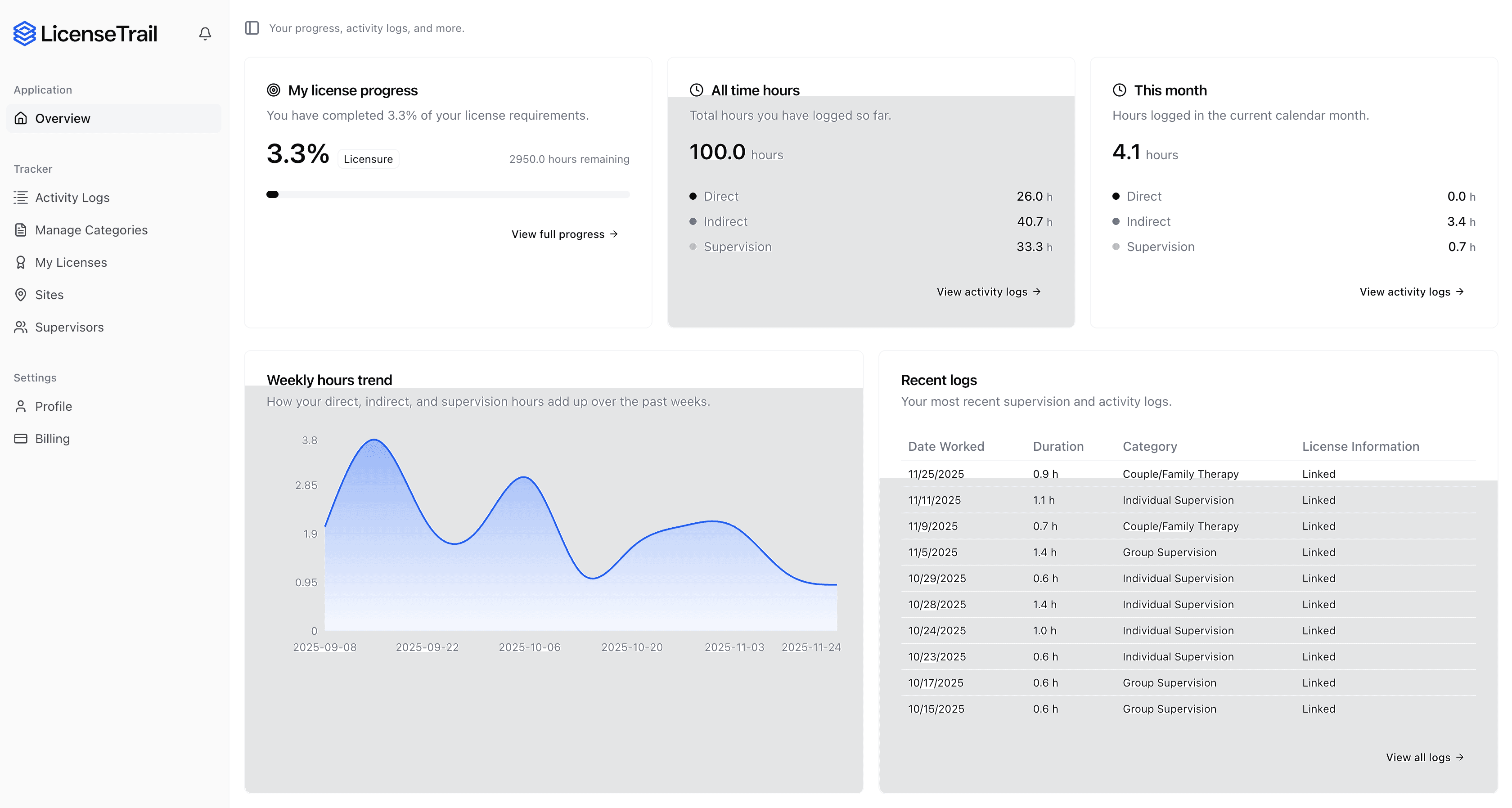
Track your RNNC hours with confidence
License Trail checks your direct, indirect, and supervision hours against Vermont RNNC requirements continuously and flags mismatches before you submit.
 Start Tracking for Free
No credit card required · Free plan available
Is your spreadsheet hiding Vermont RNNC risks?
Stop guessing if your categories match Vermont Board of Allied Mental Health Practitioners requirements. License Trail checks your direct, indirect, and supervision hours continuously and flags mismatches before you submit.
Import or log
Bring your spreadsheet or start fresh
Upload your existing tracking spreadsheet and we'll map every hour into the right Vermont Board of Allied Mental Health Practitioners categories automatically.
Verify against Vermont
Catch mismatches before the board does
License Trail checks your direct, indirect, and supervision hours against Vermont RNNC requirements continuously.
Export board-ready
One-click clean reports
Generate professional, board-ready reports for supervision meetings and Vermont Board of Allied Mental Health Practitioners submissions in seconds.
No credit card required · Free plan available