
Virginia Emeritus Requirements: Hours, Exams & Step-by-Step Guide
Stop guessing if your categories match Virginia requirements. License Trail checks your direct, indirect, and supervision hours against Emeritus requirements continuously and flags mismatches before you submit.
No credit card required · Free plan available
Quick Requirements Overview
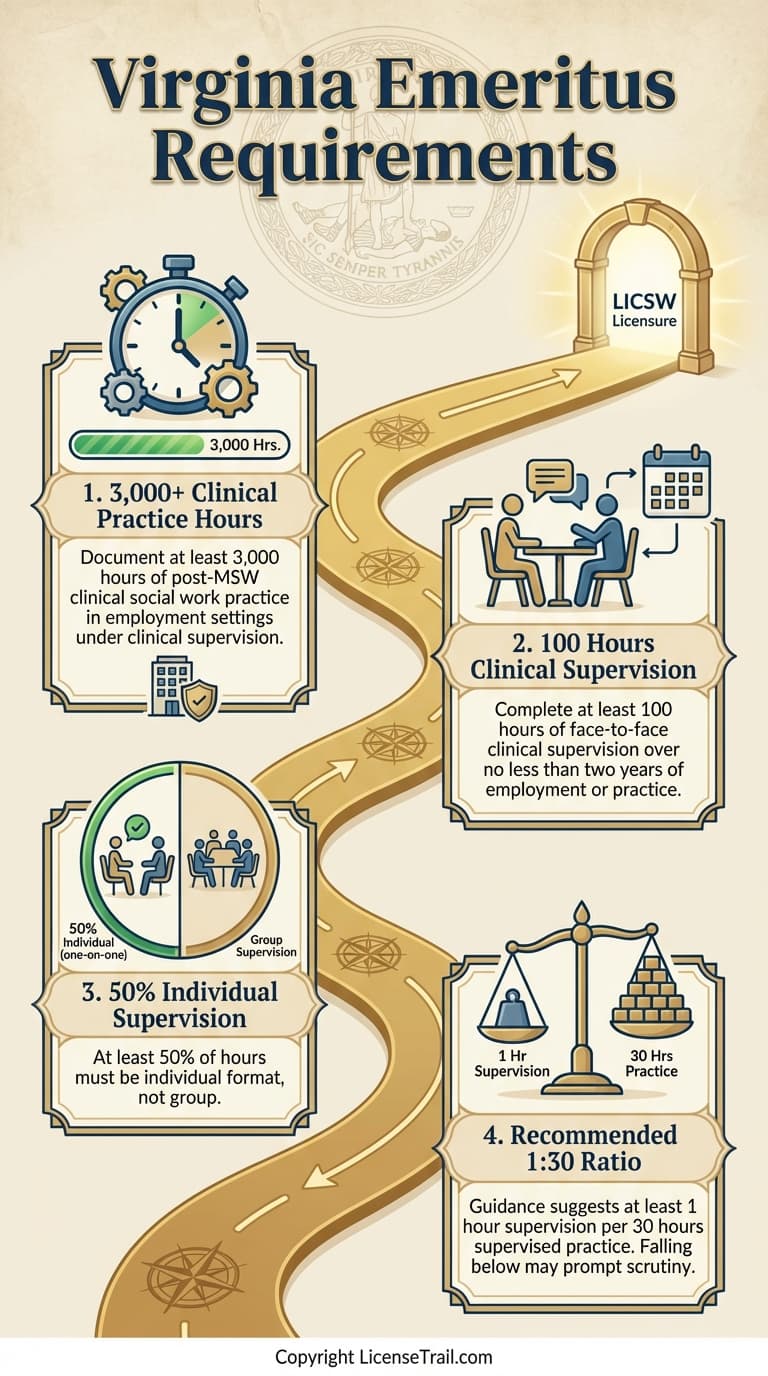
- Note: Provided source describes West Virginia (WV) emeritus status requirements (not VA)
- Must hold an active WV Regular Social Work license (LSW/LGSW/LCSW/LICSW) in good standing
- Must document 20+ years of social work practice experience (years, not hours)
- Must be retired from active/full-time practice (documentation required)
- Ineligible: Temporary and Provisional licensees
- Once approved, may practice (incl. supervision) up to 20 hours/week
- No continuing education (CE) required to maintain emeritus status; reduced renewal fee
- Apply via Board “Application for Special Status Privileges” with documentation; mail submission; Board issues written approval
License Details
Procedures
West Virginia’s Board of Social Work treats the Emeritus Status License as a special designation for long‑serving, now‑retired social workers who want to maintain a limited practice. It is not a new level of regular licensure (like LSW, LGSW, LCSW, LICSW), but a different status you move into once you meet specific criteria.
Below is what the Board and the state rules actually require, including the exact types of years/hours they specify.
1. How West Virginia Defines “Emeritus Status”
The West Virginia Code of State Rules gives a formal definition:
- “Emeritus status” is a social work license held by someone the Board has formally recognized as having more than twenty (20) years of social work practice and who is retired from the active practice of social work. (law.cornell.edu)
The Board’s own website restates this in plain language: emeritus status is for active regular licensed social workers in good standing who have retired from full‑time social work practice and have at least twenty years of social work experience. (wvsocialworkboard.org)
2. License Type: Who Can Hold Emeritus Status
West Virginia recognizes three broad license “types”: Regular License, Temporary Permit, and Provisional License. Emeritus is a special designation available only to regular licensees. (wvsocialworkboard.org)
To be eligible for an Emeritus Status License, you must:
-
Hold an active Regular License (Level A–D: LSW, LGSW, LCSW, or LICSW).
- The Board explicitly labels emeritus as “for Regular Licensees ONLY.” (wvsocialworkboard.org)
-
Be in good standing.
- The Board’s emeritus page specifies that it is for active regular licensed social workers in good standing. (wvsocialworkboard.org)
-
Have at least 20 years of social work practice experience.
- The rule requires documentation of twenty (20) years of social work practice experience. (law.cornell.edu)
-
Be retired from active/full‑time practice.
- The rule requires documentation of retirement from the active practice of social work, and the Board’s site describes this as retired from full‑time social work practice. (law.cornell.edu)
-
Not hold only a temporary or provisional license.
- The statute states that a provisional licensee is not eligible for an emeritus status license. (law.cornell.edu)
- The Board’s emeritus page adds: “Not available to Temporary Licensed Social Workers.” (wvsocialworkboard.org)
In other words, emeritus is something you move into after a career as a fully licensed (regular) social worker, not something you use to get into practice.
3. Experience and “Hours” Requirements
For emeritus status, West Virginia does not define the requirement in terms of a specific number of practice hours (such as “1,500 hours direct practice plus 1,500 supervised hours”).
Instead, the experience requirement is expressed as years:
- You must document twenty (20) years of social work practice experience. (law.cornell.edu)
There is no separate requirement for:
- A set number of supervised hours, or
- A breakdown of direct vs. indirect hours,
for the purpose of obtaining Emeritus Status.
The only “hours” figure tied directly to emeritus in the rule is a limit on how much you may practice once you hold the emeritus license, not a pre‑licensure accumulation requirement.
4. Practice Limits Once You Have Emeritus Status
After the Board approves you for emeritus status in writing:
- You may engage in active social work practice, including supervision, for up to twenty (20) hours per week. (law.cornell.edu)
Practically, that means:
- You can still see clients and provide services, but
- You must keep your total professional social work activity at or below 20 hours per week.
- You may continue to provide supervision within your prior license level’s scope (for example, an LICSW emeritus licensee can continue clinical supervision) so long as you respect the 20‑hours‑per‑week cap.
5. Continuing Education and Renewal Obligations
A significant benefit of emeritus status in West Virginia is reduced maintenance requirements compared with a regular license.
Continuing education
- Regular licensees (LSW, LGSW, LCSW, LICSW) must complete 30 hours of Board‑approved continuing education every two‑year license period. (wvsocialworkboard.org)
- Regular licensees with Emeritus status are not required to pursue continuing social work education. (wvsocialworkboard.org)
So once you are moved into emeritus status, there is no CE hour requirement to maintain that status.
Fees
- The Board states that emeritus licensees pay a reduced renewal fee compared to regular licensees. (wvsocialworkboard.org)
- The exact dollar amount is not listed on the emeritus page itself; it appears as part of the Board’s overall fee structure, which can change. Always confirm the current fee directly with the Board or in the most recent fee schedule.
6. Step‑by‑Step: How to Apply for Emeritus Status
Based on the Board’s rules and website, the application process can be understood as follows.
Step 1 – Confirm basic eligibility
Before you apply, make sure that:
- You currently hold an active regular West Virginia social work license (LSW, LGSW, LCSW, or LICSW). (wvsocialworkboard.org)
- Your license is in good standing (no unresolved discipline or restrictions that would block a status change). (wvsocialworkboard.org)
- You are retired from active/full‑time social work practice and intend to limit any ongoing practice to no more than 20 hours per week. (law.cornell.edu)
- You can document at least 20 years of social work practice experience. (law.cornell.edu)
Step 2 – Gather documentation
The rule requires documentation of twenty (20) years of social work practice experience and retirement from the active practice of social work. (law.cornell.edu)
In practice, this usually means collecting:
- Employment history (e.g., letters from employers, HR records, or other official statements) showing your roles and dates of employment in social work positions, adding up to at least 20 years.
- Evidence of retirement from active or full‑time practice (such as a retirement letter, HR notice, or a clear statement on the application that you are retired from full‑time practice).
Step 3 – Complete the Board’s application form
The Board instructs applicants to use a specific form:
- Download the “Application for Special Status Privileges” (this is the form used for emeritus and other special statuses) from the Emeritus Status License page. (wvsocialworkboard.org)
The form will require you to:
- Identify your current license level and number.
- Indicate the special status you are requesting (Emeritus Status License).
- Provide information or attach documentation supporting your 20+ years of practice and your retired status.
Step 4 – Submit the application to the Board
The Board requires that completed emeritus applications be mailed (not emailed) to:
WV Board of Social Work
PO Box 5459
Charleston, WV 25361 (wvsocialworkboard.org)
Include:
- Your completed Application for Special Status Privileges.
- Any supporting documentation (practice history, retirement documentation, any other items specified in the form).
- The required fee, if indicated on the form or in the Board’s fee schedule.
Step 5 – Wait for Board review and written approval
The rules state that once you have made a formal application and provided the required documentation, the Board considers your request. Upon approval:
- The Board will issue written approval of emeritus status. (law.cornell.edu)
- From that point forward, you hold an Emeritus Status License, are exempt from continuing education, and may practice (including supervision) up to twenty (20) hours per week under your emeritus license. (law.cornell.edu)
7. Summary of Key Requirements (Focused on Years/Hours)
For the Emeritus Status Social Work License under the West Virginia Board of Social Work:
- Baseline license: Must be a regular licensee (LSW, LGSW, LCSW, or LICSW) in good standing.
- Experience: Must document 20+ years of social work practice experience. This is measured in years, not in a specific number of hours. (law.cornell.edu)
- Retirement: Must be retired from the active or full‑time practice of social work. (law.cornell.edu)
- Ineligible license types: Provisional licensees and Temporary Permit holders cannot obtain emeritus status. (law.cornell.edu)
- Practice cap after approval: Once emeritus is granted, you may practice, including providing supervision, up to 20 hours per week. (law.cornell.edu)
- Continuing education: No CE hours are required for regular licensees with emeritus status. (wvsocialworkboard.org)
There is no requirement in the current rules that you complete a set number of direct practice hours or supervised hours specifically to qualify for emeritus status. The key quantitative thresholds are twenty (20) years of practice to qualify, and twenty (20) hours per week as the maximum practice allowed once emeritus is granted.
Track your Emeritus hours with confidence
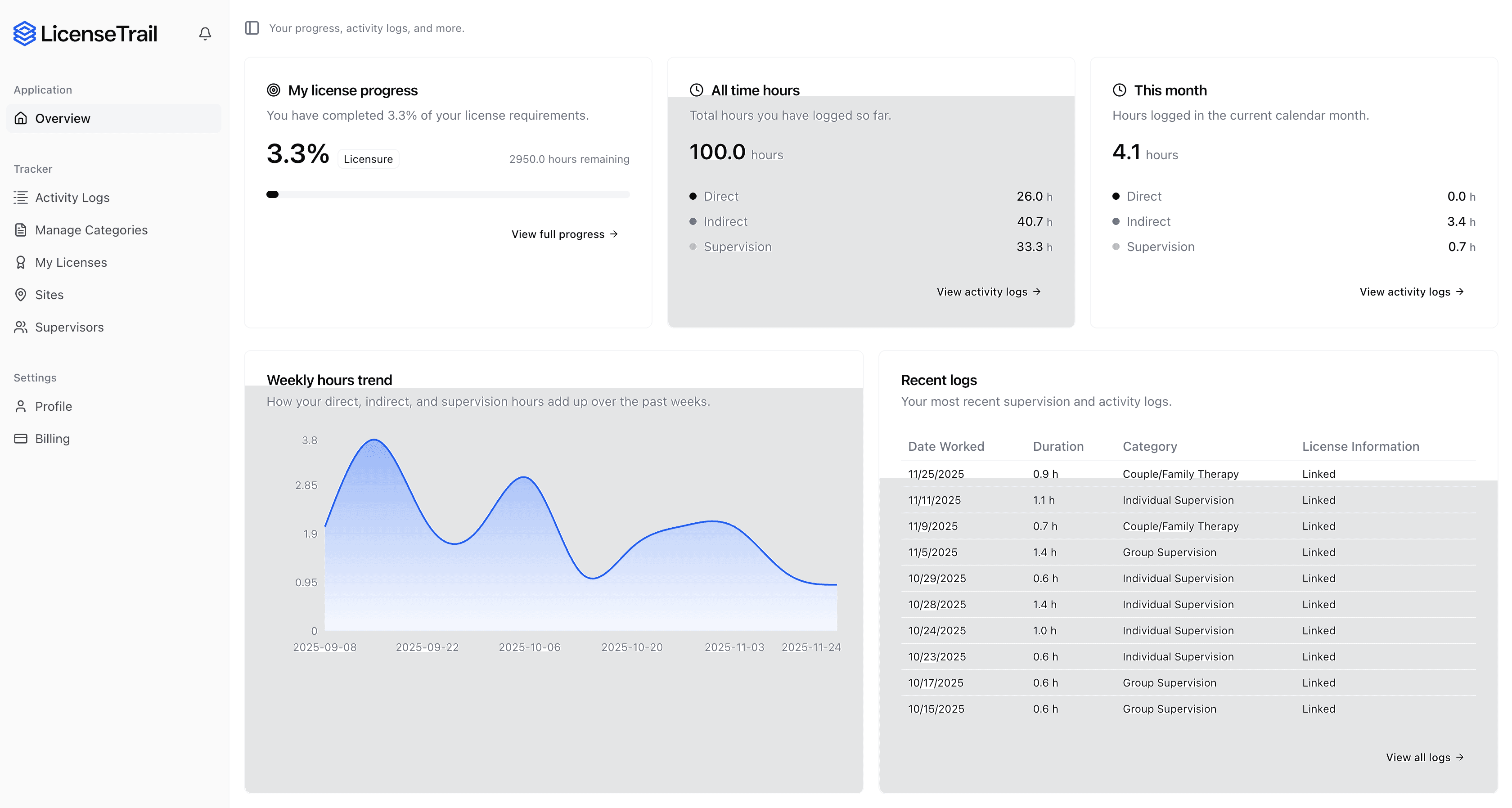
License Trail checks your direct, indirect, and supervision hours against Virginia Emeritus requirements continuously and flags mismatches before you submit.
 Start Tracking for Free
No credit card required · Free plan available
Is your spreadsheet hiding Virginia Emeritus risks?
Stop guessing if your categories match West Virginia Board of Social Work requirements. License Trail checks your direct, indirect, and supervision hours continuously and flags mismatches before you submit.
Import or log
Bring your spreadsheet or start fresh
Upload your existing tracking spreadsheet and we'll map every hour into the right West Virginia Board of Social Work categories automatically.
Verify against Virginia
Catch mismatches before the board does
License Trail checks your direct, indirect, and supervision hours against Virginia Emeritus requirements continuously.
Export board-ready
One-click clean reports
Generate professional, board-ready reports for supervision meetings and West Virginia Board of Social Work submissions in seconds.
No credit card required · Free plan available