
Virginia Inactive Requirements: Hours, Exams & Step-by-Step Guide
Stop guessing if your categories match Virginia requirements. License Trail checks your direct, indirect, and supervision hours against Inactive requirements continuously and flags mismatches before you submit.
No credit card required · Free plan available
Quick Requirements Overview
- Provided info is for West Virginia (WV) inactive status; Virginia (VA) requirements are not addressed in the text
- Inactive status is not a path to initial licensure; it’s a post-licensure status change for an existing regular license
- Eligibility: must hold a regular WV license (LSW/LGSW/LCSW/LICSW), be current/in good standing (renewed + CE completed); provisional/temporary licenses not eligible
- While inactive: no social work practice permitted in WV; no CE required; generally no ongoing renewal fees until reactivation
- How to go inactive: stop practicing in WV; submit Application for Special Status Privileges (inactive request) + required fee to the Board (mail)
- Reactivation: submit application marked reactivate, pay $90 activation fee (per fee rule), provide required sworn statement, then resume normal renewal/CE cycle
- Hours note: no extra practice/supervision hours to go inactive; hour requirements relate to the underlying license level (e.g., LICSW requires 3,000 clinical hours + 100 supervision hours before licensure)
License Details

Procedures
Inactive status for social work licensure in West Virginia is not a separate way to become licensed; it is a special status you can apply for after you already hold a regular (full) West Virginia social work license. The Board’s rules and website are quite specific about who can obtain inactive status, what it means, and which types of hours matter.
The information below reflects West Virginia law and Board rules in effect through mid‑2025.(regulations.justia.com)
1. How West Virginia defines “Inactive Status”
West Virginia law and Board rules treat inactive status as a formal status of an existing regular license:
- The Board’s definitions rule says that “inactive status” is a license status formally recognized by the Board after it approves an application to be inactive; during this time the licensee is barred from the practice of social work and exempt from continuing education provisions.(regulations.justia.com)
- The qualifications rule adds that, once approved as inactive, the inactive licensee “shall not perform the duties of a social worker” and is exempt from earning continuing education while inactive.(law.cornell.edu)
- The West Virginia Code states that a person on inactive status “may not practice social work in this state” and is not subject to ongoing fees while inactive, until they seek to return to practice.(code.wvlegislature.gov)
So, in Board language, an inactive social work license is:
a formally recognized license status where you cannot practice social work and do not have to earn continuing education while the license is inactive.(regulations.justia.com)
2. Who can get an Inactive Status License
The West Virginia Board of Social Work’s Inactive Status page makes three core points:
-
Only regular licensees qualify.
The Board states that “Inactive License Status (for Regular Licensees ONLY)” applies to those with a regular license. Provisional licensees and temporary permit holders are not eligible.(wvsocialworkboard.org) -
You must be “actively licensed” and in good standing.
The Board explains that eligible applicants are those who:- Have a regular license, and
- Are actively licensed social workers in good standing.
It further explains that an “actively licensed” social worker is one whose license has not expired and who has submitted the renewal application and accrued required continuing education before the expiration date.(wvsocialworkboard.org)
-
You must have stopped practicing in West Virginia.
The Board’s overview says inactive status applies to licensees who have ceased the practice of social work in West Virginia for an undetermined period of time, and that applying for inactive status protects the active license from expiration and loss.(wvsocialworkboard.org)
In short, you can apply for inactive status only if:
- You already hold a Regular License (LSW, LGSW, LCSW, or LICSW) in West Virginia,
- Your license is current, renewed, and in good standing, and
- You have stopped practicing social work in West Virginia.
3. License and hour requirements that matter before you can go inactive
There are no extra practice or supervision hours required solely to place a license on inactive status. Instead, West Virginia looks at:
- The hours/experience you already completed to earn your regular license level, and
- The continuing education (CE) hours you have earned to keep that regular license active up to the date you request inactive status.
3.1 Regular license levels and experience / supervision hours
West Virginia’s Regular License has four levels (A–D). The Board summarizes them with education, post‑graduate experience, supervision requirement, and exam level.(wvsocialworkboard.org)
Level A – Licensed Social Worker (LSW)
- Degree: CSWE‑accredited BSW
- Post‑grad experience hours: None required
- Supervision hours: None required
- Exam: ASWB Bachelors exam
Level B – Licensed Graduate Social Worker (LGSW)
- Degree: CSWE‑accredited MSW
- Post‑grad experience hours: None required
- Supervision hours: None required
- Exam: ASWB Masters exam
Level C – Licensed Certified Social Worker (LCSW)
- Degree: CSWE‑accredited MSW
- Post‑grad experience: 2 years of post‑MSW social work experience (the rule focuses on duration rather than total clock‑hours).(wvsocialworkboard.org)
- Supervision hours: None specifically required for this level (unlike clinical licensure).
- Exam: ASWB Advanced Generalist
Level D – Licensed Independent Clinical Social Worker (LICSW)
This is where specific clinical practice hours and supervision hours are clearly spelled out.
From the Board’s summary and the detailed rule:(wvsocialworkboard.org)
- Degree: CSWE‑accredited MSW
- Post‑grad clinical experience: At least two years of clinical practice, which by rule is tied to 3,000 hours of full‑ or part‑time clinical social work employment.
- Supervision hours:
- 100 hours of clinical supervision minimum.
- Those 100 hours must be completed over at least two years of full‑time employment or 3,000 hours of full‑ or part‑time employment.
- The rule requires at least one hour of supervision for each 30 hours of supervised practice, and at least 50% of the supervision must be individual (not group).
- Supervision must be face‑to‑face, but the rule permits face‑to‑face supervision via HIPAA‑compliant technology.(law.cornell.edu)
So, using your example format, for the LICSW in West Virginia the hour‑based requirements effectively are:
- 3,000 hours of supervised clinical employment/practice, and
- 100 hours of clinical supervision, with a minimum ratio of 1 supervision hour per 30 practice hours, at least half of it individual supervision.
These hours are completed before you can be licensed as an LICSW. Once you hold that regular license (or any other regular level) and keep it in good standing, you can later request inactive status.
3.2 Continuing education (CE) hours while the license is active
The Board’s CE rules and website set out clear CE hour requirements for active regular licensees:(wvsocialworkboard.org)
- 30 contact hours of Board‑approved continuing social work education in each two‑year licensing period for all regular licensees (LSW, LGSW, LCSW, LICSW).
- Within those 30 hours:
- At least 20 hours must be Category I (formally organized activities from Board‑approved providers).
- At least 10 of the 20 Category I hours must be face‑to‑face or synchronous (in‑person or real‑time online).
- Up to 10 hours may be Category II (Individual Professional Activities, e.g., reading, non‑approved workshops, self‑directed study) as defined by the Board.(wvsocialworkboard.org)
- At least 1 hour must be specifically in social work ethics.(wvsocialworkboard.org)
- At least 2 hours must address mental health conditions specific to veterans and their family members.(regulations.justia.com)
To be considered “actively licensed” and in good standing at renewal, you must have completed and reported these CE hours.
These CE hours are relevant to inactive status because:
- You must have earned and reported CE up to the date of expiration to remain “actively licensed” when you apply for inactive status.(wvsocialworkboard.org)
- Once your license is on inactive status, the rules explicitly state that inactive licensees are not required to earn continuing education hours.(law.cornell.edu)
4. Step‑by‑step: How to place a West Virginia social work license on Inactive Status
Step 1 – Hold an eligible, active Regular License
You must:
- Hold a Regular License at level LSW, LGSW, LCSW, or LICSW.(wvsocialworkboard.org)
- Have a license that is current (not delinquent or expired).
- Have completed the required CE hours for your current two‑year period and submitted your renewal appropriately.(wvsocialworkboard.org)
Provisional licensees and temporary permit holders cannot apply for inactive or emeritus status.(law.cornell.edu)
Step 2 – Decide to cease practice in West Virginia
Inactive status is intended for licensees who have stopped practicing social work in West Virginia for an unknown length of time. The Board explicitly notes that inactive status:
- Applies to licensees who have ceased practice in West Virginia for an undetermined period, and
- Protects the active license from expiration and loss while you are not practicing.(wvsocialworkboard.org)
Step 3 – Submit the Inactive Status application and fee
The Board instructs applicants to:(wvsocialworkboard.org)
-
Download and complete the “Application for Special Status Privileges” (this is used for both inactive and emeritus requests).
-
Indicate that you are requesting Inactive Status.
-
Mail the completed application to:
West Virginia Board of Social Work
PO Box 5459
Charleston, WV 25361 -
Include the required fee. The specific fee amount is set by the Board’s fee schedule rule; the rule currently specifies $90 to activate a biennial inactive regular status license when returning to active status, and other sections set the application/renewal fees for regular licenses.(regulations.justia.com)
The Board notes that once it receives your completed application, you should receive a written response within 10 business days.(wvsocialworkboard.org)
Step 4 – Await Board approval and status change
After review:
- If approved, your license is formally placed on Inactive Status.
- From that point, you are considered an inactive licensee under both the statute and the legislative rules.(code.wvlegislature.gov)
5. What happens to hours and obligations while your license is inactive
Once your license is on inactive status, three key things change:
-
You may not practice social work.
- The statute states that a person on inactive status “may not practice social work in this state.”(code.wvlegislature.gov)
- The Board’s rule adds that an inactive licensee “shall not perform the duties of a social worker.”(law.cornell.edu)
-
You are exempt from continuing education requirements.
- The definitions and qualifications rules say that inactive status exempts the licensee from continuing education provisions.(regulations.justia.com)
- The dedicated CE rule echoes this: “An inactive, emeritus or temporary permit licensee is not required to earn continuing social work education contact hours.”(regulations.justia.com)
-
You are not subject to ongoing renewal fees while inactive.
- Under §30‑30‑21, once placed on inactive status, you are “not subject to the payment of any fee” until you seek to return to practice and apply for renewal.(code.wvlegislature.gov)
There are no practice‑hour or supervision‑hour requirements imposed during the inactive period itself. Your previously completed hours (clinical hours, supervision hours, and prior CE hours) are preserved along with your license status.
6. Reactivating an Inactive Status License and the role of hours
When you decide to resume practice:
6.1 Application and Board requirements
To reactivate, you must:(wvsocialworkboard.org)
- Download, complete, and submit the same Application for Special Status Privileges, this time indicating you wish to reactivate your inactive license.
- Enclose the reactivation fee (the current fee rule lists $90 for activation of a biennial inactive regular status license).(regulations.justia.com)
- Provide a sworn statement to the Board affirming that:
- You have never been convicted of a felony,
- You have not engaged in behavior constituting professional misconduct, and
- You intend to meet all requirements to maintain the license upon activation.(law.cornell.edu)
The Board then reviews your materials and, if satisfied, reactivates the license.
6.2 CE hours when returning from inactive status
The statute and rules specify that, when returning from inactive status, you must submit an application for renewal and applicable fees.(code.wvlegislature.gov) They also require that you meet “all requirements to maintain the license,” which includes the CE standards for regular license renewal.
In practical terms:
- You re‑enter the regular 30‑hour / 2‑year CE cycle for your regular license.(regulations.justia.com)
- Going forward, you must again earn:
- 30 CE hours every two years,
- At least 20 hours Category I (10 face‑to‑face/synchronous),
- Up to 10 hours Category II,
- Required ethics and veterans‑mental‑health content.(wvsocialworkboard.org)
The Board’s rules do not add new supervised‑practice or clinical‑hour requirements just because you were inactive. Your previously earned 3,000 clinical hours and 100 supervision hours for LICSW, or your 2 years of post‑MSW practice for LCSW, remain valid; you simply resume meeting CE and renewal requirements as an active licensee.
7. Summary of hour requirements connected to an Inactive Status License in West Virginia
To tie the hour‑based requirements together, as they relate to inactive status:
-
To qualify for a license that can later be placed on inactive status, you must first meet the regular licensure requirements:
- LSW or LGSW: Education + exam; no specific hour totals for post‑grad practice or supervision.(wvsocialworkboard.org)
- LCSW: MSW + 2 years of post‑MSW social work experience (no specified clock‑hour total).(wvsocialworkboard.org)
- LICSW: MSW + 3,000 hours of supervised clinical employment and 100 hours of clinical supervision, at roughly 1 supervision hour per 30 practice hours, at least half of it individual supervision, over no fewer than 2 years.(law.cornell.edu)
-
While your license is active, you must keep it in good standing by completing:
- 30 hours of CE every two years, including:
- 20 hours Category I (10 face‑to‑face/synchronous),
- Up to 10 hours Category II,
- At least 1 hour ethics and 2 hours on veterans‑related mental health.(wvsocialworkboard.org)
- 30 hours of CE every two years, including:
-
To place the license on inactive status, there are no new practice or supervision hour requirements. The key requirements are:
- Active, regular license in good standing, with CE completed up to your expiration date;
- Submission of the Application for Special Status Privileges and the applicable fee, after you have ceased practice in West Virginia.(wvsocialworkboard.org)
-
While inactive, you:
- Cannot practice social work in West Virginia,
- Do not have to earn CE hours,
- Are not subject to ongoing renewal fees until you reactivate.(code.wvlegislature.gov)
-
When reactivating, you:
- Submit the same application form marked for reactivation,
- Pay the activation fee (currently $90),
- Provide the required sworn statement, and
- Re‑enter the normal CE and renewal cycle applicable to your license level.(law.cornell.edu)
Taken together, “Inactive Status” in West Virginia is primarily a status change—not a new license category with its own hour requirements. The hour‑based requirements that matter are those for the underlying regular license (especially clinical and supervision hours for LICSW) and the continuing education hours required to keep that regular license in good standing up to the moment you choose to go inactive and when you later return to practice.
Track your Inactive hours with confidence
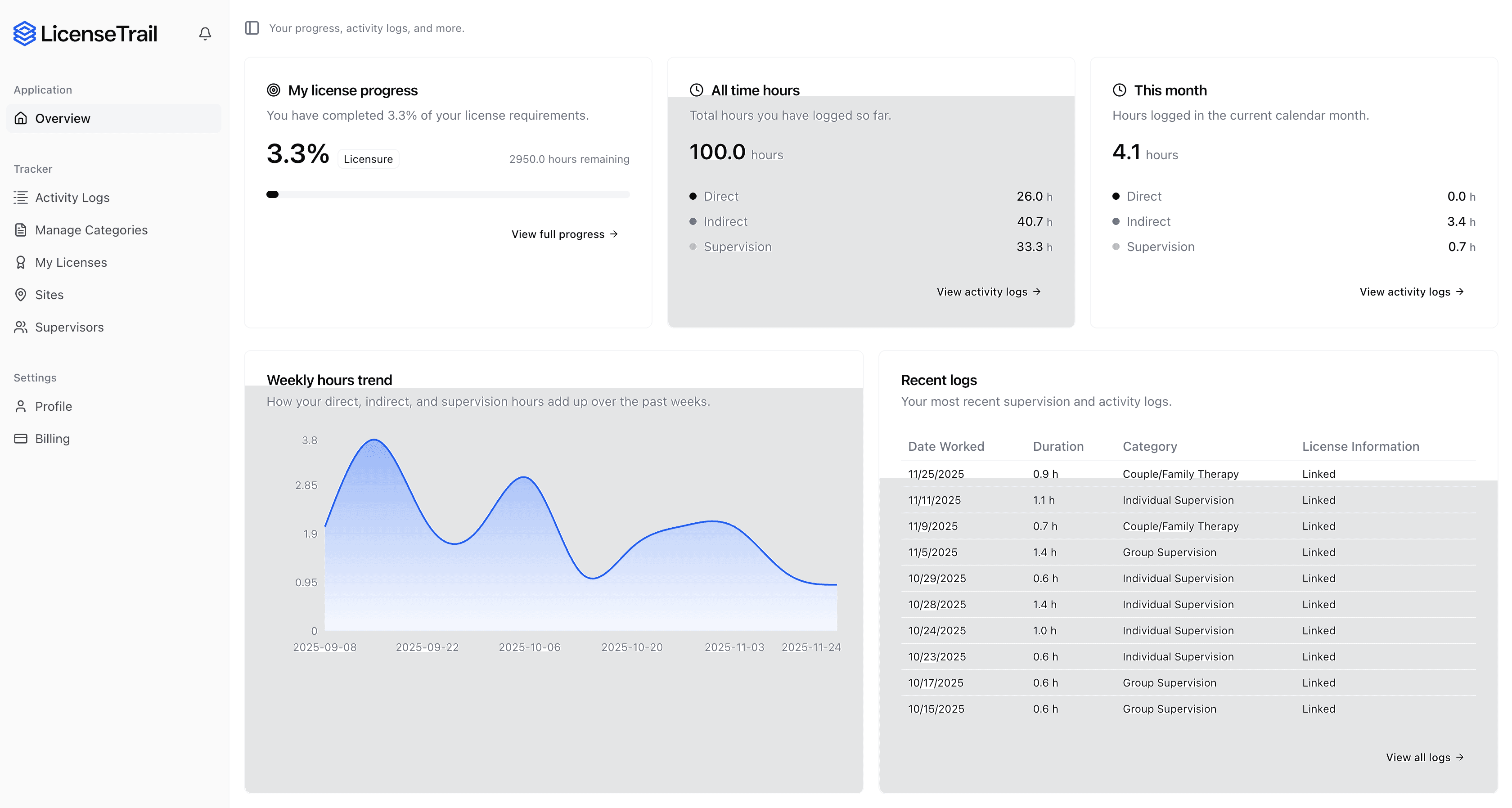
License Trail checks your direct, indirect, and supervision hours against Virginia Inactive requirements continuously and flags mismatches before you submit.
 Start Tracking for Free
No credit card required · Free plan available
Is your spreadsheet hiding Virginia Inactive risks?
Stop guessing if your categories match West Virginia Board of Social Work requirements. License Trail checks your direct, indirect, and supervision hours continuously and flags mismatches before you submit.
Import or log
Bring your spreadsheet or start fresh
Upload your existing tracking spreadsheet and we'll map every hour into the right West Virginia Board of Social Work categories automatically.
Verify against Virginia
Catch mismatches before the board does
License Trail checks your direct, indirect, and supervision hours against Virginia Inactive requirements continuously.
Export board-ready
One-click clean reports
Generate professional, board-ready reports for supervision meetings and West Virginia Board of Social Work submissions in seconds.
No credit card required · Free plan available