
Virginia LICSW Requirements: Hours, Exams & Step-by-Step Guide
Stop guessing if your categories match Virginia requirements. License Trail checks your direct, indirect, and supervision hours against LICSW requirements continuously and flags mismatches before you submit.
No credit card required · Free plan available
Quick Requirements Overview
- Provided source text describes West Virginia (WV) LICSW (Level D) rules; VA LICSW requirements are not included, so a VA-specific snapshot can’t be derived from this text.
- Education: MSW (or PhD/DSW) in social work from a CSWE-accredited/recognized program.
- Clinical training: Graduate clinical field placement (or Board-accepted equivalent) + graduate psychopathology/abnormal psych course (or equivalent).
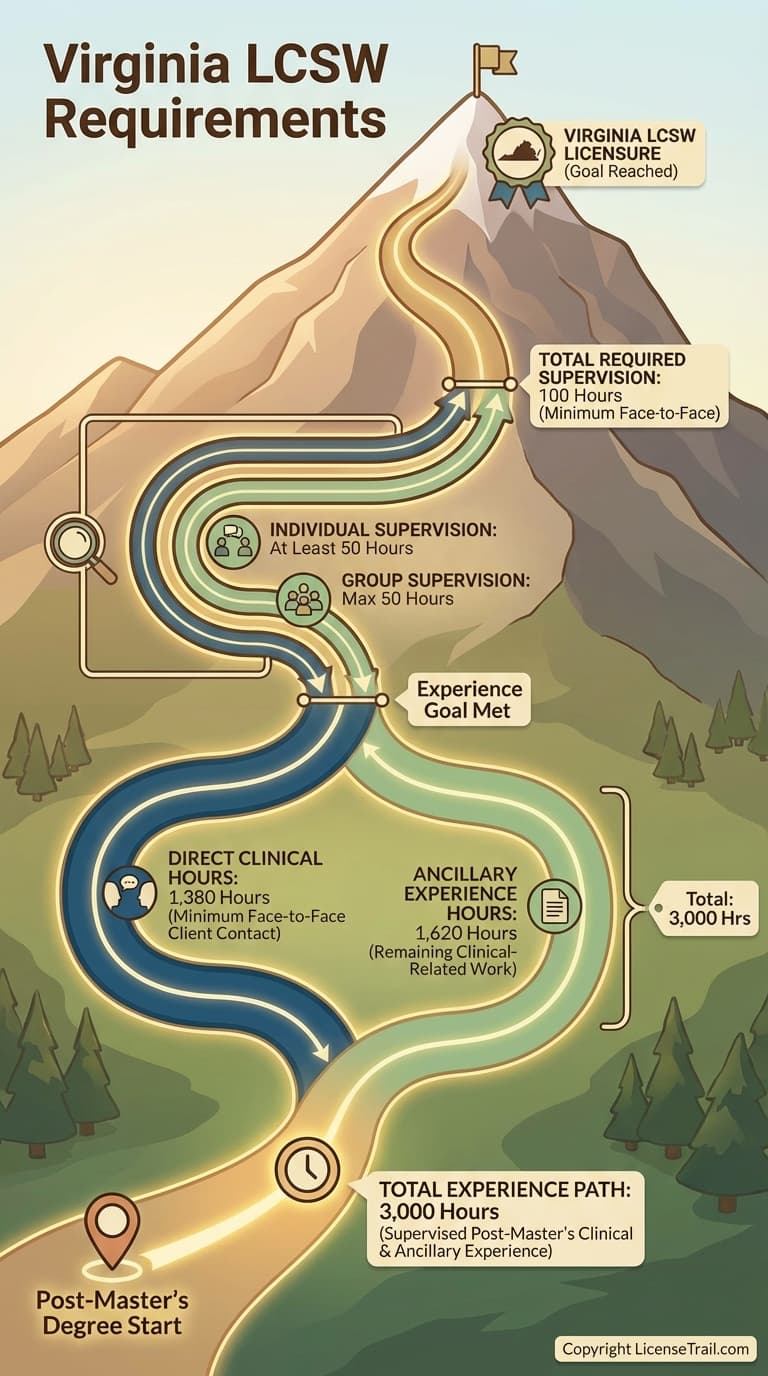
- Experience: 3,000 hours post‑MSW supervised direct clinical social work practice in a Board‑approved clinical setting over ≥ 2 years.
- Supervision: ≥ 100 hours face‑to‑face (HIPAA‑compliant video allowed), ~1 hour per 30 practice hours; ≥ 50% individual supervision.
- Supervisor: Board‑approved WV LICSW (or approved out‑of‑state clinical social worker); Supervision Agreement/Contract must be filed and approved before hours count.
- Exam: Board approval to sit for ASWB Clinical exam; pass exam for licensure.
- Renewal/CE: 30 hours CE every 2 years (includes required topic areas per WV rules).
License Details
Procedures
Becoming a Licensed Independent Clinical Social Worker (LICSW) in West Virginia means meeting both the statutory requirements in Title 25, Series 1 of the Code of State Rules and the Board’s own policy manual. Below is a step‑by‑step guide that tracks those sources and highlights the exact types of hours and supervision the Board requires.
1. Understand what the LICSW license is
West Virginia’s Board of Social Work recognizes four regular license levels: LSW, LGSW, LCSW, and Level D – LICSW. The LICSW is the highest, “independent clinical” level, authorizing diagnosis and treatment of mental and emotional disorders and full independent clinical practice under §30‑30‑9 of the West Virginia Code. (wvsocialworkboard.org)
The Board’s Professional Manual describes the LICSW as requiring “no less than two years post‑MSW full time / 3,000 hours part‑time supervised direct clinical social work practice in a clinical setting pre‑approved by the Board” under a qualified clinical supervisor. (wvsocialworkboard.org)
2. Meet the education requirements
2.1. Degree
You must have:
- A master’s degree in social work (MSW) from a CSWE‑accredited program, or
- A PhD/DSW in social work from a program recognized by CSWE. (wvsocialworkboard.org)
2.2. Clinically oriented training
For the LICSW, the Board expects a clinically oriented graduate education, which includes:
-
Supervised clinical field placement
Multiple sources summarizing the Board’s standards state that LICSW candidates must have completed a supervised clinical field placement at the graduate level, or post‑master’s clinical training that the Board finds equivalent. (ecpcta.org) -
Graduate coursework in psychopathology / abnormal psychology
The Board’s licensure disclosures and derivative summaries specify that an LICSW applicant:- “must have completed a graduate course in either psychopathology or abnormal psychology or other course found equivalent by the Board.” (ecpcta.org)
That course may be part of your MSW program or an additional graduate class.
Practical implication:
If your MSW did not clearly include (a) a supervised clinical field placement and (b) a graduate‑level psychopathology/abnormal psych course, the Board may require you to document equivalent post‑master’s clinical training or additional coursework before it will approve you for LICSW.
3. Hold an appropriate WV social work license while you gain hours
In practice, you earn your supervised clinical experience after the MSW while holding a West Virginia social work license that allows clinical practice under supervision—typically:
- LGSW (Licensed Graduate Social Worker), and/or
- LCSW (Licensed Certified Social Worker), if you already qualify at that level. (wvsocialworkboard.org)
The Board’s manual explains that LICSW hours must occur “in a clinical setting pre‑approved by the Board” and “while being under the supervision of a qualified and pre‑approved WV Licensed Independent Clinical Social Worker or Licensed Clinical Social Worker from another jurisdiction.” (wvsocialworkboard.org)
4. Arrange Board‑approved clinical supervision
4.1. Who can be your clinical supervisor?
Under the Board’s rules, a clinical supervisor must be:
- A West Virginia‑licensed Independent Clinical Social Worker (LICSW), or
- A licensed clinical social worker from another jurisdiction, in good standing, who meets Board approval. (apps.sos.wv.gov)
To be approved, the clinical supervisor must, among other things:
- Have at least two years of clinical practice after receiving their clinical license;
- Complete an application to supervise on Board forms; and
- Complete at least 6 hours of Board‑approved clinical supervision training on supervisory methods for clinical social workers (unless exempt as specified in the rule). (apps.sos.wv.gov)
4.2. Supervision agreement
Before your clinical hours count toward LICSW:
- You and your supervisor must file a formal Supervision Agreement Contract with the Board when supervision begins.
- The Professional Manual stresses that LICSW experience “must occur while being under the supervision of a qualified and pre‑approved” clinical supervisor, and that a formal supervision contract is required at the start of supervision. (wvsocialworkboard.org)
Clinical supervision is not supposed to start (for LICSW credit) until the Board has approved this contract. (apps.sos.wv.gov)
5. Complete the required clinical practice and supervision hours
This is the heart of LICSW candidacy, and it is where the Board’s specific hour requirements matter most.
5.1. Total clinical practice hours
The Board’s LICSW license page and manual, together with the legislative rules, are consistent on the basic minimum:
- You must document a minimum of two years of full‑time employment and
- 3,000 hours of post‑master’s clinical social work practice in full‑ or part‑time employment. (wvsocialworkboard.org)
The manual characterizes this as “supervised direct clinical social work practice in a clinical setting pre‑approved by the Board.” (wvsocialworkboard.org)
So unlike some states that split hours into “direct” vs “indirect,” West Virginia’s Board:
- Treats the entire 3,000 hours as post‑MSW supervised direct clinical social work practice,
- Performed in a clinical setting the Board has approved.
5.2. Required clinical supervision hours
The Board requires a substantial amount of supervision, both in total hours and format.
From the Level D – LICSW page:
- “An applicant should have at least 100 hours of face to face supervision.” (wvsocialworkboard.org)
The legislative rule at 25 CSR 1, §3.6.1.e adds detail:
-
The supervisor must maintain records of supervision for 100 hours of face‑to‑face sessions
conducted over no less than two years of full‑time employment or 3,000 hours of full or part‑time employment (i.e., the same practice window as your 3,000 clinical hours). (apps.sos.wv.gov) -
The rule specifies that “[a]n applicant should have at least one hour of supervision for each thirty (30) hours of supervised practice.” (apps.sos.wv.gov)
- 3,000 practice hours ÷ 30 ≈ 100 supervision hours, which is why the Board uses that number.
-
At least 50% of supervision must be in an individual setting (one‑on‑one with your supervisor, not group). (apps.sos.wv.gov)
-
“Face to face supervision conducted with technology compliant with the Health Insurance Portability and Accountability Act is acceptable,” so HIPAA‑compliant video can count as “face‑to‑face.” (apps.sos.wv.gov)
Putting this together in plain terms
For LICSW in West Virginia, the Board’s own language and rules effectively require:
- 3,000 hours of post‑MSW supervised direct clinical social work practice in a Board‑approved clinical setting;
- Carried out over at least two years (you cannot compress it into a shorter period);
- With about 1 hour of clinical supervision for each 30 hours of practice, resulting in at least 100 hours of face‑to‑face clinical supervision;
- At least 50 of those 100 supervision hours must be individual supervision (the remainder may be group, but no more than half);
- All supervision must be provided by a Board‑approved LICSW (or qualifying clinical social worker from another jurisdiction) under an approved supervision contract.
So, unlike your example of “1,500 hours of direct experience and 1,500 hours of supervised experience,” West Virginia does not divide the 3,000 clinical hours that way. Instead, the Board expects 3,000 hours of clinical practice plus 100 hours of separate, face‑to‑face clinical supervision layered on top, with a required supervision‑to‑practice ratio.
6. Document your experience
Throughout the supervision period:
- Your supervisor must keep detailed records of each supervision session (date, duration, type, topics), initialed by both of you, as required in §3.6.1.e. (apps.sos.wv.gov)
- You must be able to document:
- Employment setting and job duties (showing that hours were clinical in nature);
- Total clinical practice hours;
- Total supervision hours (individual vs group, in‑person vs HIPAA‑compliant video);
- That the experience spanned at least two years.
The Board may review this documentation when you apply for LICSW candidacy.
7. Apply for the LICSW and test authorization
Once you and your supervisor believe you have completed all clinical and supervision requirements:
-
Submit the “Application for Independent Clinical Social Work License (LICSW)” to the Board with all supporting documentation (supervision records, employment verification, transcripts, etc.). The Board’s LICSW page instructs that individuals in West Virginia “seeking test authorization upon finishing clinical supervision” should file this application. (wvsocialworkboard.org)
-
If you are or have been licensed in another state, you must request license verification from that state’s social work board. (wvsocialworkboard.org)
The Board reviews your materials to determine whether you have met:
- Education requirements (degree, clinical field placement, psychopathology/abnormal psych course);
- Clinical experience and supervision requirements (3,000 hours, 100 supervision hours, proper supervision ratio and format);
- Any other statutory requirements (e.g., criminal background considerations under §25‑1‑4). (apps.sos.wv.gov)
If approved, the Board notifies the Association of Social Work Boards (ASWB) that you are cleared to sit for the Clinical examination. (wvsocialworkboard.org)
8. Pass the ASWB Clinical exam
After Board approval:
- Register with ASWB for the Clinical level exam and pay the exam fee.
- Take and pass the exam; ASWB sends official scores directly to the Board. (wvsocialworkboard.org)
Only after both the Board’s LICSW application review and your passing exam score are complete will the Board issue the Level D – LICSW license.
9. Maintain your license
Once licensed as an LICSW, you must comply with West Virginia’s continuing education and renewal requirements:
- All regular licensees (including LICSW) must complete 30 hours of Board‑approved continuing education every two years, including specific hours in ethics and veterans’ mental health, under recent rule changes. (wvsocialworkboard.org)
Summary of key numbers and Board‑defined hour types
For LICSW in West Virginia, as of rules effective July 1, 2022 and the Board’s current manual:
- Degree: MSW (or higher) in social work from a CSWE‑accredited program.
- Clinical education:
- Supervised clinical field placement or equivalent post‑master’s clinical training;
- One graduate course in psychopathology or abnormal psychology, or equivalent. (ecpcta.org)
- Clinical practice experience:
- ≥ 3,000 hours of post‑MSW supervised direct clinical social work practice in a Board‑approved clinical setting;
- Spanning at least two years of full‑time (or equivalent part‑time) employment. (wvsocialworkboard.org)
- Clinical supervision:
- ≥ 100 hours of face‑to‑face clinical supervision with a Board‑approved LICSW (or equivalent clinical social worker),
- At roughly 1 supervision hour per 30 hours of supervised practice,
- With at least 50% of supervision in an individual (1:1) format,
- Conducted over the same two‑year/3,000‑hour period. (apps.sos.wv.gov)
- Exam: ASWB Clinical examination. (wvsocialworkboard.org)
Those figures and terms reflect the Board’s own statute, rules, and Professional Manual as of late 2025; applicants should still confirm current requirements directly with the West Virginia Board of Social Work before applying, in case of future rule changes.
Track your LICSW hours with confidence
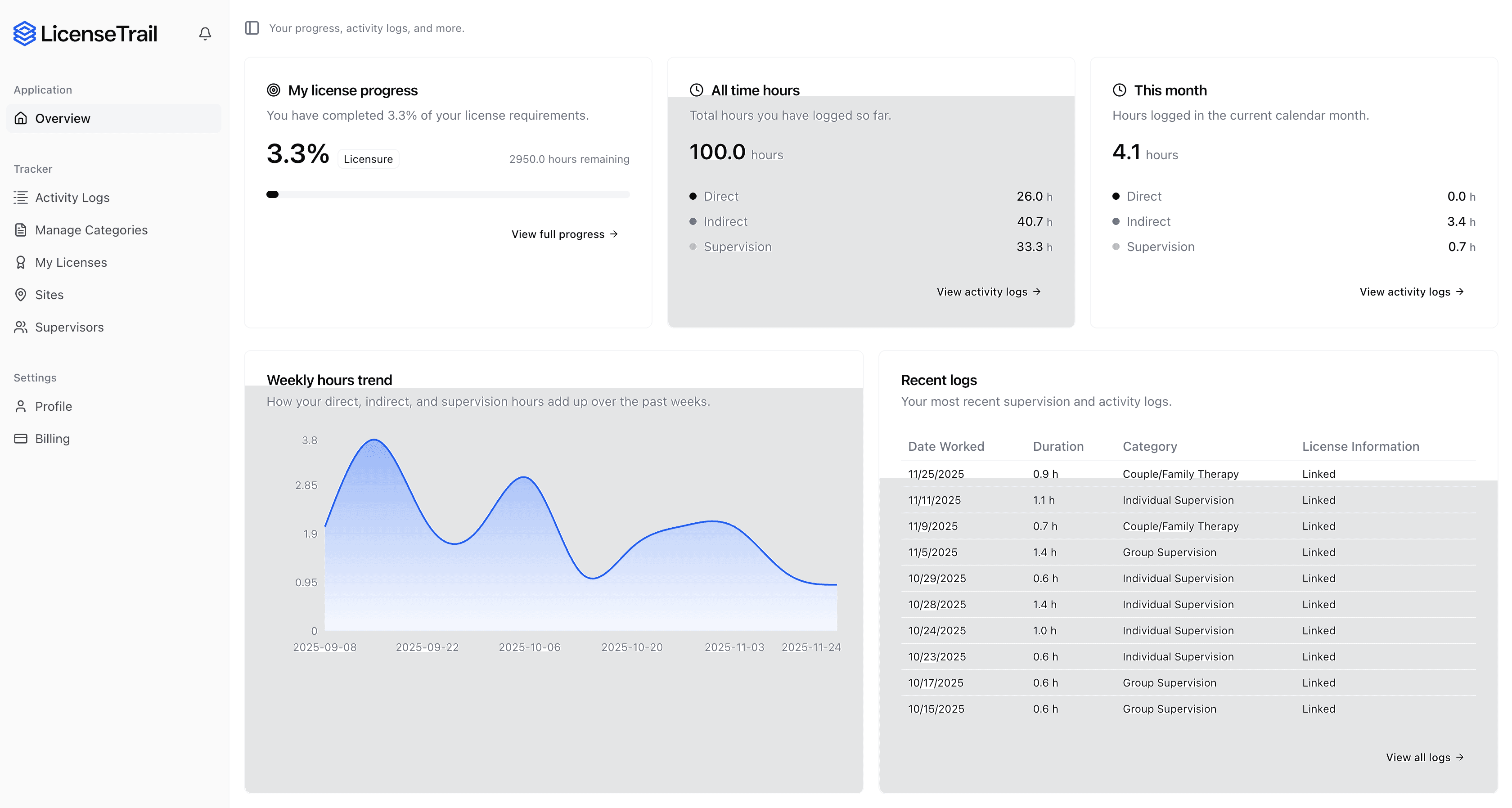
License Trail checks your direct, indirect, and supervision hours against Virginia LICSW requirements continuously and flags mismatches before you submit.
 Start Tracking for Free
No credit card required · Free plan available
Is your spreadsheet hiding Virginia LICSW risks?
Stop guessing if your categories match West Virginia Board of Social Work requirements. License Trail checks your direct, indirect, and supervision hours continuously and flags mismatches before you submit.
Import or log
Bring your spreadsheet or start fresh
Upload your existing tracking spreadsheet and we'll map every hour into the right West Virginia Board of Social Work categories automatically.
Verify against Virginia
Catch mismatches before the board does
License Trail checks your direct, indirect, and supervision hours against Virginia LICSW requirements continuously.
Export board-ready
One-click clean reports
Generate professional, board-ready reports for supervision meetings and West Virginia Board of Social Work submissions in seconds.
No credit card required · Free plan available