
Virginia LMSW Requirements: Hours, Exams & Step-by-Step Guide
Stop guessing if your categories match Virginia requirements. License Trail checks your direct, indirect, and supervision hours against LMSW requirements continuously and flags mismatches before you submit.
No credit card required · Free plan available
Quick Requirements Overview
- Degree: MSW from a CSWE-accredited school/program required
- Exam: Pass the ASWB Master’s exam
- Application: Apply to the VA Board of Social Work and receive board approval before registering/sitting for the exam
- Experience hours: No post‑MSW supervised/practice hours required for LMSW (hours apply to LCSW, not LMSW)
- Documentation: Proof of MSW; NPDB self‑query; disclose/submit items for any discipline/criminal history; name change/license verifications if applicable
- Fee: $115 application fee (non‑refundable)
- Timing: Board review up to ~30 days once complete; generally 2 years after approval to pass exam; 90‑day wait between failed attempts
- Renewal/CE: 15 CE hours every 2 years, including 3 hours in ethics/standards/VA laws
License Details
Procedures
Becoming a Licensed Master Social Worker (LMSW) in Virginia is comparatively streamlined: the state focuses on your accredited education and your exam, not on accumulating post‑graduate practice hours. The more intensive hour requirements you may have seen (e.g., thousands of supervised clinical hours) apply to the Licensed Clinical Social Worker (LCSW), not to the LMSW.
Below is a structured guide based on the current Virginia regulations and Virginia Board of Social Work materials as of November 2025.
1. What the LMSW License Is in Virginia
The Virginia Board of Social Work defines the LMSW as a social worker who practices at the master’s level and provides non‑clinical, generalist services, including staff supervision and management. (dhp.virginia.gov)
The LMSW:
- Is a non‑clinical license (no psychotherapy/clinical diagnosis authority—that belongs to the LCSW).
- Allows you to engage in generalist social work such as case management, assessment, coordination of services, policy interpretation, advocacy, and management roles. (dhp.virginia.gov)
- Is not a prerequisite for becoming an LCSW; you can go directly into supervised clinical experience for LCSW without ever holding an LMSW. (dhp.virginia.gov)
2. Core Eligibility Requirements for an LMSW (Virginia)
Virginia’s requirements for LMSW licensure are set in regulation and on the Board’s LMSW applicant pages. In summary, for licensure by examination you must: (law.lis.virginia.gov)
-
Education
- Hold a master’s degree in social work from an accredited school of social work.
- In regulatory language, “The applicant for licensure as an LMSW shall hold a master’s degree from an accredited school of social work.” (18VAC140‑20‑60). (law.lis.virginia.gov)
- The accreditation must be by the Council on Social Work Education (CSWE), per the Board’s LMSW Exam instructions. (dhp.virginia.gov)
-
Examination
- Pass the Association of Social Work Boards (ASWB) Master’s level examination.
- The regulation states that the exam for LMSW is “the licensing examination of the Association of Social Work Boards at the master’s level.” (18VAC140‑20‑70). (law.lis.virginia.gov)
-
Board Approval to Take the Exam
- You must apply to the Virginia Board for LMSW licensure by examination and be approved before registering for the ASWB Master’s exam. (dhp.virginia.gov)
-
Good Standing/Background
- You must be eligible for licensure under Virginia law (no disqualifying criminal history, impairment, or disciplinary actions), and you will be asked to provide documentation if such issues exist. (dhp.virginia.gov)
-
Fees
- Pay the LMSW application fee, currently listed by the Board as $115. (dhp.virginia.gov)
3. Step‑by‑Step: Licensure by Examination (First‑Time LMSW)
The Board’s “Licensed Master Social Worker (LMSW) – By Examination” page outlines the process. (dhp.virginia.gov)
Step 1 – Complete an Accredited MSW
- Graduate with a master’s degree in social work from a CSWE‑accredited program. (dhp.virginia.gov)
Step 2 – Review Virginia Laws, Regulations, and LMSW Handbook
The Board directs applicants to:
- Read Virginia laws on the practice of social work.
- Read the Regulations Governing the Practice of Social Work (18VAC140‑20).
- Review the LMSW Licensure Process Handbook, which details required documents and workflow. (dhp.virginia.gov)
Step 3 – Gather Required Documentation
Per the Board’s instructions, you will typically need to prepare or request items such as: (dhp.virginia.gov)
- Official proof of your MSW degree.
- A National Practitioner Data Bank (NPDB) Self‑Query Report.
- If applicable:
- Proof of any out‑of‑state social work license.
- Documentation of name changes.
- Court and related documents for criminal convictions or disciplinary actions, if any.
The exact checklist is detailed in the Board’s “Application Instructions for LMSW by Examination.”
Step 4 – Submit Online Application for LMSW by Examination
Using the Department of Health Professions online portal, the Board instructs you to: (dhp.virginia.gov)
- Register or log in to your DHP account.
- Choose:
- Profession: Social Work
- License Type: Licensed Master Social Worker
- Method: Examination
- Complete all required fields.
- Upload required documents in PDF format.
Step 5 – Pay the Application Fee
- Pay the LMSW fee ($115) online.
- All fees are non‑refundable. (dhp.virginia.gov)
Step 6 – Wait for Board Review and Exam Authorization
- The Board indicates it may take up to 30 days from receipt of a complete application to review. (dhp.virginia.gov)
- Once approved, you will receive authorization to register with ASWB and sit for the Master’s exam. (dhp.virginia.gov)
Step 7 – Take and Pass the ASWB Master’s Exam
From the Board’s exam FAQ and regulations: (dhp.virginia.gov)
- You may sit for the exam after you have graduated with your MSW and received Board approval.
- You typically have two years from the date of Board approval to pass the exam.
- If you fail, ASWB requires a 90‑day waiting period between attempts.
When you pass, ASWB or the Board processes your results toward issuance of your LMSW license.
4. Licensure by Endorsement (Already Licensed Elsewhere)
If you already hold an active, unrestricted master‑level social work license in another state that is comparable to Virginia’s LMSW, you may be eligible for licensure by endorsement. (dhp.virginia.gov)
The Board requires, among other things:
-
Comparable License
- You must hold an active, unrestricted comparable social work license in another jurisdiction at a level equivalent to a Virginia LMSW. (dhp.virginia.gov)
-
Exam Verification
- Provide evidence of a passing ASWB Master’s exam score, or documentation that no national exam was required at the time you were first licensed. (dhp.virginia.gov)
-
Good Standing and NPDB Report
- Verification that your license is in good standing in that other jurisdiction.
- A current NPDB Self‑Query report. (dhp.virginia.gov)
-
Application and Fee
- Submit the online LMSW by Endorsement application and pay the LMSW fee. (dhp.virginia.gov)
5. Hours and Supervision: What Virginia Actually Requires for LMSW
A. Post‑Degree Practice Hours for LMSW Licensure
For LMSW licensure itself, Virginia does not require any specific number of post‑graduate practice hours, direct client hours, or supervised hours.
This is explicit in the structure of the regulations:
- Education requirement: 18VAC140‑20‑60 states that the LMSW applicant must hold a master’s degree from an accredited school of social work—no experience hours are specified. (law.lis.virginia.gov)
- Licensure by examination rule for LBSW/LMSW (18VAC140‑20‑51) simply requires that you meet the education requirement in 18VAC140‑20‑60 and then take the exam—again, no practice hours are listed. (law.lis.virginia.gov)
- Independent summaries consistent with Board materials explicitly note that for Virginia’s Master’s Social Worker License, postgraduate work experience is “None”; only an accredited MSW and the relevant ASWB exam are required. (waldenu.edu)
So, using the kind of example you gave:
- The Virginia Board does not specify “1,500 hours of direct experience and 1,500 hours of supervised experience” (or any similar hour breakdown) for LMSW licensure.
- Instead, the only quantified requirement is that you complete an accredited master’s degree and pass the ASWB Master’s exam.
Any practice hours you complete in your MSW field placements are governed by CSWE and your school, not by a stand‑alone hour requirement in Virginia’s LMSW regulations.
B. How This Differs from LCSW (Where Hours DO Matter)
The confusion often arises because LCSW licensure in Virginia does have detailed hour requirements, but that is a different license.
For LCSW, current Virginia rules require: (law.lis.virginia.gov)
- 3,000 hours of post‑master’s supervised experience in clinical social work and related services, over no fewer than two and no more than four years.
- Within those 3,000 hours, at least 1,380 hours must be face‑to‑face client contact in delivering clinical social work services; the remainder may be ancillary services.
- At least 100 hours of face‑to‑face supervision with a qualified LCSW supervisor.
Those hour requirements do not apply to LMSW licensure. They come into play only if and when you pursue LCSW.
C. Supervision for Counting Hours Toward LCSW (Optional Path While Non‑Clinical)
Virginia specifically points out that the LMSW license is not a prerequisite for LCSW and that if you want to start counting supervised hours toward LCSW, you must instead register as a supervisee in social work via the “Application for Initial Registration of Supervision.” (dhp.virginia.gov)
So if your ultimate goal is LCSW, you have two independent tracks:
- Obtain LMSW for non‑clinical generalist practice; or
- Register for clinical supervision and accumulate LCSW hours (with or without ever holding an LMSW).
6. Continuing Education Hours After You Are Licensed
Once you hold the LMSW, Virginia requires continuing education (CE) to renew your license.
Recent guidance summarizing Virginia’s requirements indicates: (msweducation.org)
- Renewal cycle: Every two years (biennial).
- LMSW CE requirement: 15 contact hours per renewal period.
- Of those 15 hours, at least 3 hours must focus on ethics, standards of practice, or Virginia social work laws.
- The Board recognizes Category I (formally organized learning) and other CE categories, with minimums you must meet in Category I activities.
These are continuing education hours, not supervised practice or clinical experience hours.
7. Summary of “Hours” in Plain Terms for a Virginia LMSW
For Licensed Master Social Worker (LMSW) – Virginia:
- Post‑MSW practice hours required for initial license:
- 0 hours specified by the Virginia Board of Social Work.
- Supervised experience hours required for initial LMSW license:
- 0 hours specified; supervision is relevant if you are working toward LCSW, not for LMSW licensure itself.
- Exam‑related timing:
- You must pass the ASWB Master’s exam within two years of Board approval, or re‑apply under then‑current regulations. (law.lis.virginia.gov)
- Continuing education hours after licensure:
- 15 contact hours every two years, including 3 ethics‑related hours, to maintain your LMSW. (msweducation.org)
In other words, Virginia’s LMSW license hinges on: an accredited MSW, a passing ASWB Master’s exam score, and a complete, acceptable application—not on accumulating a specified number of supervised practice hours prior to licensure.
Track your LMSW hours with confidence
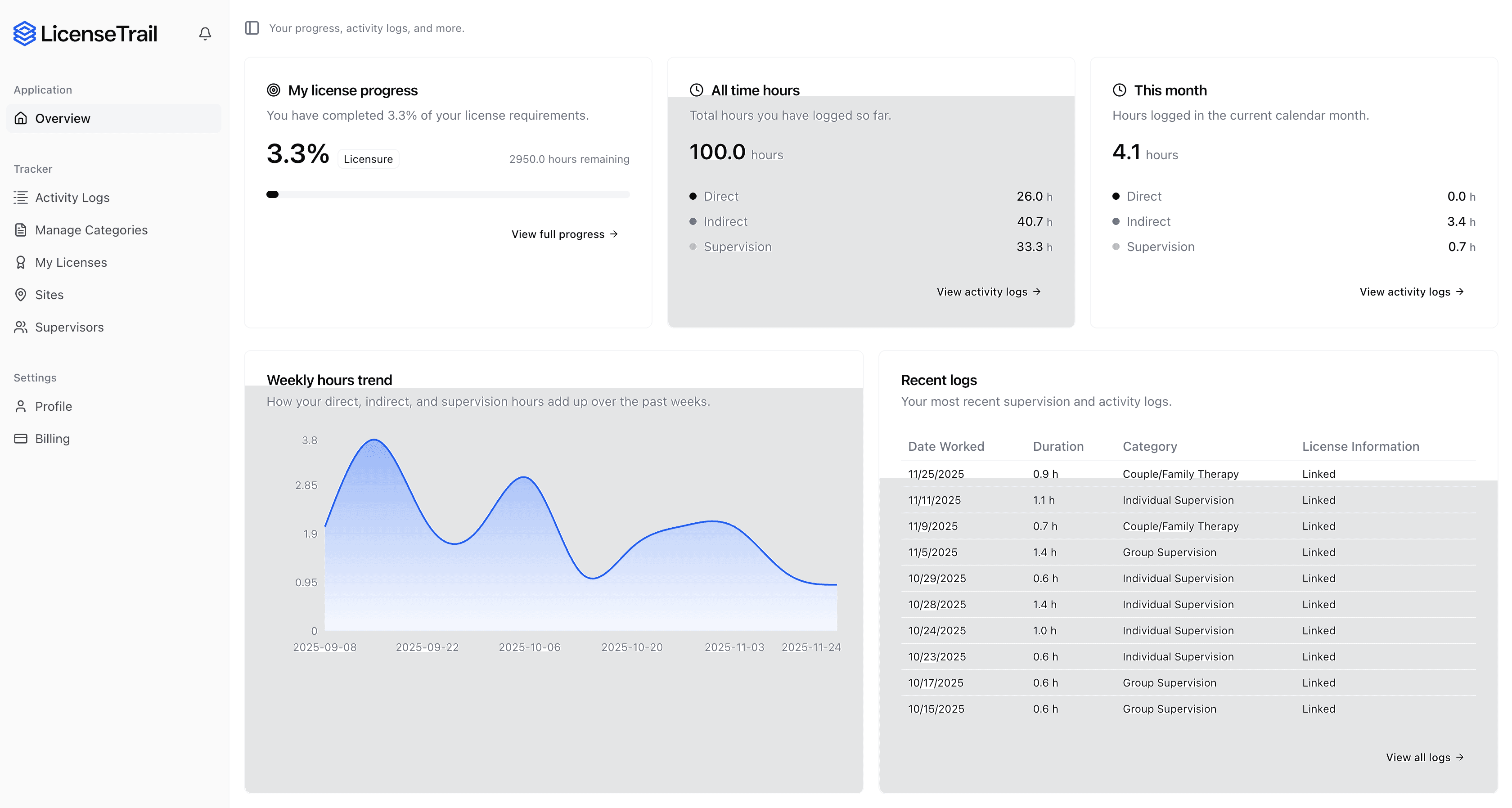
License Trail checks your direct, indirect, and supervision hours against Virginia LMSW requirements continuously and flags mismatches before you submit.
 Start Tracking for Free
No credit card required · Free plan available
Is your spreadsheet hiding Virginia LMSW risks?
Stop guessing if your categories match Virginia Board of Social Work requirements. License Trail checks your direct, indirect, and supervision hours continuously and flags mismatches before you submit.
Import or log
Bring your spreadsheet or start fresh
Upload your existing tracking spreadsheet and we'll map every hour into the right Virginia Board of Social Work categories automatically.
Verify against Virginia
Catch mismatches before the board does
License Trail checks your direct, indirect, and supervision hours against Virginia LMSW requirements continuously.
Export board-ready
One-click clean reports
Generate professional, board-ready reports for supervision meetings and Virginia Board of Social Work submissions in seconds.
No credit card required · Free plan available