
Virginia LSP-I Requirements: Hours, Exams & Step-by-Step Guide
Stop guessing if your categories match Virginia requirements. License Trail checks your direct, indirect, and supervision hours against LSP-I requirements continuously and flags mismatches before you submit.
No credit card required · Free plan available
Quick Requirements Overview
- Provided text describes West Virginia (WV) LSP‑I requirements (not Virginia, VA); VA requirements may differ
- Degree: Master’s/Ed.S./C.A.S. in approved school psychology program from regionally accredited institution (core coursework aligned to WV scope)
- Employment: Must be W‑2 employee of a WV county school board; supervision and supervisor must be WV‑approved/in‑state
- Initial status: Apply to Board for Supervised‑School‑Psychologist; receive/renew annual “Gold Card” listing approved supervisor(s)
- Supervision term: 3 school calendar years (credit 1 year if degree-required internship → typically 2 post‑degree years); possible reduction to ½ year for certain Ed.S. applicants with 2 years full‑time school board employment
- Supervision hours: Minimum 1 hour individual supervision per 20 hours of services; full‑time: at least 6 hrs/month individual face‑to‑face (plus up to 2 hrs/month group/multidisciplinary)
- Exams & CE: Pass Praxis School Psychologist (min 147; attempt within 12 months, pass within 2 years) + oral exam after supervision; maintain 10 CE hrs/year (incl. 1.5 ethics) during supervised status
License Details
Procedures
Licensure as a Licensed School Psychologist (Level I, “LSP‑I”) in West Virginia is governed by the West Virginia Board of Examiners of Psychologists and by the state’s psychology legislative rules (Title 17, Series 3 and related sections). The process centers on three school calendar years of supervised practice (with some possible reductions), structured supervision hours, and two required examinations.
Below is a structured guide that stays close to the Board’s own language while keeping the pathway easy to follow.
1. What “Licensed School Psychologist (Level I)” Means in West Virginia
West Virginia law defines a Licensed School Psychologist (Level I) as a school psychologist who:
- Provides school psychology services on school board property, and
- Is a school board employee or contractee. (law.cornell.edu)
The Board’s own Level 1 licensure sheet stresses that Level I licensees work for one or more West Virginia county school boards and that this license allows them to provide services for more than one county school board. (psychbd.wv.gov)
By contrast, a person who holds only a West Virginia Department of Education (WVDE) school psychologist certification and works full‑time for a single local school board does not have to be licensed as Level I or II, but such an individual may not call themselves “licensed,” contract with other districts, or provide private/independent school psychology services. (regulations.justia.com)
2. Educational Requirements
The Board’s official “School Psychology Level 1 – Requirements” document sets the degree standards:
- You must hold a Master’s, Educational Specialist (Ed.S.), or Certificate of Advanced Study (C.A.S.) in an approved school psychology program.
- The degree must be from a regionally accredited institution (one of the six major regional accrediting bodies).
- Your core coursework must be relevant to the practice of school psychology as defined in West Virginia Code §30‑21‑2. (psychbd.wv.gov)
The Board does not in this document set a specific internship hour count for Level I (e.g., 1,200 hours), but it recognizes whether an internship was required for your degree, and that affects how long you must stay under supervision (see Section 4).
3. Employment and Initial Application (“Supervised‑School‑Psychologist” Status)
3.1 Required employment status
Before or as you enter supervision toward Level I:
- You must be employed by a West Virginia school board as a school psychologist. (psychbd.wv.gov)
- You must be a W‑2 employee in West Virginia; supervision is explicitly required to occur in WV, with a WV‑approved supervisor and a WV employer paying you as a W‑2 employee. (psychbd.wv.gov)
This is not a license you can complete on a purely volunteer, contract‑only, or out‑of‑state basis.
3.2 Applying to the Board
Once your credentials match the education and employment criteria:
- Contact the Board office ([email protected]) and request the Level I application packet. (psychbd.wv.gov)
- Submit:
- Completed application forms,
- All required documentation and fees listed on the Board’s checklist,
- Evidence of W‑2 employment in a qualifying WV school psychology role. (psychbd.wv.gov)
Upon approval, you are authorized as a Supervised‑School‑Psychologist (Level I track).
3.3 The “Gold Card”
Approved applicants receive a “Gold Card,” which:
- Shows that you are a Board‑approved Level I supervised psychologist, and
- Lists your Board‑approved supervisor(s). (psychbd.wv.gov)
The Gold Card:
- Has an expiration date, and
- Must be renewed annually, requiring:
- A renewal form,
- Continuing education documentation (see Section 6),
- The applicable fee. (psychbd.wv.gov)
4. Supervision Requirements: Time and Hours
West Virginia regulates both (1) how long you are supervised (in school calendar years) and (2) how supervision hours relate to your practice hours.
4.1 Length of supervision period (school calendar years)
For Level I applicants with a Master’s, C.A.S., or Ed.S. in school psychology:
- You must complete 3 school calendar years of supervision as a supervised‑school‑psychologist. (regulations.justia.com)
Internship credit:
- If your degree required a school psychology internship, one school calendar year of supervision is automatically credited as part of those 3 years, so you then need only 2 school calendar years of post‑degree supervision. (regulations.justia.com)
Special reduction for experienced Ed.S‑level school psychologists:
- Under a separate rule, Level I applicants who have an Ed.S., a degree‑required internship, and at least two full school calendar years of full‑time school psychologist employment with a school board may reduce the required Board‑approved supervision to one‑half of a school calendar year, plus any additional time needed to pass the Praxis and oral exams. (regulations.justia.com)
In other words:
- Standard path (Master’s/Ed.S./C.A.S., internship required):
2 school calendar years of supervised practice (because 1 year is credited for internship). - Accelerated path (Ed.S + 2 years full‑time post‑grad school board employment):
½ school calendar year of Board‑approved supervised practice beyond that prior work.
The Board will apply the exact rule that fits your degree and employment history.
4.2 Supervision ratio: “1 hour per 20 hours” of services
The state’s supervision rule for school psychologist applicants specifies the type and amount of supervision in relation to your service hours:
- Supervision must include a minimum of 1 hour of individual supervision for every 20 hours of school psychology services you provide as a supervised‑school‑psychologist. (regulations.justia.com)
Key features of those hours:
- “Individual supervision” is defined as face‑to‑face, private interaction between you and your supervisor.
- When you and your supervisor are not at the same site, you must still meet regularly for individual supervision, and the supervisor must be available by telephone during the workday.
- All of your work is reviewed by the supervisor, and you sign reports as a “Supervised‑School‑Psychologist.” (regulations.justia.com)
The Board’s Supervision Contract for School Psychology Degrees (incorporated by reference in statute) further clarifies that:
- Full‑time supervisees must receive at least 6 hours of individual face‑to‑face supervision per month, and
- Up to 2 additional hours per month can be met via group or multidisciplinary supervision activities noted in the supervision contract. (law.cornell.edu)
Put simply, your hours are tracked in two ways:
- School psychology service hours (assessments, consultation, direct interventions, program planning, etc.), logged each week on the Board’s quarterly supervision form; and (psychbd.wv.gov)
- Individual supervision hours, which must meet both:
- The 1:20 ratio, and
- The monthly minimums for full‑time workers.
The Board does not specify a fixed total number of practice hours (e.g., 1,500 hours of direct experience) for Level I. Instead, it requires a specified number of school years under supervision and a minimum supervision‑to‑practice ratio (1 hour of supervision for every 20 hours of services).
4.3 Scope of supervised practice
Regulations require that Level I supervision cover all aspects of your school psychology practice, including but not limited to:
- Evaluations,
- Consultations,
- Ethics and record-keeping,
- Mental health interventions,
- Family/school collaboration, and
- Professional development. (regulations.justia.com)
Quarterly reports you submit to the Board break down your hours across detailed activity categories—various assessments, direct interventions (e.g., therapy, crisis counseling, behavior management), consultation (IEP meetings, eligibility committees), program development and evaluation, and other professional tasks. (psychbd.wv.gov)
5. Examination Requirements
You must pass two examinations to become a Level I Licensed School Psychologist.
5.1 Praxis Exam in School Psychology
The Board requires passage of the Praxis School Psychologist examination at the cut score used for National Association of School Psychologists (NASP) certification. As of the current Board document:
- Applicants must achieve a minimum score of 147 on the Praxis School Psychologist test. (psychbd.wv.gov)
- Past versions of the exam had higher or different passing scores (e.g., 165 between 2008–2014; 660 or higher before September 2008). (psychbd.wv.gov)
Timing:
- Supervised‑school‑psychologists must take the Praxis at least once within the first 12 months of becoming supervised if they have not already done so. (law.cornell.edu)
- They must pass the exam within 2 years of application for licensure. Failing to pass within 2 years makes the person ineligible for Level I licensure until they satisfy the exam requirement within an additional limited period. (law.cornell.edu)
5.2 Oral Examination
After:
- Completing the required supervision period (school calendar years), and
- Completing the required number of supervision hours,
you become eligible to sit for the oral examination. (psychbd.wv.gov)
The oral exam:
- Is conducted by the Board or a Board committee,
- Evaluates your:
- Professional ethics,
- Legal knowledge,
- Clinical and school‑based judgment,
- Professionalism, and
- Whether your independent practice plans are consistent with your training and supervision. (ecpcta.org)
Upon successful passage of the oral examination, the Board issues your West Virginia Level I school psychology license. (psychbd.wv.gov)
6. Continuing Education During Supervision
While you hold the Gold Card as a supervised‑school‑psychologist, the Board requires ongoing continuing education (CE):
- 10 hours of CE per full year,
- Of which 1.5 hours must be in ethics,
- To renew your Gold Card and continue in supervised status. (psychbd.wv.gov)
These CE requirements apply even before you are fully licensed, and proof of CE is part of your annual Gold Card renewal.
7. Step‑By‑Step Overview
Putting the pieces together, the typical route to LSP‑I in West Virginia looks like this:
-
Complete your graduate education
- Earn a Master’s, Ed.S., or C.A.S. in an approved school psychology program from a regionally accredited institution.
- Ensure coursework is clearly oriented toward school psychology as defined in WV Code §30‑21‑2. (psychbd.wv.gov)
-
Obtain employment with a WV school board
- Secure a W‑2 school psychologist position with a West Virginia county school board.
- This role forms the basis of your supervised practice. (psychbd.wv.gov)
-
Apply to the Board for Supervised‑School‑Psychologist (Level I) status
- Request and submit the Level I application, supporting documents, and fees.
- Once approved, receive your Gold Card showing approved supervisor(s). (psychbd.wv.gov)
-
Begin and maintain supervision
- Work in your school psychology role while:
- Logging school psychology service hours each week,
- Receiving individual supervision at a minimum of 1 hour per 20 hours of services, with at least 6 hours/month of individual face‑to‑face supervision for full‑time practice, and
- Meeting all documentation requirements (quarterly reports, supervision logs, etc.). (regulations.justia.com)
- Work in your school psychology role while:
-
Complete the required supervision period
- Standard requirement: 3 school calendar years of supervision (minus one year if your degree required an internship).
- Possible reduction to ½ school calendar year of Board supervision for certain Ed.S‑level applicants who already have 2 full years of full‑time post‑degree school board employment. (regulations.justia.com)
-
Pass the Praxis School Psychologist exam
- Achieve at least the NASP‑aligned cut score (currently 147) within 2 years of application, observing the Board’s timelines on first attempts and re‑attempts. (law.cornell.edu)
-
Maintain CE and Gold Card
- Complete 10 CE hours per year (including 1.5 ethics hours) and submit them with your Gold Card renewal. (psychbd.wv.gov)
-
Sit for and pass the oral examination
- Once your supervision years and supervision/practice hours are complete and Praxis is passed, the Board schedules an oral exam.
- Successful completion results in issuance of the Licensed School Psychologist (Level I) license. (psychbd.wv.gov)
8. How West Virginia Handles “Hours” Compared with Some Other States
For clarity, West Virginia does not state its LSP‑I requirements as “X hours of direct experience plus Y hours of supervision,” the way some jurisdictions might (for example, 1,500 direct and 1,500 supervised hours). Instead:
- The quantity of experience is expressed in:
- School calendar years of supervised practice (3 years, with defined exceptions), and
- A required supervision ratio (1:20) plus monthly minimums for individual supervision. (regulations.justia.com)
The actual total number of direct practice hours you accumulate will depend on your full‑time or part‑time status and the specific school calendar in your district, but all of it must be captured in your quarterly logs and meet the Board’s supervision and time‑in‑service requirements.
Track your LSP-I hours with confidence
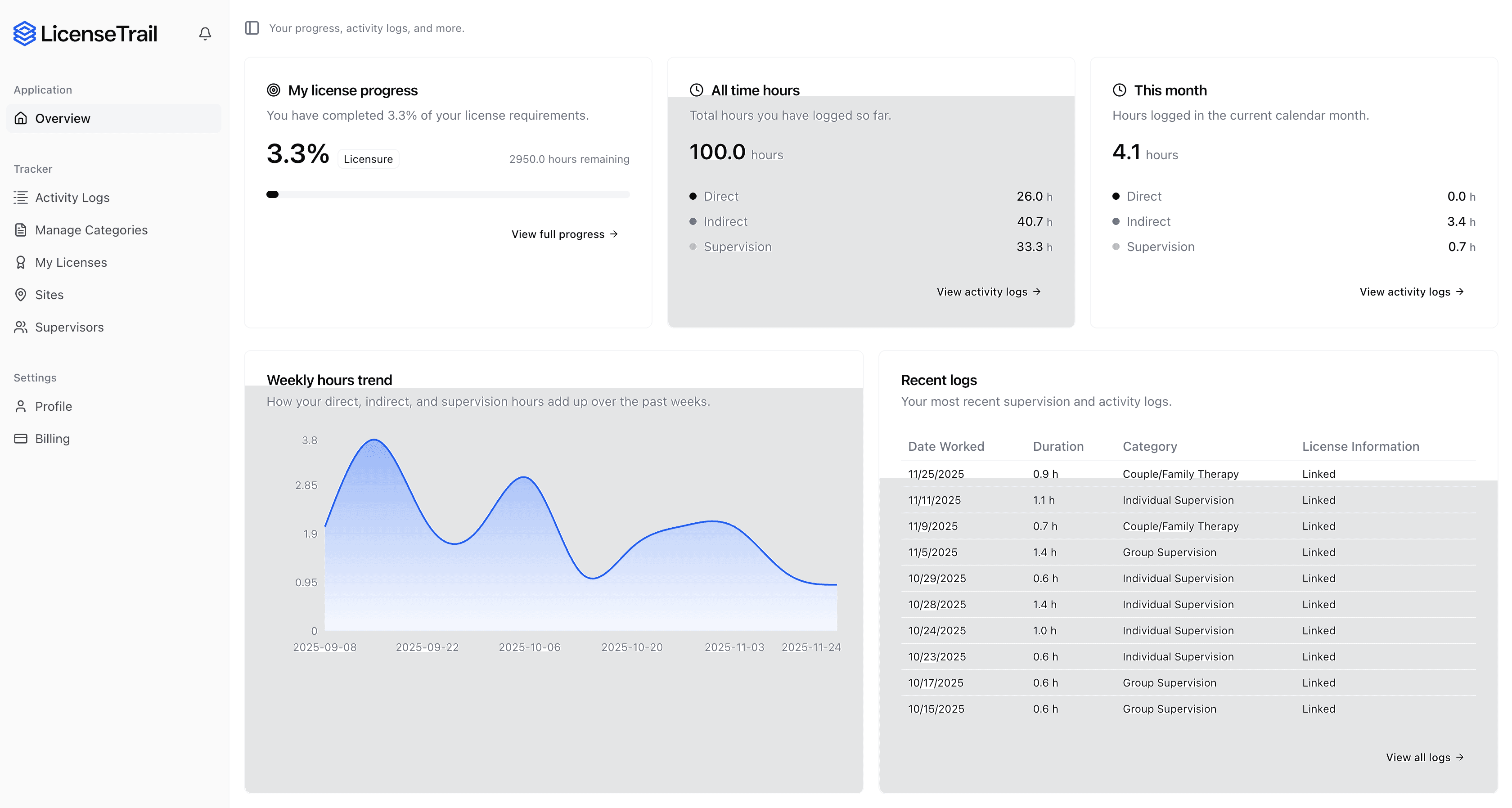
License Trail checks your direct, indirect, and supervision hours against Virginia LSP-I requirements continuously and flags mismatches before you submit.
 Start Tracking for Free
No credit card required · Free plan available
Is your spreadsheet hiding Virginia LSP-I risks?
Stop guessing if your categories match West Virginia Board of Examiners of Psychologists requirements. License Trail checks your direct, indirect, and supervision hours continuously and flags mismatches before you submit.
Import or log
Bring your spreadsheet or start fresh
Upload your existing tracking spreadsheet and we'll map every hour into the right West Virginia Board of Examiners of Psychologists categories automatically.
Verify against Virginia
Catch mismatches before the board does
License Trail checks your direct, indirect, and supervision hours against Virginia LSP-I requirements continuously.
Export board-ready
One-click clean reports
Generate professional, board-ready reports for supervision meetings and West Virginia Board of Examiners of Psychologists submissions in seconds.
No credit card required · Free plan available