
Virginia PLMFT Requirements: Hours, Exams & Step-by-Step Guide
Stop guessing if your categories match Virginia requirements. License Trail checks your direct, indirect, and supervision hours against PLMFT requirements continuously and flags mismatches before you submit.
No credit card required · Free plan available
Quick Requirements Overview
- Graduate degree meeting rule standards (typically 60 semester hrs/90 quarter hrs) + required MFT curriculum areas
- Degree must include 12-month supervised practicum with 300 direct-contact hrs; ≥50% with couples/families present
- Pass AMFTRB national MFT exam (generally 3 attempts within 12 months; passing score valid 5 years) before PLMFT issued
- Must hold PLMFT before starting post‑graduate supervised experience; unlicensed hours don’t count
- Post‑grad supervised experience: Master’s 3,000 hrs (≥2 years) / Doctoral 1,500 hrs (≥1 year); max 1,500 hrs credited per 12 months; Master’s may credit up to 600 practicum/internship hrs (doctoral: none)
- Experience content: ≥50% direct therapy; and ≥50% of direct therapy with couples/families present
- Supervision: ≥1 hr individual supervision per 20 practice hrs (if supervisor not on-site full-time: ≥2x/month); supervisor must be Board‑approved and meet licensure/experience/supervision‑training requirements
- PLMFT limits & term: no private practice/contract labor; must maintain continuous Board‑acceptable supervision; license valid 36 months + one 24‑month renewal (max 60 months)
License Details
Procedures
In West Virginia, the Provisional Licensed Marriage and Family Therapist (PLMFT) credential is the license you must hold while you complete the supervised post‑graduate experience required to become a fully Licensed Marriage and Family Therapist (LMFT). The credential and its requirements are governed by the West Virginia Board of Examiners in Counseling (WVBEC) under the Marriage and Family Therapist Licensing Rule (Title 27, Series 8 of the West Virginia Code of State Rules). (regulations.justia.com)
Below is a step‑by‑step outline of what the Board requires, with emphasis on the exact kinds of hours you need and how the Board defines them.
1. Regulatory framework and big‑picture structure
Key authorities:
- Statute: W. Va. Code §30‑31 (Professional Counselors; Marriage and Family Therapists) (code.wvlegislature.gov)
- Rule: Title 27, Series 8 – Marriage and Family Therapist Licensing Rule (Agency 27 – Counseling). (regulations.justia.com)
Licensure pathway:
- Complete an approved graduate program in marriage and family therapy (or equivalent).
- Complete a supervised clinical practicum during the degree.
- Pass the national MFT examination.
- Apply for and receive a Provisional LMFT license (PLMFT).
- While provisionally licensed, complete post‑graduate supervised experience (3,000 or 1,500 hours, depending on degree).
- Apply for full LMFT licensure.
The PLMFT itself does not require you to have already accrued the 3,000/1,500 post‑graduate hours; it is the license that allows you to accrue them in West Virginia. (regulations.justia.com)
2. Educational requirements and practicum hours (pre‑PLMFT)
2.1 Graduate degree
The Board requires a master’s or doctoral degree that meets the standards in §27‑8‑6:
- A master’s or doctoral degree in marriage and family therapy from a program accredited by COAMFTE, CACREP, NCACS, SACS, or a comparable body; or
- Another mental health graduate degree (60 semester or 90 quarter hours) that the Board finds equivalent to an MFT degree under the rule. (regulations.justia.com)
The degree must include at least 60 semester hours (or 90 quarter hours) of graduate coursework and specific MFT curriculum areas laid out in §27‑8‑6.6.1, such as marriage and family studies, systems theory, research, ethics, human development, appraisal, and others. (regulations.justia.com)
2.2 Practicum and direct‑contact hours (during the degree)
Within that degree, the Board’s rule explicitly requires a supervised clinical practicum that includes:
- A minimum of twelve months of supervised clinical practicum with
- 300 hours of direct contact with individuals, couples, and/or families, and
- At least 50% of those 300 hours must be with couples and families present. (regulations.justia.com)
This 300‑hour practicum is a pre‑licensure requirement; you must complete it before you can qualify academically for the PLMFT.
3. Standardized exam requirement (before PLMFT)
You must pass the national marriage and family therapy exam before the Board will issue a provisional license.
3.1 Exam type
Under §27‑8‑4 and §27‑8‑6.3:
- The Board requires the “Examination in Marital and Family Therapy” offered by the Association of Marital and Family Therapy Regulatory Boards (AMFTRB), or another exam approved by the Board. (regulations.justia.com)
3.2 Timing and validity
- You may sit for the exam within a 12‑month period with three attempts before needing additional Board permission. (regulations.justia.com)
- A passing exam score is valid for five years from the exam date for purposes of licensure. (regulations.justia.com)
For PLMFT, the Board expressly requires that you have “passed the required examination” before it issues the provisional license. (regulations.justia.com)
4. Supervised post‑graduate work experience (what you complete while PLMFT)
The supervised post‑graduate experience is laid out in §27‑8‑6.2 – “Supervised post‑graduate work experience”. This is what you must complete while holding the PLMFT in order to later qualify for full LMFT licensure.
4.1 Total supervised experience hours
The rule states:
-
Master’s degree holders:
“a minimum of 3000 hours of supervised marriage and family therapy experience, after earning a master’s degree in marriage and family therapy…” (regulations.justia.com)
-
Doctoral degree holders:
a minimum of 1500 hours of supervised marriage and family therapy experience after earning the doctoral degree. (regulations.justia.com)
4.2 Time frame and annual cap
The Board further specifies:
- Master’s‑level experience must be obtained in not less than two years. (regulations.justia.com)
- Doctoral‑level experience must be obtained in not less than one year. (regulations.justia.com)
- The Board may not credit more than 1500 hours of experience in any twelve‑month period. (regulations.justia.com)
So you cannot simply compress all hours into one year; the experience must be spread over the minimum time frames and within the annual cap.
4.3 How practicum hours can count toward the 3,000
For master’s‑level applicants only, the rule allows some credit from your graduate practicum/internship:
- You may receive up to 600 hours of credit toward the 3,000‑hour minimum for work completed in practicum and internship in your master’s program.
- The Board’s credentialing committee decides how many of those hours will be accepted.
- No practicum/internship hours may be credited toward the doctoral‑level 1,500‑hour requirement. (regulations.justia.com)
4.4 Direct client contact vs. other hours
The Board distinguishes direct provision of therapy from other professional activities:
- At least 50% of the supervised marriage and family therapy experience shall be in the direct provision of therapy to individuals, couples, or families. (regulations.justia.com)
In practical terms:
-
For a master’s‑level applicant completing 3,000 hours:
- At least 1,500 hours must be direct therapy (face‑to‑face or equivalent) with individuals, couples, or families.
- Up to 1,500 hours may be other clinical duties (documentation, consultation, training, etc.), provided overall requirements are met.
-
For a doctoral‑level applicant completing 1,500 hours:
- At least 750 hours must be direct therapy with individuals, couples, or families.
- Up to 750 hours may be other related professional activities.
4.5 Required work with couples and families
The rule also requires that a substantial portion of your direct therapy be with couples and families:
- Applicants must “make every effort to work with as many couples and families as possible,” and
- At least 50% of the 1,500 hours referenced in §6.2.c must be with couples and families present. (regulations.justia.com)
Read together with the 50%‑direct‑therapy rule and Board summaries, this means:
-
For a typical 3,000‑hour master’s‑level path:
- At least 1,500 hours: direct therapy.
- At least 750 of those direct hours with couples and families present.
-
For a 1,500‑hour doctoral‑level path:
- At least 750 hours: direct therapy.
- At least 375 of those direct hours with couples and families present.
This structure mirrors the Board‑linked and AAMFT summaries, which state that at least half of supervised hours must be direct client contact and at least half of those must be with couples and families. (aamft.org)
4.6 Supervision hours and ratio
Supervision is tightly defined in §27‑8‑6.2.f:
- The professional supervisor determines your activities.
- You must receive at least one hour of direct individual supervision for every 20 hours of practice, unless the supervisor decides more is needed. (regulations.justia.com)
That ratio implies minimum supervision hours:
- For 3,000 hours of supervised practice → at least 150 hours of individual supervision.
- For 1,500 hours of supervised practice → at least 75 hours of individual supervision.
Additional points:
- If the supervisor is not a full‑time employee of the same agency, supervision must occur at least twice each calendar month, while still meeting the 1:20 ratio. (regulations.justia.com)
- Supervisors must be reasonably available for telephone consultation and may not supervise more than four individual applicants. (regulations.justia.com)
- Supervision may occur in person or via secure, encrypted telecommunication. (regulations.justia.com)
4.7 Supervisor qualifications
The rule requires that the professional supervisor:
- Be pre‑approved by the Board.
- Be a Licensed Marriage and Family Therapist or Licensed Professional Counselor, licensed at least two years, with five years of therapy/counseling experience. (regulations.justia.com)
- Have completed Board‑approved training in clinical supervision (a graduate‑level supervision course or a 30‑hour CE course), or hold AAMFT Approved Supervisor status. (regulations.justia.com)
The supervisor must document their license, supervision training, therapy philosophy, and experience to the Board. (regulations.justia.com)
5. The Provisional LMFT license (PLMFT) itself
5.1 When you must obtain the PLMFT
Under §27‑8‑7.1, you must obtain the provisional license before starting supervised post‑graduate experience in West Virginia:
- “An applicant shall obtain a provisional license before the applicant begins his or her supervisory experience.”
- Hours obtained by an unlicensed person in any setting do not count toward the supervised experience requirements. (regulations.justia.com)
This means supervised hours you accrue without a PLMFT (or other acceptable license/permit recognized by the Board) will not be credited.
5.2 Criteria for the Board to issue a PLMFT
Per §27‑8‑7.2, the Board issues a provisional license to an applicant who:
- Has filed a licensure application in accordance with §3.1 of the rule (the Board’s standard LMFT application). (regulations.justia.com)
- Has met all licensure requirements, including:
- The academic requirements in §6 (degree + curriculum + practicum), and
- Passed the required examination in §6.3 (the national MFT exam). (regulations.justia.com)
- Has signed a statement, included in the application, affirming that they have read and understand the MFT Code of Ethics and the Board’s rules. (regulations.justia.com)
In practice, the Board and third‑party summaries indicate that a PLMFT application typically includes: (counselingschools.com)
- Completed online Provisional LMFT Application.
- Application fee.
- Official graduate transcripts showing the qualifying MFT degree and practicum.
- Two professional recommendations from master’s‑level mental health professionals.
- Three personal references.
- A supervision agreement/verification of supervision form signed by your Board‑approved supervisor.
- Criminal background check (including fingerprints).
5.3 Status and limitations while provisionally licensed
The rules impose clear practice limits on PLMFTs:
- PLMFTs remain under “professional supervision satisfactory to the Board” and may not be called a Licensed Marriage and Family Therapist or represented as such until fully licensed. (regulations.justia.com)
- Provisionally licensed marriage and family therapists are not permitted to operate their own private practice or practice in a contract labor position in any setting. They may practice only as part of their licensure supervisory requirement, as laid out in §6.2. (regulations.justia.com)
Supervision must also be:
- Continuous during the provisional licensing period; any interruption longer than six weeks must be reported in writing within 30 days. Failure to report may result in termination of the provisional license or other discipline. (regulations.justia.com)
- Board‑approved when it changes: any change of supervisor or job position must be approved before it occurs; otherwise, hours accrued between the change and Board approval do not count. (regulations.justia.com)
5.4 Duration and renewal of the PLMFT
Per §27‑8‑7.7:
- A provisional license is valid for 36 months.
- If you do not complete the supervised experience in those 36 months, you may renew the provisional license once for an additional 24 months, by written request and payment of a fee equal to the initial application fee. (regulations.justia.com)
The AAMFT and other state resources summarize this as a maximum of 60 months (5 years) to complete your supervised hours under a PLMFT in West Virginia. (aamft.org)
6. Putting the hour requirements together
6.1 During your MFT degree (before PLMFT)
- 300 hours minimum of direct client contact in a supervised clinical practicum.
- At least 150 hours (50%) of those with couples and families present.
- Practicum must span at least 12 months. (regulations.justia.com)
6.2 After the degree, while PLMFT (toward LMFT)
For a master’s‑level graduate:
- 3,000 hours of supervised MFT experience, accrued after the degree. (regulations.justia.com)
- Up to 600 hours may be credited from your graduate practicum/internship, with Board approval. (regulations.justia.com)
- At least 50% (1,500 hours) must be direct therapy to individuals, couples, or families. (regulations.justia.com)
- At least 50% of those direct hours (≈750 hours) must involve couples and families present. (regulations.justia.com)
- Maximum 1,500 hours per 12‑month period credited. (regulations.justia.com)
- Supervision: minimum 1 hour of individual supervision per 20 hours of practice → at least 150 supervision hours across 3,000 hours. (regulations.justia.com)
For a doctoral‑level graduate:
- 1,500 hours of supervised MFT experience after the doctoral degree. (regulations.justia.com)
- No practicum/internship credit toward this total. (regulations.justia.com)
- At least 50% (750 hours) must be direct therapy. (regulations.justia.com)
- At least 50% of the key direct‑contact block (~375 hours) must involve couples and families present. (regulations.justia.com)
- Same 1,500‑hours‑per‑year cap and 1:20 supervision ratio → at least 75 supervision hours. (regulations.justia.com)
These hour structures—300 direct practicum hours plus 3,000/1,500 supervised post‑graduate hours with the specified direct‑contact and couples/families proportions—are the Board’s core quantitative requirements that define West Virginia’s PLMFT and LMFT pathway. (regulations.justia.com)
7. Practical sequence to become a PLMFT in West Virginia
Putting the statutory and rule language into a practical timeline:
-
Complete an approved MFT graduate program
- Ensure it meets the 60‑credit and curriculum requirements in §27‑8‑6.
- Complete the required 12‑month practicum with 300 direct hours (50% couples/families).
-
Pass the national MFT examination (AMFTRB)
- Take the “Examination in Marital and Family Therapy” or Board‑approved equivalent.
- Remember the passing score is valid for five years.
-
Secure a Board‑qualifying supervisor and supervision plan
- Choose a supervisor who meets the Board’s license, experience, and supervision‑training criteria.
- Work out a plan that will allow you to meet the 3,000/1,500‑hour totals, the 50% direct‑therapy rule, and the couples/families requirements.
-
Submit the PLMFT application to WVBEC
- File the licensure application electronically (Provisional LMFT Application).
- Include transcripts, exam verification, supervision agreement, references, and fees as specified by WVBEC forms and instructions. (wvbec.org)
-
Receive the Provisional LMFT license (PLMFT)
- Once issued, you may begin accruing supervised post‑graduate hours in West Virginia.
- Do not start counting hours before the provisional license effective date.
-
Work under continuous supervision and track hours carefully
- Maintain the 1:20 supervision ratio and twice‑monthly supervision if your supervisor is off‑site.
- Ensure at least half of your hours are direct therapy and that couples/families constitute at least half of those direct hours.
- Report any supervision interruptions >6 weeks, and seek Board approval before changing supervisors or jobs.
-
Apply for full LMFT licensure when hour and supervision requirements are met
- Submit the Board’s verification forms documenting total supervised hours, direct‑client and couples/families hours, and supervision received, all signed by your supervisor. (regulations.justia.com)
This reflects the requirements currently in effect through the June 19, 2025 update to the Marriage and Family Therapist Licensing Rule. For actual application filing, always cross‑check WVBEC’s own site and forms, as administrative details (fees, specific form names, and electronic processes) can change more frequently than the underlying rule.
Track your PLMFT hours with confidence
License Trail checks your direct, indirect, and supervision hours against Virginia PLMFT requirements continuously and flags mismatches before you submit.
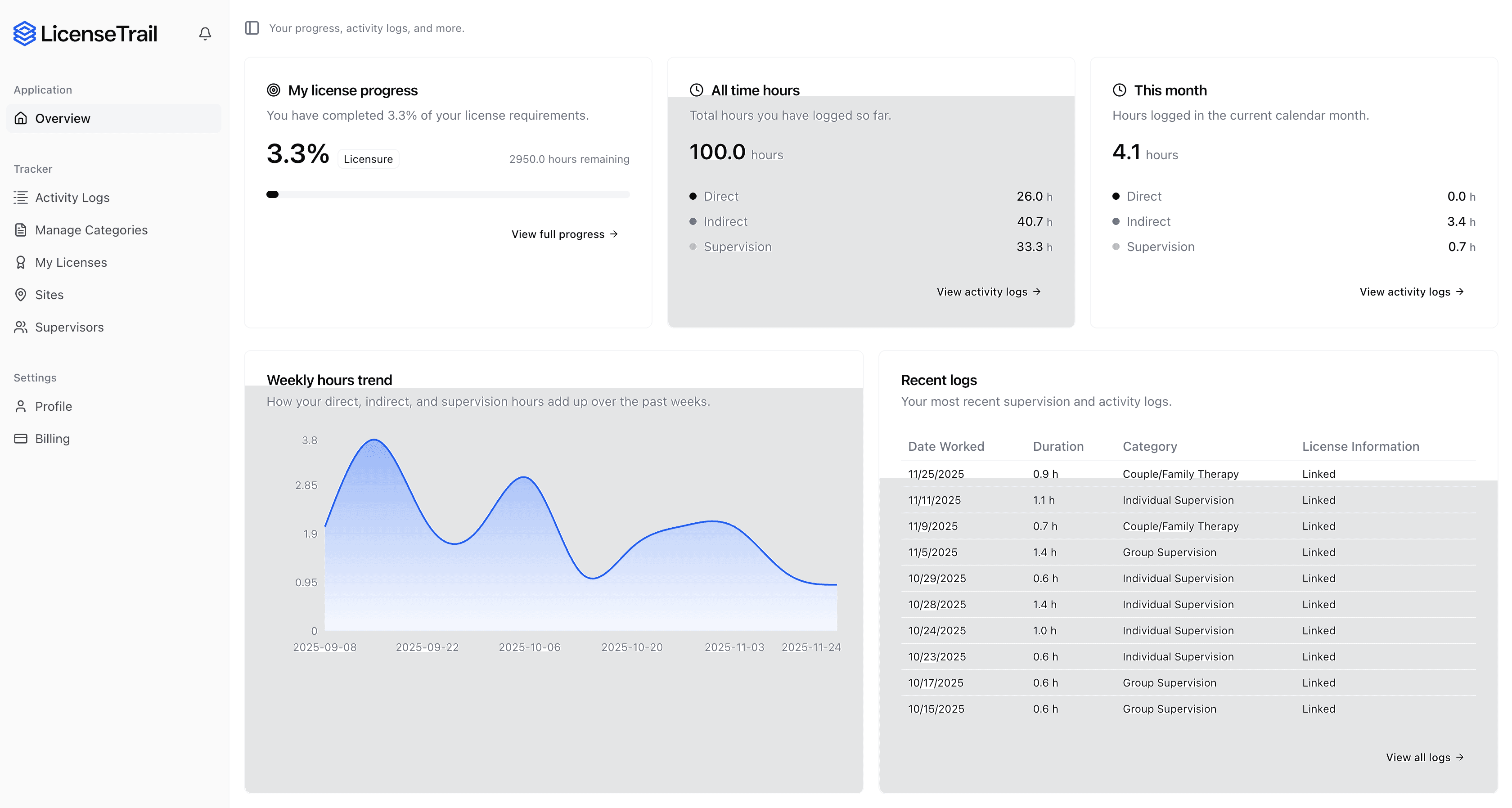 Start Tracking for Free
No credit card required · Free plan available
Is your spreadsheet hiding Virginia PLMFT risks?
Stop guessing if your categories match West Virginia Board of Examiners in Counseling requirements. License Trail checks your direct, indirect, and supervision hours continuously and flags mismatches before you submit.
Import or log
Bring your spreadsheet or start fresh
Upload your existing tracking spreadsheet and we'll map every hour into the right West Virginia Board of Examiners in Counseling categories automatically.
Verify against Virginia
Catch mismatches before the board does
License Trail checks your direct, indirect, and supervision hours against Virginia PLMFT requirements continuously.
Export board-ready
One-click clean reports
Generate professional, board-ready reports for supervision meetings and West Virginia Board of Examiners in Counseling submissions in seconds.
No credit card required · Free plan available