
Virginia PLC Requirements: Hours, Exams & Step-by-Step Guide
Stop guessing if your categories match Virginia requirements. License Trail checks your direct, indirect, and supervision hours against PLC requirements continuously and flags mismatches before you submit.
No credit card required · Free plan available
Quick Requirements Overview
- Provided text describes West Virginia (WVBEC) requirements (not VA) for Provisionally Licensed Counselor (PLC)
- Education: Master’s+ in counseling/related; 60 semester hrs (90 quarter hrs); CACREP/CORE/NCATE/SACS or Board-approved; includes practicum + internship
- Exam: Pass one—NCE or NCMHCE or CRC (official scores sent to Board / permission to test)
- Application items (typical): online application + fee; 2 professional recs; 3 personal references; official transcripts; photo; background/legal disclosures (incl. SSN)
- Practice limits while PLC: must be under supervision; no private practice; no contract-only roles; approved site; approved supervisor onsite during services; title must be “Provisionally Licensed Counselor” (no abbreviation)
- Hours to upgrade to LPC: 3,000 counseling activity hrs post-master’s while PLC, incl. 1,500 direct client hrs (50%)
- Supervision: 150 hrs individual supervision with ALPS, 1:20 ratio; at least biweekly/continuous (hours may not count if missed)
- Timing cap: max 1,500 activity hrs per 12 months → minimum ~19 months supervised period before LPC upgrade submission (SVA + logs)
License Details
Procedures
West Virginia regulates professional counseling through the West Virginia Board of Examiners in Counseling (WVBEC). The Board issues two main counseling credentials:
- Provisionally Licensed Counselor – your supervised, pre‑independent license (often called Provisional Licensed Professional Counselor, Provisional LPC, or PLPC in school/employer materials). (wvbec.org)
- Licensed Professional Counselor (LPC) – full, independent license once all supervision requirements are completed.
Becoming a Provisionally Licensed Counselor is the gateway to accumulating the supervised hours that lead to independent LPC status. The sections below walk through both (1) how to get the provisional license and (2) the exact supervised hour requirements you must meet while provisionally licensed.
1. Education requirements
The Board’s licensing rule and multiple official/academic summaries agree on the core education standard: (pdf4pro.com)
- Degree level:
- At least a master’s degree (or higher) in counseling or a closely related counseling field.
- Program accreditation:
- The program must be accredited by CACREP (Council for Accreditation of Counseling & Related Educational Programs), CORE, NCATE/SACS or another Board‑approved equivalent accrediting body.
- Credit hours:
- Minimum of 60 semester hours (or 90 quarter hours) of graduate coursework.
- Required curricular content:
- Coursework in at least 12 core areas such as counseling theories, counseling techniques, human growth and development, social and cultural foundations, appraisal, professional responsibilities, principles of etiology (diagnosis/psychopathology), addictions, group counseling, career/lifestyle development, marriage/couple/family, and research/evaluation (language varies slightly by source, but content areas are consistent). (onlinegrad.pepperdine.edu)
- Practicum and internship:
- Your program must include both a supervised practicum and supervised internship in counseling as part of those 60 hours. (counselingschools.com)
2. Exam requirement
To qualify for a Provisional Licensed Counselor credential, you must pass one Board‑approved national counseling examination: (wvbec.org)
- National Counselor Examination (NCE), or
- National Clinical Mental Health Counseling Examination (NCMHCE), or
- Certified Rehabilitation Counselor examination (CRC).
Applicants must either receive permission from WVBEC to sit for the exam as part of the application process, or (if they already passed one of these exams) have official scores sent directly to the Board. (wvbec.org)
3. Application for Provisional Licensed Counselor
On the Board’s website, the provisional license is handled under the general “Becoming a Licensed Counselor” section and the electronic application system. (wvbec.org)
Typical elements the Board or official school licensure disclosures list for a Provisional LPC / Provisionally Licensed Counselor application include: (counselingschools.com)
- Completed online application through the WVBEC database portal.
- Application fee (often cited as around $250 in third‑party summaries; confirm current fee on the Board’s fee schedule). (counselingschools.com)
- Two professional recommendations from counseling‑related professionals (typically master’s‑level or higher).
- Three personal reference letters.
- Official graduate transcripts sent directly from your university.
- Verification of exam – official NCE/NCMHCE/CRC scores sent to WVBEC.
- Photograph (recent headshot) attached as directed in the application instructions. (phoenix.edu)
- Background and legal disclosures, including:
- Social Security number (for state requirements),
- Responses to questions about criminal convictions or disciplinary actions. (phoenix.edu)
The Board notes that applicants must submit a completed application before it will either (a) grant permission to take an exam, or (b) issue a provisional licensure certificate. (wvbec.org)
4. Official title and practice limitations under the provisional license
Title you must use
WVBEC specifies that while you are under supervision: (wvbec.org)
- The title for a supervised counselor with a provisional license is “Provisionally Licensed Counselor.”
- This title may not be abbreviated (e.g., you should not sign notes as “PLPC” or “PLC”).
This is the Board’s terminology; many schools and employers will still talk about “Provisional Licensed Professional Counselor (PLPC)” or “Provisional LPC,” but your legal title in West Virginia documentation is “Provisionally Licensed Counselor.” (wvbec.org)
Where and how you can practice
While holding the provisional license: (wvbec.org)
- You must work under supervision as part of your licensure plan.
- You cannot operate your own private practice.
- You cannot work in contract‑only positions; employment must fit the Board’s supervisory structure.
- An ALPS (Approved Licensed Professional Supervisor) or another approved licensed mental health professional must be onsite whenever you are providing counseling services.
- You practice only at Board‑approved sites that match the job description and supervision contract on file.
5. Supervised experience requirements while provisionally licensed
Once you hold the provisional license, you begin accruing the supervised experience required to upgrade to full LPC. These requirements are set by WVBEC’s Licensing Rule (Series 1) and detailed in the Board’s Supervision FAQ. (pdf4pro.com)
5.1 Total counseling activity hours
Under the Board’s current guidance, a master’s‑level applicant must complete:
- 3,000 counseling activity hours (post‑master’s, obtained while provisionally licensed).
The Board’s supervision FAQ sets out the core numbers explicitly:
- “3000 counseling activity hours”
- “1500 hours must be in direct provision of the client(s) – 50% of the total counseling activity hours”
- “150 individual supervision hours with your ALPS.” (wvbec.org)
These three bullet points are treated as separate requirements, not overlapping categories.
For applicants with a doctoral degree in counseling, state and academic summaries describe a reduced requirement of 1,500 hours of post‑degree supervised professional counseling experience, with at least 50% in direct client contact. (research.com)
5.2 Direct vs. other counseling hours
Using the Board’s language and related rule definitions: (wvbec.org)
-
Direct counseling hours (minimum 1,500):
- Hours in the “direct provision of the client(s)” – i.e., face‑to‑face or synchronous counseling/therapy sessions with individuals, couples, families, or groups, where you are actively providing clinical counseling services.
- Must be at least 50% of your total counseling activity hours (1,500 of the 3,000).
-
Other counseling activity hours (up to 1,500):
- The Board’s licensing rule defines “counseling experience” as professional responsibilities in the direct provision of counseling services or such indirect services… as may be approved by the Board. (pdf4pro.com)
- In practice, the remaining 1,500 hours commonly include:
- Case documentation and treatment planning,
- Consultation with other providers,
- Phone or telehealth follow‑up,
- Certain administrative or program duties tied to client care,
- Other Board‑approved indirect counseling services.
These non‑direct hours still count toward the 3,000 counseling activity hours, as long as they fit the Board’s definition and occur under approved supervision.
5.3 Individual supervision hours (separate from the 3,000)
WVBEC treats individual supervision as its own tracked category: (wvbec.org)
- Total individual supervision required:
- 150 hours of individual supervision with an ALPS (Approved Licensed Professional Supervisor) for a master’s‑level applicant.
- Required ratio:
- For every 20 hours of total counseling activity, you must have 1 hour of individual supervision with your ALPS.
- Frequency and continuity:
- Individual supervision must be continuous and occur at least every two weeks.
- The FAQ emphasizes that counseling activity hours “cannot be counted” if this requirement is not met. (wvbec.org)
This supervision is generally in addition to the 3,000 counseling activity hours (i.e., you track “counseling activity” and “individual supervision” separately on quarterly logs).
The Licensing Rule further distinguishes between: (pdf4pro.com)
- Direct counselor supervision – face‑to‑face or interactive contact (in‑person, phone, video, secure electronic) that focuses on the required practice areas.
- Indirect counselor supervision – review of reports, case notes, test data, and other representations of the supervisee’s work.
The 150 required supervision hours refer to individual, direct supervision with your ALPS, not just informal indirect oversight.
5.4 Timeframe limits and pacing
The Board sets clear timing and pacing rules for counting supervised experience toward LPC: (wvbec.org)
- WVBEC will not credit more than 1,500 counseling activity hours in any 12‑month period.
- The supervision FAQ notes:
- “1500 supervised counseling hours is the maximum number of hours that can be obtained in 12 months.”
- This “equates to a minimum duration of 19 months of continued supervised counseling experience.”
- If there are gaps in supervision, additional time is required to meet this minimum timeframe.
Because of the 1,500‑per‑year cap, even if you work full‑time you cannot compress the supervision into a single year. Many summaries describe the experience requirement as “two years / 3,000 hours of post‑master’s supervised professional counseling experience,” which aligns with how supervision typically unfolds in practice. (counselor-education.com)
Your ALPS and the Board can require longer than the minimum if your supervisor feels more experience is needed before recommending you for independent LPC licensure. (wvbec.org)
6. Supervisor qualifications (ALPS)
Your primary supervisor during the provisional period must be an Approved Licensed Professional Supervisor (ALPS) or another LPC approved by the Board under the ALPS criteria. Key points from the Board: (wvbec.org)
- The professional supervisor must:
- Be pre‑approved by the Board,
- Be a Licensed Professional Counselor, permanently licensed for at least 2 years, and
- Have five years of counseling experience (licensed or unlicensed, if documented).
- Supervisors must complete specific training in clinical counseling supervision (15 or 30 contact hours depending on length of counseling experience).
- An ALPS must sign:
- The Supervisor Registration Form/Contract,
- Your job description, and
- The Supervisor’s Verification and Assessment (SVA) forms and quarterly log summaries.
You are responsible for keeping copies of your quarterly logs and ensuring that supervision hours and counseling activity hours are accurately tracked and aligned with Board requirements. (wvbec.org)
7. Upgrading from Provisional Licensed Counselor to full LPC
After you have: (wvbec.org)
- Completed 3,000 counseling activity hours (with at least 1,500 direct client hours),
- Accumulated 150 hours of individual supervision at a 1:20 ratio,
- Met the minimum timeframe (at least 19 months and effectively about two years of supervised practice under Board rules), and
- Satisfied any additional experience your ALPS believes you need,
your ALPS will:
- Determine the next scheduled WVBEC meeting date, and
- Submit a final Supervisor’s Verification and Assessment (SVA) and the final quarterly log summarizing all hours, at least two weeks before that meeting. (wvbec.org)
You must remain in supervision and continue practicing as a Provisionally Licensed Counselor until the Board formally votes to grant you full Licensed Professional Counselor (LPC) status and notifies you of its decision. (wvbec.org)
8. Summary of hour types and numbers (master’s‑level pathway)
All hours are post‑master’s, completed while you hold the provisional license:
- 3,000 counseling activity hours, of which: (wvbec.org)
- 1,500 hours minimum must be direct counseling with clients (“direct provision of the client(s)” – 50% of total).
- Up to 1,500 hours may be other Board‑approved counseling activity (indirect but counseling‑related tasks).
- 150 hours of individual supervision with an ALPS,
- At a rate of 1 hour supervision / 20 hours counseling activity,
- Occurring at least every two weeks, continuously. (wvbec.org)
- Maximum 1,500 counseling activity hours per 12 months can be credited, producing a minimum supervision duration of 19 months (and typically about two years). (wvbec.org)
This is the structure the West Virginia Board of Examiners in Counseling applies when moving someone from Provisionally Licensed Counselor to Licensed Professional Counselor, and it is the key supervised‑experience framework attached to the provisional counseling license in West Virginia.
Track your PLC hours with confidence
License Trail checks your direct, indirect, and supervision hours against Virginia PLC requirements continuously and flags mismatches before you submit.
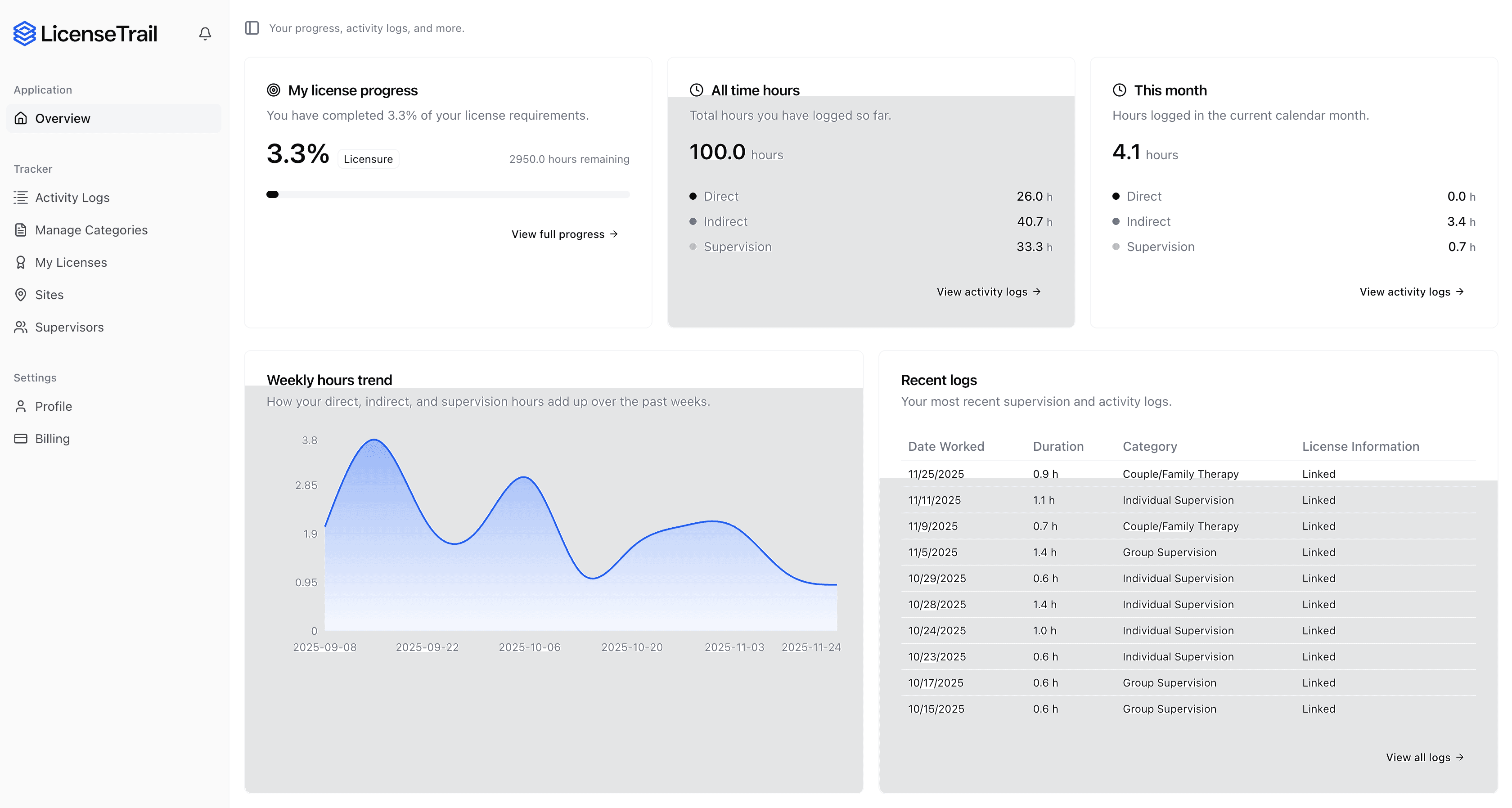 Start Tracking for Free
No credit card required · Free plan available
Is your spreadsheet hiding Virginia PLC risks?
Stop guessing if your categories match West Virginia Board of Examiners in Counseling requirements. License Trail checks your direct, indirect, and supervision hours continuously and flags mismatches before you submit.
Import or log
Bring your spreadsheet or start fresh
Upload your existing tracking spreadsheet and we'll map every hour into the right West Virginia Board of Examiners in Counseling categories automatically.
Verify against Virginia
Catch mismatches before the board does
License Trail checks your direct, indirect, and supervision hours against Virginia PLC requirements continuously.
Export board-ready
One-click clean reports
Generate professional, board-ready reports for supervision meetings and West Virginia Board of Examiners in Counseling submissions in seconds.
No credit card required · Free plan available