
Virginia SVP Requirements: Hours, Exams & Step-by-Step Guide
Stop guessing if your categories match Virginia requirements. License Trail checks your direct, indirect, and supervision hours against SVP requirements continuously and flags mismatches before you submit.
No credit card required · Free plan available
Quick Requirements Overview
- No-fee SVP license for retired/retiring psychologists to provide uncompensated services to indigent/needy patients (WV Board of Examiners of Psychologists)
- Must be currently licensed or “otherwise eligible for WV licensure” (meets all standard licensure requirements except fees)
- Education: Doctorate (PhD/equiv) or Master’s in psychology (Board-determined adequacy)
- Experience (Doctoral): 1,800-hour predoctoral supervised internship (counts as ≥ 1 year Board-approved supervised experience)
- Experience (Master’s): 5 years post-grad Board-approved supervised experience; ≥2 supervising psychologists; “year” = 12 full-time months (part-time prorated)
- Supervision structure (toward licensure): 1 hr individual supervision/20 hrs practice and ≥1 hr/week (no less frequent than every 2 weeks); supervisor countersigns reports
- Practice + immunity conditions: work only via qualifying free clinic, with written clinic agreement and ≥$1M/occurrence clinic liability coverage; civil immunity applies except gross negligence/willful misconduct; CE required (generally 20 hrs/2-year, incl 3 ethics + 2 veterans/family)
License Details
Procedures
West Virginia’s “Special Volunteer Psychologists License” (often abbreviated SVP or “special volunteer psychologist”) is a distinct, no‑fee license that lets retired or retiring psychologists provide uncompensated services to indigent patients, with limited civil immunity, under the West Virginia Board of Examiners of Psychologists.
This license is created by West Virginia Code §30‑21‑17 and implemented in the Board’s legislative rule at W. Va. Code R. §17‑3‑22.(code.wvlegislature.gov)
What follows is a structured guide to:
- The underlying licensure requirements (including hours and supervised experience),
- The additional conditions specific to the Special Volunteer Psychologists License,
- How the Board defines key terms like “years” of supervised experience and supervision ratios,
- And what is not required (there is no separate SVP‑specific hour quota).
1. What the Special Volunteer Psychologists License Is
State law establishes “a special volunteer psychologists license for psychologists retired or retiring from the active practice of psychology” who want to donate their expertise to “indigent and needy” patients in clinics that deliver health care services without charge.(code.wvlegislature.gov)
Key features:
- Purpose: Provide free psychological services to indigent and needy patients in West Virginia through clinics organized (in whole or in part) to provide care without charge.
- Cost: No application fee, license fee, or renewal fee.(code.wvlegislature.gov)
- Scope: Practice under this license must be exclusively devoted to psychological care for needy/indigent persons in West Virginia; no compensation is allowed.
- Civil immunity: If you meet statutory conditions, you receive immunity from civil liability for acts/omissions in providing those services, except for gross negligence or willful misconduct.(code.wvlegislature.gov)
The Board’s rule at 17‑3‑22 essentially mirrors and elaborates on §30‑21‑17 and is the operative Board “verbiage” on this license.(law.cornell.edu)
2. Baseline Requirement: You Must Be Licensed or “Otherwise Eligible for Licensure”
The statute is explicit that the special volunteer license can only be issued to psychologists who are:
- Already licensed, or
- “Otherwise eligible for licensure” under §30‑21‑7 and the Board’s rules.(code.wvlegislature.gov)
“Otherwise eligible for licensure” is defined in §30‑21‑17(e) and repeated in 17‑3‑22: you must satisfy all standard licensure requirements except paying fees.(code.wvlegislature.gov)
So the starting point is: you must meet normal West Virginia requirements to be a psychologist (or school psychologist, if that is the license type you would hold), including education and supervised experience hours/years.
2.1. Education
Under §30‑21‑7(a), to be eligible for a psychology license you must:(code.wvlegislature.gov)
- Be at least 18 years old.
- Be of good moral character.
- Hold either:
- A doctoral degree (Ph.D. or equivalent) in psychology from an accredited institution, or
- A master’s degree in psychology from an accredited institution, with “adequate course study” in psychology (as judged by the Board).
2.2. Doctoral path – internship hours and supervised experience
For doctoral‑level applicants, West Virginia law sets a specific hour requirement for internship:
- When the degree is doctoral (Ph.D. or equivalent), at least 1,800 hours must be a predoctoral internship in the performance of the psychological services listed in the statute’s definition of “practice of psychology” (testing, therapy, evaluation, etc.).(code.wvlegislature.gov)
The Board’s rule on “Adequacy of Supervised Experience” states that when the applicant holds a Ph.D. or equivalent, §30‑21‑7(a)(4) requires at least one year of Board‑approved supervised experience.(law.cornell.edu)
Important points about these hours/experience:
- The 1,800‑hour internship must involve work that falls within the statutory definition of the practice of psychology, not just routine tasks.
- The Board clarifies what counts as acceptable supervised experience: it must be true “practice of psychology” (e.g., psychological evaluation, psychotherapy, interpretation of tests) and not just routine, pre‑professional tasks like scoring structured tests or basic clerical work.(law.cornell.edu)
- For doctoral applicants, this one year of Board‑approved supervised experience is generally satisfied by the 1,800‑hour predoctoral internship, and West Virginia does not impose a separate, additional postdoctoral‑hours requirement the way some states do. Secondary sources discussing West Virginia licensure uniformly describe 1,800 supervised internship hours as the state’s minimum supervised‑hours requirement for doctoral licensure.(research.com)
So, if you are doctoral‑level:
Experience requirement (doctorate): at least 1,800 hours of supervised predoctoral internship in psychological practice, constituting at least one year of Board‑approved supervised experience.
2.3. Master’s path – five years of supervised post‑graduate practice
For master’s‑level psychologists, §30‑21‑7(a)(4) requires:(code.wvlegislature.gov)
- A master’s degree in psychology, and
- At least five years’ experience after receiving the degree in performing psychological services described in §30‑21‑2(e).
The Board’s rule 17‑3‑5 is more specific:
- Masters‑degree applicants must earn “five (5) years of post‑graduate Board‑approved supervised experience.”
- A minimum of two Board‑approved supervising psychologists is required over those five years (they may be concurrent or sequential).(law.cornell.edu)
The Board also defines how a “year” of supervised experience is counted:
- A year = twelve average work months of full‑time employment (using the employer’s full‑time schedule).(law.cornell.edu)
- Part‑time employment is prorated: the number of hours per week is divided by 40, and that fraction is applied to the months worked to determine months of credit. (Example: 16 months at 20 hours/week = credit for 8 months of supervised experience.)(law.cornell.edu)
The regulations do not convert these five years into a fixed number of total hours (e.g., “6,000 hours”). The controlling requirement is years of Board‑approved supervised experience as defined above.
Experience requirement (master’s): five years of post‑graduate, Board‑approved supervised practice, with at least two supervising psychologists, counted per the Board’s “year” definition and prorating rule.
2.4. Supervision ratio during those supervised years
For applicants working under supervision toward licensure (“Supervised‑Psychologists”), the Board requires a specific supervision ratio:
- Minimum 1 hour of individual supervision per 20 hours of clinical practice, and
- At least 1 hour of individual supervision per week, regardless of total hours worked, with sessions no less frequent than every 2 weeks.(law.cornell.edu)
Individual supervision is defined as private, face‑to‑face interaction (in person or, if approved, secure video) between supervisor and supervisee. All professional opinions/reports by the supervised‑psychologist must be countersigned by the supervisor.(law.cornell.edu)
While this doesn’t give a total hour count for supervision across the five years, it specifies how those supervised years must be structured.
3. Additional Requirements Specific to the Special Volunteer Psychologists License
Once you meet (or previously met) the underlying licensure requirements, you must also satisfy conditions that are unique to the special volunteer license.
3.1. Retired or retiring, with license in good standing
The special volunteer license is explicitly for psychologists “retired or retiring from the active practice of psychology.”(code.wvlegislature.gov)
The Board’s rule adds that:
- You must have retired with a license in good standing in the state in which you were practicing at the time of retirement; and
- The Board (WVBEP) has sole discretion to issue or refuse the special volunteer license, especially if your prior license was disciplined or not in good standing, or if too much time has elapsed since you were last licensed.(law.cornell.edu)
The statute also states that nothing requires the Board to issue this license to anyone whose license has been subject to disciplinary action, surrendered, lapsed/expired in lieu of discipline, placed inactive in lieu of discipline, or denied.(code.wvlegislature.gov)
3.2. “Otherwise eligible for licensure”
If you are not currently licensed in West Virginia, you can still obtain a special volunteer license if you are “otherwise eligible for licensure.” That means:
- You meet all requirements of §30‑21‑7 and the associated rules (education, supervised experience, moral character, examination, etc.),
- Except for payment of fees.(code.wvlegislature.gov)
3.3. Application and required acknowledgments
The Board’s rule 17‑3‑22 requires you to complete an application obtained from the West Virginia Board of Examiners of Psychologists and to indicate that you understand and agree to several specific conditions, including:(law.cornell.edu)
-
Scope of practice under this license
Your practice under the special volunteer license will be exclusively devoted to providing psychological care to needy and indigent persons in West Virginia. -
No compensation
You will not receive any payment or compensation, direct or indirect, nor have any expectation of payment, for services rendered under the special volunteer license. (The general statute allows donation of any reimbursement to the clinic, but you cannot keep it.(code.wvlegislature.gov)) -
Documentation
You agree to supply any supporting documentation that the Board may reasonably require. -
Continuing education
You agree to participate in continuing education as required by the Board for a special volunteer license.
The Board also emphasizes:
- Applicants must have had a valid license in good standing at the time of application or as of their retirement, and
- The Board reserves the right to refuse a special volunteer license if the applicant is “unfit to practice psychology,” taking into account, among other things, the time since last licensure.(law.cornell.edu)
4. Practice Conditions and Civil Immunity
To obtain the civil immunity provided by §30‑21‑17 and 17‑3‑22, several conditions must be met:(code.wvlegislature.gov)
-
Clinic setting & patient population
- Services must be rendered to indigent and needy patients of a clinic organized (in whole or in part) to deliver health care services without charge.
- Services may be provided in the clinic itself; the statute also allows arrangements whereby an actively licensed psychologist (not necessarily retired) may serve indigent patients via such a clinic arrangement, including from the psychologist’s office, but the special volunteer license is tied specifically to the retired/retiring status.(code.wvlegislature.gov)
-
Written agreement with the clinic
- There must be a written agreement between you and the clinic specifying that you will provide voluntary, uncompensated psychological services under the clinic’s control before you begin services.(code.wvlegislature.gov)
-
Clinic’s liability coverage
- Any clinic entering into such an agreement must maintain not less than $1 million per occurrence in liability coverage.(code.wvlegislature.gov)
-
Scope of immunity
- If the above conditions are met and you receive no compensation, you are immune from civil actions for acts or omissions in providing those services, except where the act/omission is due to gross negligence or willful misconduct.
- The clinic itself is not relieved of its imputed liability for your negligent acts.(code.wvlegislature.gov)
The statute also requires liability insurers to waive using this statutory immunity as a defense against paying covered claims within policy limits.(code.wvlegislature.gov)
5. Continuing Education Hours While on a Special Volunteer License
Both statute and rule require the volunteer psychologist to participate in continuing education as determined by the Board. Neither §30‑21‑17 nor §17‑3‑22 sets a different CE hour amount specifically for special volunteers, so the default Board CE rules for psychologists apply unless the Board grants an explicit exception.(code.wvlegislature.gov)
Under §17‑3‑20:
- Licensed Psychologists and Supervised‑Psychologists must complete at least 20 hours of Board‑approved continuing education every 2‑year renewal cycle, including:
- 3 hours in ethics, and
- 2 hours on mental health conditions common to veterans and their family members (these 2 hours are part of the 20).(law.cornell.edu)
Because special volunteer licensees remain “license holders” subject to §30‑21‑17’s CE requirement, you should plan on meeting this 20‑hour/2‑year standard (unless the Board gives you specific written guidance to the contrary).
6. What Is Not Required for the Special Volunteer Psychologists License
Several things that sometimes exist in other states or in other special volunteer schemes are not found in the West Virginia law or Board rules for this license:
-
No extra SVP‑specific practice‑hour minimums.
There is no requirement in §30‑21‑17 or §17‑3‑22 that you perform a specified minimum number of volunteer service hours (e.g., 100 hours/year) to hold or renew the special volunteer license. The requirements focus instead on:- Your underlying licensure eligibility and supervised‑experience hours/years,
- Your retired or retiring status with a license in good standing,
- The uncompensated nature and indigent‑care focus of the work,
- The presence of a compliant clinic agreement and insurance.(code.wvlegislature.gov)
-
No separate “direct vs. supervised” hour split beyond the internship and supervised‑experience rules.
West Virginia does not state requirements like “X hours of direct client contact plus Y hours of supervision” in its statutes for psychologists. Instead, it requires:- A 1,800‑hour predoctoral internship for doctoral applicants;(code.wvlegislature.gov)
- Five years of post‑graduate supervised experience for master’s applicants;(law.cornell.edu)
- A specific supervision ratio of 1 hour of individual supervision per 20 hours of clinical practice (with weekly minimums) during supervised practice;(law.cornell.edu)
rather than prescribing fixed totals (e.g., “1,500 direct + 1,500 supervised”).
-
No fees.
There are no application, license, or renewal fees for the special volunteer psychologist license.(code.wvlegislature.gov)
Summary
To become licensed as a Special Volunteer Psychologist with the West Virginia Board of Examiners of Psychologists, you must:
-
Meet the full underlying requirements for psychologist licensure in West Virginia:
- Doctoral path: doctoral degree + 1,800 supervised internship hours (one year of Board‑approved supervised experience) and exam.(code.wvlegislature.gov)
- Master’s path: master’s degree + five years of post‑graduate, Board‑approved supervised practice, structured under the Board’s supervision and “year” definitions.(law.cornell.edu)
-
Be retired or retiring, with a psychology license in good standing (in West Virginia or your prior state), and free of disqualifying disciplinary history.(code.wvlegislature.gov)
-
Complete the Board’s special volunteer license application and formally agree:
- To limit practice under this license exclusively to needy and indigent persons in West Virginia,
- To accept no compensation,
- To supply documentation as required,
- To maintain continuing education, generally at least 20 CE hours per 2‑year cycle, including ethics and veterans’ mental‑health training.(law.cornell.edu)
-
Arrange to practice only through properly insured free clinics, with a written agreement in place, in order to receive the statute’s civil immunity protections.(code.wvlegislature.gov)
No additional SVP‑specific hour quotas are imposed. The key “hours” components are the internship and supervised‑experience requirements used to qualify (or remain qualified) as a psychologist under West Virginia law.
Track your SVP hours with confidence
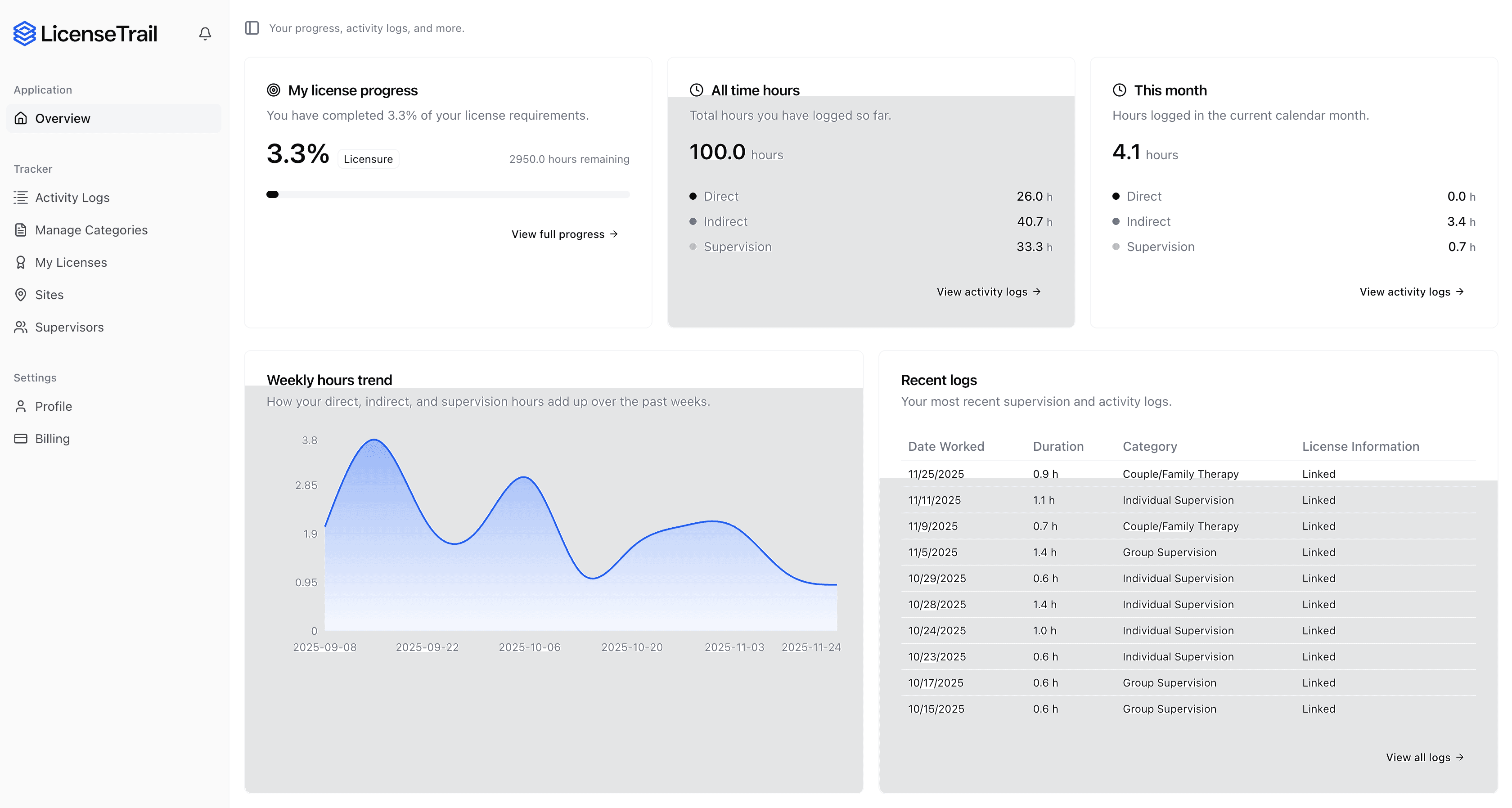
License Trail checks your direct, indirect, and supervision hours against Virginia SVP requirements continuously and flags mismatches before you submit.
 Start Tracking for Free
No credit card required · Free plan available
Is your spreadsheet hiding Virginia SVP risks?
Stop guessing if your categories match West Virginia Board of Examiners of Psychologists requirements. License Trail checks your direct, indirect, and supervision hours continuously and flags mismatches before you submit.
Import or log
Bring your spreadsheet or start fresh
Upload your existing tracking spreadsheet and we'll map every hour into the right West Virginia Board of Examiners of Psychologists categories automatically.
Verify against Virginia
Catch mismatches before the board does
License Trail checks your direct, indirect, and supervision hours against Virginia SVP requirements continuously.
Export board-ready
One-click clean reports
Generate professional, board-ready reports for supervision meetings and West Virginia Board of Examiners of Psychologists submissions in seconds.
No credit card required · Free plan available