
Virginia SP Requirements: Hours, Exams & Step-by-Step Guide
Stop guessing if your categories match Virginia requirements. License Trail checks your direct, indirect, and supervision hours against SP requirements continuously and flags mismatches before you submit.
No credit card required · Free plan available
Quick Requirements Overview
- Provided text describes West Virginia (WV) “Supervised‑Psychologist (SP)” rules, not Virginia (VA); VA requirements can’t be confirmed from this text.
- Supervised practice is measured in years of employment (not a fixed hour total); a “year” = 12 full‑time work months, part‑time prorated by (hours/week ÷ 40).
- Duration required: Doctoral = 1 year (with approved internship) or 2 years (without internship); Master’s = 5 years supervised practice.
- Employment condition: SP must be a W‑2 employee in the state; no independent contractor practice while supervised.
- Supervision minimums: 1 hour individual supervision per 20 hours of clinical practice, plus ≥1 hour/week and sessions at least every 2 weeks; full‑time requires ≥6 hrs/month individual face‑to‑face (up to 2 hrs/month may be group/other).
- Documentation: Board‑approved supervision contract before starting; quarterly reports; supervisor must keep detailed supervision logs; only work performed while approved counts.
- Exams: Must take EPPP within first 12 months; must pass within 2 years (doctoral) or 5 years (master’s); max 5 attempts; then oral exam eligibility per track.
- Renewal/CE: “Gold Card” renewed annually; 10 CE hours/year including 1.5 ethics.
License Details
Procedures
West Virginia’s “Supervised‑Psychologist” (SP) status is the Board‑approved supervised practice stage on the way to independent licensure as a psychologist. The Board treats supervised practice somewhat differently from many other states: it is framed primarily in years of full‑time supervised work, with a required supervision‑to‑practice ratio, rather than a fixed number of total hours such as “3,000 hours.”
Below is a structured guide, using the Board’s own terminology and rules.
1. What “Supervised‑Psychologist” Means in West Virginia
Under the Board’s rules, applicants for licensure who are obtaining their required supervised experience must refer to themselves and sign all work as a “Supervised‑Psychologist.” (regulations.justia.com)
Once your supervision application is approved, the Board issues a “Gold Card” that:
- Identifies you as a Board‑approved supervised psychologist
- Lists your Board‑approved supervisor(s)
- Has an expiration date and must be renewed annually with a form, CE certificates, an audit form, and a fee (psychbd.wv.gov)
You are not independently licensed at this stage; rather, you are practicing psychology under supervision and building the supervised experience required to qualify for full licensure.
2. Degree Level Determines Your Supervised‑Practice Requirement
2.1 Doctoral‑level applicants (PhD, PsyD, EdD in a clinical form of psychology)
To become a supervised‑psychologist with a doctoral degree, you must: (psychbd.wv.gov)
- Hold a qualifying doctoral degree in a clinical form of psychology from an appropriately accredited institution and program (psychology/psychological in the department name, plus required core clinical coursework).
- Apply to the Board and be approved for supervised practice.
- Be employed as a W‑2 employee in West Virginia with a WV employer; all doctoral‑level supervised‑psychologists must be W‑2 employees.
- Have supervision in West Virginia with a WV‑approved supervisor.
Length of supervised practice (doctoral path)
The Board’s own licensure‑with‑supervision document specifies:
- If you completed a pre‑ or post‑doctoral internship approved by APA or arranged through your accredited program:
→ You must complete “one year of supervision.” (psychbd.wv.gov) - If you did not complete an internship:
→ You must complete “2 years of supervised practice.” (psychbd.wv.gov)
Separately, the Board defines a “year” for supervised‑psychologists as: (regulations.justia.com)
- Twelve “average work months” of full‑time employment; and
- For part‑time work, months are prorated by dividing your actual hours per week by 40 to get a fraction of a full‑time month (e.g., 20 hours/week for 16 months = credit for 8 full‑time months).
In practice, if a full‑time work week is 40 hours, a “year” usually approximates about 2,000 hours of employment, but the regulation itself does not specify a fixed total such as “2,000 hours”; it relies on the “12 average work months” definition and 40‑hour proration.
In addition, if your pre‑doctoral internship was at least 1,800 hours, you may be eligible to sit for the oral exam after passing the EPPP and submitting the required reports and oral‑exam materials, rather than needing an extra full year solely for that purpose. (psychbd.wv.gov)
2.2 Master’s‑level applicants (MA/MS in psychology)
To become a supervised‑psychologist with a master’s degree, you must: (psychbd.wv.gov)
- Hold a qualifying MA or MS in psychology (or educational psychology, etc.) from an appropriately regionally accredited institution.
- Have at least 50 graduate semester hours of psychology coursework.
- Meet Board requirements for on‑campus instruction and core clinical coursework.
- Apply and be approved for supervised practice.
- Be a W‑2 employee with a WV employer.
- Work under a WV‑approved supervisor.
Length of supervised practice (master’s path)
The Board’s master’s‑level requirements document states that master’s level supervised‑psychologists must complete:
- “5 years of supervised practice.” (psychbd.wv.gov)
Those “5 years” are interpreted using the same “year” definition above (12 average full‑time work months, prorated by dividing actual weekly hours by 40). (regulations.justia.com)
Again, the Board does not translate this into a single statewide hour number (for example, 10,000 hours). If you worked a consistent 40‑hour week in psychology for 5 years, your work time would commonly be around 10,000 hours, but that is an arithmetic approximation, not language used in the rule itself.
3. Supervision Structure and Required Supervision Hours
West Virginia is more specific about supervision hours than about total practice hours.
3.1 Supervision ratio and minimums
For supervised‑psychologists, the Board’s rules and supervision contracts require: (regulations.justia.com)
- At least 1 hour of individual supervision for every 20 hours of the supervisee’s clinical practice.
- A minimum of 1 hour of individual supervision each week, regardless of how few hours you actually practice.
- Individual supervision sessions must occur no less frequently than every 2 weeks.
- Individual supervision is defined as face‑to‑face and private interaction between supervisor and supervised‑psychologist (video supervision can be allowed for a limited portion of hours if the Board approves it and it is documented in the supervision contract).
The Board’s supervision contracts add that for full‑time supervisees: (regulations.justia.com)
- There must be at least 6 hours per month of individual face‑to‑face supervision, and
- Group supervision and other venues (e.g., grand rounds, multidisciplinary supervision) may count for up to 2 hours per month of the total supervision experience (the rest must be individual face‑to‑face).
3.2 What this looks like in hours
Because West Virginia uses a ratio rather than a fixed total, the actual hours of supervision you accrue depend on how many hours you work.
For illustration only (not a Board‑specified requirement):
- If you work 40 hours/week in clinical practice for 50 weeks (~2,000 hours in a year):
- Required individual supervision at the 1:20 ratio ≈ 100 hours of individual supervision per full‑time year.
- Over 1 year (doctoral path with internship) that might mean ~2,000 practice hours and ~100 individual supervision hours.
- Over 2 years (doctoral without internship) that might approximate ~4,000 practice hours and ~200 individual supervision hours.
- Over 5 years (master’s path) that might approximate ~10,000 practice hours and ~500 individual supervision hours.
The Board itself does not frame the requirement as “X hours of direct service and Y hours of supervision”; it frames it as:
- Years of supervised practice (1, 2, or 5 years depending on degree and internship status) plus
- A mandatory supervision‑to‑practice ratio and minimum supervision hours per week/month.
4. Employment and Practice Conditions While Supervised
Key conditions the Board specifies for supervised‑psychologists include: (regulations.justia.com)
- You must be a W‑2 employee of your supervisor or of an agency/employer (not an independent contractor providing your own services as a psychologist). Only fully licensed psychologists may provide independent services on a contract basis.
- Your supervisor must be Board‑approved; for supervised‑psychologists, the supervisor must have additional training in supervision (e.g., 14 hours of supervision training or a 3‑credit graduate supervision course) and at least 2 years of licensure.
- A supervisor may supervise no more than four supervisees at any one time.
- Your practice must stay within areas in which your supervisor is competent to supervise. If you need to practice outside that scope, you must obtain Board‑approved adjunctive supervision in advance and include it in your contract.
- All psychological reports and other professional opinions you issue must be co‑signed by your supervisor, and you must sign with the designation “Supervised‑Psychologist.”
- The supervisor is legally and ethically responsible for your work and must be available by phone or in person during your work hours.
5. Documentation and Reporting of Hours
The Board closely tracks both your practice and supervision hours.
5.1 Supervision contracts
Before starting supervised practice, both you and your supervisor must sign a Board supervision contract, which the Board must approve before any supervised practice begins. (regulations.justia.com)
The contracts set out:
- Names and degrees of supervisee, supervisor(s)
- Population served, work sites and supervision sites
- Scope of practice under supervision
- Supervision strategies and frequency
- Fees for supervision (if any)
- Effective date and signatures
5.2 Quarterly reports and supervision logs
The Board requires:
- Quarterly reports submitted four times per year by the supervisee (signed by the supervisor) that document:
- Face‑to‑face supervision hours
- Psychology work hours completed in the quarter (psychbd.wv.gov)
- Supervisor’s log listing date, time, and location of each individual supervision session and consultation, plus a brief note on the content (without identifying client characteristics). (regulations.justia.com)
The Board will not grant supervision credit “for work performed other than during supervision toward licensure”—in other words, you must be in an approved supervised status for the work to count toward your requirement. (regulations.justia.com)
6. Examination Requirements While in Supervised Status
6.1 EPPP timing and limits
The Board’s rules and licensure documents specify: (regulations.justia.com)
- All supervised‑psychologists must take the EPPP at least once during the first 12 months of supervised status.
- Master’s supervised‑psychologists:
- Must pass the EPPP within 5 years.
- Must take the EPPP at least once per year during that period.
- May attempt the EPPP a maximum of 5 times in the 5‑year supervision period.
- Doctoral supervised‑psychologists:
- Must pass the EPPP within 2 years.
- May attempt the EPPP a maximum of 5 times in the 2‑year supervision period.
If you do not pass within these time limits, you become ineligible for licensure and must cease all psychological practice and stop using the title “Supervised‑Psychologist.” (regulations.justia.com)
6.2 Oral examination
After completing your required years of full‑time supervised work and the required number of face‑to‑face supervision hours, and after passing the EPPP:
- Master’s supervisees become eligible to sit for the Board’s oral examination. (psychbd.wv.gov)
- Doctoral supervisees:
- Those with an approved 1,800‑hour internship can be scheduled for the oral exam once they have passed the EPPP and submitted quarterly reports and oral‑exam materials.
- Those completing required years of supervised practice become eligible after completing both the time requirement and the supervision‑hour requirement. (psychbd.wv.gov)
The oral exam assesses ethics, legal knowledge, competence, professionalism, and appropriate scope of independent practice; passing it is required for the Board to issue an independent psychology license. (regulations.justia.com)
7. Continuing Education and Gold Card Renewal
While you are a supervised‑psychologist (gold card holder), you must complete continuing education (CE) each year to renew that status:
- 10 hours of CE per full year, with
- At least 1.5 hours in ethics. (psychbd.wv.gov)
This is separate from the CE required later to maintain an independent psychologist license under the Board’s general renewal rule, which requires 20 CE hours per 2‑year renewal cycle for licensed and supervised‑psychologists. (regulations.justia.com)
8. Putting It All Together: Requirements in Terms of “Type of Hours”
West Virginia does not state its requirements as something like “1,500 hours of direct experience and 1,500 hours of supervised experience.” Instead, the Board’s requirements for the Supervised‑Psychologist route can be summarized as:
Master’s‑level SP
- Total supervised practice time:
- 5 years of supervised practice (measured as years of full‑time work, prorated by hours/week). (psychbd.wv.gov)
- Supervision hours during that time:
- At least 1 hour individual supervision per 20 hours of clinical practice,
- Plus minimum 1 hour/week, with ≥6 hours/month of individual face‑to‑face supervision for full‑time supervisees (up to 2 of those hours/month may be group/multidisciplinary). (regulations.justia.com)
- CE hours as a supervisee:
- 10 CE hours per year, including 1.5 ethics hours, to renew the gold card. (psychbd.wv.gov)
Doctoral‑level SP
- Total supervised practice time, depending on internship: (psychbd.wv.gov)
- With APA or program‑arranged pre‑ or post‑doctoral internship: 1 year of supervision.
- Without internship: 2 years of supervised practice.
- Year defined as 12 average full‑time work months, prorated by actual hours/week ÷ 40.
- Supervision hours (same structure as above):
- At least 1 hour individual supervision per 20 hours of clinical practice,
- Minimum 1 hour/week,
- For full‑time supervisees, ≥6 hours/month of individual face‑to‑face supervision, with up to 2 hours/month allowed from group/multidisciplinary supervision. (regulations.justia.com)
- CE hours as a supervisee:
- 10 CE hours per year, including 1.5 ethics hours, for gold‑card renewal. (psychbd.wv.gov)
From these rules, you can estimate your own approximate total practice and supervision hours based on your actual weekly workload, but the enforceable requirements are expressed by the Board in years of supervised practice, a supervision‑to‑practice ratio, and specified CE and exam timelines, rather than in a single fixed hour count.
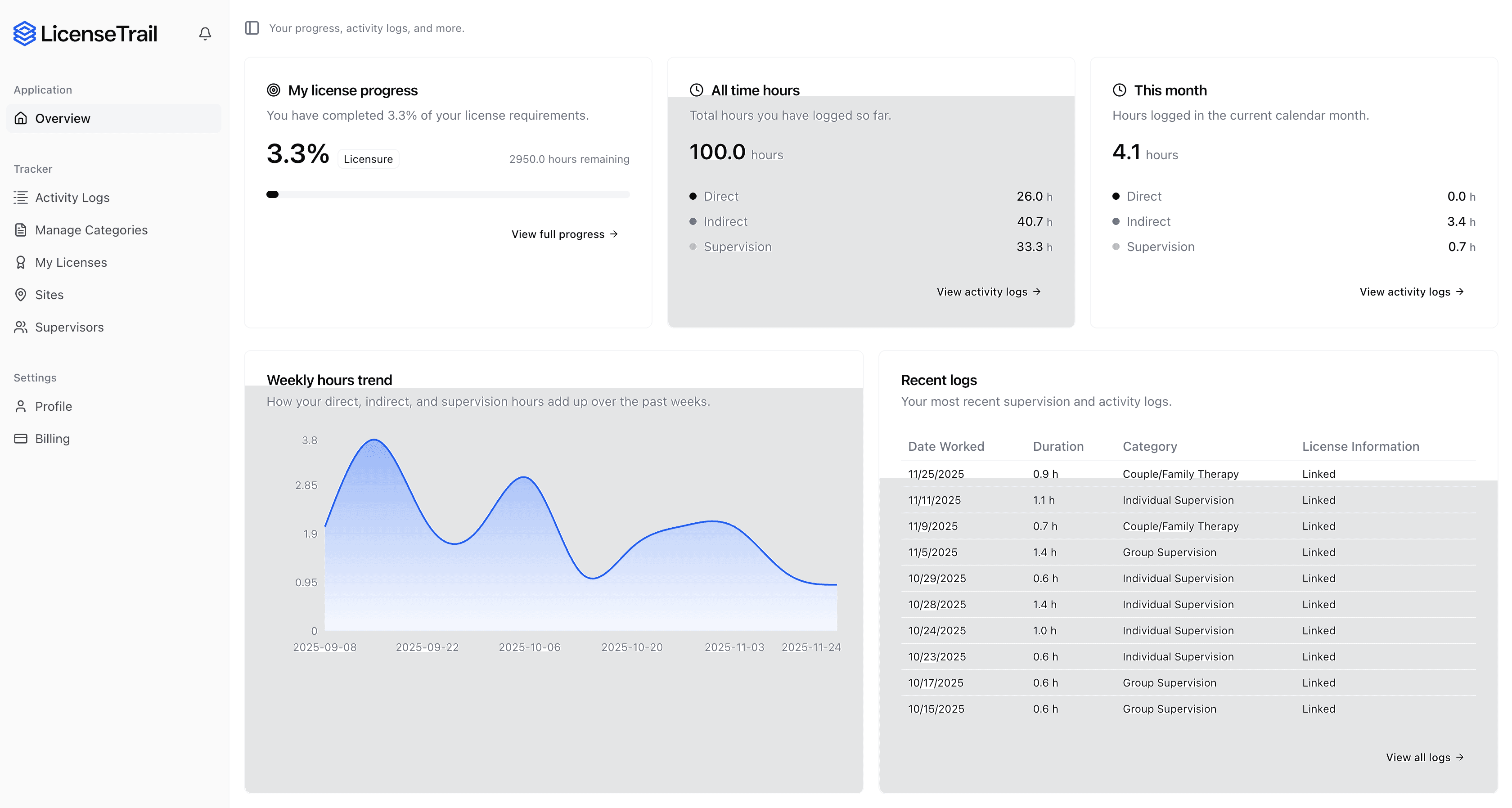
Track your SP hours with confidence
License Trail checks your direct, indirect, and supervision hours against Virginia SP requirements continuously and flags mismatches before you submit.
 Start Tracking for Free
No credit card required · Free plan available
Is your spreadsheet hiding Virginia SP risks?
Stop guessing if your categories match West Virginia Board of Examiners of Psychologists requirements. License Trail checks your direct, indirect, and supervision hours continuously and flags mismatches before you submit.
Import or log
Bring your spreadsheet or start fresh
Upload your existing tracking spreadsheet and we'll map every hour into the right West Virginia Board of Examiners of Psychologists categories automatically.
Verify against Virginia
Catch mismatches before the board does
License Trail checks your direct, indirect, and supervision hours against Virginia SP requirements continuously.
Export board-ready
One-click clean reports
Generate professional, board-ready reports for supervision meetings and West Virginia Board of Examiners of Psychologists submissions in seconds.
No credit card required · Free plan available