
Virginia SSP Requirements: Hours, Exams & Step-by-Step Guide
Stop guessing if your categories match Virginia requirements. License Trail checks your direct, indirect, and supervision hours against SSP requirements continuously and flags mismatches before you submit.
No credit card required · Free plan available
Quick Requirements Overview
- Provided requirements are for West Virginia (WV), not Virginia (VA); VA-SSP rules can’t be confirmed from this text
- Credential purpose: Board-issued pre-licensure Supervised-School-Psychologist (SSP) status while working toward Level I/II School Psychologist licensure
- Education: Master’s/Ed.S./C.A.S. (or qualifying doctorate) in approved school psychology program from regionally accredited institution
- Supervision setup: Board-approved supervisor + Board-approved supervision contract/forms required before practice (Supervision Contract + Supervision 1 & 2); supervisor licensed ≥2 years, supervision-training required; max 4 supervisees
- Supervision hours: Minimum 1 hour individual supervision per 20 hours of services and at least 1 hr/week (plus monthly minimums for full-time)
- Time in supervision: Typically 3 school years for Level I (up to 1 year internship credit) + 2 additional school years for Level II (with limited alternative pathways noted)
- Exams: Praxis School Psychologist (attempt within 12 months; pass within 2 years) + Board oral exam for licensure
- Ongoing obligations: Use “Supervised School Psychologist” title; supervisor review/co-signing; quarterly reports; renew with 10 CE hours (1.5 ethics); comply with WV/APA/NASP ethics codes
License Details
Procedures
In West Virginia, the “Supervised‑School‑Psychologist” (often abbreviated SSP in practice) is a Board‑issued pre‑licensure credential for graduates of school psychology programs who are working toward licensure as a Level I or Level II school psychologist.
The West Virginia Board of Examiners of Psychologists regulates this status and sets specific rules for:
- Education
- Supervision (who can supervise you, intensity of supervision, and length of time)
- Exams
- Ongoing obligations while you are supervised
Unlike some states, West Virginia generally does not set a single fixed total number of hours (e.g., “1,500 direct + 1,500 supervised hours”) for school psychology licensure. Instead, it uses school calendar years of supervised practice combined with a minimum ratio of supervision hours to service hours. (regulations.justia.com)
Below is a step‑by‑step guide, with the key Board language and hour requirements highlighted.
1. Basic definition and educational requirement
How West Virginia defines a Supervised‑School‑Psychologist
The Board’s school psychology licensure rule defines a “Supervised‑School‑Psychologist” as a person who:
- Has earned a master’s, Ed.S., or Certificate of Advanced Study (C.A.S.) in an approved program,
- From a regionally accredited institution of higher education, and
- Is applying for Level I or Level II licensure as a school psychologist. (law.cornell.edu)
The rule also requires that your core coursework be “relevant to the practice of school psychology” as that practice is defined in the psychology statute. (law.cornell.edu)
Doctoral‑level applicants for school psychology licensure are also treated as supervised school psychologists for purposes of required supervised practice. (regulations.justia.com)
2. Step one: qualify educationally and choose your licensure path
Before the Board will grant you SSP status, you must:
-
Complete the degree
- Master’s / C.A.S. / Ed.S. in School Psychology from an approved, regionally accredited program, with appropriate school psychology coursework. (law.cornell.edu)
- Or a doctoral degree in psychology if you are pursuing licensure as a school psychologist at the doctoral level; statute and rules then layer on specific supervision and exam requirements. (regulations.justia.com)
-
Decide which license you are ultimately aiming for
- Licensed School Psychologist (Level I) – provides services on school board property as an employee or contractee. (law.cornell.edu)
- Licensed School Psychologist – Independent Practitioner (Level II) – can provide school psychology services to the public on or off school board property for a fee or other compensation, in addition to school‑board work. (law.cornell.edu)
Your status as a Supervised‑School‑Psychologist is the supervised phase on the way to one or both of these licenses.
3. Step two: secure a Board‑approved supervisor and supervision contract
Who is allowed to supervise you?
The supervision rule for school psychology applicants states:
-
Level I applicants must be supervised by:
- A Level I school psychologist, or
- A Level II school psychologist, or
- A licensed psychologist approved by the Board based on sufficient school psychology experience. (regulations.justia.com)
-
Level II applicants must be supervised by:
- A Level II school psychologist, or
- A licensed psychologist approved by the Board based on relevant school psychology or related practice expertise. (regulations.justia.com)
In addition, the Board’s supervision‑contracts rule requires that any supervisor of school psychologist supervisees:
- Be licensed for at least two years, and
- Have completed specified training in supervision (for Level I, at least 7 hours of supervision training or a 3‑hour graduate course; for Level II, 14 hours or a 3‑hour course). (law.cornell.edu)
Supervisors are limited to no more than four supervisees at a time. (law.cornell.edu)
Required paperwork before you can practice as an SSP
Before you may practice as a Supervised‑School‑Psychologist, the Board requires:
- A Supervision Contract – School Psychology Degree (Board form), and
- A Supervision 1 form (completed by both supervisee and supervisor), and
- A Supervision 2 form (completed by the supervisor). (psychbd.wv.gov)
All of these must be signed and approved by the Board before supervised practice begins. (law.cornell.edu)
Once approved, the Board issues you a supervised credential (commonly referred to as a “gold card”), and you may then practice school psychology under supervision. (psychbd.wv.gov)
4. Supervision intensity: how your hours must be structured
West Virginia regulates how much supervision you must receive relative to your practice hours, rather than specifying a single total hour count for licensure.
A. Hour‑by‑hour supervision ratio
For Supervised‑School‑Psychologists (regardless of level), the school psychology licensure rule requires:
- At least 1 hour of individual supervision for every 20 hours of school psychology services you provide. (regulations.justia.com)
This is the key “hours requirement” in West Virginia: your supervision hours must be at least 1/20 of your service hours.
The more general supervision contract rule (which applies to all supervisees unless the Board specifies otherwise) further requires:
- Minimum 1 hour per week of individual supervision, regardless of the number of hours you practice that week.
- For full‑time supervisees, at least 6 hours per month of individual face‑to‑face supervision, with up to 2 additional hours per month that may be group or other modalities as specified in the supervision contract.
- Individual supervision is ordinarily face‑to‑face; limited exceptions (e.g., secure videoconference) can be approved by the Board and must be reflected in the contract. (law.cornell.edu)
In practice, this means that your supervised experience is not described as “1,500 direct + 1,500 supervised hours.” Instead, you track:
- Total school psychology service hours, and
- Total individual supervision hours, which must satisfy at least:
- 1 hour of individual supervision per 20 service hours, and
- The weekly/monthly minimums in the supervision contract rule.
B. What counts as “school psychology services”?
The regulations do not give a single numeric list of tasks, but they explicitly state that supervision for Level I must cover “all aspects” of professional practice, including:
- Evaluations,
- Consultations,
- Ethics and record‑keeping,
- Mental health interventions,
- Family/school collaboration,
- Professional development, among others. (regulations.justia.com)
For Level II supervision, you must also gain competency in private practice–related areas such as duty‑to‑protect, liability and abandonment issues, confidentiality, court issues, business issues, supervision of others, and ethics of professional practice. (regulations.justia.com)
5. Length of supervised practice: years required, by degree and pathway
West Virginia measures the length of your supervised experience in school calendar years, not as a single all‑purpose hour total. The requirements differ depending on your degree level and whether you are pursuing Level I, Level II, or a doctoral‑level license.
A. Master’s / C.A.S. / Ed.S. – standard pathway to Level I and Level II
Under the primary licensure rule for school psychologists:
-
To qualify for Level I licensure, a supervised‑school‑psychologist with a master’s, C.A.S., or Ed.S. must complete:
- Three (3) school calendar years of supervision.
- If your degree required an internship, one school calendar year of supervision can be credited for that internship, reducing your post‑degree supervised practice to two additional school years. (regulations.justia.com)
-
To qualify for Level II licensure, a master’s/C.A.S./Ed.S. holder must complete:
- Two additional school calendar years of supervision beyond what was required for Level I. (regulations.justia.com)
Combined, a typical master’s‑level path, if you pursue both levels, looks like:
- 3 years of supervision for Level I (with up to 1 year of internship counting toward that),
- Then 2 more years of supervision for Level II,
- Total of up to 5 supervised school years over the course of both levels.
Throughout these years you must maintain the 1:20 supervision‑to‑service ratio and weekly/monthly minimum supervision hours described above. (regulations.justia.com)
B. Alternative Ed.S. pathway: reduced supervised practice after school employment
A separate rule in the Board’s organizational procedures provides a shorter supervised period in a specific situation:
-
If you:
- Hold an Ed.S. degree in school psychology,
- Completed an internship before earning the degree, and
- Have completed two school calendar years of full‑time employment as a school board school psychologist,
then you are required to complete only one‑half of a school calendar year of Board��approved supervised school psychology practice, plus additional time until you pass the Praxis and oral examinations. (regulations.justia.com)
This provision appears to recognize prior school‑board employment as a substantial portion of the supervised experience for Level I applicants who meet those specific criteria.
C. Doctoral‑level applicants for school psychology licensure
For doctoral‑level applicants seeking school psychology licensure, the rules provide:
-
You must complete supervision activities similar to those for master’s‑level applicants, but:
- If your doctoral program required an internship, you must complete one (1) school calendar year of Board‑approved supervision for school psychology licensure. (regulations.justia.com)
- If you did not complete an internship, you must complete two (2) school calendar years of supervision. (regulations.justia.com)
-
When your degree is a doctorate in philosophy or equivalent, and you have completed at least 1,800 hours in a predoctoral internship, you may ask the Board to waive one year of supervision by documenting that internship. (regulations.justia.com)
If you are working in West Virginia during this time, you must identify a Board‑approved supervisor and continue under supervision until both the Praxis and oral examinations are passed. (regulations.justia.com)
6. Examinations required while you are a Supervised‑School‑Psychologist
A. Praxis School Psychologist exam
For both Level I and Level II licensure, the rules require that Supervised‑School‑Psychologists pass the Praxis School Psychologist examination. (law.cornell.edu)
Key points:
- The Board sets the passing score, taking into account national standards and especially the Nationally Certified School Psychologist (NCSP) cutoff set by NASP. (law.cornell.edu)
- You must:
- Take the exam at least once within the first 12 months of your supervised‑school‑psychologist status (if you haven’t already passed it before applying). (law.cornell.edu)
- Pass the exam within 2 years of your application for licensure. (law.cornell.edu)
If you do not pass within the two‑year period:
- You become ineligible for Level I licensure and must stop all independent or supervised practice of school psychology.
- You may retake the exam during the subsequent two‑year window, and if you then obtain a passing score, you may re‑apply for “Supervised‑School‑Psychologist” status and resume supervised practice. (law.cornell.edu)
B. Oral examination
After completing the required supervised experience and passing the Praxis, you must pass a Board oral examination to move from supervised status to full licensure.
The Board describes the oral exam as a meeting to determine whether a Supervised School Psychologist is ready for licensure as a school psychologist in West Virginia, and provides candidate‑specific instructions and forms when you are eligible. (psychbd.wv.gov)
7. Obligations, title use, and ethics during SSP status
While you hold SSP (gold card) status, there are several continuing obligations:
A. Title and signature requirements
Supervisees must:
- Sign all work using the title “Supervised School Psychologist”, and
- Ensure that all work is reviewed by the supervisor. (regulations.justia.com)
If you work:
- As a contractor with a school board, your supervisor must co‑sign all reports.
- In a private practice setting, all psychological work must be co‑signed by your supervisor. (regulations.justia.com)
B. Quarterly reporting to the Board
Supervised‑School‑Psychologists must complete quarterly reports documenting their supervised practice; supervisors sign off before the reports are submitted to the Board. There are distinct quarterly forms and instructions for school psychologist supervisees. (psychbd.wv.gov)
C. Continuing education (CE) while supervised
To renew your supervised credential (“gold card”), you must complete continuing education:
- The Board specifies that supervisees need 10 CE hours, including 1.5 hours in ethics, per renewal cycle. (psychbd.wv.gov)
D. Ethics standards
All licensed and supervised psychologists and school psychologists must comply with:
- The West Virginia Board of Examiners of Psychologists Code of Ethics, and
- The APA Ethics Code, and
- For school psychologists specifically, the NASP Principles for Professional Ethics, which the Board treats as if formally adopted by rule. (regulations.justia.com)
Violations of these codes during your supervised period can affect both your ongoing supervised status and your ultimate licensure.
8. Putting it together: what the “hours” requirements really look like
For a typical master’s/Ed.S./C.A.S. graduate aiming for Level I licensure as a school psychologist via the standard pathway, the supervised experience that West Virginia expects can be summarized as:
-
Length of time
- Three school calendar years of supervision, with up to one year credited for an internship if required for your degree. (regulations.justia.com)
-
Structure of hours during those years
- Your practice consists of school psychology services (assessments, interventions, consultation, etc.).
- You receive individual supervision at a minimum ratio of 1 hour for every 20 hours of services, and no less than 1 hour per week, with additional monthly minimums for full‑time practice under the Board’s supervision contract rule. (regulations.justia.com)
Because these requirements are expressed in years plus supervision ratios, the Board does not say, for example, “you must complete 1,500 hours of direct experience and 1,500 hours of supervised experience.” Instead, your total hours will depend on your actual workload during those school years, so long as the supervision intensity and length of time set in rule are met.
For doctoral‑level applicants, there is a similar year‑based framework (1–2 supervised school years, with possible waiver based on a documented 1,800‑hour predoctoral internship) combined with the same supervision‑to‑service ratio and exam requirements. (regulations.justia.com)
9. High‑level checklist for becoming a Supervised‑School‑Psychologist in West Virginia
-
Complete required education
- Master’s / C.A.S. / Ed.S. in school psychology (or a qualifying doctoral degree), from an approved, regionally accredited institution, with school psychology coursework. (law.cornell.edu)
-
Identify a Board‑approved supervisor
- Must meet licensure‑length and supervision‑training requirements; Level I and II applicants have specific supervisor type options. (regulations.justia.com)
-
Submit supervision paperwork to the Board
- Supervision Contract – School Psychology Degree, Supervision 1, and Supervision 2 forms; obtain Board approval before starting supervised practice. (psychbd.wv.gov)
-
Begin work as a Supervised‑School‑Psychologist
- Use the proper title, ensure supervisor review/co‑signatures as required, and maintain supervision intensity (1:20 ratio, weekly/monthly minimums). (regulations.justia.com)
-
Track supervised school years
- Master’s/C.A.S./Ed.S.: generally three supervised school years for Level I (with possible credit for an internship), plus two more for Level II, unless you qualify for the reduced Ed.S. pathway. (regulations.justia.com)
- Doctoral: one or two supervised school years depending on internship, with potential waiver when a documented 1,800‑hour internship has been completed. (regulations.justia.com)
-
Complete exams and CE
- Take and pass the Praxis School Psychologist exam within the timelines specified (first attempt within 12 months; pass within 2 years). (law.cornell.edu)
- Meet CE requirements (10 hours with 1.5 in ethics) to renew your supervised “gold card.” (psychbd.wv.gov)
- After meeting supervision and exam requirements, complete the Board’s oral examination for licensure. (psychbd.wv.gov)
Together, these statutes, rules, and Board procedures define the full pathway from Supervised‑School‑Psychologist status to full licensure as a Level I or Level II school psychologist in West Virginia, including the specific supervision ratios, supervision year requirements, and competency areas that must be covered.
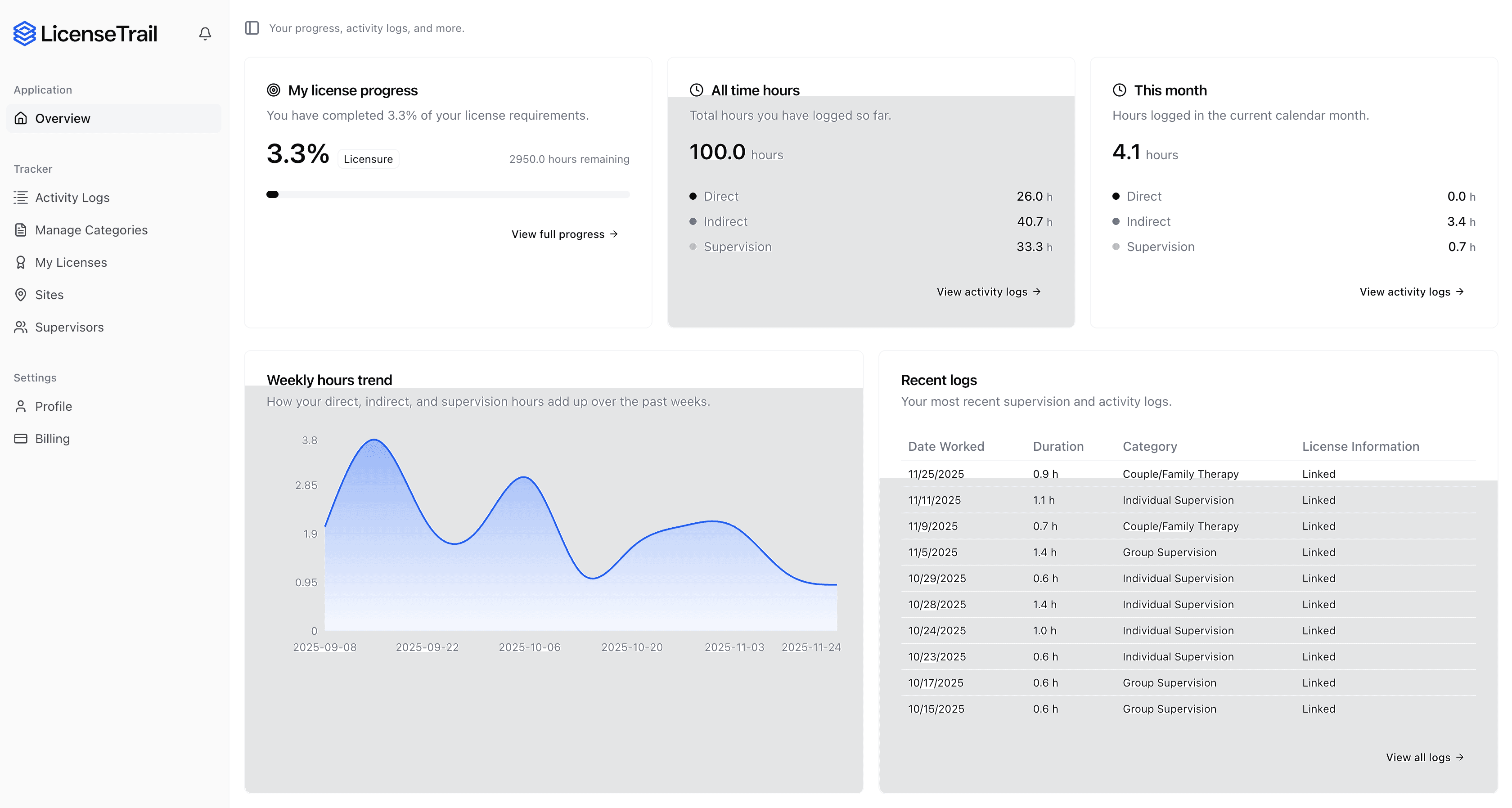
Track your SSP hours with confidence
License Trail checks your direct, indirect, and supervision hours against Virginia SSP requirements continuously and flags mismatches before you submit.
 Start Tracking for Free
No credit card required · Free plan available
Is your spreadsheet hiding Virginia SSP risks?
Stop guessing if your categories match West Virginia Board of Examiners of Psychologists requirements. License Trail checks your direct, indirect, and supervision hours continuously and flags mismatches before you submit.
Import or log
Bring your spreadsheet or start fresh
Upload your existing tracking spreadsheet and we'll map every hour into the right West Virginia Board of Examiners of Psychologists categories automatically.
Verify against Virginia
Catch mismatches before the board does
License Trail checks your direct, indirect, and supervision hours against Virginia SSP requirements continuously.
Export board-ready
One-click clean reports
Generate professional, board-ready reports for supervision meetings and West Virginia Board of Examiners of Psychologists submissions in seconds.
No credit card required · Free plan available