
Washington LMFT Requirements: Hours, Exams & Step-by-Step Guide
Stop guessing if your categories match Washington requirements. License Trail checks your direct, indirect, and supervision hours against LMFT requirements continuously and flags mismatches before you submit.
No credit card required · Free plan available
Quick Requirements Overview
- Graduate degree: Master’s/Doctorate in MFT or closely allied behavioral science from an approved program (regionally/nationally accredited or COAMFTE).
- Coursework: Minimum 45 semester / 60 quarter credits across 9 content areas (≥27 semester / 36 quarter in the first 5: systems, MFT, development, psychopathology, sexuality).
- Associate pathway: Obtain LMFT Associate (LMFTA) and practice only under an approved supervisor while accruing hours.
- Supervised experience: 3,000 total MFT experience hours (may reduce to 2,700 with qualifying SUDP experience; other minimums unchanged).
- Direct client contact: 1,000 hours minimum, including 500 hours diagnosing/treating couples & families.
- Supervision: 200 hours qualified supervision—100 hours with an LMFT (≥2 years clinical experience); ≥100 hours must be one-on-one (remainder one-on-one or group).
- Exam: Pass AMFTRB national MFT exam (score verification sent directly to DOH).
- Credits/shortcuts: COAMFTE master’s may credit 500 direct hours + 100 supervision hours; AAMFT clinical membership deemed to meet education requirement.
License Details
Procedures
Becoming a Licensed Marriage and Family Therapist (LMFT) in Washington State involves meeting specific education, supervised experience, and examination requirements set by the Department of Health (DOH) under RCW 18.225 and WAC 246‑809, with guidance from the Mental Health Counselors, Marriage and Family Therapists, and Social Workers Advisory Committee. (doh.wa.gov)
The sections below walk through those requirements, with particular emphasis on the exact hour breakdown and the state’s own terminology.
1. Regulatory framework
LMFT requirements come from:
- Statute: RCW 18.225.090 (“Issuance of license—Requirements”) for LMFTs. (law.justia.com)
- Rules: WAC 246‑809‑110 (definitions) and WAC 246‑809‑130 (supervised postgraduate experience for LMFTs and LMFTA). (warules.elaws.us)
- DOH policy: The Department of Health “Marriage and Family Therapist – Licensing Requirements” page. (doh.wa.gov)
All three use the same core terms: direct client contact, qualified supervision, approved supervisor, marriage and family therapy experience, etc.
2. Step 1 – Earn a qualifying graduate degree
Base education requirement
Washington requires that an LMFT applicant have: (doh.wa.gov)
- A master’s or doctoral degree in marriage and family therapy, or
- A master’s or doctoral degree in a closely allied behavioral science with coursework equivalent to a marriage and family therapy program, from an approved educational program.
In WAC 246‑809‑110, an “approved educational program” for LMFTs means either: (warules.elaws.us)
- A college or university accredited by a recognized national or regional accrediting body, or
- A program accredited by the Commission on Accreditation for Marriage and Family Therapy Education (COAMFTE).
Required coursework areas
DOH further specifies that the degree must include at least 45 semester hours or 60 quarter credits across nine areas, with at least 27 semester / 36 quarter credits in the first five: (doh.wa.gov)
- Marital and family systems
- Marital and family therapy
- Individual development
- Psychopathology
- Human sexuality
- Research
- Professional ethics and law
- Electives (one course)
- Supervised clinical practice
Programs not clearly labeled in these areas must be backed up with syllabi to show equivalency.
AAMFT/COAMFTE shortcuts
- Applicants with AAMFT clinical membership are considered to have met the educational requirements. (doh.wa.gov)
- Applicants who completed a COAMFTE‑accredited master’s program receive automatic credit toward their supervised experience (details in Section 4.4). (doh.wa.gov)
3. Step 2 – Obtain the LMFT Associate credential (LMFTA)
Washington expects new graduates to practice under supervision as Licensed Marriage and Family Therapist Associates (LMFTA) while they accrue their hours.
For LMFTA, DOH requires: (doh.wa.gov)
- The same qualifying master’s or doctoral degree as above
- A declaration that the applicant is working toward full LMFT licensure
- Practice only under the supervision of an approved supervisor
LMFTA applicants are not required to have any supervised postgraduate hours before becoming associates, but they must accumulate and document those hours later to upgrade to full LMFT (see Section 4). (regulations.justia.com)
4. Step 3 – Postgraduate supervised experience: hours and breakdown
This is where Washington’s hour requirements and terminology matter most.
4.1 Total experience hours
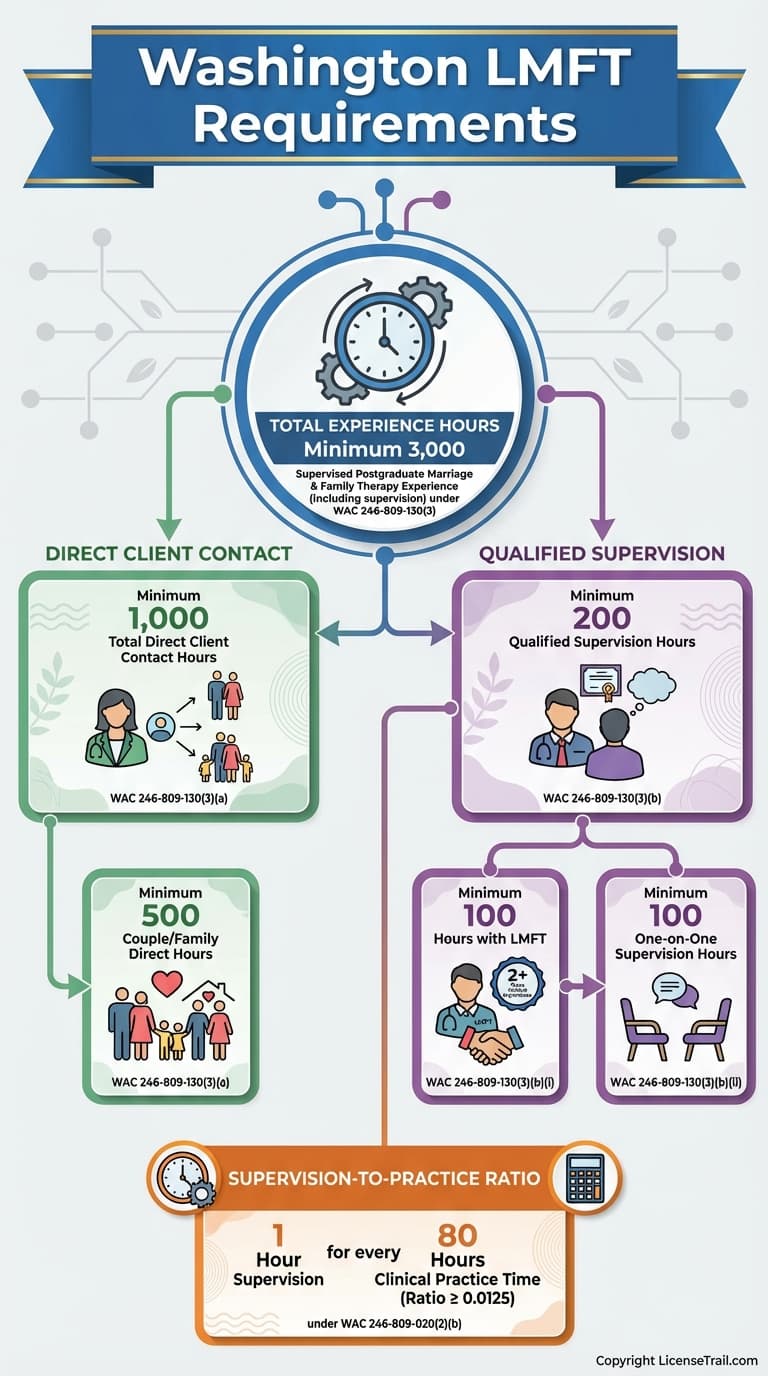
Under RCW 18.225.090 and WAC 246‑809‑130, an LMFT applicant must complete a supervised experience requirement consisting of a minimum of 3,000 hours of marriage and family therapy. (law.justia.com)
The DOH licensing page echoes this as “at least 3,000 hours of experience” for LMFT applicants. (doh.wa.gov)
Washington does not split this into “1,500 hours direct experience and 1,500 supervised experience.” Instead, it defines three key components within the LMFT experience requirement:
- Total marriage and family therapy experience: at least 3,000 hours
- Direct client contact: at least 1,000 hours
- Qualified supervision: at least 200 hours
(Details for #2 and #3 are below.)
4.2 Direct client contact hours
RCW 18.225.090 and WAC 246‑809‑130 define the direct service portion this way: (law.justia.com)
- You must complete at least 1,000 hours of direct client contact.
- At least 500 of those direct hours must be in diagnosing and treating couples and families (not just individuals).
DOH uses the same phrasing: “1,000 hours of which must be direct client contact. At least 500 hours must be gained in diagnosing and treating couples and families.” (doh.wa.gov)
In practice, “direct client contact” in Washington means face‑to‑face (including telehealth) therapeutic work with individuals, couples, families, or groups in a clinical context—not administrative time, training, or charting.
4.3 Qualified supervision hours
Washington separates out a specific supervision requirement:
- At least 200 hours of qualified supervision with an approved supervisor. (law.justia.com)
Those 200 hours must be structured as follows:
-
Type of supervisor
- 100 of the 200 hours must be with a licensed marriage and family therapist (LMFT) who has at least two years of clinical experience.
- The other 100 hours may be with an equally qualified licensed mental health practitioner (see definitions below). (law.justia.com)
-
Format of supervision
- At least 100 of the 200 hours must be one‑on‑one supervision.
- The remaining 100 hours may be one‑on‑one or group supervision. (law.justia.com)
-
Group vs one‑on‑one (WAC definitions)
- “One‑on‑one supervision” is face‑to‑face supervision with one supervisor and no more than two licensure candidates.
- “Group supervision” is face‑to‑face supervision with one supervisor and no more than six licensure candidates. (warules.elaws.us)
In DOH’s language, these are “qualified supervision” hours with an “approved supervisor” (terms defined in Section 7). (doh.wa.gov)
4.4 COAMFTE program credit toward hours
If you completed a COAMFTE‑accredited master’s program, Washington credits part of the requirement automatically. RCW 18.225.090 and WAC 246‑809‑130 state that such applicants may be credited with: (law.justia.com)
- 500 hours of direct client contact, and
- 100 hours of supervision (“formal meetings with an approved supervisor” / “qualified supervision”).
This credit counts toward the 1,000‑hour direct‑contact requirement and the 200‑hour supervision requirement. You still must document the remaining hours and reach the 3,000 total experience hours.
4.5 Reduction for Substance Use Disorder Professional (SUDP) experience
RCW 18.225.095 and WAC 246‑809‑130 allow a reduction of the total supervised experience for certain applicants with SUDP experience: (regulations.justia.com)
If you can demonstrate that you:
- Have been licensed and practicing as a Substance Use Disorder Professional for at least three years within the 10 years before your LMFT application,
then:
- The required 3,000 supervised experience hours are reduced by 10%, to 2,700 hours.
However, the structure of the hours does not change. You still must meet all of the following:
- At least 1,000 hours of direct client contact
- At least 500 direct hours with couples and families
- At least 200 hours of qualified supervision, with the same supervisor and format breakdown (100 with an LMFT, 100 one‑on‑one, etc.) (regulations.justia.com)
5. Step 4 – Pass the required examination
RCW 18.225.090 requires “successful passage of an approved examination” for LMFTs. (law.justia.com)
For marriage and family therapists, DOH identifies this as the Association of Marital and Family Therapy Regulatory Boards (AMFTRB) national MFT exam:
- If you have already taken the AMFTRB exam, verification must be sent directly to DOH by the exam service. (doh.wa.gov)
Some applicants may also need to complete any state‑specific requirements in effect at the time of application (e.g., telemedicine training if they will practice via telehealth). (doh.wa.gov)
6. Step 5 – Apply for full LMFT licensure
Once education, supervised experience, and the exam are complete, you apply to DOH for full LMFT licensure.
The application typically requires: (doh.wa.gov)
-
Verification of education
- Official transcripts showing degree and date, and demonstrating coursework in the required areas or program equivalency.
-
Documentation of supervised postgraduate experience
- DOH‑supplied forms completed and signed by your approved supervisor(s) documenting:
- Total experience hours
- Direct client contact hours
- Couples/families hours
- Qualified supervision hours (with breakdown by supervisor type and format). (doh.wa.gov)
- DOH‑supplied forms completed and signed by your approved supervisor(s) documenting:
-
Exam verification
- AMFTRB exam results sent directly to DOH. (doh.wa.gov)
-
State license verifications
- Verification from every jurisdiction where you currently hold, or have ever applied for, a health‑care credential. (doh.wa.gov)
-
Personal data and background questions
- Disclosure of professional liability claims, criminal history, and disciplinary actions, with documentation as required. (doh.wa.gov)
-
Telemedicine training (if applicable)
- If you will provide telemedicine, you must complete a Washington State telemedicine training course as required by law. (doh.wa.gov)
7. Key Washington definitions related to hours and supervision
The Washington Administrative Code uses specific terms that are important when planning and documenting your LMFT hours.
From WAC 246‑809‑110 (for LMFTs and LMFTAs): (warules.elaws.us)
-
“Approved supervisor”
A licensed marriage and family therapist or an equally qualified licensed mental health practitioner who also meets specific supervision‑training requirements in WAC 246‑809‑134 (e.g., at least 15 hours of training in clinical supervision and specified supervision-of-clinical-practice experience). -
“Equally qualified licensed mental health practitioner”
A licensed mental health counselor, licensed clinical social worker, licensed psychologist, psychiatrist (licensed physician practicing psychiatry), or licensed psychiatric nurse practitioner who has:- 300 clock hours of graduate/postgraduate education or continuing education in MFT or supervision by an approved MFT supervisor, and
- Five years of clinical practice, including the equivalent of one year of practice with couples and families.
-
“Group supervision”
Face‑to‑face supervision with an approved supervisor involving no more than six licensure candidates. -
“One‑on‑one supervision”
Face‑to‑face supervision with an approved supervisor involving no more than two licensure candidates. -
“Supervised experience requirement”
Experience obtained under an approved supervisor who meets WAC 246‑809‑134.
These definitions govern who can sign off on your 3,000 experience hours and 200 supervision hours, and how group supervision can be structured.
8. Out‑of‑state applicants and reciprocity
Washington has both licensure by experience and a probationary reciprocity option:
-
An applicant who has held an active LMFT license in another state, D.C., or a U.S. territory for at least one year, without disqualifying history, is deemed to have met the supervised experience requirement in WAC 246‑809‑130(3). (lawfilesext.leg.wa.gov)
-
Separately, DOH administers a probationary reciprocity license program for behavioral health professions (Senate Bill 5054), allowing a temporary license if the other state’s scope is substantially equivalent. (doh.wa.gov)
Out‑of‑state LMFTs can either pursue full licensure based on equivalency or use the probationary license while addressing any gaps in Washington requirements.
9. Hour requirements – concise summary
Putting Washington’s LMFT requirements into the kind of breakdown you asked about:
Marriage and family therapy experience (LMFT) – Washington State
-
Total supervised marriage and family therapy experience:
- At least 3,000 hours of marriage and family therapy (may be reduced to 2,700 with qualifying SUDP experience). (law.justia.com)
-
Within those hours, you must have:
- Direct client contact:
- 1,000+ hours of direct client contact with individuals, couples, families, or groups
- Of these, 500+ hours specifically in diagnosing and treating couples and families. (law.justia.com)
- Qualified supervision:
- 200+ hours of qualified supervision with an approved supervisor, including:
- 100+ hours with a licensed LMFT (≥ 2 years of clinical experience)
- Up to 100 hours with an equally qualified licensed mental health practitioner
- At least 100 of the total supervision hours in one‑on‑one format; remaining hours may be one‑on‑one or group supervision (maximum six supervisees per group). (law.justia.com)
- 200+ hours of qualified supervision with an approved supervisor, including:
- Direct client contact:
-
Automatic credit for COAMFTE graduates:
- 500 hours of direct client contact credited
- 100 hours of supervision credited. (law.justia.com)
This structure, rather than a “50/50 split” like 1,500 direct and 1,500 supervised hours, is the official breakdown used by Washington’s Department of Health and reflected in RCW 18.225.090 and WAC 246‑809‑130.
Track your LMFT hours with confidence
License Trail checks your direct, indirect, and supervision hours against Washington LMFT requirements continuously and flags mismatches before you submit.
 Start Tracking for Free
No credit card required · Free plan available
Is your spreadsheet hiding Washington LMFT risks?
Stop guessing if your categories match Washington State Department of Health (Mental Health Counselors, Marriage and Family Therapists, and Social Workers Advisory Committee) requirements. License Trail checks your direct, indirect, and supervision hours continuously and flags mismatches before you submit.
Import or log
Bring your spreadsheet or start fresh
Upload your existing tracking spreadsheet and we'll map every hour into the right Washington State Department of Health (Mental Health Counselors, Marriage and Family Therapists, and Social Workers Advisory Committee) categories automatically.
Verify against Washington
Catch mismatches before the board does
License Trail checks your direct, indirect, and supervision hours against Washington LMFT requirements continuously.
Export board-ready
One-click clean reports
Generate professional, board-ready reports for supervision meetings and Washington State Department of Health (Mental Health Counselors, Marriage and Family Therapists, and Social Workers Advisory Committee) submissions in seconds.
No credit card required · Free plan available