
Arizona LCSW Requirements: Hours, Exams & Step-by-Step Guide
Stop guessing if your categories match Arizona requirements. License Trail checks your direct, indirect, and supervision hours against LCSW requirements continuously and flags mismatches before you submit.
No credit card required · Free plan available
Quick Requirements Overview
- MSW (or higher) in Social Work from a CSWE-accredited program (or substantially equivalent foreign degree); supervised hours must be post‑master’s
- Meet general AzBBHE prerequisites: application, age 21+, fees, fit to practice, no disqualifying discipline/conduct
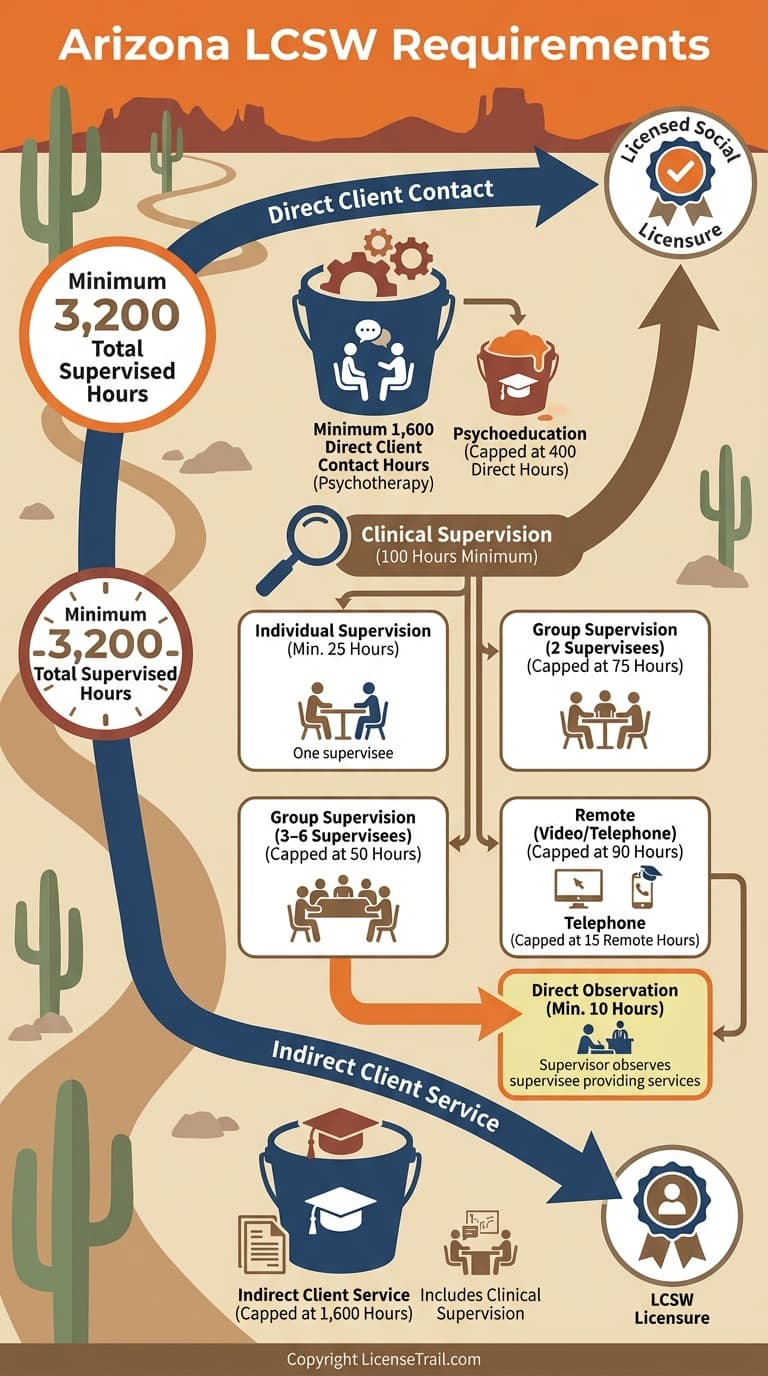
- Supervised clinical social work experience: 3,200 total hours over at least 24 months
- Direct client contact/psychotherapy: 1,600+ hours; psychoeducation max 400 of those direct hours
- Indirect client service: up to 1,600 hours (to total 3,200)
- Clinical supervision: 100+ hours total, including 50+ hours supervised by an AZ-licensed clinical social worker; no SA counselor supervision accepted
- Monthly rule: at least 1 hour of clinical supervision in any month you provide direct client contact
- Exam: pass ASWB Clinical; must test within 12 months of board authorization; max 2 attempts per authorization period
License Details
Procedures
Arizona regulates Licensed Clinical Social Workers (LCSWs) through the Arizona Board of Behavioral Health Examiners (AzBBHE). The requirements are set in statute (Arizona Revised Statutes, Title 32) and in the Arizona Administrative Code (Title 4, Chapter 6). Below is a step‑by‑step guide grounded in that language, with special attention to the exact hour types and categories the Board uses.
1. Educational foundation
Arizona law requires an LCSW applicant to:
- Have “a master’s or higher degree in social work from a regionally accredited college or university in a program accredited by the [CSWE]” or a substantially equivalent foreign degree. (law.justia.com)
You must complete the degree before any of your supervised clinical hours can count toward LCSW licensure; supervised work experience must be post‑master’s. (law.cornell.edu)
2. General licensure prerequisites (for all behavioral health licenses)
Under A.R.S. § 32‑3275, any behavioral health licensure applicant (including LCSW) must: (azleg.gov)
- Submit an application as prescribed by the Board.
- Be at least 21 years of age.
- Pay all applicable Board fees.
- Have the physical and mental capability to practice safely and competently.
- Not have engaged in conduct that would be grounds for disciplinary action, and not have certain serious licensure discipline or surrender in other jurisdictions (unless the Board is satisfied the issue is corrected or mitigating circumstances exist).
These are in addition to the social‑work‑specific requirements below.
3. Core LCSW practice‑experience requirement: 3,200 hours
Arizona combines a time requirement (at least 24 months) with a total‑hours requirement and specific categories of those hours.
3.1 Total supervised work experience
Arizona Administrative Code R4‑6‑403(A) states that an LCSW applicant must:
- “demonstrate completion of at least 3200 hours of supervised work experience in the practice of clinical social work in no less than 24 months.” (regulations.justia.com)
Statute 32‑3293 is consistent with this by requiring at least 24 months of post‑master’s experience in the practice of clinical social work under supervision, and it points to the Board’s rules for the specific hour breakdown. (law.justia.com)
In plain language:
- You need a minimum of 3,200 total hours of supervised clinical social work,
- Accrued over at least 24 months after your MSW (you may take longer; 24 months is a minimum, not a maximum).
3.2 Required breakdown of the 3,200 hours
R4‑6‑403(A) further defines how those 3,200 hours must be distributed: (regulations.justia.com)
-
Direct client contact involving psychotherapy – at least 1,600 hours
- The rule requires “at least 1600 hours of direct client contact involving the use of psychotherapy.”
- Within these 1,600 direct hours, you are limited to a maximum of 400 hours of psychoeducation (see below).
-
Limit on psychoeducation – no more than 400 of those direct hours
- Of the 1,600 direct client contact hours, “no more than 400 of the 1600 hours of direct client contact are in psychoeducation.”
In practice, that means you must have at least 1,200 hours of direct psychotherapy that is not psychoeducation, and up to 400 hours may be psychoeducational activities that still qualify as direct contact.
-
Indirect client contact – no more than 1,600 hours
- The same rule caps indirect client contact at 1,600 hours “for the purpose of licensure.”
Since your total supervised hours must be 3,200, and at least 1,600 must be direct, the remaining up to 1,600 may be indirect client service (charting, case consultation, certain forms of preparation and follow‑up work as defined below).
-
Clinical supervision – at least 100 hours
- Within the same 3,200‑hour period, you must complete “at least 100 hours of clinical supervision as prescribed under R4‑6‑212 and R4‑6‑404.”
Those 100 hours are part of your supervised experience; they do not sit on top of a separate 3,200‑hour count.
-
Monthly supervision requirement
- R4‑6‑403(B) adds: For any month in which an applicant provides direct client contact, the applicant shall obtain at least one hour of clinical supervision. (law.cornell.edu)
4. How Arizona defines your hour types
Arizona doesn’t just count hours; it also defines what each category means.
4.1 Direct client contact
“Direct client contact” is defined in A.R.S. § 32‑3251 and repeated in the rules as:
- The performance of therapeutic or clinical functions at your professional practice level of psychotherapy that include diagnosis, assessment and treatment,
- May include psychoeducation for mental, emotional, and behavioral disorders,
- Is based primarily on verbal or nonverbal communication and intervention with, and in the presence of, one or more clients, including via telehealth. (azleg.gov)
In practice, hours typically counted as direct client contact:
- Individual, couple, family, and group psychotherapy sessions
- Clinical intake assessments and diagnostic interviews conducted face‑to‑face (including telehealth)
- Certain psychoeducational sessions when they meet the Board’s definition and are delivered as part of treatment with clients present (within the 400‑hour cap)
4.2 Indirect client service
“Indirect client service” is defined as: (azrules.elaws.us)
- Training for, and performance of, functions at your professional practice level in preparation for or on behalf of a client for whom you also provide direct client contact;
- Includes case consultation and receipt of clinical supervision;
- Does not include the provision of psychoeducation.
Typical indirect activities:
- Case staffing and treatment‑team meetings about your own caseload
- Reviewing client records, collateral contacts, coordination of care
- Writing clinical notes, treatment plans, discharge summaries
- Time spent in clinical supervision sessions regarding your cases
The key is that indirect hours alone are not enough; you must also be providing direct psychotherapy contact to the same clients or caseload.
4.3 Psychoeducation (within direct hours)
While “psychoeducation” is not exhaustively defined in a stand‑alone rule, the Board clearly distinguishes it as a subset of direct client contact and caps it at 400 of the 1,600 direct hours. (law.cornell.edu)
Common examples:
- Structured educational groups for clients about diagnosis, coping skills, relapse prevention, or similar content delivered as part of treatment.
- Brief educational components within therapy sessions.
These count as direct client contact only up to 400 hours; beyond that, they will not satisfy the direct‑contact requirement.
5. Clinical supervision requirements (the 100 hours)
Beyond the simple numeric requirement (at least 100 hours), the Board has detailed rules about who can supervise and how.
5.1 Minimum 100 hours and supervisor type
A.A.C. R4‑6‑404 provides: (azrules.elaws.us)
- You must “receive at least 100 hours of clinical supervision” during the same 3,200‑hour supervised work‑experience period required under R4‑6‑403.
- Of those 100 hours:
- At least 50 hours must be supervised by a clinical social worker licensed by the Arizona Board.
- The remaining hours may be supervised by another qualifying independent behavioral health professional under R4‑6‑212(A) (e.g., certain independently licensed counselors, MFTs, psychologists, or psychiatrists), or by someone approved through a supervisor exemption under R4‑6‑212.01.
- The Board will not accept supervision provided by a substance abuse counselor for LCSW clinical supervision hours.
5.2 Format and structure of supervision
The Board’s general supervision rules (R4‑6‑212 and R4‑6‑211) specify that: (law.cornell.edu)
- Supervision must be direct supervision, meaning responsibility and oversight for all services you provide under your supervised work experience.
- Clinical supervision can be conducted face‑to‑face, by video, or by telephone, as long as it meets the Board’s definition of “clinical supervision” (evaluating, guiding, and directing your behavioral health services). (law.cornell.edu)
- Supervised work experience must:
- Be in the practice of behavioral health (here, clinical social work).
- Be for a term of no fewer than 24 months. (law.cornell.edu)
The Board provides separate Verification of Clinical Supervision and Verification of Supervised Work Experience – Social Work forms on its website, which supervisors must complete and submit (or return to you sealed) to document these hours. (bbhe.az.gov)
6. Supervisor attestation of competence
A.R.S. § 32‑3293 also requires that your supervisor attest to your competence—not just your hours. Specifically, on a board‑approved form, the supervisor must certify that you: (law.justia.com)
-
Were observed during supervised hours to have demonstrated satisfactory competency in:
- Clinical documentation;
- Consultation;
- Collaboration; and
- Coordination of care related to the clients for whom you provided direct care.
-
Have at least a satisfactory overall performance rating.
This means your supervision must be substantive and performance‑oriented; the Board is not just auditing a log of hours, but the supervisor’s evaluation of your readiness for independent clinical practice.
7. Examination requirement (ASWB Clinical exam)
To become an LCSW, you must pass a licensing examination approved by the Board. Statute and rule provide that: (law.justia.com)
- LCSW applicants must receive a passing score on the ASWB Clinical Examination.
- You must pass the exam within 12 months of receiving written authorization from AzBBHE; you are allowed no more than two attempts in that 12‑month period for a given application cycle.
The Board now has a process for “Automatic Exam Approval for LCSW Applicants”, which links LCSW applications directly to ASWB exam authorization once your eligibility has been confirmed. (bbhe.az.gov)
8. Application process and documentation of hours
Although forms and portals change over time, the current structure on the AzBBHE “Social Work” page is: (bbhe.az.gov)
- Submit an LCSW application through the Board’s online system (the “BOARDAL” application portal for social work licenses).
- Arrange for your official transcripts (CSWE‑accredited MSW or higher) to be sent directly or included as instructed.
- Have your employer/supervisors complete:
- Verification of Supervised Work Experience – Social Work (documenting the 3,200 hours and their breakdown); and
- Verification of Clinical Supervision (documenting the 100 hours and supervisor qualifications).
These forms must be submitted directly to the Board or returned to you signed and sealed, depending on current Board instructions.
- Complete any required background check / fingerprinting and pay the application and license fees specified by AzBBHE. (publichealthonline.org)
- Once the Board determines you meet eligibility requirements, it authorizes you to register for and take the ASWB Clinical exam. After you pass and all documentation is in order, the Board issues your LCSW license, which permits independent social work practice.
9. Summary of the hour requirements in numeric form
Putting all of the above into the simple, number‑based breakdown you asked for:
-
Total supervised work experience (post‑MSW, practice of clinical social work):
- 3,200 hours minimum
- Spanning at least 24 months
-
Within the 3,200 hours, you must have:
- 1,600 hours minimum of direct client contact involving psychotherapy, of which:
- No more than 400 hours may be psychoeducation.
- Up to 1,600 hours of indirect client service related to psychotherapy (case consultation, documentation, supervision time, etc.).
- At least 100 hours of clinical supervision, with:
- At least 50 of those 100 hours provided by an Arizona‑licensed clinical social worker;
- Remaining hours provided by another qualified independent behavioral health professional or an exempted supervisor, per R4‑6‑212 and R4‑6‑404. (regulations.justia.com)
- 1,600 hours minimum of direct client contact involving psychotherapy, of which:
-
Additional structure requirements:
- For every month in which you provide any direct client contact, you must receive at least one hour of clinical supervision that month. (law.cornell.edu)
- All supervised hours must be post‑degree and involve the practice of behavioral health, specifically clinical social work, under appropriate supervision. (law.cornell.edu)
These requirements are current as reflected in the Arizona Revised Statutes and Arizona Administrative Code versions available through March–June 2025, and the AzBBHE website as of late 2025. Because the Board periodically updates its rules and forms, applicants should always cross‑check these details with the latest statutes, rules, and Board guidance before relying on them for licensure planning.
Track your LCSW hours with confidence
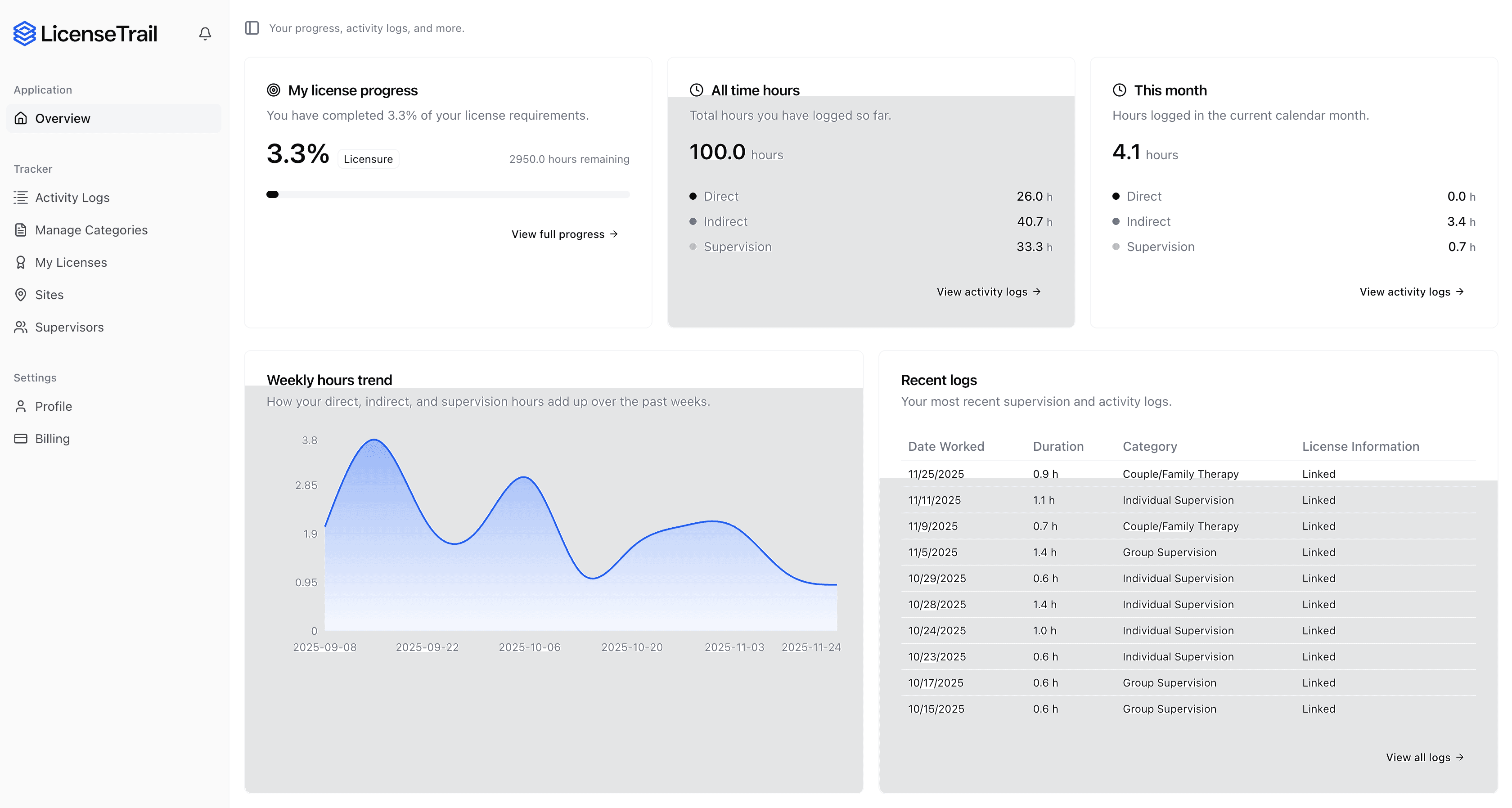
License Trail checks your direct, indirect, and supervision hours against Arizona LCSW requirements continuously and flags mismatches before you submit.
 Start Tracking for Free
No credit card required · Free plan available
Is your spreadsheet hiding Arizona LCSW risks?
Stop guessing if your categories match Arizona Board of Behavioral Health Examiners requirements. License Trail checks your direct, indirect, and supervision hours continuously and flags mismatches before you submit.
Import or log
Bring your spreadsheet or start fresh
Upload your existing tracking spreadsheet and we'll map every hour into the right Arizona Board of Behavioral Health Examiners categories automatically.
Verify against Arizona
Catch mismatches before the board does
License Trail checks your direct, indirect, and supervision hours against Arizona LCSW requirements continuously.
Export board-ready
One-click clean reports
Generate professional, board-ready reports for supervision meetings and Arizona Board of Behavioral Health Examiners submissions in seconds.
No credit card required · Free plan available