
Arizona LIAC Requirements: Hours, Exams & Step-by-Step Guide
Stop guessing if your categories match Arizona requirements. License Trail checks your direct, indirect, and supervision hours against LIAC requirements continuously and flags mismatches before you submit.
No credit card required · Free plan available
Quick Requirements Overview
- Regulator: Arizona Board of Behavioral Health Examiners (AzBBHE) (A.R.S. §32‑3321; A.A.C. R4‑6‑701–706)
- Education: Master’s+ in behavioral science with counseling emphasis (regionally accredited; board-approved/meeting board rules); often ≥24 semester credits counseling-related (board-determined)
- Practicum (in degree): 300 hours supervised practicum with face-to-face direct counseling (does not replace post-degree hours)
- Post-degree supervised experience: 3,200 hours in ≥24 months (board rule)
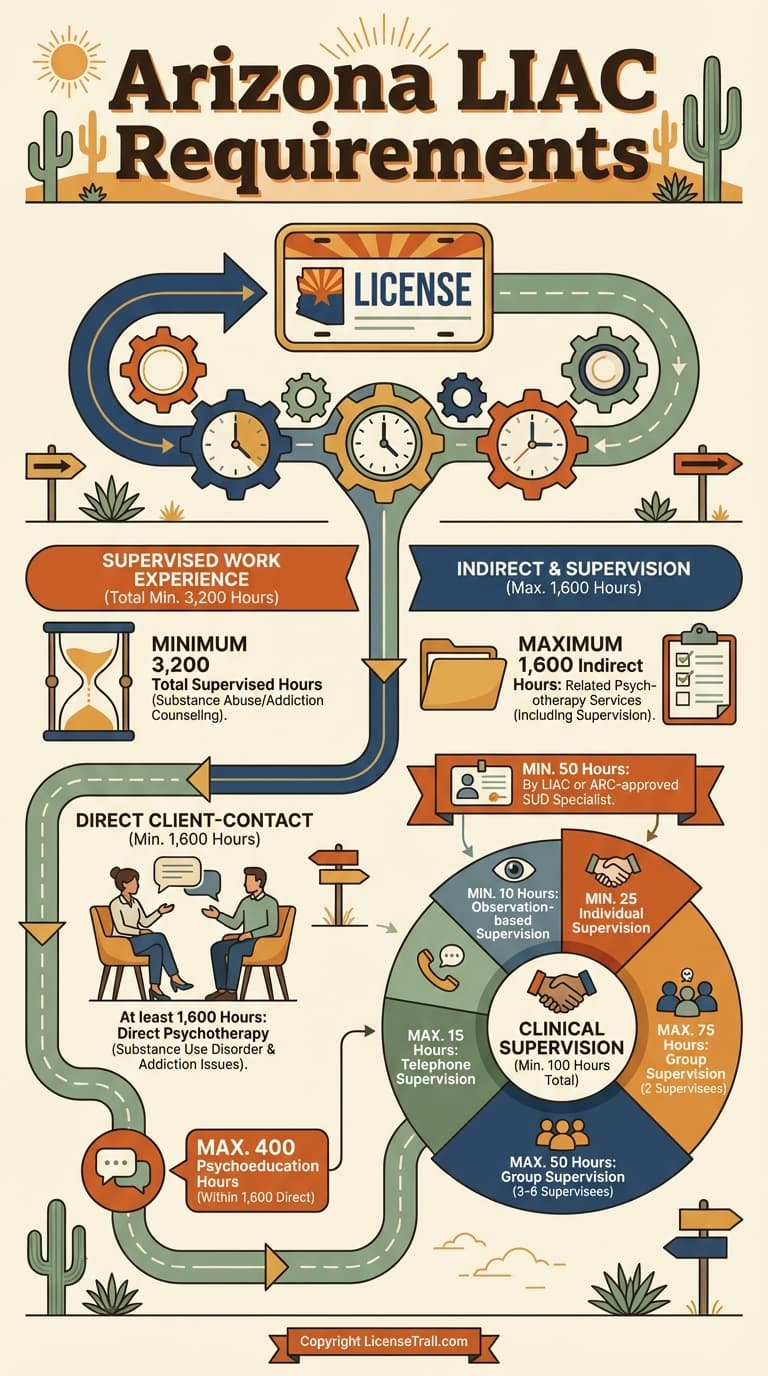
- Hour breakdown: ≥1,600 direct client contact (psychotherapy); ≤400 of the 1,600 may be psychoeducation; ≤1,600 indirect client-related hours
- Clinical supervision: ≥100 hours; ≥1 hour/month in any month with direct client contact; ≥50 hours by qualified/approved independent addiction/BH supervisor (per R4‑6‑706)
- Exam: Pass a board-approved exam (e.g., ICRC or NAADAC Level II+)
- Documentation/attestation: Use AzBBHE verification forms; supervisor must attest to competency (documentation/consultation/collaboration/coordination) and satisfactory overall performance
License Details
Procedures
Arizona regulates Licensed Independent Addiction Counselors (LIAC) through the Arizona Board of Behavioral Health Examiners (AzBBHE) under Arizona Revised Statutes § 32‑3321 and the Arizona Administrative Code, Article 7 (Substance Abuse/ Addiction Counseling). Together these set both the educational requirements and the exact mix of supervised, direct‑client, and clinical‑supervision hours.
Below is a structured explanation of the requirements, with the key hour counts and the Board’s own terminology.
1. License structure and terminology
AzBBHE now uses the term “addiction counseling,” with three levels of license listed on its Addiction Counseling page:
- Licensed Addiction Counselor Technician (LACT)
- Licensed Associate Addiction Counselor (LAAC)
- Licensed Independent Addiction Counselor (LIAC) (bbhe.az.gov)
On that same page, the LIAC applications are labeled “for existing LAAC,” which in practice means you upgrade from LAAC to LIAC once you meet the independent‑level experience and supervision requirements. (bbhe.az.gov)
The underlying experience and supervision standards are still defined in the Board’s Substance Abuse Counseling rules (A.A.C. R4‑6‑701–706), which AzBBHE continues to apply to addiction counseling licensure. (azrules.elaws.us)
2. Education and coursework
Graduate degree requirement
For LIAC, statute requires:
A master’s or higher degree in a behavioral science with an emphasis on counseling, in a program that is approved by the board pursuant to § 32‑3253 or that meets the requirements as prescribed by the board by rule, from a regionally accredited college or university. (azleg.gov)
In practice this means:
- Master’s degree or higher
- In a behavioral health/behavioral science field
- With a clear counseling emphasis
- From a regionally accredited institution
- Program must meet AzBBHE’s addiction‑counseling curriculum standards
A commonly cited summary of the Board’s expectations (used by an Arizona partner college that aligns its programs to AzBBHE requirements) describes the LIAC academic standard as:
- Master’s degree or higher in a behavioral health science with emphasis in counseling, from a regionally accredited college or university
- Minimum of 24 semester credit hours of counseling‑related coursework, “as determined by the substance abuse credentialing committee” (the AzBBHE committee that reviews addiction counseling applications) (riosalado.edu)
Supervised practicum during the degree
For independent addiction (formerly “independent substance abuse”) counselor licensure, the Board’s curriculum rule (R4‑6‑703) requires that the qualifying graduate program include at least 300 hours of supervised practicum that:
- Integrates didactic learning on substance use disorders with
- Face‑to‑face, direct counseling experience with clients (azrules.elaws.us)
These practicum hours are part of your degree and do not substitute for the post‑degree supervised work‑experience hours described below.
3. Post‑degree supervised work experience: total hours
There are two overlapping frameworks you should be aware of:
- Statutory minimum (A.R.S. § 32‑3321) for LIAC; and
- Board rule (A.A.C. R4‑6‑705), which sets the detailed breakdown the Board actually uses when evaluating your hours.
Statutory minimum for LIAC (work experience hours)
For a Licensed Independent Addiction Counselor, current statute states that an applicant must:
Present documentation … that the applicant has received at least one thousand six hundred hours of work experience in at least twenty‑four months in addiction counseling with direct client contact under supervision that meets the requirements as prescribed by the board by rule. For the direct client contact hours, not more than four hundred hours may be in psychoeducation. (azleg.gov)
At the statutory level, then, the minimum is:
- 1,600 hours of supervised work experience,
- All of which must be direct client contact in addiction counseling,
- Completed over at least 24 months,
- And within those direct hours, no more than 400 hours may be psychoeducation (e.g., structured educational groups).
Board rule: supervised work‑experience breakdown (independent level)
AzBBHE’s own rule on Supervised Work Experience for Substance Abuse Counselor Licensure (R4‑6‑705) specifies a more detailed – and higher – standard for independent‑level licensure:
An applicant for independent substance abuse counselor licensure shall demonstrate completion of at least 3200 hours of supervised work experience in substance abuse counseling in no less than 24 months. The applicant shall ensure that the supervised work experience meets the standards specified in subsection (A). (azrules.elaws.us)
Subsection (A), which those 3,200 hours must meet, requires that the supervised work experience:
- Include at least 1,600 hours of direct client contact using psychotherapy related to substance use disorder and addiction.
- Include no more than 400 of the 1,600 direct‑contact hours in psychoeducation.
- Include no more than 1,600 hours of indirect client contact related to psychotherapy services.
- Include at least 100 hours of clinical supervision as prescribed in R4‑6‑212 and R4‑6‑706.
- Include at least one hour of clinical supervision in any month in which you provide direct client contact. (azrules.elaws.us)
A widely used summary (aligned with these rules) describes LIAC requirements as:
- Minimum of 3,200 hours of supervised work experience in substance abuse counseling in no less than 24 months, including
- 1,600 hours of direct client contact, and
- 100 hours of clinical supervision;
- Passing the licensing exam. (riosalado.edu)
Putting this together in plain terms for LIAC:
- You should plan on 3,200 total supervised work‑experience hours in addiction/substance abuse counseling over at least 24 months.
- Of those 3,200 hours:
- 1,600 hours must be direct client‑contact hours (face‑to‑face psychotherapy/counseling dealing with substance use disorder/addiction);
- Within those direct hours, no more than 400 may be psychoeducation;
- Up to 1,600 hours may be indirect services (documentation, treatment planning, staffings, etc.);
- You must log at least 100 hours of clinical supervision, with at least 1 hour of supervision in any month you provide direct client contact. (azrules.elaws.us)
This means the Arizona framework is not “1,500 hours of direct experience and 1,500 hours of supervised experience.” Instead, it is:
- 3,200 hours of supervised experience total,
- including 1,600 hours of supervised direct client contact, and
- 1,600 additional hours of supervised indirect client service (maximum);
- plus 100 hours of clinical supervision within that period.
Statute sets a floor of 1,600 supervised direct‑contact hours; Board rules then flesh that out to a 3,200‑hour supervised experience package with the above breakdown.
4. What counts as each type of hour
The Board’s rules do not provide a single‑sentence definition list, but taken together they use these categories:
-
Direct client contact hours
- “Involving the use of psychotherapy related to substance use disorder and addiction issues.” (azrules.elaws.us)
- Typically includes intake assessments, individual, group, and family counseling/psychotherapy, crisis intervention, and other face‑to‑face treatment activities.
-
Psychoeducation hours (subset of direct contact)
- Educational groups or sessions that focus primarily on teaching about substance use, relapse prevention, coping skills, etc.
- These hours do count as direct hours but are capped at 400 of the required 1,600 direct hours.
-
Indirect client service hours
- The rules cap these at 1,600 hours “of indirect client contact related to psychotherapy services.” (azrules.elaws.us)
- Common examples are documentation, treatment‑team meetings, case consultation, care coordination, and some training or case‑review activities tied directly to your caseload.
-
Clinical supervision hours
- A minimum of 100 hours of clinical supervision within the 3,200‑hour period is required, with at least one hour of clinical supervision in each month where you provide direct client contact. (azrules.elaws.us)
- At least 50 of those supervision hours must be provided by:
- an independent substance abuse/addiction counselor licensed by the Board, or
- an independently licensed behavioral health professional with proven substance‑use‑disorder treatment expertise and approved by the Board’s Addiction (formerly Substance Abuse) Credentialing Committee. (law.cornell.edu)
All of these hours must:
- Be behavioral‑health/addiction focused, and
- Be documented on AzBBHE’s Verification of Supervised Work Experience and Verification of Clinical Supervision forms listed on its Addiction Counseling page. (bbhe.az.gov)
5. Supervisor attestation and competency requirements
In addition to raw hour counts, statute requires a competency attestation:
For both LAAC and LIAC, your supervisor must submit a Board‑approved form attesting that you:
- “Were observed during supervised hours to have demonstrated satisfactory competency in clinical documentation, consultation, collaboration and coordination of care related to clients to whom [you] provided direct care”; and
- Have “a rating of at least satisfactory in overall performance.” (azleg.gov)
Without this attestation, your hours alone will not qualify you for LIAC.
6. Examination requirement
For LIAC, statute also requires that you:
Pass an examination approved by the board. (azleg.gov)
AzBBHE’s addiction counseling credentialing committee recognizes:
- The ICRC exam; and
- The NAADAC Level II or higher examination
as accepted licensure exams for addiction counseling licensure. (riosalado.edu)
You must pass one of these board‑approved exams either at the LAAC stage or as part of your LIAC upgrade, depending on your application history.
7. Typical pathway from LAAC to LIAC
Putting the pieces together, the usual progression for someone aiming for LIAC in Arizona is:
- Complete a qualifying master’s or higher degree in a behavioral health/behavioral science field with counseling emphasis, meeting AzBBHE curriculum standards (including a 300‑hour supervised practicum). (azrules.elaws.us)
- Obtain LAAC licensure, meeting the associate‑level requirements (which, if based on a bachelor’s degree, include 1,600 supervised direct‑contact hours; if based on a qualifying master’s, no additional supervised-work requirement at that level). (azleg.gov)
- Accumulate at least 3,200 hours of supervised work experience in addiction/substance abuse counseling over a minimum of 24 months, structured exactly as required in R4‑6‑705:
- 1,600 direct client‑contact hours (≤ 400 psychoeducation)
- Up to 1,600 indirect hours
- At least 100 hours of clinical supervision, with at least 1 hour per month in months with direct contact
- Ensure supervision is provided by qualified supervisors, including at least 50 supervision hours with an independent addiction/substance‑abuse counselor or an independently licensed BH professional with addiction expertise, approved per R4‑6‑706. (law.cornell.edu)
- Pass a Board‑approved exam (ICRC or NAADAC Level II+). (riosalado.edu)
- Have your supervisor complete AzBBHE’s verification forms documenting:
- your 3,200 supervised hours and their breakdown;
- your 100+ hours of clinical supervision; and
- their attestation that your competence and overall performance are at least satisfactory. (bbhe.az.gov)
- Apply to upgrade from LAAC to LIAC through the AzBBHE “Licensed Independent Addiction Counselor (LIAC) for existing LAAC” application route. (bbhe.az.gov)
8. Key hour requirements for LIAC in one place
For clarity, the AzBBHE framework for Licensed Independent Addiction Counselor currently amounts to:
- 3,200 hours of supervised work experience in addiction/substance abuse counseling in not less than 24 months, including:
- 1,600 hours of direct client contact using psychotherapy related to substance use/addiction;
- Of those direct hours, no more than 400 hours of psychoeducation;
- No more than 1,600 hours of indirect client service;
- At least 100 hours of clinical supervision, with at least 1 hour of supervision in each month with direct client contact;
- At least 50 of the supervision hours provided by an independent addiction/substance‑abuse counselor or an independently licensed BH professional with substance‑use‑treatment expertise approved by the Board. (azrules.elaws.us)
In addition, statute requires that those hours include at least 1,600 hours of direct client‑contact work experience over at least 24 months, with no more than 400 of those direct hours in psychoeducation, all under supervision that meets the Board’s rules. (azleg.gov)
Because statutes and administrative rules can be amended, and Board forms change over time, applicants should always verify the latest requirements directly on AzBBHE’s Addiction Counseling page and, if needed, by contacting the Board before relying on any numerical hour targets.
Track your LIAC hours with confidence
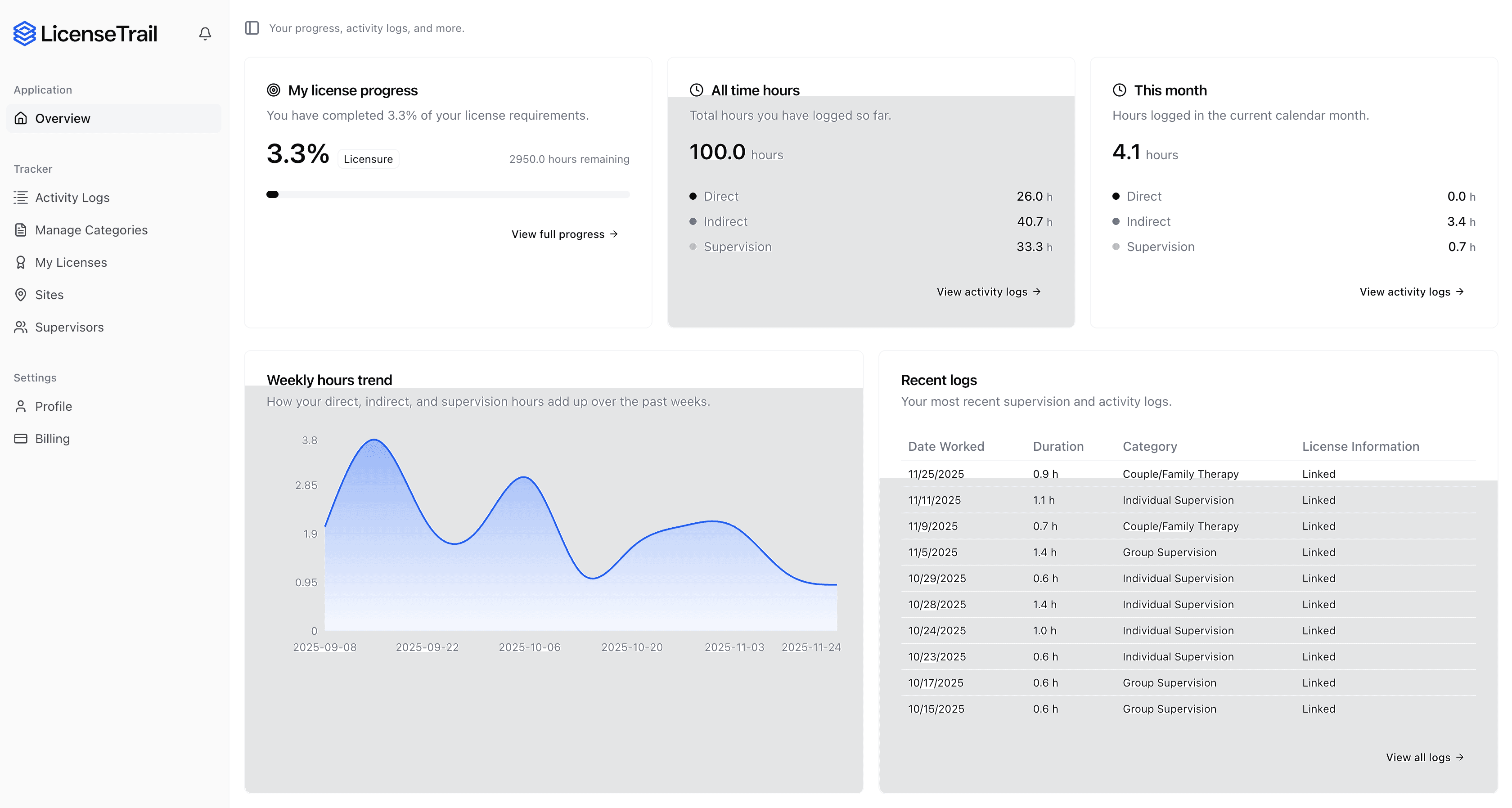
License Trail checks your direct, indirect, and supervision hours against Arizona LIAC requirements continuously and flags mismatches before you submit.
 Start Tracking for Free
No credit card required · Free plan available
Is your spreadsheet hiding Arizona LIAC risks?
Stop guessing if your categories match Arizona Board of Behavioral Health Examiners requirements. License Trail checks your direct, indirect, and supervision hours continuously and flags mismatches before you submit.
Import or log
Bring your spreadsheet or start fresh
Upload your existing tracking spreadsheet and we'll map every hour into the right Arizona Board of Behavioral Health Examiners categories automatically.
Verify against Arizona
Catch mismatches before the board does
License Trail checks your direct, indirect, and supervision hours against Arizona LIAC requirements continuously.
Export board-ready
One-click clean reports
Generate professional, board-ready reports for supervision meetings and Arizona Board of Behavioral Health Examiners submissions in seconds.
No credit card required · Free plan available