
Arizona LPC Requirements: Hours, Exams & Step-by-Step Guide
Stop guessing if your categories match Arizona requirements. License Trail checks your direct, indirect, and supervision hours against LPC requirements continuously and flags mismatches before you submit.
No credit card required · Free plan available
Quick Requirements Overview
- Pathway: Obtain LAC first, then upgrade to LPC after supervised post‑master’s experience (AzBBHE).
- Education: Master’s+ in counseling, 60 semester credits / 90 quarter credits (CACREP/CORE, Board‑approved, or equivalent meeting core content rules).
- Graduate practicum: 700 clock hours in a counseling setting incl. 240 direct client contact hours.
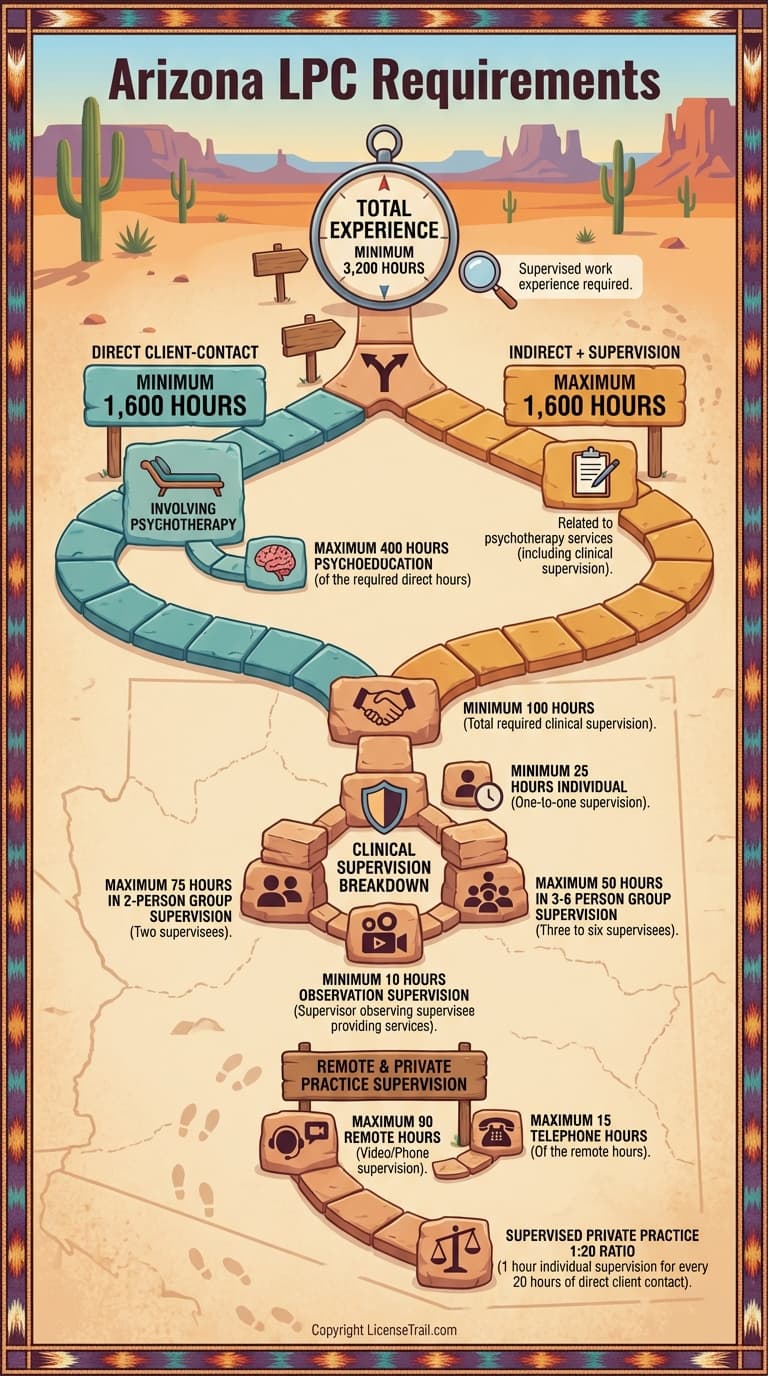
- Post‑master’s supervised work: 3,200 hours minimum completed over ≥24 months.
- Direct client contact: ≥1,600 hours psychotherapy; within that, ≤400 hours psychoeducation.
- Indirect client contact: ≤1,600 hours (psychotherapy‑related).
- Clinical supervision: ≥100 hours total; ≥1 hour supervision in any month you provide direct client contact.
- Exam: Pass Board‑approved exam (NCE, NCMHCE, or CRCE); active AZ LAC satisfies exam requirement for LPC under current rule.
License Details
Procedures
Becoming a Licensed Professional Counselor (LPC) in Arizona is a multi‑stage process governed by the Arizona Board of Behavioral Health Examiners (AzBBHE) through statute (A.R.S. § 32‑3301) and the Arizona Administrative Code (A.A.C. Title 4, Chapter 6, Article 5). The core of licensure is graduate education plus a substantial block of supervised post‑master’s experience with clearly defined hour types.
Below is a structured guide focused on the LPC (independent) level and the exact hour requirements and terminology used by the Board and its rules.
1. Licensure structure: LAC first, then LPC
Arizona uses a two‑tier counseling license structure:
- Licensed Associate Counselor (LAC) – entry‑level license; no post‑degree supervised work experience is required for initial LAC licensure. The rules explicitly state “there is no supervised work experience requirement for licensure as an associate counselor.” (law.cornell.edu)
- Licensed Professional Counselor (LPC) – independent practice level; requires post‑master’s supervised work experience and clinical supervision as detailed below.
In practice, you complete your qualifying degree, obtain LAC, complete the supervised work experience under that license, then apply to upgrade to LPC through AzBBHE’s counseling portal and forms. (bbhe.az.gov)
2. Graduate education and curriculum requirements
Degree level and credit hours
By statute, an LPC applicant must have a master’s or higher degree with a major emphasis in counseling from a regionally accredited college or university, with a program of study that includes at least 60 semester credits (or 90 quarter credits). (law.justia.com)
A.A.C. R4‑6‑501 adds that this degree must be from one of the following: (regulations.justia.com)
- A CACREP or CORE‑accredited program (≥60 semester / 90 quarter credits) including a supervised counseling practicum; or
- A program previously approved by the Board; or
- A regionally accredited program that:
- Has ≥60 semester / 90 quarter credits in counseling‑related coursework; and
- Meets specific core content area and practicum requirements set out in R4‑6‑501(C)–(E).
Required core content areas
For programs not CACREP/NCRE‑accredited, statute requires at least 700 supervised clinical hours and at least 24 semester credits (32 quarter credits) across eight core content areas, including: professional orientation and ethical practice; social and cultural diversity; human growth and development; career development; helping relationships; group work; assessment; and research and program evaluation. (law.justia.com)
The Board’s rule (R4‑6‑501(C)) mirrors and elaborates on these core areas. (law.cornell.edu)
Required supervised counseling practicum (during the degree)
R4‑6‑501(E) defines the graduate‑level practicum standards. The Board will accept a practicum if it: (law.cornell.edu)
- “Consists of at least 700 clock hours in a professional counseling setting,”
- “Includes at least 240 hours of direct client contact,”
- Provides opportunities to perform activities associated with employment as a professional counselor;
- Has faculty oversight and onsite supervision by a college‑approved supervisor.
These practicum hours are part of your degree requirements and are separate from the post‑master’s supervised work experience required for LPC.
3. Post‑master’s supervised work experience for LPC
The supervised work requirement is defined in both statute and Board rule:
- Statute (A.R.S. § 32‑3301(F)–(G)) requires at least 24 months of post‑master’s work experience in professional counseling, including at least 1,600 hours of direct client contact and at least 100 hours of clinical supervision, with limits on psychoeducation hours. (law.justia.com)
- Board rule R4‑6‑503 is more specific and sets the total number of hours and their breakdown.
Total hours and time frame
R4‑6‑503(A) states that an applicant for professional counselor licensure must demonstrate completion of:
“at least **3200 hours of supervised work experience in the practice of professional counseling in no less than 24 months.” (regulations.justia.com)
Key points:
- Total supervised work experience: at least 3,200 hours
- Minimum duration: at least 24 months (2 years) post‑master’s
You may submit more than 3,200 hours for Board consideration, but 3,200 is the minimum threshold. (regulations.justia.com)
Required “direct client contact” hours
Within those 3,200 hours, the Board requires:
- At least 1,600 hours of direct client contact involving the use of psychotherapy. (regulations.justia.com)
“Direct client contact” refers to face‑to‑face (or equivalent telehealth) psychotherapy services where you are directly providing counseling/psychotherapeutic intervention to clients.
The rules further specify:
- No more than 400 of the 1,600 direct‑contact hours may be in psychoeducation. (regulations.justia.com)
“Psychoeducation” here means structured educational activities (classes, groups, or presentations) focused on mental health topics rather than individualized psychotherapy; only up to 400 such hours can count toward your required 1,600 direct‑contact hours.
Indirect client contact hours
R4‑6‑503(A)(4) caps indirect hours:
- For LPC licensure, no more than 1,600 hours may be **“indirect client contact related to psychotherapy services.” (regulations.justia.com)
“Indirect client contact” typically includes activities such as:
- Clinical documentation and record‑keeping
- Case consultation and treatment‑team meetings focused on client care
- Care coordination and collateral contacts (e.g., with families, schools, other providers)
- Treatment planning, case review, and case‑related research
Administrative tasks not tied to psychotherapy services (purely clerical work, general staff meetings) are not usually counted toward these indirect hours.
Clinical supervision hours (as part of supervised work experience)
Within the 3,200 supervised work hours, you must obtain at least 100 hours of clinical supervision:
- R4‑6‑503(A)(3) requires “at least 100 hours of clinical supervision” that meets R4‑6‑212 and R4‑6‑504. (regulations.justia.com)
- Statute separately states that, in addition to the required work experience, the applicant must have at least 100 hours of clinical supervision, and again limits psychoeducation hours within direct contact. (law.justia.com)
R4‑6‑503(B) adds:
- For any month in which you provide direct client contact, you must receive at least one hour of clinical supervision during that month. (regulations.justia.com)
In other words, supervision must be ongoing and contemporaneous with your direct client work; it is not acceptable to batch supervision long after the services are provided.
4. Who can provide clinical supervision and what it means
Definition and source of clinical supervision
R4‑6‑504 and R4‑6‑212 together define who can supervise and what the Board accepts as clinical supervision:
- You must receive at least 100 hours of clinical supervision during your 3,200‑hour supervised work period. (regulations.justia.com)
- The Board accepts clinical supervision hours only from the following behavioral health professionals (who also must meet specific educational requirements under R4‑6‑214): (regulations.justia.com)
- Licensed Professional Counselor (LPC)
- Licensed Clinical Social Worker (LCSW)
- Licensed Marriage and Family Therapist (LMFT)
- Licensed Psychologist
- An individual granted a specific Board exemption under R4‑6‑212.01
Critically, the rule also states:
- The Board “shall not accept hours of clinical supervision provided by a substance abuse counselor for professional counselor licensure.” (regulations.justia.com)
R4‑6‑212 (Clinical Supervision Requirements) adds general conditions for any qualifying clinical supervisor, including:
- They must hold an active and unrestricted license in the relevant discipline (e.g., LPC, LCSW, LMFT, Psychologist) and
- They must meet the Board’s education requirements for supervisors under R4‑6‑214. (regulations.justia.com)
Direct supervision vs. supervised work experience
Separate rules under R4‑6‑211 describe “direct supervision” and general supervised work requirements, including that a masters‑level licensee under practice limitations must practice in an entity with clinical oversight, and that unprofessional conduct can lead the Board to reject affected supervision hours. (regulations.justia.com)
For LPC purposes:
- “Supervised work experience” is the entire 3,200‑hour block of post‑master’s practice under Board‑recognized supervision. (regulations.justia.com)
- “Clinical supervision” refers to the formal, documented supervisory relationship (case review, feedback, competency assessment) that must total at least 100 hours within that period.
5. Examination requirements
Statute requires LPC applicants to “pass an examination approved by the board.” (law.justia.com)
R4‑6‑502(A) lists the examinations the Board approves for counselor licensure: (law.cornell.edu)
- National Counselor Examination for Licensure and Certification (NCE) – NBCC
- National Clinical Mental Health Counseling Examination (NCMHCE) – NBCC
- Certified Rehabilitation Counselor Examination (CRCE) – Commission on Rehabilitation Counselor Certification
Under the current rule, if you already hold an active, in‑good‑standing LAC issued by the Board, you are deemed to meet the exam requirement for LPC (because the LAC required a passing score on one of the approved exams). (law.cornell.edu)
6. Board forms and documentation of hours
For LPC applicants, AzBBHE provides specific forms on its counseling page: (bbhe.az.gov)
- Verification of Supervised Work Experience – documents your 3,200 hours and their breakdown (direct, indirect, time frame).
- Verification of Clinical Supervision – documents your 100 hours of qualifying clinical supervision, including who supervised you and in what capacity.
- Clinical Supervisor Exemption Request – used if you need to request Board permission to count supervision from someone not employed by the same agency, under R4‑6‑212.01.
Supervisors/employers normally submit these verifications directly (or in sealed form) to be included with your LPC application.
7. Snapshot: Arizona LPC hour requirements
The core quantitative requirements based on current statute and Board rules are:
During your qualifying degree (practicum): (law.cornell.edu)
- 700+ clock hours in a professional counseling setting
- 240+ hours of direct client contact within those 700 hours
Post‑master’s, for LPC licensure (supervised work experience): (law.justia.com)
-
Total supervised work experience:
- 3,200+ hours of supervised work in the practice of professional counseling
- Completed in no less than 24 months post‑master’s
-
Required breakdown of those 3,200 hours:
- Direct client contact (psychotherapy): at least 1,600 hours
- Of those direct hours, psychoeducation: no more than 400 hours
- Indirect client contact (related to psychotherapy services): no more than 1,600 hours
- Clinical supervision: at least 100 hours (provided by qualified supervisors under R4‑6‑212, 504)
- Ongoing supervision: at least 1 hour of clinical supervision in any month you provide direct client contact
These post‑master’s hours must be accrued under appropriate supervision and documented on AzBBHE’s Verification of Supervised Work Experience and Verification of Clinical Supervision forms as part of your LPC application.
8. Putting it all together: sequence to LPC in Arizona
In practical order, the path to Arizona LPC typically looks like this:
-
Complete a qualifying graduate counseling degree
- Master’s or higher, 60+ graduate credits in counseling with required core content and a 700‑hour practicum (240 direct contact hours).
-
Obtain LAC licensure
- Apply to the Board as an Associate Counselor; pass one of the Board‑approved national exams (NCE, NCMHCE, or CRCE); receive LAC.
-
Accrue post‑master’s supervised work experience
- Under LAC, complete at least 3,200 hours over a minimum of 24 months.
- Ensure 1,600+ hours are direct psychotherapy contact; no more than 400 in psychoeducation and no more than 1,600 indirect hours.
- Obtain 100+ hours of qualifying clinical supervision, including at least one hour in every month you provide direct services.
-
Document supervision and work experience with Board forms
- Have supervisors/employers complete and submit Verification of Supervised Work Experience and Verification of Clinical Supervision.
-
Apply to upgrade to LPC
- File your LPC application with AzBBHE, including verification forms, proof of education, and required fees. Because you already passed an approved exam for LAC, the exam requirement is considered met under current rules.
-
Maintain LPC licensure
- Meet continuing education and renewal requirements (set elsewhere in statute/rule) on a 2‑year cycle.
This framework reflects the requirements as expressed in A.R.S. § 32‑3301 and A.A.C. R4‑6‑501 through R4‑6‑504, along with the Board’s current counseling licensure materials, as of late 2025. If you’re planning an actual application, it is wise to cross‑check these details directly on the Board’s counseling page and in the current versions of the cited statute and rules, as procedural details and interpretations can change.
Track your LPC hours with confidence
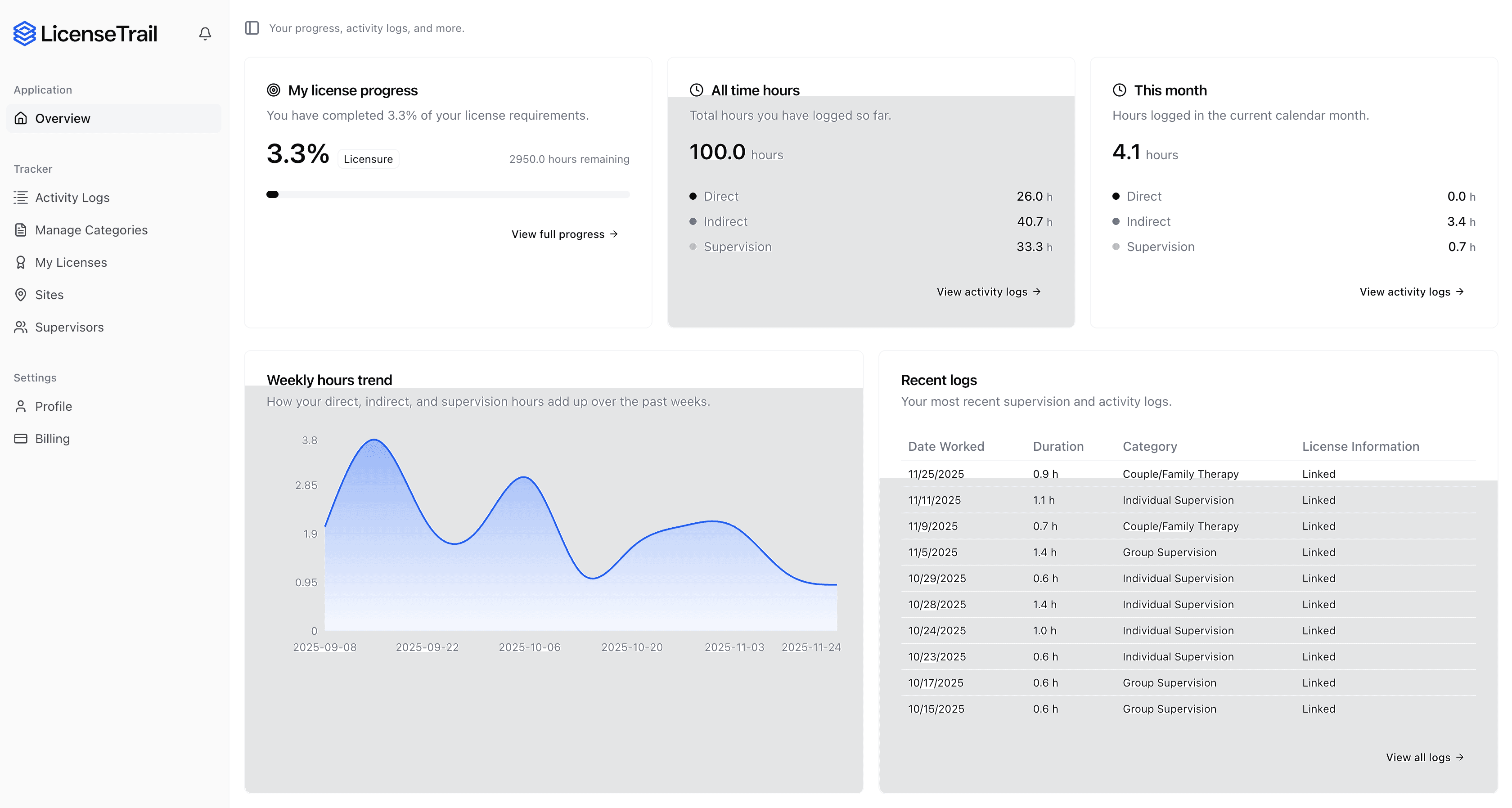
License Trail checks your direct, indirect, and supervision hours against Arizona LPC requirements continuously and flags mismatches before you submit.
 Start Tracking for Free
No credit card required · Free plan available
Is your spreadsheet hiding Arizona LPC risks?
Stop guessing if your categories match Arizona Board of Behavioral Health Examiners requirements. License Trail checks your direct, indirect, and supervision hours continuously and flags mismatches before you submit.
Import or log
Bring your spreadsheet or start fresh
Upload your existing tracking spreadsheet and we'll map every hour into the right Arizona Board of Behavioral Health Examiners categories automatically.
Verify against Arizona
Catch mismatches before the board does
License Trail checks your direct, indirect, and supervision hours against Arizona LPC requirements continuously.
Export board-ready
One-click clean reports
Generate professional, board-ready reports for supervision meetings and Arizona Board of Behavioral Health Examiners submissions in seconds.
No credit card required · Free plan available