
Arizona LMFT Requirements: Hours, Exams & Step-by-Step Guide
Stop guessing if your categories match Arizona requirements. License Trail checks your direct, indirect, and supervision hours against LMFT requirements continuously and flags mismatches before you submit.
No credit card required · Free plan available
Quick Requirements Overview
- Regulator/Path: Arizona Board of Behavioral Health Examiners (AzBBHE); LAMFT (supervised) → LMFT (independent)
- Education: Master’s/doctoral behavioral science degree from regionally accredited school; COAMFTE or Board-equivalent MFT curriculum
- Graduate practicum: 300 supervised client-contact hours (individuals, couples, families); supervised by LMFT unless exempted
- Exam: AMFTRB MFT exam (typically passed for LAMFT; active LAMFT generally satisfies LMFT exam requirement)
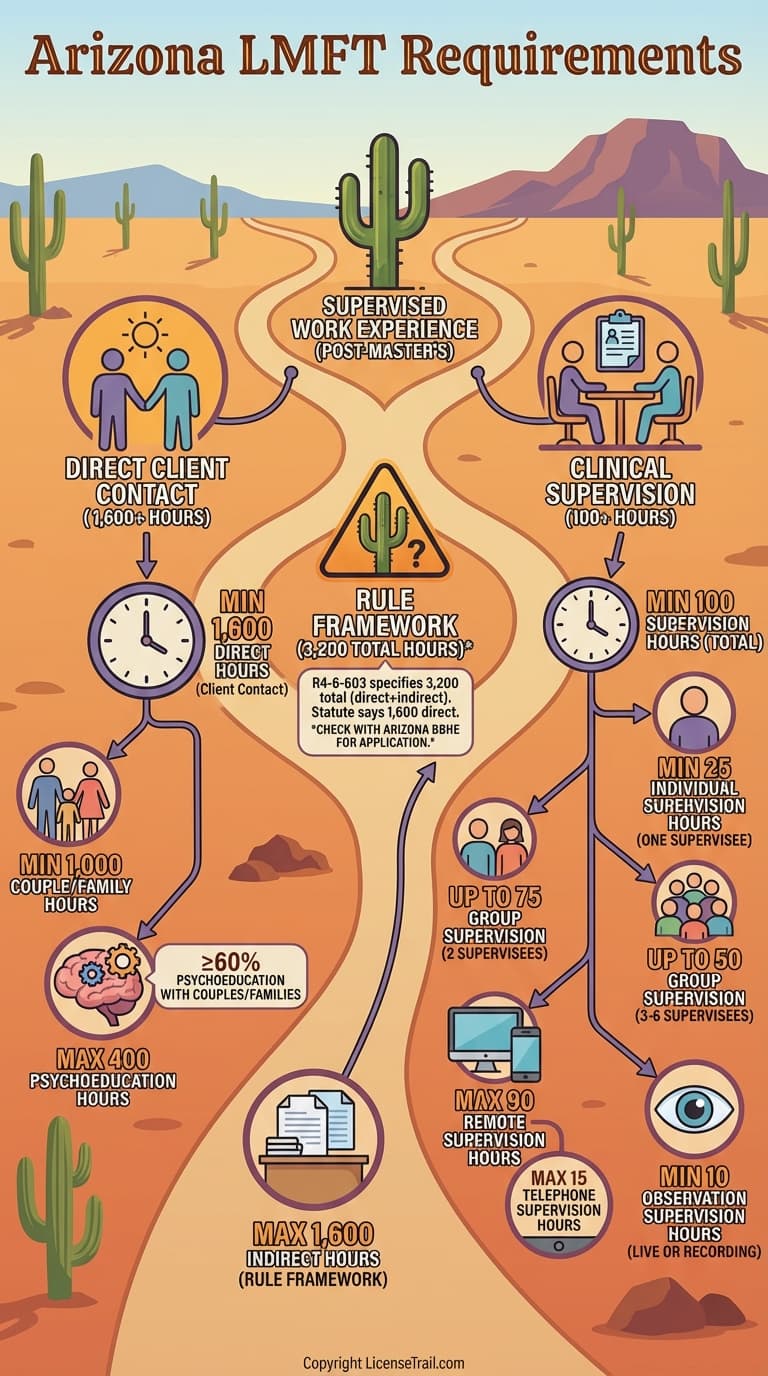
- Post-master’s experience (LMFT): 1,600 supervised direct client-contact hours over ≥24 months; includes ≥1,000 hours with couples/families; ≤400 hours psychoeducation (≥60% with couples/families)
- Clinical supervision: ≥100 hours; ≥50 hours by AZ LMFT or AAMFT Approved Supervisor; remaining by qualified LPC/LCSW/LMFT/psychologist (no SUD counselor supervision accepted)
- Rule-framework note: Board rules still reference 3,200 total supervised work hours with ≤1,600 indirect service—ensure hours documentation meets both statute/rule expectations
- Application items: Apply via Boardal; fingerprint clearance card/fingerprints, fees, and Board verification forms for supervised experience & supervision (supervisor competency attestation required)
License Details
Procedures
Becoming a Licensed Marriage and Family Therapist (LMFT) in Arizona is a two‑stage process regulated by the Arizona Board of Behavioral Health Examiners (AzBBHE) under Arizona law and the Arizona Administrative Code. The path moves from:
- Licensed Associate Marriage and Family Therapist (LAMFT) →
- Licensed Marriage and Family Therapist (LMFT – independent practice).
The details below focus on what the Board and statutes actually require, especially the types and amounts of hours.
1. Arizona’s two MFT licenses and who regulates them
Arizona issues two marriage and family therapy licenses through the AzBBHE:
- Licensed Associate Marriage and Family Therapist (LAMFT)
- Licensed Marriage and Family Therapist (LMFT) (bbhe.az.gov)
The statutes governing LMFTs are primarily A.R.S. § 32‑3311 (LMFT qualifications) and § 32‑3313 (LAMFT qualifications), with further detail in the Board’s rules at A.A.C. R4‑6‑601 to R4‑6‑605. (azleg.gov)
2. Key definitions for hours and supervision (Board language)
Arizona uses specific definitions that matter when you count hours.
Direct client contact
“Direct client contact” is defined in statute and in the Board’s rules as performing therapeutic or clinical functions at your level of psychotherapy practice that involve diagnosis, assessment and treatment. It may include psychoeducation, and it is based on verbal or nonverbal interaction with one or more clients in their presence (including via telehealth). (law.cornell.edu)
In practice: only time you spend actually providing psychotherapy (and certain psychoeducational interventions) with the client present counts as direct client contact.
Indirect client service
“Indirect client service” means activities done in preparation for or on behalf of a client for whom you also provide direct client contact—such as case consultation and receiving clinical supervision. The rules make clear that indirect service does not include providing psychoeducation. (regulations.justia.com)
Examples: documentation, treatment planning, case staffing meetings, and clinical supervision hours are indirect service (not direct client contact).
Clinical supervision
“Clinical supervision” is defined by the Board as direction or oversight (face‑to‑face, by video, or by phone) by a qualified supervisor who evaluates, guides, and directs all behavioral health services you provide, to help you develop safe and competent practice. (law.cornell.edu)
These clinical supervision hours are what count toward the 100‑hour minimum for LMFT licensure.
Supervised work experience
“Supervised work experience” means practicing marriage and family therapy (or another behavioral health discipline) for pay or as a volunteer under direct supervision while also receiving clinical supervision as required by the rules. (regulations.justia.com)
This is the framework for the hour requirements described below.
3. Step One – Education and practicum requirements
Degree requirement
For both LAMFT and LMFT you must have:
- A master’s or doctoral degree in behavioral science (for example, marriage and family therapy, psychology, counseling, social work, or sociology),
- From a regionally accredited college or university,
- Either in a COAMFTE‑accredited program or in a program the Board deems “substantially equivalent” to its required marriage and family therapy curriculum. (azleg.gov)
The Board’s MFT curriculum rule (R4‑6‑601) specifies core content areas and requires that the program’s supervised practicum meet certain standards.
Practicum / internship requirement
Your graduate program’s supervised practicum must: (law.cornell.edu)
- Give you the opportunity to provide marriage and family therapy services to individuals, couples, and families.
- Include at least 300 client‑contact hours provided under direct supervision.
- Be supervised by a designated licensed marriage and family therapist, unless the Board grants an exemption.
Those 300 hours are educational practicum hours; they are separate from the post‑master’s supervised work experience you accumulate later as a LAMFT.
4. Step Two – Licensed Associate Marriage and Family Therapist (LAMFT)
The LAMFT is Arizona’s supervised, non‑independent license.
Statutory requirements
To be licensed as a LAMFT, a person must satisfy: (law.justia.com)
- The degree and curriculum requirements in A.R.S. § 32‑3311(A)(1) and (B) (the behavioral science degree and approved MFT curriculum, including practicum).
- The examination requirement in § 32‑3311(A)(3) (passing an exam approved by the Board).
- Any other general Board application requirements (fingerprints/clearance card, fees, etc.).
The Board’s “Applying for Licensure” page adds that all license applicants must: (bbhe.az.gov)
- Apply through the Board’s online “Boardal” portal.
- Submit either:
- An Arizona Department of Public Safety fingerprint clearance card or
- A set of fingerprints on the specified FD‑258 card with the Board’s fingerprint fee.
- Pay the application fee (currently listed as $250 for licensure by examination).
Examination
The Board approves the marriage and family therapy licensure examination offered by the Association of Marital and Family Therapy Regulatory Boards (AMFTRB). (azrules.elaws.us)
- An applicant for associate or full LMFT licensure must receive a passing score on this examination unless otherwise deemed to have met the exam requirement (see LMFT section below). (law.cornell.edu)
Supervision status as a LAMFT
Under statute, a LAMFT may only practice under direct supervision as prescribed by the Board. (law.justia.com)
“Direct supervision” means the supervisor has responsibility and oversight for all services the supervisee provides, under the specific supervisory rules in R4‑6‑211. (law.cornell.edu)
LAMFTs do not practice independently and do not provide supervision to others.
5. Step Three – Supervised post‑master’s experience for LMFT
The heart of LMFT licensure in Arizona is your post‑master’s supervised experience. Two layers govern this:
- The statute (A.R.S. § 32‑3311), and
- The Board’s rules (A.A.C. R4‑6‑603 and R4‑6‑604).
Because they use slightly different framing, it is useful to see both.
5.1 Statutory minimum (A.R.S. § 32‑3311)
Under the current statute, to qualify for LMFT licensure you must: (azleg.gov)
- Complete 1,600 hours of post‑master’s degree experience in the practice of marriage and family therapy,
- In at least 24 months,
- Under supervision that meets Board requirements.
Within those 1,600 hours:
- All 1,600 hours must be direct client contact.
- At least 1,000 hours must be clinical experience with couples and families.
- Not more than 400 hours of the direct‑contact hours may be in psychoeducation.
- The hours must include at least 100 hours of clinical supervision that meets Board rules.
Statute also requires your supervisor to attest, on a Board‑approved form, that during your supervised hours you: (azleg.gov)
- Demonstrated satisfactory competency in clinical documentation, consultation, collaboration, and coordination of care for clients you treated; and
- Had at least a “satisfactory” overall performance rating.
5.2 Board rule – supervised work experience (R4‑6‑603)
The Board’s MFT rule on supervised work experience still frames the requirement in terms of total supervised work hours: (law.cornell.edu)
- “At least 3,200 hours of supervised work experience in the practice of marriage and family therapy in no less than 24 months.”
Within those 3,200 supervised hours, the rule requires:
-
Direct client contact
- At least 1,600 hours of direct client contact involving the use of psychotherapy.
- Of those 1,600 direct hours:
- At least 1,000 hours must be with couples or families.
- No more than 400 hours may be in psychoeducation, and at least 60% of the psychoeducation hours must be with couples or families. (law.cornell.edu)
-
Clinical supervision
- At least 100 hours of clinical supervision that meets the general supervision requirements (R4‑6‑212) and the MFT‑specific supervision rule (R4‑6‑604). (law.cornell.edu)
-
Indirect client service cap
- For licensure purposes, no more than 1,600 hours of the 3,200 total may be indirect client service (i.e., preparatory and supportive functions, including supervision, but not psychoeducation). (law.cornell.edu)
In everyday terms, the Board’s rule still describes:
- 3,200 hours total supervised work experience, of which
- 1,600 hours must be direct client contact, and
- Up to 1,600 hours may be indirect client service, and
- Within the supervised experience you must log 100 hours of clinical supervision.
5.3 Clinical supervision: who can supervise and how the hours must look
The MFT‑specific clinical supervision rule (R4‑6‑604) requires: (law.cornell.edu)
- Total clinical supervision: at least 100 hours during the supervised work experience required under R4‑6‑603.
- Supervisor qualifications:
- Supervision must be provided by individuals who meet Board educational requirements in R4‑6‑214.
- At least 50 of the 100 hours must be supervised by either:
- A licensed marriage and family therapist (LMFT) in Arizona, or
- An independently licensed behavioral health professional who holds an “Approved Supervisor” designation from AAMFT.
- The remaining hours may be supervised by:
- A licensed professional counselor,
- A licensed clinical social worker,
- A licensed marriage and family therapist, or
- A licensed psychologist,
- Or by a supervisor for whom the Board has granted an exemption under R4‑6‑212.01.
- Prohibited supervisors: The Board expressly will not accept clinical supervision hours provided by a substance abuse counselor for MFT licensure. (law.cornell.edu)
The general clinical supervision rule (R4‑6‑212) further requires that supervision be provided by a Board‑licensed independent behavioral health professional (or a licensed psychologist) who meets specified education and training standards, or by someone granted a formal exemption. (regulations.justia.com)
5.4 Reconciling statute (1,600 hours) and rule (3,200 hours)
In 2021, SB1089 amended A.R.S. § 32‑3311 and related sections to reduce required post‑master’s experience from 3,200 hours to 1,600 hours of supervised direct client contact, and to specify that those 1,600 direct hours must include at least 1,000 hours with couples/families and at least 100 hours of clinical supervision. (azleg.gov)
- The statute now speaks in terms of 1,600 hours of post‑master’s experience, all of which are direct client contact. (azleg.gov)
- The Board’s MFT rule on supervised work experience (R4‑6‑603) still describes the broader 3,200‑hour supervised work experience, specifying how much of that must be direct contact, how much can be indirect, and that at least 100 hours must be clinical supervision. (law.cornell.edu)
Because the statute controls and Board rules are in the process of being harmonized with SB1089, current practice is often described to applicants in terms of:
- 1,600 hours of supervised direct client contact (with the 1,000 couples/families, 400 psychoeducation cap, and 100 clinical supervision hours built into those direct hours),
- Completed over at least 24 months of supervised practice. (azleg.gov)
At the same time, you will still see the 3,200‑hour supervised work experience framework in Board rules and older secondary sources. To avoid any problem when your application is evaluated, it is prudent to structure your experience so you meet:
- The statutory minimum of 1,600 supervised direct‑contact hours; and
- The Board rule’s structure of supervised work experience, with no more than 1,600 hours of indirect service and at least 100 hours of clinical supervision.
6. Step Four – Applying for the independent LMFT license
Once you have:
- Your qualifying master’s or doctoral degree and practicum,
- An active LAMFT license,
- At least 24 months of supervised work experience, and
- The required 1,600 hours of supervised direct client contact (including 1,000 couples/families hours and your clinical supervision hours),
you can apply for LMFT licensure.
Meeting the examination requirement
The Board’s exam rule now states that an applicant for LMFT licensure is deemed to have met the examination requirement if the applicant holds an active, in‑good‑standing LAMFT license issued by the Board. (law.cornell.edu)
This reflects the practical reality that LAMFTs must already have passed the AMFTRB licensure exam.
Application components
The AzBBHE “Marriage and Family Therapy” page and the general “Applying for Licensure” page indicate that LMFT applicants must: (bbhe.az.gov)
- Apply for LMFT in the Board’s online portal (Boardal).
- Submit:
- Verification of supervised work experience (on the Board’s “Verification of Supervised Work Experience” form), and
- Verification of clinical supervision (on the Board’s “Verification of Clinical Supervision” form).
- These forms must be submitted by employers/supervisors or, if the applicant submits them, they must be in a signed, sealed envelope with the application.
- Provide updated employment history and proof of legal presence, and maintain a valid fingerprint clearance card or submit new fingerprints and fee if required.
- Pay the application fee for independent licensure.
Your supervisor(s) must also complete the statutory attestation regarding your competency and performance on the Board’s approved form. (azleg.gov)
7. After licensure – Renewal and continuing education (briefly)
To maintain LMFT or LAMFT licensure in Arizona, the Board requires renewal every two years with continuing education (CE). Current CE requirements include: (athealth.com)
- 30 hours of continuing education every 2‑year renewal period.
- Within those 30 hours:
- At least 3 hours in ethics,
- At least 3 hours in cultural competence and diversity, and
- A 3‑hour Board‑approved tutorial on Board statutes and rules (this counts toward the 30‑hour total).
8. Numerical summary of Arizona LMFT hour requirements
Putting the Board’s language and the statute together, the practical hour requirements to progress from LAMFT to LMFT are:
Graduate practicum (during degree)
- At least 300 client‑contact hours of supervised practicum providing MFT services to individuals, couples, and families, under direct supervision. (law.cornell.edu)
Post‑master’s supervised experience (LAMFT → LMFT)
Under the statute and Board rules as currently written:
-
Supervised work experience (Board rule framework)
- 3,200 hours of supervised work experience in the practice of marriage and family therapy over at least 24 months.
- Within that:
- At least 1,600 hours are direct client contact involving the use of psychotherapy.
- No more than 1,600 hours are indirect client service (documentation, case consultation, supervision, etc.). (law.cornell.edu)
-
Direct client contact requirements (statute and rule)
Within the 1,600 direct‑contact hours: (azleg.gov)- The full 1,600 hours must be direct client contact (psychotherapy) rather than purely administrative work.
- At least 1,000 hours must be with couples and families.
- No more than 400 hours may be psychoeducation, and at least 60% of those psychoeducation hours must involve couples or families.
-
Clinical supervision within that experience
During the same supervised experience, you must receive: (law.cornell.edu)- At least 100 hours of clinical supervision that:
- Meets general supervision requirements in R4‑6‑212;
- Is provided by qualified supervisors (LCSW, LPC, LMFT, psychologist, or exempt supervisor) who meet education standards;
- Includes at least 50 hours supervised by:
- An Arizona‑licensed LMFT, or
- An independently licensed behavioral health professional who is an AAMFT Approved Supervisor;
- Has the remaining hours supervised by LPCs, LCSWs, LMFTs, or psychologists (or an exempt supervisor);
- Does not include any hours supervised by a substance abuse counselor (these are not accepted for MFT licensure).
- At least 100 hours of clinical supervision that:
-
Statutory framing of the hours
- A.R.S. § 32‑3311 now frames the requirement as 1,600 hours of post‑master’s experience consisting entirely of direct client contact, and specifies that those 1,600 hours must include at least 1,000 hours with couples/families and at least 100 hours of clinical supervision, with no more than 400 direct hours in psychoeducation. (azleg.gov)
In practice, if you think of the requirement in the way the user’s example was phrased:
- Arizona effectively requires 1,600 hours of direct psychotherapy experience,
- Completed under supervision over at least 24 months,
- With a built‑in requirement of 100 hours of clinical supervision and specific sub‑requirements (1,000 couple/family hours; psychoeducation caps),
- Structured within a total supervised work‑experience framework that still references 3,200 hours in the Board’s rules.
Because laws and rules evolve and the Board is aligning its rules with SB1089, it is always wise to confirm current interpretations directly with AzBBHE before finalizing supervision contracts or counting borderline hours, but the numbers and definitions above reflect the Board’s and statutes’ actual language as of 2025.
Track your LMFT hours with confidence
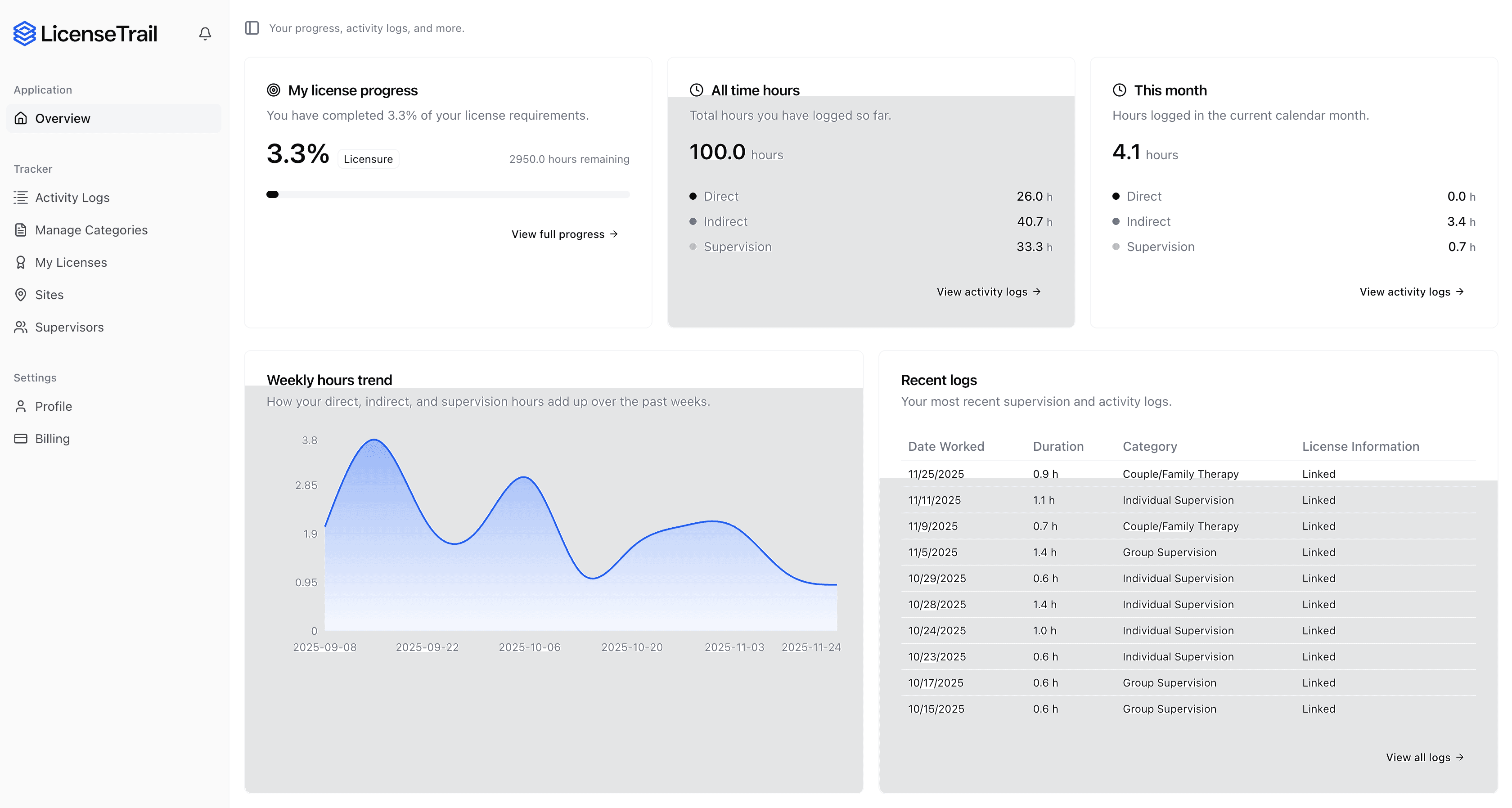
License Trail checks your direct, indirect, and supervision hours against Arizona LMFT requirements continuously and flags mismatches before you submit.
 Start Tracking for Free
No credit card required · Free plan available
Is your spreadsheet hiding Arizona LMFT risks?
Stop guessing if your categories match Arizona Board of Behavioral Health Examiners requirements. License Trail checks your direct, indirect, and supervision hours continuously and flags mismatches before you submit.
Import or log
Bring your spreadsheet or start fresh
Upload your existing tracking spreadsheet and we'll map every hour into the right Arizona Board of Behavioral Health Examiners categories automatically.
Verify against Arizona
Catch mismatches before the board does
License Trail checks your direct, indirect, and supervision hours against Arizona LMFT requirements continuously.
Export board-ready
One-click clean reports
Generate professional, board-ready reports for supervision meetings and Arizona Board of Behavioral Health Examiners submissions in seconds.
No credit card required · Free plan available