
California LEP Requirements: Hours, Exams & Step-by-Step Guide
Stop guessing if your categories match California requirements. License Trail checks your direct, indirect, and supervision hours against LEP requirements continuously and flags mismatches before you submit.
No credit card required · Free plan available
Quick Requirements Overview
- License authority: California Board of Behavioral Sciences (BBS); must already be a credentialed/licensed school psychologist (or equivalent)
- Education: Master’s (or higher) in psychology/educational psychology/school psychology/counseling & guidance (or BBS‑approved equivalent) from a regionally accredited university
- Coursework: 60 semester units (90 quarter units) of postgraduate study in pupil personnel services (often met via CA PPS School Psychology pathway)
- Background: Live Scan fingerprints + DOJ/FBI criminal background check required
- Experience (recency): Required school psychologist experience must generally be within the 6 years immediately before BBS receives the application
- Base experience (SB 775 / BPC §4989.20, effective 1/1/2026): 2 school terms full‑time (or equivalent) as a credentialed/licensed school psychologist (min 1,050 hours or 175 days per term; school term ≥35 weeks)
- Supervised component: Either (A) 1,200 hours supervised professional experience in an accredited school psychology program, or (B) 1 school term full‑time (or equivalent) under direction of a CA‑licensed LEP/psychologist (min 1,050 hours)
- Exam/issuance timing: Pass LEP Written Exam (Pearson VUE) within 1 year of application approval; request license issuance/pay initial fee within 1 year after passing
License Details
Procedures
Becoming a Licensed Educational Psychologist (LEP) in California means meeting the Board of Behavioral Sciences’ (BBS) education, experience, and examination requirements set out on its LEP applicant page and in the Educational Psychologist Practice Act (Business and Professions Code §4989.20).
Below is a structured guide, with an emphasis on the kind and amount of experience/hours the law actually requires.
1. Who licenses LEPs and what do they do?
In California, LEPs are licensed by the Board of Behavioral Sciences (BBS), a state regulatory agency within the Department of Consumer Affairs. (bbs.ca.gov)
An LEP license allows you to practice privately (outside the school system) in areas such as:
- Psychoeducational assessment
- Diagnosis of psychological disorders related to academic learning processes
- Educationally related counseling for students and families
- Consultation with parents, schools, and agencies
You must already be a school psychologist (or equivalent) and then meet additional requirements to become licensed as an LEP.
2. Education requirements
2.1 Qualifying graduate degree
You must hold at least a master’s degree in one of these areas (or a board‑approved equivalent): (bbs.ca.gov)
- Psychology
- Educational psychology
- School psychology
- Counseling and guidance
The degree must be from a university accredited by a regional accrediting body recognized by the BBS (WASC, Middle States, etc.). (bbs.ca.gov)
2.2 Required graduate units
The BBS currently states that applicants must complete:
- “60 semester hours of postgraduate work in pupil personal [personnel] services.” (bbs.ca.gov)
Recent legislation (SB 775, 2025) amends Business and Professions Code §4989.20 to specify this more precisely as: (legiscan.com)
- “60 semester units or 90 quarter units of postgraduate study in pupil personnel services.”
In practice, this is usually met by completing a standard California school psychology graduate program that leads to a Pupil Personnel Services (PPS) credential in School Psychology.
3. Background check and Live Scan
Before you can be licensed, the BBS requires: (bbs.ca.gov)
- Live Scan fingerprinting (California DOJ and FBI).
- A criminal background check; the Board evaluates any criminal history as part of your application.
4. Core experience requirement – years vs. hours
This is the part you asked about most directly.
4.1 How the BBS currently describes the experience (Board website)
On the BBS LEP applicant page (as of November 2025), the experience requirement is framed in years, not hours:
- “Applicants must complete three years of full time experience (or the equivalent to three years of experience) working as a school psychologist.” (bbs.ca.gov)
The BBS then breaks this down as: (bbs.ca.gov)
- Two years of full-time (or equivalent) experience
- As a credentialed school psychologist in public schools.
- This may be unsupervised.
- Must be obtained within the most recent six years before you apply for licensure.
AND
- One of the following (a third year):
- Option A – supervised internship/practicum
- One year of supervised professional experience in an accredited school psychology program (this can be more than six years old).
OR
- One year of supervised professional experience in an accredited school psychology program (this can be more than six years old).
- Option B – supervised post‑credential experience
- One year of full‑time (or equivalent) experience as a credentialed school psychologist in public schools, under the direction of a licensed educational psychologist or a licensed psychologist (also can be older than six years).
- Option A – supervised internship/practicum
Notice that, in this current Board-facing description:
- The BBS uses years of full-time experience rather than numerical hour totals.
- It does not subdivide experience into “direct client contact hours” vs. “other” the way LMFT/LCSW/LPCC requirements do.
- It distinguishes between unsupervised employment as a credentialed school psychologist (2 years) and a supervised component (1 year), but still in terms of years, not hour counts.
So, if you’re looking for language like “1,500 hours of direct experience and 1,500 hours of supervised experience,” that does not exist for LEPs in current BBS guidance. The requirement is framed as three years of full‑time school psychologist work with specific supervision structure.
5. Statutory detail: how “years” translate into hours
Although the BBS website uses years, recent statutory changes now define those years using explicit hour counts and “school term” definitions.
5.1 New statutory standard (SB 775 amending BPC §4989.20)
SB 775, approved October 13, 2025, revises Business and Professions Code §4989.20, which governs LEP licensure. (legiscan.com)
The amended statute (effective January 1, 2026, under California’s general effective‑date rules) provides:
-
Base school psychologist experience
“Two school terms of full‑time, or the equivalent to full‑time, experience as a licensed or credentialed school psychologist…” (legiscan.com)
and specifies that this experience:
- Must be gained over at least two school terms.
- Must not be older than six years immediately before the Board receives your licensure application. (legiscan.com)
-
Additional supervised experience, if your base experience was in California
If those two school terms were completed while holding a California credential in a California school, you must also complete one of: (legiscan.com)
- Option A – Supervised professional experience in a program
- “A minimum of 1,200 hours of supervised professional experience in an accredited school psychology program.”
OR
- “A minimum of 1,200 hours of supervised professional experience in an accredited school psychology program.”
- Option B – Supervised practice under an LEP or psychologist
- One school term of full‑time (or equivalent) experience as a California credentialed school psychologist, in California public schools or another qualifying school setting, under the direction of a California‑licensed educational psychologist.
In both cases, the statute states you cannot be credited with experience obtained more than six years before the Board receives your licensure application. (legiscan.com)
- Option A – Supervised professional experience in a program
-
Additional supervised experience, if your base experience was not in California
If your required two school terms of experience were completed outside California, the statute again requires either: (legiscan.com)
- Option A – 1,200 supervised hours in California
- A minimum of 1,200 hours of supervised professional experience gained in California in an accredited school psychology program, within the six-year window.
OR
- A minimum of 1,200 hours of supervised professional experience gained in California in an accredited school psychology program, within the six-year window.
- Option B – one supervised school term under a California LEP or psychologist
- One school term of full‑time (or equivalent) experience as a California credentialed school psychologist, in California schools or another qualifying setting, obtained under a California‑licensed educational psychologist (or, in the statutory text you saw earlier, a California‑licensed psychologist). (legiscan.com)
- Option A – 1,200 supervised hours in California
5.2 Definition of “full time” and hour equivalents
The amended statute adds explicit definitions that convert “years” or “terms” into hours/days: (legiscan.com)
-
“Full time”
- Means the days or hours of creditable service your employer requires in a school term under your contract.
- It “shall consist of a minimum of 175 days, or 1,050 hours, per school term.”
-
“Equivalent to full time”
- Means the days/hours a part‑time employee would have to work in that position to equal full‑time in a school term.
-
“School term”
- At least 35 weeks between the first and last day of required creditable service for a full‑time employee (with some exceptions for contractually excluded periods).
Putting this together in approximate hour terms:
-
Base requirement:
- Two school terms of full‑time work as a school psychologist
- Minimum: 2 × 1,050 hours = 2,100 hours of full‑time school psychologist experience.
-
Additional supervised requirement (depending on route):
- Option A: At least 1,200 hours of supervised professional experience in an accredited school psychology program.
- Option B: One more school term of full‑time (or equivalent) experience under a California LEP/psychologist = at least 1,050 hours.
So, in terms of credited experience:
- One common path under the new law would involve at least 2,100 hours of school psychologist work plus 1,200 supervised hours in a program (3,300+ hours in total, though some may overlap functionally within your employment or training program).
- Another path is three school terms of full‑time (or equivalent) work as a school psychologist, with at least one of those terms under the direction of a California LEP (minimum 3 × 1,050 = 3,150 hours).
The statute does not break these hours into “assessment vs. counseling vs. consultation” or “direct vs. indirect” the way LMFT/LCSW/LPCC requirements do. It focuses on:
- Being employed as a licensed or credentialed school psychologist, and
- Ensuring a defined supervised component (either 1,200 supervised hours or a fully supervised school term).
6. Comparing old BBS experience framing to new statutory language
For someone reading both the BBS LEP page and §4989.20, it helps to see how they line up:
BBS website (current wording) – big picture (bbs.ca.gov)
- Three years of full‑time (or equivalent) experience as a school psychologist, broken down as:
- 2 years full‑time as a credentialed school psychologist in public schools (unsupervised allowed, recent 6 years), plus
- 1 year either in an accredited school psychology program (supervised) or as a credentialed school psychologist under an LEP or licensed psychologist.
Statute as amended by SB 775 – more precise (legiscan.com)
- Two school terms of full-time (or equivalent) experience as a licensed or credentialed school psychologist (≥2,100 hours).
- An additional supervised requirement:
- Either 1,200 hours of supervised professional experience in an accredited program,
- Or one supervised school term (≥1,050 hours) under a California LEP/psychologist.
- Structural definitions for full time (≥1,050 hours/175 days) and school term (≥35 weeks).
In substance, the law is tightening the definitions around what had long been described informally as roughly three years of school psychologist work with at least one year clearly supervised.
7. Examination and licensure issuance
Once education and experience requirements are met (and your application is approved):
-
Take and pass the LEP Written Examination
- Administered by Pearson Vue.
- You must sit for the exam within one year of initial approval or your application can be closed and you may need to reapply. (bbs.ca.gov)
-
Request initial license issuance
- After you pass the exam, you must request your license and pay the initial license fee within one year, or you risk abandonment of your exam results/application. (bbs.ca.gov)
8. Continuing education and ongoing practice
After licensure:
- LEPs follow the BBS continuing education (CE) rules (generally 36 hours of CE every two years for renewal, including mandatory topics, with a lower requirement for the very first renewal depending on issue date). (bbs.ca.gov)
- LEPs may also act as supervisors for certain pre‑licensees (e.g., AMFTs, ASWs, APCCs) for up to 1,200 hours of educationally related mental health services, provided they meet the Board’s supervisory criteria and stay within the LEP scope of practice. (bbs.ca.gov)
9. Practical takeaway on “hours” for LEP licensure
- The BBS itself still frames LEP experience in years of full‑time school psychologist work plus a supervised year, not in “X direct hours + Y supervised hours.” (bbs.ca.gov)
- The governing statute now gives you explicit minimum hour definitions:
- Full-time per school term: at least 1,050 hours.
- Supervised professional experience route: at least 1,200 supervised hours. (legiscan.com)
- Functionally, an LEP applicant is looking at:
- Roughly two school terms (≥2,100 hours) of base school psychologist experience, and
- An additional supervised component of either 1,200 hours in a program or another full‑time school term (≥1,050 hours) under a qualified California supervisor.
Anyone planning a path to LEP licensure should map their time as a credentialed school psychologist and their internship/practicum carefully against these statutory definitions and the BBS application forms, keeping in mind the six‑year recency limitations for creditable experience.
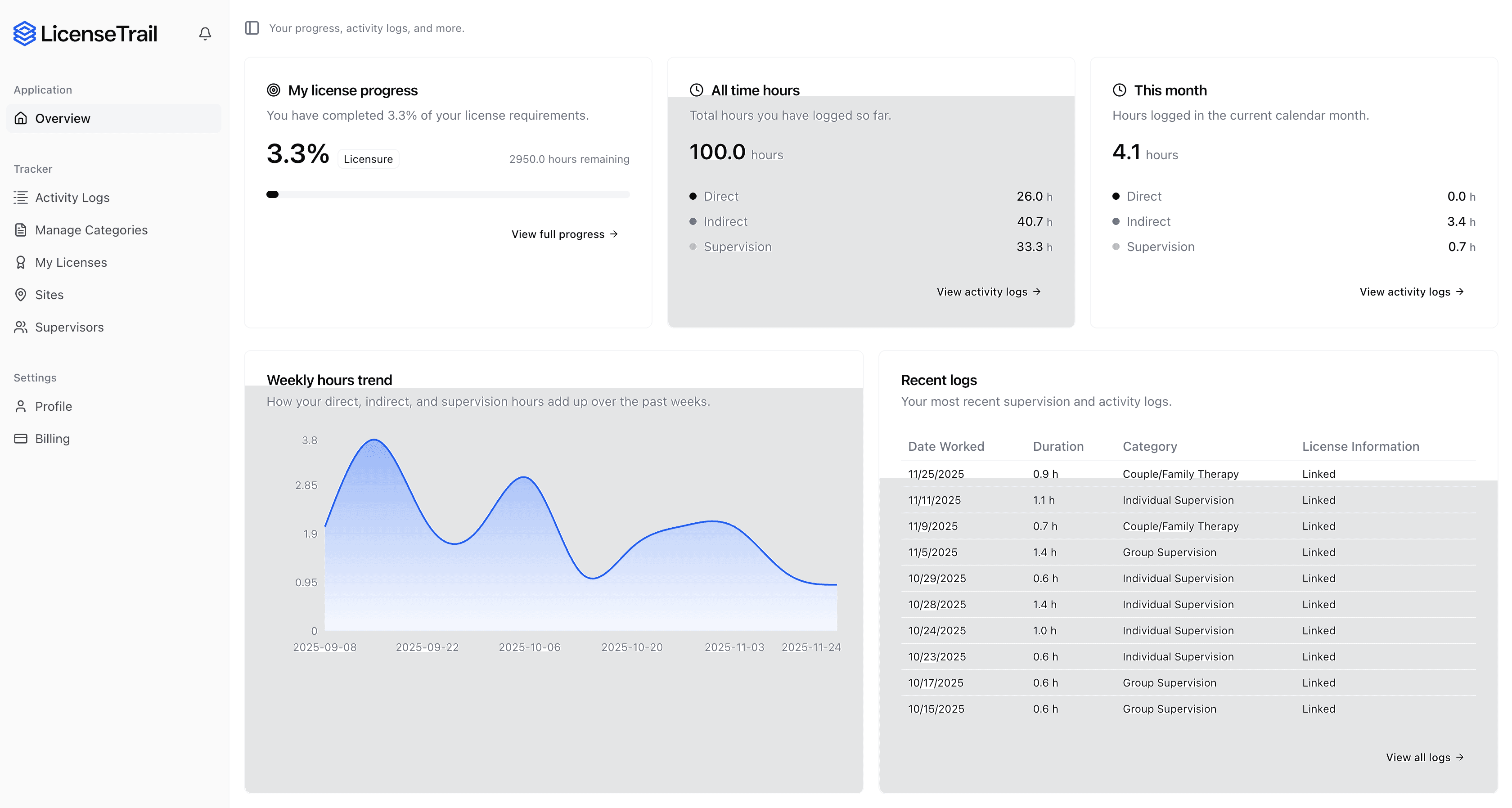
Track your LEP hours with confidence
License Trail checks your direct, indirect, and supervision hours against California LEP requirements continuously and flags mismatches before you submit.
 Start Tracking for Free
No credit card required · Free plan available
Is your spreadsheet hiding California LEP risks?
Stop guessing if your categories match California Board of Behavioral Sciences requirements. License Trail checks your direct, indirect, and supervision hours continuously and flags mismatches before you submit.
Import or log
Bring your spreadsheet or start fresh
Upload your existing tracking spreadsheet and we'll map every hour into the right California Board of Behavioral Sciences categories automatically.
Verify against California
Catch mismatches before the board does
License Trail checks your direct, indirect, and supervision hours against California LEP requirements continuously.
Export board-ready
One-click clean reports
Generate professional, board-ready reports for supervision meetings and California Board of Behavioral Sciences submissions in seconds.
No credit card required · Free plan available